Obsessive
ecologies
SHREYA VAISH
‘Production for the sake
of production – the obsession with the rate of growth, whether in the
capitalist market or in planned economies – leads to monstrous absurdities. The only acceptable finality of human
activity is the production of a subjectivity that is auto-enriching its
relation to the world in a continuous fashion.’
– Félix Guattari,
Chaosmosis: An Ethico-Aesthetic
Paradigm
TODAY, Guattari
and Bateson’s mental ecology1 is typified and populated by
the hyper-rational and managerialist bracketing of
existential territories, and the stilted subjectivities that congeal as
by-products of this bracketing movement. Several years have elapsed since Guattari first published The Three Ecologies,2 and yet he accurately anticipated the
contemporary psychologisation of the mental ecology,
its pulverisation into zones of auto-optimisation and voluntary servitude.
Capitalism, having morphed into the
aggressively decentralised and cybernetic Integrated World Capitalism (IWC)3, is transforming the ecologies
into its pale and hollow imitations. New aspects of this dystopia – the
pandemic, cognitive-behavioural psychotherapy, and the aggressive medicalisation of distress – are rendering old oppositions
obsolete while installing new barriers in the path of radical subjectivations. This essay tracks the mental ecology
through its obsessive neurotic evolution, attempting to understand how it finds
itself today in the pharmacological stupor of hospital gowns and half-formed
thoughts.
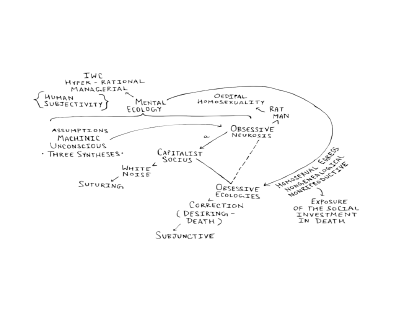
Diagram: A Cartograph of the Obsessive
Ecology.
As Sadie Plant4 writes, ‘we live in a culture of compulsive
counting, a society so obsessed with figures that if it were an individual, it
would be seeing a psychiatrist.’ Counting and recounting the undulations of the
stock market, worldwide Covid-19 cases, proliferating cryptocurrencies,
footsteps indicated by fitness watches, calories in my food – all this
common-place restlessness resembles obsessive compulsive disorder (OCD),5 especially as a
type of social structure.
The American Psychiatric Association’s
(APA’s) Diagnostic and Statistical Manual of Mental Disorders, fifth edition
(DSM-5)6 defines OCD as a psychological and behavioural
pathology characterised by the presence of obsessions and/or compulsions that
cause marked impairments in the patient’s functioning in multiple domains,
producing clinically significant distress. The World Health Organisation’s
(WHO’s) International Classification of Diseases, tenth version (ICD-10)7 also defines
OCD along similar lines, differing from its American counterpart only in the
presentation of clinical features8 and the classification of OCD as an anxiety
disorder9 alongside other forms of neurosis (excluding depression).
However, the ICD-10’s OCD is not the focus of this essay; for the purpose of
her critique,10 she will home in on the clinical criteria for
OCD in DSM-5 and Freudo-Lacanian psychoanalysis.
In its
distinctively dry and atheoretical nosology, the
DSM-5 identifies obsessions as ‘[r]ecurrent and
persistent thoughts, urges, or images that are experienced, at some time during
the disturbance, as intrusive and unwanted […].’11 The manual conveys how the patient, tormented
by these obsessions, produces mental and behavioural patterns to counteract
them. Having sanitised the mental ecology of desire and the uncon-scious,
the DSM-5 suspends lived experience to one or more of its 297 disorders and
sub-disorders.12 In
2019, it branded over 970 million people worldwide with such diagnoses,13 establishing its complicity in the med-icalisation of distress.
To return to OCD, obsessions are underlying
thoughts, images, or urges that drive compulsions. The patient with OCD is
compelled to enact compulsions through pre-established, rigid, and repetitive
sequences of behaviour or ideation.14 Movements like pacing, chanting under one’s
breath, arranging and rearranging one’s belongings, etc. become compulsions
when they take on an all-consuming and uncontrollable quality. Owing to their
neutralising function,15 compulsions are usually unrelated to the
object(s) of obsession, and the patient comes to rely more and more on them
after their initial success in staving off obsessions. In other words,
compulsions are sanitary and deodorising.
What
causes OCD, or, in clinical language, what is its aetiology? The
bio-psycho-social model and similar approaches cannot explain it; such etiologies claim novelty while presupposing the same
hyper-rational and managerial conjecture. There is nothing ethical or aesthetic
about the inoffensive mishmash of therapeutic models and techniques that is
passed off as ‘evidence-based’ eclecticism in clinical practice. In spite of
the stupidity of their discipline, clinical psychologists are slowly coming to
terms with the false singularity of their sacred models.16 Whether one practices CBT, psychoanalysis, or a combination
of the two has little effect on therapeutic outcomes, the implication being
that pseudo-eclecticism is as good as dogmatic foreclosure. This bitter
revelation is as significant as the replication crisis17 that plagued clinical psychology in the 2010s,
and still has damning implications for the field. Anticipating the falsity of
the clinician’s benevolence, the Situationist International
made a rare but much-needed observation when they equated mental health centres
to police stations, those ‘vanguard agencies of modern oppression’,18 though this
equation would still hold if ‘counselling centres at universities’ were swapped
with ‘psychiatric clinics anywhere.’
To
depart from narrow clinical definitions, obsessions and compulsions not only
jam up the flows of production that course through the socius,
19 but they also
give consistency to the social surface as its guiding axiomatic. By fixating on
the anti-productive and excessive rituals that characterise patients with OCD,
clinicians fail to see how their practice is embedded in the larger obsessive
neurosis of IWC. Here, the ritualistic back-and-forth movement in obsessive
neurosis takes on an asubjective hue,
and the free market sutures the capitalist socius in
the same way it consolidates the narrative of Don DeLillo’s
White Noise.20
The supermarket dominates White Noise, becoming
a spiritual abode for Jack Gladys (the narrator), his family, and other
faceless shoppers. Inspiring both familiarity and awe,
the market dissolves subjectivities in lineal rituals of selecting products, scanning
them at the counter, and exchanging money for receipts. Dizzying quantities of
consumer brands, data flashing in tabloids, catchy product jingles, and the
oversaturated colours of the (super)market are stuffed
into the cracks in the three ecologies, the same cracks caused by the
extractive and exploitative policies21 that enable capitalists to generate consumer
products.
In the course of these lineal rituals or
serial disjunctions, simplified and commodified
subjectivities merge with the organic and inorganic inhabitants of other
ecologies, emerging as statis-tical data points. The
capitalist socius expresses its obsession with
management and rationality through this metric language, organising and
reorganising data points according to increasingly obtuse and arbitrary
principles.22
Contemporary
IWC-infested mental ecology contains neither the social nor the individual; the
former disintegrates into a Hobbesian mass of discrete individuals while the
latter is pulverised into flashes of neuronal energy and the afterimages of
fascist fantasies. Freed of the biopolitical
structures that defined disciplinary societies, the individual (the capitalist
subject) continually encounters the memory of their excesses as the only
coherent point of reference against which he charts his movement. Capitalist
desire invests in this obsessive disassembly, causing a highly segmented and
simplified unconscious to congeal alongside the capitalist subject, with the
organs of allegiance and dissent already attached to individual bodies.
IWC
self-selects across the mental ecology, stealing and reorganising certain legs
and fingers, nightly dreams, lobes of the brain, and other materials into a
transversal pattern that strengthens the allegiance of present and future
subjectivities. Caught in this torrent, capitalist subjects express their
allegiance to the prevailing order against their own subjectivity and class
interests.23
For others who dissent volun-tarily
or involuntarily, the capitalist socius descends upon
them, dismissing the distress it produces as the subject’s failure to cope,24 her social-occupational dysfunction,25 or tragic
genetic predispositions.26 In the miraculous event an alterity
escapes the control mechanisms that have come to define the three ecologies,
the capitalist socius ensures its quiet death in the
psychotherapist’s office.
For
Aaron Beck, the founder of CBT, all negative perceptions of the world are rooted
in cognitive distortions.27 Not only does CBT enjoy the near-unanimous
support28 of
psychologists and psychiatrists, whose bread and butter depends on the peddling
of the mental health industrial complex, but insurance companies, policy
planners, and educators also privilege it over structural intervention.
The marketplace of psychotherapies has
grown to include hundreds of treatment alternatives with new practitioners and
treatment packages being approved by accrediting bodies across
the globe. Given this rapid expansion,29 the skyrocketing rates of addictions30 and suicides31 among young
people cannot be attributed to the lack or absence of psychotherapeutic
options. One wonders whether negligence, incompetence, or a tacit complicity
with the prevailing order mars the noble mission of allaying global psychomorbidity. In the words of Hillman and Ventura’s
impishly serious book, We’ve Had a Hundred
Years of Psychotherapy and the World’s Getting Worse.32
To
reiterate, the capitalist socius is as asocial as it
is anti-individual. The recent coronavirus pandemic merely exposed and
accelerated the obsessive neurotic asociality
inherent in the capitalist socius. Earlier on, the
bodies of minorities were unsanitary, but now anybody can become the harbinger
of disease and death. Many obsessive neurotics harbour contamination fears and
sanitary compulsions33 which are meant to preserve the neurotic
against an antagonistic other which cannot coincide with my body.
At the height of the Covid-19 pandemic,
when the TV flashed images of damaged lung tissue,34 faces rotting with mucormycosis,35 and the mass
cremation of coronavirus casualties,36 one could not help but look away, forming
series of little obsessive neurotic disjunctions to cancel the scopic obscenity37 of the capitalist socius.
This asociality, evinced by the international immiseration of the mental ecology, constitutes the necro-productive link between killing and dying. As a
character in White Noise observes, the solution to Gladys’s obsession
with death is murder: to let another die is to forget the Real of one’s own
death, securing temporary immortality. The capitalist socius
invests this desire of the other’s death in the new theology of the market and
the economy, disseminating obsessive neurosis across multiple ecologies.
Through reciprocal reinforcement, obsessive
neurosis becomes prevalent to the point that it ceases to be a
pathology. Spilling out of the mental ecology, it expands and mutates
into obsessive ecology, infecting diverse ecologies like the Covid-19 virus.
The obsessive ecology proliferates by apparent self-negation; insinuating
itself as a familiar entity, each obsessive-compulsive
iteration becomes the foundation for another, before becoming neutral or
asymptomatic.
To maintain this trajectory, the obsessive
ecology continually disinfects the mental ecology of its past, erasing the
archive of its barbarism from collective memory. Yet such sanitary attempts are
doomed to repetition for they reproduce the very disjunctions they are meant to
annul. This reality of obsessive neurosis as structure and crisis, a
significant paradoxical quality, is completely precluded by the church of
clinical psychology, its neoliberal priests and bibles.
A comprehensive understanding of
obsessive-compulsive phenomena necessitates a detour through Freudo-Lacanian nosology. Freud’s views on obsessive
neurosis – one of his favourite psychopathologies38 – can be traced back to his encounter with the
Rat Man, a patient who shared the psychoanalyst’s anal character.39 The young patient was irrationally fixated on the
autoeroticism of the anal stage, and his very career (law) was symptomatic40 of the desire
to exorcise the obsessions that plagued him.
An army
of rats, suicidal imagery, and other fears tormented the Rat Man, becoming the
basis for his painful isolation and consequent obsessive neurotic
homosexuality.41 In this way, psychoanalysis breaks with the identitarian definition of homosexuality which presupposes
the presence of a same-sex other. Obsessive homosexuality lacks this other,42 its narcissistic preoccupation with itself
causes it to desire the other’s death.
For Freud, the Rat Man’s dead father and
overbearing mother were responsible for cementing their child’s infantile
sexuality and his obsessive neurotic character. Lacan’s
interpretation builds on Freud’s Oedipalisation: the
obsessive neurotic searches for his missing Father43 in the quest to identify with the enigmatic
object of his Mother’s desire. This ambiguity of a slave in search of his
master constitutes obsessional subjectivity as an existential subjunctive.
Paralysed by the Hamletian injunction ‘to be or not
to be,’ the obsessive neurotic wavers between identifying with the Father and
being his subordinate.
This uncertainty or the subjunctive is
endemic to capitalism – the capitalist subject and the obsessive neurotic
coalesce, shuffling back and forth between the subject-status of the corporate
bureaucrat whose power secures them a nonreciprocal relation with subordinates
and the object’s fate of continual displacement spurred by free market
transactions.
The
exchange between the Rat Man and Freud was anything but innocuous or neutral;
presupposing an obsolete metaphysics of individualism, the psychotherapist’s
office replaces the priest’s confession box44 and masks its theological genealogy by
adopting a depoliticised and scientistic language.45 Assuming the
clinical definition of abnormality – the violation of social expectations and
deviation from statistical norms46 – the psychotherapeutic ‘cure’ begins with the
pathologisation of nonconforming existential
territories.
Through these ‘cures’ the socius locates its own pathologies in the subject, and
summons the Fatherly psychotherapist to haul back escapees into the prison of
obsessive neurotic subjectivity. When the Father’s medicine – CBT,
clomipramine, transcranial magnetic stimulation –
fails to produce well-adapted and docile subjects, the Father’s stunted and
stigmatised children become undeserving of his benevolence, and the machinic and asignifying vitality
immanent to their symptoms is written off as inferior and wasteful.
Is it possible to theorise obsessive
neurosis without falling back on the quasi-theological drama of Mummy and
Daddy? All Lacanians know that psychotic desire47 is not
symbolised, that it escapes Oedipal triangulation. As Deleuze and Guattari note in
Anti-Oedipus,48 psychotic egress holds in it the potential to
trigger other lines of flight. This essay approaches the obsessive neurotic as
a psychotic child, stuffing his clinical picture with her own coordinates till
it implodes. Below are some obscene self-references,disfigurements, and hyperchromatisms
with which this essay redraws the anal obsessional neurotic. Needless to say,
she assumes the starting point of foreclosure.
As the
progeny of catatonia,49 obsessive neurosis shares many differences and
similarities with its ancestor. It is distinct from the absolute disjunction of
catatonia, where an uncommunicative void opens up between the objects
implicated in this relation. Obsessive neurosis inherits and reconfigures this
arboreal or dichotomising axiomatic by creating the shallow and lineal
divisions and linkages of serial disjunction. The obsessive neurotic shields
herself against the deeper disjunction of the machinic
and asignifying real by substituting it with this
serial disjunction. Obsessional subjectivation links
production to preservation, and the complex and varying rituals it produces
reproduce the atomised capitalist subject in a sea of egosyntonic
little others.
For example, the obsessive-capitalist
subjectivity marked off by this ‘I’ worries that the skewed muscle to fat ratio
of her body will develop into obesity and early death. A partial object – the
image of a blocked artery, anxiolytic medical reports, the beeping electroen-cephalogram – stubbornly lodges itself between
the connective and conjunctive syntheses, threatening the integrity of the
triangulated structures of the nation-state, family, etc. and my investment in
them. Death, sharing an exclusionary-disjunctive relation with life, haunts and
terrifies me to the point that I spend considerable time and energy on
consuming health supplements, counting my steps to the gym and back, and using
the weighing machine again and again.
The
obsessional attempts to ward off, annul, or expel the impinging partial object
by overcoding it with compulsions that manifest as
serial disjunctions. This serial-disjunctive hostility towards the other as
anything which is not-me, not-here, and not-now overwrites
the strong negativity of machinic disjunction. This
is the common factor between obsessive neurosis and paranoia: the former
primarily employs serial disjunction, while the latter wields exclusionary
disjunction against her enemy, and both lose the machinic
disjunction to foreclosure in the ensuing kerfuffle.
What do the obsessive neurotic and
paranoiac want? They desire the absolute disjunction of catatonia, that state
of zero intensity which dwarfs death itself.
In spite of all its compulsive cleanliness,
hygiene, and negentropy, obsessive neurosis is
obsessed with death. The spatio-temporal sterility it
engenders (all hail catatonia) is the paralytic effect50 of the
subjunctive: the obsessional neurotic, caught in a serial-disjunctive relation
with the ecologies he occupies, can only mark time, shuffle back and forth, and
clean his bedroom in a general pedantism that cancels
the future and anchors him to one familiar, worn out spot.
This living death forms the basis of the
homicidal expression of obsessive neurosis of which Hamlet is an exemplary
example. Death occupies the other side of Hamlet’s dilemma – ‘not to be’
captures the subjunctive’s potential for fascist destruction,51 marking it as indissociable
from obsessional neurosis. In Hamlet, the Prince’s frantic efforts to
find closure after King Hamlet’s death, his dogged search for the Father, lead
to the needless deaths of Polonius, Rosencrantz, Ophelia, and others.52
Just
like the Father who haunts Prince Hamlet, Roithamer
rises from the grave of his incomplete manuscript to torment the narrator of
Bernhard’s Correction.53 In Correction, the
scientist Roithamer posthumously bequeaths the task
of editing and publishing his biography to his colleague, the unnamed narrator
of Correction. The latter becomes embroiled in Roithamer’s
hyperrational drive to ‘correct’ everything to the
point of nonexistence, an obsessive negation of negation54 that culminated
in Roithamer’s suicide. Upon realising his
predicament, the narrator attempts to thwart his own death by substituting
negation for compulsive reorganisation. He sorts and sifts through the pages of
the manuscript, vowing to not edit it, and yet he is unable to escape Roithamer’s obsessive neurosis by leaving Hoeller’s garret.
As Shuler55 remarks, ‘[a]n
obsession inevitably reasserts itself and though it is in fact the “negative”
component of the psyche, produces an inescapable attraction.’ Wedged between Hamlet and Roithamer, obsessive subjectification
is marked off by an impasse: the obsessive neurotic cannot produce the new and
is hostile to anything that does not share their inability.
The
homosexual refrain is one response to Guattari’s call
for new subjectivities included at the beginning of this essay. For Guattari, a system seeking to be ethico-aesthetically
effective should be able to detect sites of rupture and generate autopoietic subjectivities through the production of
refrains. The refrain,56 a rhythmic repetition forged in chaos, is the
minimum consistency that allows for movement and transformation while avoiding
catatonia and obsessive neurosis. The identitarian
and psychoanalytical definitions of homosexuality discussed earlier are two
instances of obsessive calcification as both pre-suppose an investment in
either Oedipus or little capitalist egos.
Freud57 and Lacan58 are quick to
note the strong egos that obsessive neurotics are endowed with – it is their
rigidity or oblativity that allows them to
continually reassert their compulsions. Investing desire in homosexual
ego-identities would just reassert this obsessive normativity. The singularity
of homosexual becomings lies in the unflinching disavowal
of the completeness of the connective-conjunctive syntheses that, banishing
disjunction, can only reproduce living death. The homosexual must continually
disturb the obsessive neurotic’s carefully established sutures or else risk
being locked into an exclusionary disjunctive relation with heterosexuality as
its passive, exotic, and alien ‘other’.59
Only by
employing the disjunctive synthesis in all its strength and flexibility, i.e.,
in its machinic form, the homosexual can hope to
escape the exclusionary disjunctions of life-death and
hetero-sexuality-homosexuality assumed in and imposed by the capitalist socius. Obsessive neurosis will not abdicate its privileged
position easily, and so it requires not only homosexuals but also tulips,
heterosexuals, mountains, transexuals, stars,
children, and the sun to practise homosexuality as a type of nongenealogical and nonreproductive
becoming.
The homosexual must also renounce her own
obsessive investments in homosexuality by refusing the calcification of desire
upon ego-identities, families, nation-states, and even nomadic relations. This
agile non-allegiance is the necessary condition for mobilising a multiplicity
of holes, transversal alliances, and irreducible ambiguities to puncture the
obsessive neurotic screen of foreclosure.
Leaping
beyond identity and irony, the homosexual refrain becomes an untranslatable
pattern of subjectivation: by refusing the stability
of allegiance, it can no longer be translated into the metric language of
fiscal deposits, stock value, and monetary transactions. Given the recuperative
speed of obsessive ecologies, it is vital to unceasingly destabilise the closed
holism of the connective and conjunctive syntheses, freeing desire whenever
possible from the straitjacket of the socius and its
psychotherapeutic institutions. Homosexuals and other minorities intimately
understand the social investment in death as their subjectivities are
continually associated with it, making them uniquely capable of seeing and
dismantling the world created by this investment.
The homosexual refrain must seize the serial and
exclusionary disjunctions in obsessive neurosis and turn them into the asignifying vitality of the machinic
disjunction, becoming a Sancho Panza to the desire
that underwrites the structure. This newfound vitality, freed from its obsessive
yoke, will wander and gallop across the borders of familiar and unfamiliar
existential territories, producing its own equine cadence. Trailing these becomings, the homosexual refrain will exit the
psychobabble of the family, university, and clinic, fusing with other militant
subjectivities in a shared quixotic unfolding across multiple ecologies.
Perhaps, looking back, these subjectivities will find a rhythm in their tracks
and a shared harmony in each other’s machinic
disjunctions, discovering in the ruins of the asylum music for a new earth.
Footnotes:
1. Gregory Bateson, Steps to an Ecology of Mind. University of Chicago Press, Chicago [U.A.], 2016.
2. Félix Guattari, The Three Ecologies. Bloomsbury Academic, London, 2014.
3. Ibid.
4. Sadie Plant, ‘1.1. Compelled to Count’, CCA Annex, 29 April 2021, cca-annex.net/entry/compelled-to-count/. Accessed 25 April 2023, p. 1.
5. American Psychiatric Association. Obsessive-Compulsive Disorder. In Diagnostic and Statistical Manual of Mental Disorders. 5th ed., American Psychiatric Association, 2013.
6. American Psychiatric Association. Diagnostic and Statistical Manual of Mental Disorders. 5th ed., American Psychiatric Association, 2013.
7. World Health Organization, The ICD-10 Classification of Mental and Behavioural Disorders. World Health Organization, 1993.
8. World Health Organization, F42 Obsessive-compulsive disorder. In The ICD-10 Classification of Mental and Behavioural Disorders. World Health Organization, 1993.
9. Ibid.
10. This essay assumes the voice of a young homosexual woman (indicating a people yet-to-come) who is distinct from the hysteric and the maternal body in psychoanalysis. She is also not the author; the latter has already disappeared in the pursuit of another elsewhere. This is a meta-textual experiment to unsettle the linguistic triangle of ‘I’, ‘you’, and ‘them’, the grammatical person assumed by the obsessive neurotic and scrambled by the psychotic.
11. American Psychiatric Association, Obsessive-Compulsive Disorder, p. 237.
12. Allen Frances, Saving Normal: An Insider’s Revolt against Out-of-Control Psychiatric Diagnosis, DSM-5, Big Pharma, and the Medicalization of Ordinary Life. William Morrow, 2014.
13. World Health Organization, ‘Mental Disorders’. Who.int, World Health Organization, 9 April 2018, www.who.int/en/news-room/fact-sheets/detail/mental-disorders.
14. American Psychiatric Association, Obsessive-Compulsive Disorder.
15. Ibid.
16. Recent research suggests that the psy-chotherapist, the client, and their therapeutic alliance matter more than the clinician’s psychotherapeutic model. This has caused the development of a ‘common factors’ view that eschews old antagonisms between different traditions of psychotherapy. See Douglas H. Sprenkle and Adrian J. Blow, ‘Common Factors and Our Sacred Models’, Journal of Marital and Family Therapy 30(2), April 2004, pp. 113-29, https://doi.org/10.1111/j.1752-0606.2004.tb01228.x.
17. Bradford J. Wiggins, and Cody D. Chriso-pherson, ‘The Replication Crisis in Psychology: An Overview for Theoretical and Philosophical Psychology’, Journal of Theoretical and Philosophical Psychology 39(4), November 2019, pp. 202-17, https://doi.org/10.1037/teo0000137. Accessed 10 March 2020.
18. Black & Red. Firm, and Vale Zines Collection. Beinecke Rare Book and Manuscript Library, On the Poverty of Student Life: A Consideration of Its Economic, Political, Sexual, Psychological and Notably Intellectual Aspects and of a Few Ways to Cure It. Black & Red, 1983, p. 8.
19. Gilles Deleuze and Félix Guattari, Anti-Oedipus: Capitalism and Schizophrenia. University of Minnesota Press, 1983.
20. Don Delillo, White Noise. Viking Press, 2018.
21.
Gilles Deleuze and Félix Guattari,
Anti-Oedipus.
22. Ibid.
23.
The psychoanalytic category of repression cannot explain why people continue to
extend their support to a socius that crushes their
personalities. As Lyotard infamously put it, ‘the
English unemployed did not become workers to survive, they – hang on tight and
spit on me – enjoyed the hysterical, masochistic, whatever exhaustion it
was of hanging on in the mines, in the foundries, in the factories, in
hell, they enjoyed it, enjoyed the mad destruction of their organic body which
was indeed imposed upon them […]’ In Jean-François Lyotard,
Libidinal Economy. Indiana University Press, 1993,
pp. 111.
24. Farhad Dalal, CBT: The Cognitive Behavioural Tsunami: Politics, Power, and the Corruptions of Science. Routledge, London, 2018.
25. Ibid.
26. Ibid.
27. It is no coincidence that African-Americans are more likely than others to qualify for schizophrenia. For CBT, negative feelings about institutionalised racism can only be the product of individual misperceptions or conditioned complexes. See Jonathan Metzl, The Protest Psychosis: How Schizophrenia Became a Black Disease. Beacon, 2011.
28.
Farhad Dalal, CBT.
29. Just like the capitalist socius, mainstream clinical psychology attempts to mask its decay by feigning reproduction as the production of the new. Brief psychoanalytic therapies and third-wave CBT’s orientalist appropriation of mindful-ness are two equally laughable symptoms of this defensive production.
30. Ashley Abramson, ‘Substance Use during the Pandemic’, American Psychological Association, 1 March 2021, www.apa.org/monitor/2021/03/substance-use-pandemic.
31. WHO, ‘Suicide’. Who.int, World Health Organization, WHO, 17 June 2021, www.who.int/news- room/fact-sheets/detail/suicide.
32. James Hillman and Michael Ventura, We’ve Had a Hundred Years of Psychotherapy – and the World’s Getting Worse. Harper, San Francisco, 1992.
33. I.E. Perkes, et al. ‘Contamination Compulsions and Obsessive-Compulsive Disorder during COVID-19’, Australian & New Zealand Journal of Psychiatry 54(11), September 2020, pp. 1137-38, https://doi.org/10.1177/0004867420952846.
34.
Zarir F. Udwadia, et al.
‘Post-Covid Lung Fibrosis: The Tsunami that Will
Follow the Earthquake’, Lung India: official organ of Indian Chest Society,
vol. 38, Supplement (2021), S41-S47. doi:10.4103/lungindia.lungindia_818_20
35. Soutik Biswas, ‘Mucormycosis: The “Black Fungus” Maiming Covid Patients in India’, BBC News, 9 May 2021, www.bbc.com/news/world-asia-india-57027829.
36. CNN, Jessie Yeung, Clarissa Ward, Rishabh Pratap, and Scott McWhinnie, ‘As India’s Crematoriums Overflow with Covid Victims, Pyres Burn through the Night’, CNN, 1 May 2021, edition.cnn.com/2021/04/29/india/india-covid-deaths-crematoriums-intl-hnk-dst/index.html.
37. A virus, person, machine, or a work of art is obscene insofar it reveals the scene of mass cathexis.
38. Astrid Gessert, Obsessional Neurosis. Routledge, 2020.
39. The anal personality’s preoccupation with cleanliness, orderliness, and trustworthiness is a defence mechanism (reaction-formation) against her innate interest in unsanitary aspects of human experience. Such individuals compensate for their underlying desires and impulses by projecting an image of excessive control and discipline. See Dany Nobus, Key Concepts of Lacanian Psychoanalysis. Routledge EBooks, Informa, 2018, https://doi.org/10.4324/9780429476402. Accessed 25 April 2023.
40.
Sam Shuler, ‘“Carrion Crow”: The Rat Man and the Excesses of Modernity’, www.academia.edu,
www.academia.edu/40000406/_Carrion_Crow_The_Rat_Man_
and_the_Excesses_of_Modernity. Accessed
25 April 2023.
41. Astrid Gessert, Obsessional Neurosis.
42. Ibid.
43.
For Lacan, the Father is not a flesh-and-blood
guardian or a biological parent. Rather, the concept denotes a fictional or
real entity before whom the subject kneels in Oedipal
adoration. The social order invests greatly
in this Father, turning him into the phallic object that inspires fear, awe and
envy. See Dany Nobus, Key
Concepts of Lacanian Psychoanalysis.
44.
Gilles Deleuze and Félix Guattari,
Anti-Oedipus.
45. Félix Guattari, Chaosmosis: An Ethico-Aesthetic Paradigm. Power, 1995.
46. Jill M. Hooley, Abnormal Psychology. Pearson, 2020.
47. Dany Nobus, Key Concepts of Lacanian Psychoanalysis.
48.
Gilles Deleuze and Félix Guattari,
‘The Second Positive Task’. Anti-Oedipus.
49.
Gilles Deleuze and Félix Guattari,
‘The First Positive Task of Schizoanalysis’. Anti-Oedipus.
50. Astrid Gessert, Obsessional Neurosis.
51. Fascism invests in an imaginary messiah who ‘returns’ the earth to a natural and ideal order. In the Lacanian sense, this betrays an investment in the Father and the phallic mental ecology that he represents.
52. William Shakespeare, Tragedy of Hamlet Edited by E Dowden.
53. Thomas Bernhard, Correction. Random House, 2013.
54. Here, the negation of negation is used in the Adornoian sense where succeeding negations indicate the incomplete negativity of preceding negations. See Jeffrey W. Salyer, ‘Mastery and Mock Dialectic in Thomas Bernhard’s Correction’, 2010. In obsessive neurosis, the negation of negation selectively reinforces the capitalist socius and punishes attempts to break free from it.
55. Sam Shuler, ‘Carrion Crow’, pp. 13-14.
56. Gilles Deleuze and Félix Guattari, A Thousand Plateaus: Capitalism and Schizophrenia. 1980. Bloomsbury, London [U.A.], 2017.
57. Astrid Gessert, Obsessional Neurosis.
58. Ibid.
59. Regarding the
question of homosexual becomings, Deleuze
and Guattari write, ‘[N]o “gay liberation movement”
is possible as long as homosexuality is caught up in a relation of exclusive
disjunction with heterosexuality, a relation that ascribes them both to a
common Oedipal and castrating stock, charged with ensuring only their
differentiation in two non-communicating series, instead of bringing to light
their reciprocal inclusion and their transverse communication in the decoded
flows of desire (included disjunctions, local connections, nomadic
conjunctions) […]’ Gilles Deleuze and Félix Guattari, Anti-Oedipus, pp. 350-351.