Panchayat secretary: the last-mile bureaucrat
RAHUL VERMA and NISHANT RANJAN
INDIA’S experiment with local governance in
the last thirty years has seen a considerable body of scholarly research.1 However, the
existing literature does not adequately engages with the role and
responsibilities of government officials working as the last-mile bureaucracy.
In this essay, we focus on one such village-level government functionary,
namely, the Panchayat Secretary (hereafter, PS). The
PS is the executive head of the panchayat secretariat
and deals with a range of subjects devolved to gram panchayats
(hereafter, GP) under the 73rd Amendment Act.2 It is important to note that local government
is a state subject and thus the number of items devolved varies greatly across
states. Similarly, some states in the recent years have massively increased
their bureaucratic presence at the village panchayat
and urban ward level.3
We collected information on panchayat secretaries from the Ministry of Panchayati Raj website in March-April 2021 that listed the
name of secretary, panchayat name, block and district
name, and last four digits of their official mobile number. This dataset helped
us in creating a
unique id for each PS, and our analysis revealed that while
southern and eastern states had one PS per panchayat,
the northern states had a lower ratio with one PS looking after many panchayats. We also collected information on population
size of panchayats to test the average rural
population size panchayat secretaries
serve.4
We conducted fieldwork in three districts
of Bihar in January 2022 to understand the role and responsibilities of panchayat secretaries, how they interact
with citizens and elected representatives, and what challenges they face while
discharging their duties. And to get a picture of variation across the states,
we also conducted telephonic interview with more than two dozen panchayat secretaries across Uttar Pradesh, Maharashtra,
Rajasthan, Madhya Pradesh, Chhattisgarh, Kerala and West Bengal. These
interviews, along with our analyses of government notifications, reveal that
the duties and responsibilities of the PS are largely similar across states and
regions. Most PS lack proper training, are overburdened
with multiple tasks, which get reflected in many functions that the state hopes
to perform with ease – such as counting births and deaths, welfare delivery,
among others.
The
recruitment process, monthly salaries, staffing patterns, and transfer rates of
panchayat secretaries varies considerably by state.
Our interviews with PSs across state revealed that a significant number of the
PSs were either transferred or promoted from other departments. In Bihar, for
example, we found that many PSs have been promoted from the rank of dalpatis, Village Level Workers (VLW) or head panchayat clerks. We were informed that the last direct
recruitment of panchayat secretaries in Bihar was
conducted in 1999. During our interviews, we learnt that a large number of
posts were vacant and a single PS has to look after multiple panchayats. For example, in Paliganj
block of Patna district in Bihar, there were only two panchayat
secretaries looking after twenty-five village panchayats.
Further, the monthly salaries of the PSs also varies by state – a PS in
Chhattisgarh receives fifteen thousand rupees per month, whereas its sixty
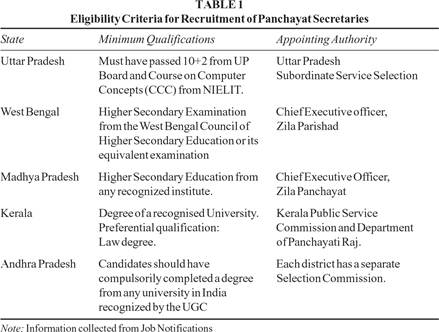
thousand in Kerala.5 Table 1 provides an overview of the different
criteria vis-a-vis
recruitment of PS in five select states.
In
states such as Bihar and Uttar Pradesh, transfers of PSs can only be within a
district, whereas in Maharashtra, the PSs can be transferred across the state.
We also found that a PS can be posted in a given gram panchayat
for a maximum period of three years. However, transfers and postings are often
contingent upon several factors such as personal rapport with panchayat heads. One secretary from Uttar Pradesh, for
example, told us, ‘One can be posted in a particular panchayat
for as many years as one wishes depending on personal equation with the Gram
Pradhan.’ For the local elected representatives,
the threat of transfer acts as a mechanism to keep a check on local-level
bureaucrats. In many places, Gram pradhans are
closely aligned with district-level politicians parties and leverage such connections
to make local officials to work as per their diktats.
Our fieldwork and interviews quickly
revealed that there were very few female panchayat
secretaries. We then decided to create an algorithm to check the level of female
representation among panchayat secretaries across
India. We developed this algorithm using names and sex identification of Lok Sabha and Vidhan
Sabha candidate across the country over the last 30
years, and also manually verified predictions from this model in two districts
of Uttar Pradesh.6 Our
algorithm correctly predicted more than 90% cases, and it did not predict any
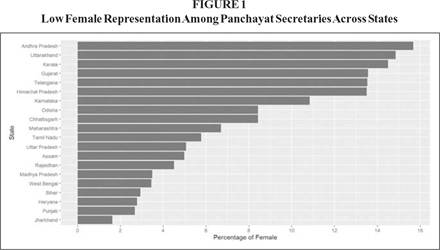
false positive cases, i.e. a male being predicted as female. Figure 3 shows
that the representation of female panchayat
secretaries is abysmally low across all states. Less than one in five PSs are women and in some states this ratio is below 10%.
This low
representation of women in local government jobs has severe implications for
the panchayati system. In his study on local
governance in India, James Manor provides evidence on how male councillors
conspire with male panchayat secretaries and other
local officials to deny relevant pieces of information to women councillors.7 This kind of collusion severely undermines the capacity of
women representatives to perform well and exert influence. Similarly, Bhumi Purohit has shown that
women sarpanches find it more challenging to engage
with the state due to the biased behaviour of male bureaucrats who assume that
women politicians have limited understanding of how to operate the system.8 As one of the
female PSs from Uttar Pradesh mentioned during our telephonic interview, ‘Both
female panchayat secretaries and elected women
representatives lack the kind of networks required to exert influence and carry
out the development works smoothly. Many times, male village pradhans don’t take our words seriously.’
Our
analysis of panchayat secretary dataset revealed that
there are 1.79 lakh panchayat secretaries for 2.65
lakh panchayats. We found that states such as Kerala,
West Bengal and Karnataka have approximately one PS for each panchayat in these states. In contrast, states such as
Uttar Pradesh, Bihar, Punjab and Haryana have the lowest mean where one PS is
responsible for the administration of many panchayats.
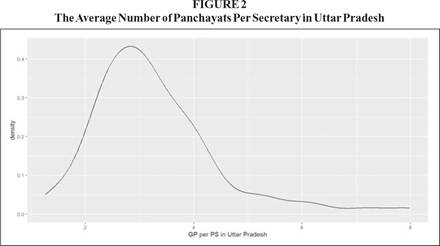
For example, the density plot in Figure 2 shows that a PS in Uttar Pradesh on
an average is responsible for three panchayats. And a
significant number of secretaries look after more than five panchayats.
However, as noted above, village panchayats in India also vary by population size,
geographical area, and the number of staff in the panchayat
secretariat.9 We mapped the size of the rural population under each PS
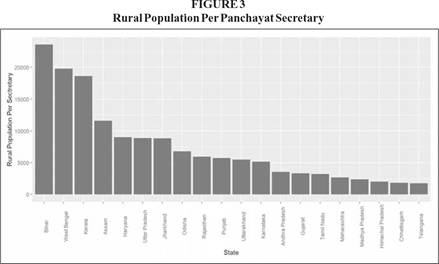
across states and observed an interesting pattern. Figure 3 shows that the
rural population under each PS is higher in the states of Bihar and West
Bengal, whereas it is lower in Chhattisgarh and Telangana.
This means that a panchayat secretary in Bihar has to
serve far more citizens than in Gujarat, indicating higher workload.
The PS
performs some key functions such as registration of births and deaths,
identifying the beneficiaries of government schemes such as the National Social
Assistance Programme (Old Age Pension Scheme), managing accounts related to
state and national finance commissions’ funds, and ensuring the maintenance of
village roads and other infrastructure. Their daily routine varies by state.
For example, as our telephonic interviews revealed that collecting house tax
and water tax consume a lot of their time in Maharashtra, whereas implementing
state government welfare schemes such as Duaare Sarkaar (Government at doorstep) and State Nutrition
Mission consumed maxi-mum time in West Bengal.
Another
response that repeatedly came in our interviews is that they get regularly
called to assist officials of other departments such as revenue and
electricity. For instance, one PS from Satara
district of Maharashtra told us, ‘My Gram Panchayat
is very close to the town of Satara. The cost of land
has become disproportionately high in the last few years. Selling and buying
land became so common in my panchayat that I became a
subordinate to the revenue department officials. I regularly need to report to
them about issues related to land purchase and sale. I am not able to look into
other important issues due to this.’ We also came across instances where local
officials, for being unable to act on time, resort to excessive legality and
strict adherence to rules and procedures to delay the delivery of public
service.
In
Bihar, we followed sixteen PSs in three districts to check their daily routine
by maintaining a time-usage diary. We called each one of them on four different
days and asked them about the work they did on that particular day. One of them
explained that the lack of a planner or routine worksheet made their work
difficult, and many remained clueless about the work they were supposed to
undertake. Moreover, we found that local panchayat
officials often lacked adequate information and training needed for implementing
a programme. In such situations, they were left with no option but to resort to
informal ways of dealing with work.10 A large number of PSs
felt that their work was done as long as they were collecting, collating, and
sending the required data to senior officials. An aging PS informed us with a
grim smile, ‘Keep the paperwork robust, everything will be fine. We are
powerless people in the government hierarchy.’11
As mentioned above, the Paliganj
block in Patna district has a population of more than 2.5 lakh and its
twenty-five village panchayats are managed by just
two panchayat secretaries. Ideally, the two PSs
should visit the GPs under their charge regularly. Instead, they preferred to
meet people from the villages at the Block office one day every week. One PS
from Paliganj complained about the situation, ‘I
am a panchayat secretary who is catering to the
demands of twelve village panchayats whose population
adds up to more than one lakh. I have no additional staff and no vehicle. How
can I work according to the written formal rules and procedures? I am aware of
the fact that as a panchayat secretary, I have to be
responsive to the individual’s problems and needs of all citizens, but it’s not
possible. I have to develop some sort of informal mechanism through which I can
work easily.’
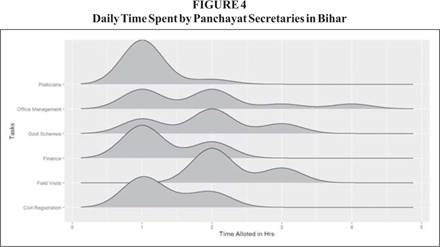
The data
presented in Figure 4 reveals that PSs in Bihar spend a significant portion of
their time doing managerial work such as office management and overseeing
accounts of the finance commission. These tasks should have been done by the
secretariat accountant or a junior panchayat
secretary, i.e. the posts that lay vacant. Essential work such as daily field
visits, organizing GS meetings, and other tasks get overshadowed. The absence
of the Indian state, in terms of low capacity in key bureaucratic positions,
has led to severe problems in policy implementation. In a study of Block
Development Officers (BDOs), Dasgupta and Kapur (2020) showed that underinvestment in bureaucratic
resources has led to severe work overload resulting in poor implementation of
different policies at the local level.12 The situation appears
similar at the panchayat level. As PSs are
subordinate to BDOs and report to them, the amount of bureaucratic workload at
the panchayat level accumulates to a greater degree
at the Block level.
It is
also important to reiterate here that states also vary in their staffing patterns,
which may add more responsibilities for secretaries in certain states.
Furthermore, there exists considerable number of vacant positions for various
posts in panchayat administration. These vacancies
contribute to a greater work overload for PSs. This also has an impact on their
essential duties such as registration of births and deaths and implementation
of welfare schemes such as MGNREGS.
In many states, panchayat
secretaries act as registrars of births and deaths. Births and deaths are to be
reported within 21 days of the occurrence of the event. The birth/death that is
reported after 21 days but within 30 days also gets recorded, but only on
payment of a prescribed fee.13
The
birth/death reported after 30 days but within one year of its occurrence can be
registered with the written permission of the prescribed authority and on the
production of an affidavit made before a notary public or any other officer
authorised by the state government including the payment of a fee as
prescribed.
In
several instances, the workload on the PS makes the registration of births and
deaths within the stipulated time period difficult. This often turns a free
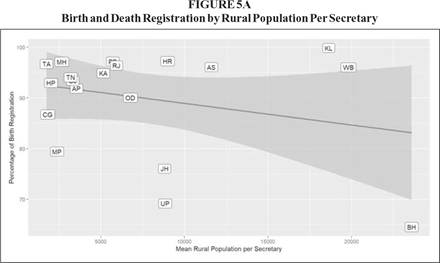
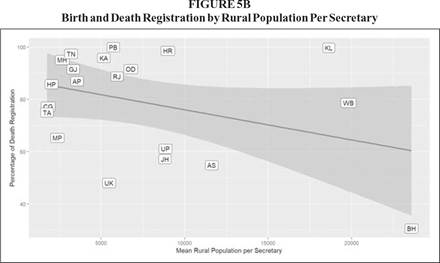
public service into a paid one for the people. We analysed registration of
births and deaths within 21 days for rural population by state and find that
states with low rural population per secretary tend perform better. The data
presented in Figure 5a and 5b indicate that among the states with higher than
average rural population per secretary, Kerala and West Bengal perform better,
but Uttar Pradesh and Bihar being in the same category do badly. We further
analysed birth and death registration at the district-level in Uttar Pradesh
and find that variation in presence of mean number of panchayat
secretaries per district is correlated with better performance on birth and
death registration.14
Similarly, we found the work overload also
impacts in implementation of MGNREGS. The scheme mandates the appointment of a Rozgar Sewak in each panchayat to oversee the scheme.15 However, we observed that appointments of Rozgar Sewak have not been made
in many panchayats, and the onus of managing the
scheme rests with the PS. GPs are the main office around which the works
related to MGNREGS such as the appointment of Rozgar Sewak, selection of work sites, maintenance of registers,
and payment of wages, among others. As one panchayat
official in Patna district explained, Rozgar Sevaks, in most cases, lack the requisite training and
technical knowledge to effectively perform their duties. Subordinate panchayat officials such as accountants are mostly
appointed on a contractual basis and they move from one job to the other
periodically, further adding to the workload of the panchayat
secretary.
The
scheme has been remarkably successful in states such as Tamil Nadu, Andhra
Pradesh and Rajasthan, but comparatively poorer and populous states such as
Uttar Pradesh and Bihar show below-average performance in implementing MGNREGS.
Our interviews with local gram panchayat officials in
Uttar Pradesh and Bihar suggest that Rozgar Sewak’s either have not been
recruited in many panchayats or they often lack the
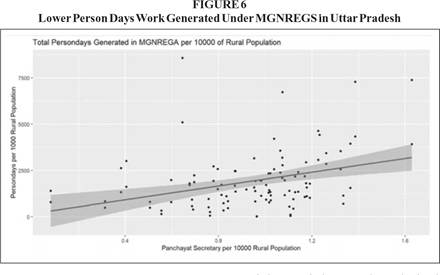
required training and information related to the scheme. Figure 6 shows that
districts with higher number of panchayat secretaries
see higher total person-days employment under MGNREGS.
In
conclusion, our understanding of local government officials and their
functioning is often marked by narratives of corruption, inefficiency,
inaccessibility, among others. The analysis presented in this essay indicates
that local government officials such as the PS face a heavy work overload and
lack resources to carry out their duties effectively. They choose to resort to
informality in the delivery of public services due to insufficient
staff, lack of training, lower incentive structures (such as low monthly
salaries in many states) and other necessary resources.16 To be sure, we are not underestimating
prevalence of corruption and the lackadaisical work attitudes of government
officials.
Citizens trust in state institutions is shaped by their experiences and encounters with these last-mile bureaucrats on an everyday basis. Thus, without understanding the conditions under which India’s last-mile bureaucracy operates from an empathetic lens, we cannot do justice to any conversation on why the Indian state underperforms in implementing routine tasks and in what ways the capacity of Indian state can be increased.
Footnotes:
1. A. Dasgupta and D. Kapur, ‘The Political Economy of Bureaucratic Overload: Evidence from Rural Development Officials in India’, American Political Science Review, Novenber 2020, pp. 1316-1334.
2. The office of the PS is a permanent executive post and is known by different names in different states. In Uttar Pradesh, for instance, the PS is called the Village Development Officer (VDO), whereas in Odisha, the term is Panchayat Executive Officer (PEO).
3.
For example, the government of Andhra Pradesh in the last four years massively
expanded its local bureaucracy by establishing 15000 sachivalayams/secretariats
(one secretariat is provisioned for a population cluster of 2000 people in
rural areas and 4000 people in urban areas) to ensure ‘door-to-door’ delivery
of services and welfare benefits.
They have recruited an additional workforce of 1.4 lakh functionaries. This
includes 10 secretaries for every ward/urban sachivalayam
and 11 secretaries for every village/gram sachivalayam.
540 services from 34 departments, and 9 primary DBT welfare schemes, are
effectively anchored by corresponding village/ward secretariats.
4. States have laid down different criteria regarding the population size under a panchayat.
5. Based on information provided by several panchayat secretaries in our telephonic interviews, February-March 2022.
6. We would like to thank Jatin Rajani for his help in scrapping the data from Ministry of Panchayati Raj website and then developing the algorithm to predict female panchayat secretaries.
7. J. Manor, Local Governance. in N.G. Jayal, and P.B. Mehta (eds.), The Oxford Companion to Politics in India. Oxford University Press, 2010.
8. B. Purohit, ‘Gendered Bureaucratic Resistance Against Female Politicians: Evidence from Telangana, India’. Working Paper, 2022.
9. For example, Uttar Pradesh (>55000) has the maximum number of Gram Panchayats followed by Maharashtra (23002) and Madhya Pradesh (22072); while Kerala (938) has the least followed by Uttarakhand (1300), Haryana (1800), and Assam (2300). According to a report, ‘Model Panchayat Cadre Manual’, out of 52000 GPs in Uttar Pradesh, only 3000 have a population of more than 5000, and 49000 GPs have a population between 1001 to 5000. In West Bengal, the minimum population of a GP is 1100, the maximum population is 48000 and the average population per GP is 17000. In Kerala, out of 978 Village Panchayats, only 15 have a population below 10,000, 297 have a population between 10,000-20,000, 460 between 20000-30000, 173 between 30000-40000, 29 between 40,000-50,000 and four have more than 50000 population each.
10. A. Mangla, ‘Bureaucratic Norms and State Capacity in India: Implementing Primary Education in the Himalayan Region’, Asian Survey 55(5), 2017, pp. 882-908.
11. Interview with a PS in Buxar district, Bihar, January 2022.
12. Anustubh Agnihotri (2022) in a study of land bureaucracy in Odisha also notes this problem. See, A. Agnihotri, ‘Transfer Preferences of Bureaucrats and Spatial Disparities in Local State Presence’, World Development 159, November 2022.
13. The birth/death reported after 30 days but within one year of its occurrence can be registered with the written permission of the prescribed authority and on the production of an affidavit made before a notary public or any other officer authorised by the state government including the payment of a fee as prescribed.
14. At district-level, only aggregate birth registration data is available.
15. Under the MGNREGS, 100 days of demand-driven work in rural areas during the slack agricultural season is provided to a member of a rural household.
16. Lipsky has described in great detail the similar dilemmas
of street-level bureaucrats in the context of American society. He argues that
there is a difference in how policies are written and how they are implemented
on the ground. See Street Level Bureaucracy. Russell
Sage Foundation, 1980.