The strange story of Sushant Rajput
SHIV VISVANATHAN
TO understand the crisis and the narratives of the Sushant Rajput story, one has to go back to the legendary storyteller of Partition, Saadat Hasan Manto. In his lighter writings on film, Manto who was heartbroken by the Partition, claimed that the cultural answer to Partition lay in Bombay Talkies, which represented the hybridity of culture, the reciprocity of Hindi and Urdu, the friendship of the stars, which transcend the ugliness of Partition. Manto proved unerringly right as Bombay Talkies became Bollywood and provided the myths of India.
Bollywood, as a script of culture, and its variants encapsulated the contradictions of Indian modernity as a text. The narrative at the level of mythos managed to weave the oppositions between town and country, legal propriety and violence, family and public interest in creatively understandable frame. It satisfied the demands of both aspects and yet saw modernity as going beyond them. Whether one thinks of Deewar or Seeta aur Geeta one senses the creative interplay of dualisms.
The encounter between Amitabh and Shashi in Deewar is exemplary. As Amitabh boasts of all the wealth he has, he asks Shashi ‘Tere paas kya hai’ and the latter replies, ‘mere paas ma hai’. The nature of the encounter captures the mutuality, the contradiction of two value frames and hints at the explosive power of each. Crowds came, watched these utterly unreal movies capture the inner categories of their lives and went back content that the big screen made meaning and added context to their lives.
Through the Nehruvian and later decades, Bollywood held India together, making sense of urbanism, development, violence, and crime in a way, which made the social sciences feel secondary. The social sciences provided a more factual, ideological narrative, which while politically charged lacked the alchemical power of myth. Yet even then Indian sociologists who were suckers for Bollywood discovered a strange companionship between the two.
The post-liberalization years saw the breakdown of Indian modernity as a myth. The legendary stars that were exemplars and exponents of archetypal roles disappeared. Dilip Kumar and Raj Kapoor faded away. Amitabh Bacchan was living parasitically on his own reputation, where a suave old man mellowed the legend of the violent young man. Yet violence, which could earlier lie contained in the usual categories, now appeared different. Violence now had an instrumental, calculated quality and it lost its operatic power. The lines of spectatorship got blurred as the perpetrator consumed his own violence with glee. The mythical socialism of Raj Kapoor disappeared as aspiration and mobility took over.
S
criptwriters failed to knit together contradictions. Bollywood realized old scripts did not work. It moved to the biopic and the historical movie as two forms of realism that failed as myth. An old generation of stars was fading away, and a new generation smelling of TV was coming into being. But the freshness of youth did not add to the freshness of ideas. The younger generation appealed but the appeal was more of the new than a reliving of myth which has layers of meaning. The Modi regime and the Covid epidemic decimated the myth of Bollywood even more ruthlessly.For decades the relation between film and politics was a remarkably symbiotic one. Not only did film stars campaign for politicians, they become politicians. The epic roles of MGR, Jayalalitha, and NTR hardly need an invocation at this point. The later period failed to produce the same charisma. One sees it in the ambivalent existences of Kamal Haasan and Rajinikanth. They have all the elements of success but the alchemy does not work because they cannot mix myth, magic and politics with the same conviction. The script and timing both fail them. They look more like editorial comments than charismatic stars making history.
The failure went deeper. To the Indian media, the only star in this decade was Narendra Modi. Politics became cinema, rather than a complementary blend. Bollywood actors like Anupam Kher and Ajay Devgun played bit actors to Modi’s stardom as the best lines of the political script belonged to him. The Covid added to this, as the sense of drama it portrayed was not cinematic. The migrant was reduced to marginality and when cinema captured suffering, it was as fragmentary documentary as one remembers migrants being sprayed with chemicals or the little child playing next to its dead mother on the railway platform. The drama of the Covid was impersonal, statistical, one of a virus and its body counts. The social lacked the cinematic power to combat the virus.
It was at this anomic moment that a young film star, a newcomer from Bihar, commits suicide in Mumbai. The narrative that followed provided one of the great serials, political and cinematic, of our time, commenting on the myth of Bollywood and Indian Democracy. It was as if Bollywood produced its greatest script and commentary on itself through an inadvertent unfolding of the reactions to the young actor’s death. It was an intellectual ambush, an anarchy of performances that broke the internal and external structure of the power of Bollywood as myth.
T
he biography of Sushant Rajput apparently combined in the beginning the best of sociology and the myth of Bollywood. Bollywood as Manto proclaimed was open to talent, thrived on the diversity of the migrant. As a mini city and myth, it reflected the diversity and openness of an ideal India. If Delhi is historic with memories like tree rings, it is Bombay that is the city of dreams, a world for talent and justice. The internal myth and the external sociology seemed to fit in the beginning as Rajput, a young Bihari, an outsider, was presented as a proud success. He represented the presentable, equalitarian face of Bollywood. The contiguity, the amalgam of Bihar and Mumbai, the great source of migrants and the great city that welcomed migrants presented a fit in the beginning.
B
eyond that here was youth at its creative best, the outsider at home, a star that moved audiences because he died a heroic death in most of his performances. He also represented the dramatic generosity of Bollywood. Reports indicate he donated a crore to a victim of disaster, moved by a news report that he saw. Bollywood represented that potlatch of generosity and conspicuous consumption that made it the great utopian city of our time. People in Bihar mourned the young actor’s death as they celebrated his success in Bollywood.But as rumors settled down, one saw the first holes in the myth as a dreary sociology of loneliness and exile became apparent. The myth of Bollywood as an open system was challenged. The emotional cost of migration and mobility seemed high, but sadly this did not emerge as systematic reportage but as eruptions of gossip, rumour and protest.
One must comment on the nature of the unfolding script. Bollywood films, no matter how anarchic before the interval, arrive at a sequence of ordering after it. Even epic movies find a simple focus resolution at the end. The first thing one must point out is the huge length of the narrative and its invertebrate nature. The middle is unusually prolonged and it is full of an epidemic of cameo roles. In a standard Bollywood movie, the vamp or side character would enact her scene quickly and move on leaving the audience content with distractions and anticipating an epic resolution.
Oddly, the Rajput story is full of episodes, each with a power of its own. There is sufficient drama to sustain each of these narratives with its succulent plots as Alia Bhatt, Ankita Lokhande, Sonam Kapoor Ahuja, Shabana Azmi all recite the lines about the openness of Bollywood. But for once their performances are not convincing and least of all to an audience which now begins to protest and question the script. Usually the audience recites the dialogue to restate the validity of myth. Now for the first time, the spectators want to rewrite the script.
A
t exactly this point a younger generation of stars questions the myth of Bollywood as being open. Suddenly the Bollywood stars from established families look spoilt, irresponsible and in the aspirational populist sense of the day, even unpatriotic and undeserving. They lack the music of an earlier time when we celebrated the talent of film families. The assumptions in the myth become the fissures in the script. As the drama moves in different directions one suddenly senses a new narrative that feels the need to challenge the myth of Bollywood as an open city and an open imagination.The insularity and the seediness emerge in the next few episodes. By that time the audience is confused. One does not know whether Rhea Chakraborty is a long suffering heroine, a vamp or villain of the story. True to its immaculate timing on side events, we have a biography of Parveen Babi published at the same time. Suddenly we see pictures of Mahesh Bhatt cooing sweet philosophical nothings to Babi. Now we see the same Bhatt, not as director but as a bit actor mouthing similar sweet nothings to Rhea. From a talented director inspired by K.G. Krishnamurthy, Bhatt sounds like a dirty old man, tired as his role goes public.
The stage is set for a proverbial clash of Mumbai and Bihar. The fissures get deeper as the Mumbai and Patna police clash and the Bihar police get quarantined in a clerical Covid comedy. There are political splits we must sense as generations read the show differently. Sharad Pawar sees nothing amiss in the story; on the other hand Ajit Pawar the grandson demands a CBI investigation. The plot thickens as Modi joins in. The fissures between film stars and Shiv Sena and the BMC (Bombay Municipal Corporation) also come into the open. The BMC usually demolishes shanties in the movies and the film stars’ erratic and ornate houses with equal relish. All these controversies converge around another rank outsider, Kangana Ranaut.
A
s one watches Kangana one cannot decipher whether she is heroine or vamp. The poised Deepika Padukone is no match for the riotous Kangana and beats an early retreat to retain her poise and statuesque image. Kangana, a Himachali, a rank outsider, suddenly seems the new centre. One is clear she is not Mother India signalling sacrifice, or a tragic Anarkali, but a new aspirant wanting her pound of Bollywood flesh. As anarchic as ever, she writes her own script to add to the myth of the outsider in Bollywood. Suddenly she and Sushant look like harassed pariahs in the exclusive salons of Bollywood. Just as you wish to mouth sympathy she crosses the conventional lines claiming she feels like a refugee, an abandoned Kashmiri Pandit. The circles of vendetta and pettiness unfold as Bollywood stalwarts turn spectators in silence. One waits for the next move.Bollywood suddenly realizes that it confronts a script gone wrong, a myth gone awry, a world gone asunder. Backstage moves front stage and the audience joins the scenes. There is an intensity, poignancy to Kangana’s role as the other woman of Bollywood, a mistress of foot-in-mouth disease. Three myths of family, cinema and city come crashing down as the script runs wild. The brilliance of Ranaut’s role lies in the way she shuffles the pack of different scripts to keep herself centre stage. One senses the energy and the desperation required to be centre stage. In fact, for a while, between Ankita Lokhande, Rhea Chakraborty and Kangana, Sushant fades to the margins as Bollywood produces its most women centric script, not women as mother but a woman as a self-styled hedonist.
T
he old style asceticism, propriety and hypocrisy falls apart while the men remain primly patriarchal. Kangana attracts pity and retribution in equal amounts. As the Shiv Sena demolishes her office in Pali Hill, the Home Minister Amit Shah gives her a new security status. The hybridity of privilege and victimhood makes her a fascinating figure. Other stars look one sided, bit roles next to this performance. There is an unexpectedness and exuberance to her role, an unboundedness of petulance, politics and feminism. In fact, the women enact a range of feminist possibilities, as the men stay patriarchal. Yet Bolllywood as a normative narrative always controlled and defined patriotism, sexuality, alcohol, drugs and violence. The question is how well these five evolve after the developments so far.It is at that moment one realizes that these five frame problems cannot handle a new issue which is the source of gossip, rumor, and scandal. Kangana is central to a second script. She is both real and a surrogate figure because for all her chutzpah and artistry, she represents what India and Bollywood cannot handle – an affair and its breakup. This operates outside the grammar of institutional norms. Kangana is giving voice to her breakup with Hrithik Roshan. Hrithik or Sushant they are substitutable. Neither can handle breakups.
Bollywood scripts can handle divorce, polygamy, sacrifice, motherhood but not modernity’s ironic gift to them, the real scandal today, the breakup. It is a script, a plot without a follow up. Our writers do not know how to craft such a relationship and its aftermath. Breakups tend to remain perpetually liminal, unresolved, creating depressions, and traumas we do not want to face. For all her progressive tantrums, her ability to cut Uddhav Thackeray to size, neither Kangana nor Ankita Lokhande can face the idea of a breakup. Forgetting or forgiving is beyond them.
The breakup as a regular part of an affair or a relationship leaves us helpless. We demand justice or revenge where such words do not quite fit. We keep such a relationship in a perpetual state of trauma. Normative India has not found the ease of language for what is now frequent in the city. The breakup as expressing the freedom and risk of a relationship.
A
diversion, but we must remember a diversion is critical because a Bollywood movie is a multitasker. It has to stretch the plot, keep normative fences intact. Politics becomes one of the sites for it.Symbolically the Shiv Sena always threatened Manto’s ideal world of Bollywood. The Shiv Sena’s brand of politics was built on the antipathy to the outsider. The migrant, especially the Bihari migrant, along with the South Indian, was a threat that had to be controlled. Bal Thackeray, a former cartoonist, created a caricature of ever threatening politics around it. But the era of Bal has yielded to Uddhav, who is neither as threatening nor as effective. His handling of the Covid virus revealed an innate ineptness, an incompetence in any politics that went beyond threat. Uddhav Thackeray loved threatening Bollywood, hated it for sustaining the myth of the welcome outsider. He felt film stars and their houses had to be trimmed to size.
U
nfortunately, Uddhav did not have the Frankenstein stature of his father. He often sounded like an unconvincing echo. When the municipal corporation demolished Kangana’s office, she attacked him but cleverly transposed the scripts by claiming it was nepotism that brought him to power, that he was not big enough to fit his father’s shoes. Suddenly Bollywood realized that it had cut the Shiv Sena down to size and no one expressed greater delight than the politicians. In a zany move, the corporation even filed charges against Kangana for using foul language. The idiocy of this move itself would let Bollywood have the last laugh. It had reduced Uddhav to a bit actor who had forgotten his lines in a failed cameo.Bollywood had turned the tables on Shiv Sena. An inept bully is a bigger disaster than a failed clown. Oddly it was politicians like Modi who were laughing their way to a vote bank. It was a calculated move using BJP to settle scores with Shiv Sena. Grimly the Sena decided to pursue drug charges against Kangana based on evidence from Shekhar Suman’s son. By the time the court had expressed its skepticism over the corporation’s actions, Kangana in a spurt of machismo had challenged Uddhav to battle. In one of the memes she is seen receiving a sword from Shivaji, with Uddhav cast as Ravana in the background.
Uddhav had lost both his lines and his sense of politics turning him into a bumbler, a comic sideshow. The giant Shiv Sena had been shrunk to size in one Kangana blow. The applause was deafening though there was little said. A Thackeray cut to size is a historic falling of a myth; perfect context for a side plot.
Y
et reality is still important, it strikes late, last and is inefficient. It is treated with contempt, laughed at and yet feared because it has the inevitability of cement. It eventually sets in. Reality here is the law as police. It is a new era; a claim to criminality has to emerge from the world of drugs or cyberspace. But drugs are central and it implicated Kangana, Rhea and Sushant’s sister. Yet again the drug as object, deals with a split-level universe. At one level as criminality and yet the other poignant aspect is illness. In fact, the police will harass Bollywood about drugs but rarely looks at issues of breakdown. Bollywood can mythologize crimes of drugs but not illness. Crime can claim its scripts but depression as illness is still left inarticulate. Depression shows that Bollywood is asymmetric about the city, well versed in crime but embarrassed about illness.Now suicide is not a joke as it was in the Sholay era. Now suicide is a ritual Indians engage in once too often. It becomes doubly unpalatable when it is a rich, young, successful man in his thirties. Drugs and suicide as sociological facts are still unpalatable to families. They become a stain on the family. Psychological illnesses are still outsiders to the Bollywood discourse. Drug consumption is rampant but then one seeks to destroy it as trade and not treat it as illness. Sushant Rajput’s suicide might represent the coming home of depression in middle class urban society, not as stigma or crime but as a normal part of urban life. One finds whole continents of life that Bollywood has stayed clear from. Partly this accounts for its narrative decline as a mythmaker and folk sociologist.
This is why the cop becomes important. He is a simplifier. He is as obvious as his lathi. He is low-level law and order while the Supreme Court represents the higher realms. But his language and behaviour are blatant and obvious. If the Rajput case were only law and order but not immorality, anomie or illness, then India would have retreated from an opportunity for real debate.
The cop is not merely brutal, he is a simplifier. Criminality has a logic that society accepts but it is not ready to look at illness or immorality in the same way. In a triptych of sin, crime and illness, crime is easiest to define and tackle. Bollywood helps Indian modernity reduce sociology to legality, to the geometry of law and order. Between brutality and simplification, Bollywood creates a narrative logic which the city accepts. As a result, sexuality, and mental illness get distorted. There is a desperate need for folk philosophers at that level. The question is when is the modern Indian city going to be a cultural construct beyond law and order, Bollywood style. With the question of crime as a dominant trope, illness and sin haunt narratives asking for a hearing.
C
entral to almost all the debates is the question of how does one construct a middle class narrative. The middle class is a strange phenomenon substantial as granite but nebulous enough to be constructed everyday. It is hard on outlines and yet impressionist in effect. One realizes that in constructing the middle class one will eventually pass judgment on the Sushant Rajput case in terms of public morality.There is a sense that the middle class we are constructing is a many-layered thing. There was the old socialist middle class of Nargis’s ‘Mother India’ embodying sacrifice blended with a socialist hypocrisy. Hypocrisy had a nuanced sense of the normative but avoided it in everyday life. The new middle class is not talking sacrifice. It is aspirational and constructed as fourfold, each represented as an archetype.
T
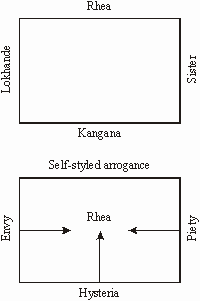
here is the small-town aspirational middle class, represented by Ankita Lokhande who describes herself as a small-town aspirant, who hit big time through the Ekta Kapoor series. She senses she does not belong to a middle class elite, a club that takes privileges for granted. She was Sushant’s earlier girlfriend, pious about her loss, suddenly normative about her position.Rhea Chakaraborty, an army officer’s daughter, is more cosmopolitan, fair, and pretty, more at ease with privilege and Sushant. She is everyone’s target as she generates a certain envy. She appears privileged and seems to have inherited it. Then there is Kangana who sees herself like Sushant, vulnerable in a hypocritical city. A newcomer, she senses the power of privilege and is angered by it.
|
|
The attitude of each to Rhea verges on a variant of the melodramatic. Ankita is jealous, envious of Rhea, the sister projects a certain piety onto a person she thinks is illicit; Kangana verges on the hysteric. There is literally a mob hysteria in soft media demanding Rhea’s arrest for a multitude of sins, from murder and arrogance to just being privileged. The idea of a live-in relationship almost becomes anti-civilizational. Rhea is actually hunted down for being Rhea, the public school kid, for a sense of privilege without the piety that should sustain it. The middle class hates undeserved privilege and is violent towards it.
Rhea stands mute against hysteria, silent against the middle class melodrama unleashed against her. A Kangaroo court of prejudice wants her erased for being Rhea. What makes her illicit is not her relationship with Sushant but her sense of privilege. The women are complaining that Rhea’s presence creates an uneven playing field in the battle called love. There is no pity as each is convinced that the winner takes all. The privilege called the club faces the intolerance of the new mob.
The police merely play out these reflexes. The mob on the soft media streets is not a crowd, but a lynch mob of opinion makers. The intolerance is horrifying but one watches helplessly fascinated as Rhea is legislated away. To be pretty, to be different, to exude the confidence of indifference is criminal today. One does not need lumpen mobs; a hysterical middle class is enough. Sushant Rajput is no longer the text but a pretext for the violence of a middle class at loggerheads with itself. The Hobbesian mind of the middle class reveals a state of society which is nasty, brutish and short. The dialogue of intolerance would be the enemy of any Bollywood scriptwriter. It is interesting that innocence today is not the claim of an individual but something allotted like a quota, a public decision rather than individual sense of integrity.
B
y the time the narratives accumulate, one realizes that Sushant is a catalyst for each story but yet a self-effacing presence. He is like his smile – shy, tentative, open and yet remains distant. The audience and the narrator have to decide whether he is a token, an icon, a signal or a symbol of something still inarticulate, of a new vision of a city mixing freedom and violence in explosive ways while Bollywood articulates it.As one hears the stories before and after his death, one realizes the Rajput story was more like a trailer of a Bihari outsider entrancing Mumbai till we enter backstage after his demise. The drama then enfolds to convert him from token to an icon of a freer world, a city pretending silence about drug’s yet aware that it flows through its arteries, a city where old institutions like the family and friendship have to see the affair and the broken affair as more than a scandal and stop treating the unorthodox with suspicion.
Freedom demands that we remap the norms of the city, making Mumbai a more forceful filmi myth. It is not a narrative about who killed Sushant Rajput, but a new epic of the struggles needed to keep him and the city of dreams alive. Manto’s Mumbai Talkies was about diversity as a source of unity. The Rajput myth will be more about freedom as a celebration, an invention, and a toleration of the new. In this new Mumbai the Shiv Sena would have shrunk into a harmless self, the migrant flowered into a different presence, and the language of freedom become more articulate about illness, especially mental illness.
Dreams in reality demand a price. It is the job of the storyteller to articulate it. Dreams also articulate a new world of freedom where iconic heroes like Sushant Rajput fight new battles between good and evil. It is here that Bollywood must emerge to write new scripts articulating new imaginations and possibilities for the city as theatre in India.