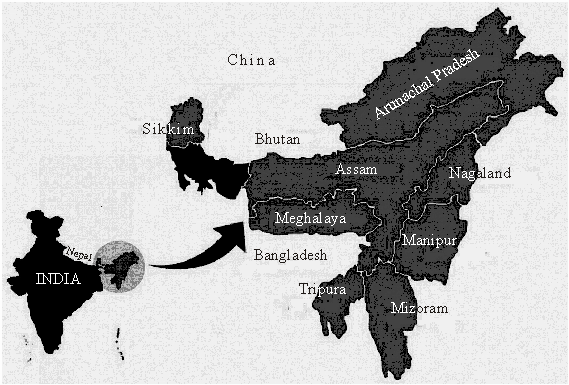
The anti-dam movement in Arunachal Pradesh, especially
the role of Save Mon Region Federation, and of the monks from the Tawang
monastery in engaging with religious traditions and ecology seem to show
the way for a peaceful solution based on their culture and religious
imperatives. Their non-violent agitation was based on the religious
conviction that natural resources are a gift of God and belong to all
human beings. So neither the state nor other human communities have a
right to monopolize them and deprive legitimate users of their sacred
right to sustainenance. The monks succeeded in stopping the dam. That
raises the question: Can religion be used as a tool for social change,
away from its fundamentalist moorings? Do the last three decades show a
direction for peace?
Leaving the reader free to comment on the issues raised
by the authors on the role played by civil society groups in peace
processes in all the above cases, let us go to the questions that are not
discussed in this issue of Seminar. The first is the distance between the
Northeast and ‘mainland’ India that protests in the region against the
CAA brought out so starkly. The protesters in the Northeast region agreed
with the ‘mainland’ civil society groups that one cannot have a law
that legalizes discrimination in citizenship based on religion. But their
bigger fear is that most migrants from Bangladesh will ultimately settle
down in the Northeast and become a threat to their land and identity. Most
of them have not left Bangladesh because of religious persecution. Like
immigrants from Bihar, they too are landless peasants coming in search of
land and livelihoods.
The people of Assam where the protests against CAA
began in December 2019, have seen the tribal proportion of Tripura decline
from 59.1% of the population in 1951 to 31.1% in 2011 because of the
influx of 800,000 Hindu immigrants to the state between 1951 and 1970, and
even later than that from East Pakistan and Bangladesh. The tribes of the
state lost to them around 40% of their land. The law was changed in 1960
in order to take land away from the tribes to rehabilitate the immigrants,
though most of them were not Partition refugees but landless agricultural
labourers who came post-1950 in search of land.
In Assam, the CAA has excluded the seven districts that
are under the Sixth Schedule. But the immigrants have also occupied much
land in its remaining 17 districts. Census data indicate that Assam had
19,44,444 direct immigrants between 1951 and 2001. That is the difference
between the state’s decadal population growth and what it would have
been if it had kept to the national average. Because of natural growth,
their number has gone up to more than 4,000,000. The Census indicates that
around 40% of them are Bengali speaking Muslims, the rest being Bengali,
Hindi and Nepali speaking Hindus. Over and above them are the 500,000
pre-1950 Partition refugees who were resettled in Assam, and 200,000 in
Tripura. The remaining states received smaller numbers. That explains the
strong reaction to the CAA in the Northeast. Its people want to protect
the secular nature of the Constitution, no doubt, but their greater
concern is about protecting their lands from immigrants, irrespective of
their origin. In Assam, the Assamese speakers who are slightly over 50% of
the population, fear that they will be reduced to a minority. The
protesters fear that the CAA will only encourage more migrants to come to
the region under the guise of being persecuted minorities. This makes them
believe that their land and identity are a greater priority than being a
secular state, which is the focus of protests in the rest of India.
The people are aware that most immigrants, whether from
Bangladesh or Bihar, are poor landless agricultural labourers in a feudal
system where land reforms have not been implemented. They come in search
of the fertile land of the Brahmaputra valley where legal ambiguity
enables them to encroach on common lands and obtain pattas by
bribing officials. Immigration can also be viewed from the perspective of
density. In 2011 the per square kilometre population density was 398 in
Assam, 350 in Tripura and lower in the remaining states of the region. But
in Bihar it was 737 against the all-India density of 382. The density of
Bangladesh was 1,240 in 2018 and 20% of its land is expected to be
submerged due to climate change within the next couple of decades. It will
push more people out of Bangladesh.
Migration can therefore also be viewed as a process of
demographic balance. The people of the region do understand their right to
a life with dignity, the implications of denial of citizenship to the
immigrants, and the injustice of sending them to detention camps. But they
disagree with ‘mainland’ human rights activists, who rush to the
region to help those who are excluded from the NRC, demanding their
inclusion in the list, but expect the Northeast to accommodate all of
them. The people of the Northeast expect the rest of India to accept the
rehabilitation of most of them, but do not see the rights activists doing
so. This attitude has increased the distance and alienation between the
Northeast and ‘mainland’ India.
The 45 million plus people of Northeast India have
always found themselves at a disadvantage because of the distance between
their region and the ‘mainland’. This distance and their relative
isolation is not merely physical, but also psychological and political.
The people of the region feel that ‘mainstream India’, centred on the
Gangetic valley Hindu dominant caste male culture, does not understand
them. The India of the ‘mainstream’ stops at Kolkata, and most of its
people only have a vague knowledge of the Northeast. For example, at the
inauguration of the World Social Forum in Mumbai in January 2004, I sat
next to a young man from Kerala who asked me where I was from. ‘From
Guwahati,’ I said. ‘So you are Bangladeshi,’ was the reponse of the
young man who had just boasted about his global knowledge. When I said
that Assam was in India, another man sitting to my right said, ‘yes,
Biharis were attacked there last year.’
This is but one of dozens of instances about the
commonly held view of the Northeast, as that faraway region beyond
Bangladesh, a land of conflict. Add to this in the last two years: ‘the
land of injustice to lakhs of immigrants who are excluded from the NRC.’
The region does not enter mainstream Indian thinking. Even the national
anthem stops at ‘Vindhya, Himachala, Yamuna, Ganga’ but ignores the
Brahmaputra, which is longer than the Ganga, and is the fifth largest
river in the world that confers an identity on the Northeast, but is not
an all-India sacred river. The present government is trying to impose some
sacredness to it but only by connecting it to the Ganga, and not in its
own right. The India of the national anthem is made up of ‘Punjab, Sindh,
Gujarat, Maratha, Dravida, Utkala, Vanga.’ The Mongoloids of the
Northeast do not exist in this Aryan-Dravidian concept of India. When
people from this region go to the ‘mainland’, they are referred to as
‘chinki’, a pejorative racist term for the Chinese.
What this means is that by being located in the extreme
Northeast of India, this region of eight states has always found itself at
a disadvantage because of poor communication with the centres of power.
Moreover, the region with only 22 members in the Lok Sabha, has very
little negotiating power in the country’s political life. It is treated
as a sub-stream without an identity of its own, and as such, has to merge
with ‘mainstream India’. Many nationalist struggles have to be
understood in this context – a search for an identity. Instead of trying
to understand this dilemma, the Indian state has interpreted the problem
as a law and order issue, militarizing the region to protect the territory
from its people.
In the initial stages of the Covid-19 pandemic, the
relative isolation of the Northeast turned out to be a blessing in
disguise because the virus took a long time to reach the region. Nearly a
week into the national lockdown, the Northeast had only two confirmed
positive cases – a woman who had returned to Manipur from the UK after
completing her doctoral studies, and a Baptist pastor who returned to
Mizoram from the Netherlands. That advantage disappeared and it has
increased the gap with the ‘mainland’. After two weeks of the
lockdown, on 10 April, the region had 32 positive cases, including one
dead and one cured. Almost half was a result of the Jamat congregation in
Nizamuddin and the rest came from other parts of the ‘mainland’.
Because of high unemployment in the Northeast, a large number of its youth
migrate to cities across India in search of unskilled or semi-skilled
work. Prior to the testing, around 100,000 had come back from cities where
the pandemic had spread, and operations had been suspended.
Testing incoming railway passengers began only after
the lockdown. Two weeks into it, 75,000 had tested negative and were
released from quarantine. One does not know whether the early returnees
had carried Covid-19 with them. Till they returned to the region testing
was by and large limited to air travel and extended to train travel after
the lockdown. But the returnee migrants had reached their villages
earlier, without having been tested. As a result, one may not know the
extent of its spread. Testing is non-existent and health services are poor
in the villages. Lockdown and social distancing can prevent the spread of
the disease, but most returnee migrants live in small houses where social
distance cannot be enforced. If they are infected, they may spread the
virus to others, and then attribute it to the ‘mainland’, thus
increasing the psychological distance between the ‘mainland’ and the
Northeast.
Side by side, the economic pandemic may be a bigger
danger than the virus. Even if the returnee migrants have not brought the
disease with them, they and their families face an economic disaster. Like
migrants in the rest of India they too were holding low paid jobs and do
not have adequate savings to tide over a crisis of this magnitude and may
even face starvation. This pandemic goes beyond them, to lakhs of migrants
to the Northeast from other states like Bihar and from Bangladesh, who
sustain themselves through daily wage unskilled work. With the lockdown
they too are left without work.
The much bigger pandemic of racism adds to this danger.
President Trump is not the only person talking of the Chinese virus. A
relatively large number of migrants from the Northeast have Mongoloid
features. Because of this, the cities to which they migrate have taunted
them as chinkis. Today the term chinki is symbolic of ‘carriers of
Covid-19’. For example, according to a news item, three Naga students
were denied entry to a mall in Mysuru because of their ‘Chinese’
features. Two students from Manipur were not allowed to enter a mall in
Hyderabad for the same reason. A nurse in Bengaluru reports how a small
child ran away from her screaming ‘corona virus’. Obviously the child
was not born a racist, but was influenced by the parents.
Dr Alana Golmei from Manipur, General Secretary of the
Northeast Support Group, living in Delhi, recounts how on three different
occasions the staff of NCERT (National Council of Educational Research and
Training) taunted her and her companion from Meghalaya as ‘corona virus’
when they entered the campus. The staff members apologized when confronted
by Golmei. Many landlords have asked Northeasterners to vacate their
premises. Thus, they have been subjected to a racist pandemic. Ironically,
one also has to see whether the villages to which they returned
discriminated against them as possible carriers of the virus. Covid-19 has
enormously increased the mainland-Northeast distance.
The CSOs in the region have to face these challenges.
Like the civil society groups that are involved in peace processes, many
provide health facilities through rural dispensaries in this region where
health infrastructure is extremely poor. Government health services exist
only on paper. The pandemic can spread if a proper infrastructure is not
built very soon. The CSOs can do it because their infrastructure consists
of rural dispensaries that render yeoman service without receiving any
funds from the state. This rural infrastructure needs to be activated on a
permanent basis. They could put pressure on the state-run health services
to function properly. They must demand that the state fund their
dispensaries in order to ensure that a good public health infrastructure
is created. The CSOs across India must build bridges with their
counterparts in the region where many are working for peace between ethnic
communities. The ‘mainland’ CSOs can be bridge builders between
peninsular and Northeastern India through partnership and dialogue with
their counterparts in the region.