Leveraging data and technology
PURNIMA MENON, RASMI AVULA, SUMATI BAJAJ and MANITA JANGID
THE burden of undernutrition in India, despite some gains, remains high when measured by any metric – child stunting, child wasting, maternal undernutrition, maternal anaemia or child anaemia.
In 1975, the Government of India launched what is now India’s flagship nutrition programme, the Integrated Child Development Services (ICDS) scheme, to improve the health and nutrition of pregnant and lactating women, and children below the age of six. The ICDS delivers a set of core services including food supplementation, nutrition and health education, growth monitoring and referral, and non-formal preschool education through anganwadi centres (AWCs) managed by an anganwadi worker (AWW) and an anganwadi helper. In addition, the ICDS provides immunization services and health check-ups in collaboration with the health department. All these services together aim to address maternal and child nutrition, health and development in the first 1,000 days after conception.
Over the last four decades, the ICDS has been universalized, and there have been efforts to strengthen the reach and quality of services, particularly at the state level. These efforts have yielded uneven results across the country.
1 Nevertheless, lessons from successful efforts to address undernutrition in different states point to a combination of factors that have supported change. These include a clear and articulated vision, sustained leadership, adequate financing, strengthened systems for delivery, processes addressing the underlying challenges of poverty and food insecurity, and the use of data to learn and strengthen efforts.2 Many of these elements are incorporated into the National Nutrition Mission, especially the call to use data.Data are critical inputs for improving nutrition programmes and scaling up interventions. This commentary discusses two broad areas – first, the use of data in nutrition programmes, and second, reflections on the integration of technology for data gathering and data use in the context of the ICDS programme. Technology is integral to the National Nutrition Mission, and over 500,000 frontline workers in several states have now been equipped with mobile technologies and smartphones.
D
ata systems are of great significance in tracking malnutrition and improving programme outcomes. The key elements of a data system for nutrition include (i) data sources, such as survey data, administrative data, and implementation research, (ii) systems and processes for data use, and (iii) data stewardship across a ‘data value chain’. Below, we reflect on insights from a body of work on this topic, done together with NITI Aayog and IDinsight collaborators in India.3The data value chain for nutrition includes prioritization of indicators, data collection, curation, analysis, and finally, translation into evidence based policy and programme decisions and actions. Finding the right fit for nutrition information systems is important – neither too little data, nor too much. However, finding the right fit for a data system that works for multiple decision-makers is an even bigger challenge.
In India, data on malnutrition, nutrition interventions and outcomes are available from both population based household surveys and administrative data systems. Population based surveys include the National Family Health Survey (NFHS-4, 2015-16), the Comprehensive National Nutrition Survey (CNNS 2016-18), and surveys conducted under the Aspirational Districts Programme by third-party organizations such as IDinsight and the Tata Trusts. Ministries and departments are another key source of data. They provide data on nutrition specific interventions such as ICDS and the National Health Mission (NHM) and data from other systems – for example, data on sanitation from the Swachh Bharat Mission.
I
nstitutional mechanisms have been set up at the national, state and district levels to monitor the Prime Minister’s Overarching Scheme for Holistic Nutrition (Poshan) Abhiyaan (formerly known as the National Nutrition Mission), the Government of India’s flagship programme to improve nutritional outcomes for children, pregnant women and lactating mothers.4 At the national level, there is the national council chaired by the vice-chairperson of NITI Aayog, along with an executive committee headed by the secretary, ministry of women and child development (MWCD). NITI Aayog, which is the Union government’s policy think tank, oversees the monitoring and evaluation activities. A technical support unit (TSU) and a monitoring and data analytics cell have been established at NITI Aayog to assess progress and impact.At the state level, state project management units (SPMUs) are expected to function as the State Nutrition Resource Centre, to monitor activities and provide direction for effective programme implementation. And at the district level, district administrators are required to monitor progress through quarterly review meetings convened by the district collector. District collectors are expected to review the data available from programmes like the ICDS, NHM and other sectors, on a set of indicators across the continuum of care. The data for the quarterly reviews are provided by frontline workers, crosschecked at the block level, and validated by a district validation committee.
Other sources of data include reviews by sectoral officials, a range of administrative dashboards to monitor progress of the Poshan Abhiyaan (such as the ICDS common application software or CAS, the Jan Andolan dashboard, Anaemia Mukt Bharat dashboard, Swachh Bharat dashboard), and data from third-party surveys such as the Aspirational Districts Programme survey.
I
n recent years, India has also seen a surge in data visualization tools to communicate nutrition data in visual formats.5 Overall, India is privileged to have such a range of data sources, systems for review of data-driven insights, and platforms to deliver health and nutrition interventions. What remains unknown is how well these systems are currently working, and what well functioning systems tell us about how data can be used to create change. As lessons emerge from the Aspirational Districts Programme and other data efforts to inform nutrition progress, more insights will be available.Next, we take a closer look at the ICDS common application software (ICDS-CAS), the biggest effort to integrate technology as the backbone of the data system for a nutrition programme.
|
|
At the national level, new energy has been infused into the ICDS programme though a technological innovation that offers new ways to gather data on the frontline, and to analyse, visualize and strengthen data use. In 2016, to strengthen ICDS service delivery, the MWCD, with support from the World Bank and the Bill & Melinda Gates Foundation, introduced into the ICDS the ICT enabled real-time monitoring CAS tool. In 2017, CAS was launched in selected districts in eight states. A year later, ICDS-CAS became one of the core elements of the Poshan Abhiyaan and has since been scaled up to reach 5,812,82 anganwadi workers. Our team, working together with many collaborators, was part of an evaluation consortium to assess the impact, processes and costs of the technology integration.
6 The insights in this essay are drawn primarily from a multi-component dynamic process evaluation.7ICDS-CAS is an innovative smartphone application that digitizes the anganwadi workers’ service tracking registers. It has an accompanying web-based application that operates through dashboards for real time monitoring, with the goal of enabling better supervision and facilitating use of data for decision-making.
ICDS-CAS is one of very few mobile health interventions that have been developed to digitize an existing delivery system, to fully embed it into complex programming structures, and to implement it at scale. The application supports four key stakeholders in the ICDS system: the AWWs, the ICDS supervisors, block and district officials. The components of the technology integration are:
* AWW app: Anganwadi workers receive a smartphone loaded with the AWW app, which acts as a job aid, guiding them to take timely and informed decisions through nine key modules: household management, daily nutrition, home visit scheduler, growth monitoring, take-home rations, due list, community based events, anganwadi centre management, and monthly progress report (MPR).
* Automated service registers: Ten of the 11 service registers of AWWs are automated. Data from the household management module enables tracking of individual beneficiaries and auto-generation of a priority list for home visits. The home visit scheduler alerts workers on upcoming home visits. For example, a home visit when a child completes six months is crucial to counsel the family on complementary feeding. The home visit scheduler alerts the AWW to visit homes with six-month-old infants. The app also contains videos on key topics to help the workers in counselling. Similarly, the due list module automatically generates the list of beneficiaries who need to be vaccinated.
|
|
T
he growth monitoring module aims to improve the accuracy of assessment – once the AWW enters the data, the module automatically calculates a child’s nutritional status and plots it on the growth chart. The monthly progress report is automatically generated from the existing data and thus saves the time an AWW would have taken to prepare a paper format MPR while ensuring data accuracy.* Lady Supervisor app: ICDS-CAS has a mobile based supervision app for lady supervisors (LS), each of whom supports 20-25 AWWs. The app allows them to access real time data from AWCs to supervise delivery of services by workers. Using this application, supervisors can identify AWWs who are not performing adequately and prioritize them for support. There is a built-in checklist for use during AWC visits, and the app also allows for data driven discussions with anganwadi workers.
* Dashboard: The ICDS-CAS dashboard generates reports with real time information for various stakeholders, including child development programme officers (CDPO), district programme officers (DPO), and state ICDS officials. These alerts and real time data are expected to ensure data based decision-making for policy and implementation.
* Helpdesk: There is a helpdesk at the district and block level to troubleshoot any issues with CAS hardware or software.
W
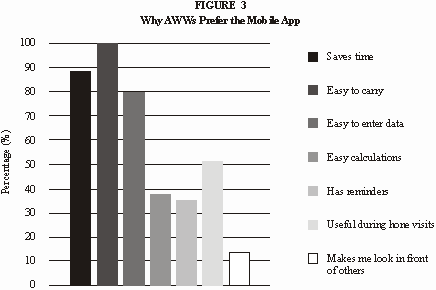
orking with numerous partners, our team conducted a mixed-methods process evaluation between 2017 and 2018 in Madhya Pradesh and Bihar to understand the rollout of ICDS-CAS, and the factors influencing its use. We conducted interviews with a range of stakeholders, from the national level to those on the frontlines, including repeated interviews with over 400 anganwadi workers, as the programme unfolded.We found that leadership, multiple-partner collaboration, an enabling environment for engaging states, and champions within and outside of the government facilitated the implementation of CAS. While central leadership was pivotal for implementation, state-level leadership was equally important. Most importantly, the target clients of the app – LS and AWWs – understood the benefits of the app and preferred it to paper based registers.
For technology based interventions such as ICDS-CAS, once the hardware and software are set up, training is the next critical step. Our research shows that nearly all AWWs and LS in both states were trained in using the ICDS-CAS app and were satisfied with the training. At the same time, several AWWs and LS felt the need for refresher trainings. However, not all ICDS officials were trained on the use of the dashboard.
W
e also found that in both states, anganwadi workers had good knowledge of the ICDS-CAS app and nearly all of them were using it. A majority of AWWs entered data into the app themselves and found it easy to use, despite facing challenges with the software, hardware, and internet. These challenges included slow internet on mobile phones, the need to travel to submit data, and absence of network or electricity at their anganwadi centre or village. Common hardware issues included freezing or slowing down of mobiles, and batteries draining or heating up. Other common problems included the time taken to enter data into the phone and submit forms, and submitted data not being reflected in their app. However, despite these problems, use was widespread.|
|
We also found that overall, at the time of research, the support structure for using the ICDS-CAS app was functioning well. AWWs and LS in both states contacted helpdesk staff when faced with any issues, and the helpdesk appeared to play an important supportive role in ensuring smooth functioning of CAS.
Our findings indicate that at the supervisory level, the ICDS-CAS dashboard enabled efficient monitoring and feedback by CDPOs and DPOs. The staff felt they could monitor the work promptly. In addition, widespread use of smartphones has enabled the supervisory cadre to stay connected with AWWs through WhatsApp. Supervisors were using WhatsApp groups to provide timely feedback to AWWs through sharing of reports and instant directives. AWWs were using peer groups to discuss issues and learn from peers.
T
he ICDS has an elaborate administrative data system that consolidates data from 11 recording registers updated every month by about 1.3 million AWWs. Overall, ICDS-CAS has made the data entry, compilation and report generation easier for users at all levels. LS can monitor daily data entry in CAS and data collation is automated. CDPOs can review the CAS dashboard and use it to discuss issues with LS and DPOs in real time. Users of data at the centre do not have to wait for monthly MPRs to know the status of service delivery. Thus, CAS gives users at all levels in the ICDS system the opportunity to use data meaningfully rather than only for reporting purposes.Looking forward, sustained investments to support the further scale-up and use of the ICDS-CAS remain essential. For instance, efforts are needed to ensure continued training of AWWs, LS, and other ICDS staff on the apps, identifying and addressing the challenges in using the app, and ensuring their routine use. In addition, both central and state level leadership are essential for the continued use of ICDS-CAS as a key data-driven decision support tool
The strengthening of data use in India’s nutrition programmes, and the integration of technology into ICDS, the world’s largest nutrition programme, are laudable efforts. However, data and technology are only tools to enable delivery of the core interventions – food supplements, growth monitoring, micronutrient supplements, counselling for behaviour change, and more. The actual delivery of the interventions is also deeply influenced by overall programme governance, availability of human resources and financial processes.
Mothers and children cannot eat data. Data and data use efforts must lead to programmatic action by frontline workers to improve household access to key programme interventions that in turn help to improve nutrition knowledge, ensure access to food and micronutrient supplements, and create enabling environments for better diets and better nutrition. Data and technology are necessary ingredients of well functioning programmes today, but they are certainly not enough to create lasting change by themselves.
* Many ideas in this article have emerged from discussions with a range of colleagues and collaborators. On issues related to the use of data, we especially acknowledge Divya Nair (IDinsight), Robert Johnston (UNICEF), Alok Kumar (NITI Aayog), Alok Dubey (previously with NITI Aayog), Supreet Kaur (NITI Aayog), Anamika Singh (NITI Aayog) and others. On issues related to the integration of technology into nutrition programmes, we acknowledge our collaboration with Dilys Walker (UCSF), Lia Fernald (UC Berkeley), Sumeet Patil (NEERMAN), Lakshmi Gopalakrishnan (US Berkeley). Our research on these topics in India is supported by the Bill & Melinda Gates Foundation.
Footnotes:
1. S. Chakrabarti et al., ‘India’s Integrated Child Development Services Programme; Equity and Extent of Coverage in 2006 and 2016’, Bulletin of the World Health Organization 97, 2019. https://www.who.int/bulletin/volumes/97/4/18-221135/en/
2. P. Menon et al., ‘25 Years of Scaling Up: Nutrition and Health Interventions in Odisha, India’, in S. Gillespie et al. (eds.), Nourishing Millions: Stories of Change in Nutrition. International Food Policy Research Institute (IFPRI), Washington DC, 2016. http://dx.doi.org/10.2499/9780896295889_17
3. P. Menon et al., ‘Tracking India’s Progress on Addressing Malnutrition: What Will It Take?’ Poshan Policy Note 34, International Food Policy Research Institute, New Delhi, 2020.
4. Launched by the prime minister on International Women’s Day (March 8) in 2018 from Jhunjhunu in Rajasthan, Poshan Abhiyaan directs the attention of the country towards the problem of malnutrition and addresses it in mission mode.
5. M. Jangid et al., ‘How Are Nutrition Data Visualisation Tools (DVTs) in India Supporting Decisionmakers?’ DataDENT, 18 May 2020. https://datadent.org/2020/05/18/how-are-nutrition-data-visualization-tools-dvts-in-india-supporting-decision-makers/
6. S. Nimmagadda et al., ‘Effects of an mHealth Intervention for Community Health Workers on Maternal and Child Nutrition and Health Service Delivery in India: Protocol for a Quasi-experimental Mixed-methods Evaluation’, BMJ Open 9(3), 2019. https://bmjopen.bmj.com/content/9/3/e025774.abstract
7. R. Avula et al., ‘Integration of the Common Application Software (CAS) into the Integrated Child Development Services (ICDS) in Madhya Pradesh and Bihar: A Process Evaluation Report’. IFPRI, 2018 (unpublished report, available on request).