What civil society organizations can do

back to issue

The Azim Premji Philanthropic Initiatives is a grants organization that partners with non-profits working for the wellbeing of deeply marginalised and vulnerable people across India. The Philanthropy is a part of the Azim Premji Foundation, which also includes grassroots efforts to improve public school education, as well as the Azim Premji University. The chronic malnutrition of India’s children is a major programme area for the philanthropy. The programme is presently concentrated in Odisha, where they support the state government in managing a multi-sectoral effort, with many civil society partners, to reduce stunting of under-5 children in the state, with particular emphasis on the underserved tribal belts.

In this interview, Anand Swaminathan, Chief Executive Officer of Azim Premji Philanthropic Initiatives, discusses the progress made by Odisha in reducing chronic malnutrition, and the conditions that have made this progress possible.


How did the Azim Premji Philanthropic Initiatives come to support the nutrition related programme undertaken in Odisha? And what are the goals of this initiative?

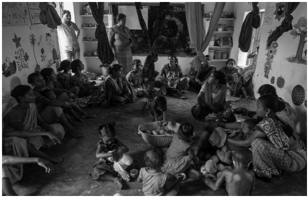
In the last 15 years, stunting of under-5 children in Odisha has reduced from 45% to 29%, a remarkable achievement brought about by the concerted efforts of the government and other stakeholders. From here, it is going to get tougher because it will need more localized planning and execution. If we get our act together, we can bring stunting down to 18-20% and get there faster. So, the specific goal of this initiative is to support the Odisha government in achieving the World Health Assembly targets for stunting, wasting, low birth weight in children, and anaemia among women. We have worked with the state government to develop a nutrition action plan that has five dimensions: (i) Integrated implementation across government departments; (ii) Support for civil society, both to technically bolster them and to help them bridge last-mile delivery. For example, in remote areas of the state, civil society organizations have come forward to strengthen the nutrition, growth monitoring and early stimulation of children under three years by establishing community-based crèches; (iii) Community involvement, especially encouraging the very active women’s groups across the state to create community awareness on nutrition, and facilitating access to various nutrition services like nutri-gardens and take-home rations; (iv) Using innovative and localized communication campaigns; and (v) Emphasizing unified state-led supervision to ensure convergence between key line departments working towards nutrition, under the chairpersonship of the Development Commissioner, Government of Odisha.

We believe this kind of holistic effort can bring stunting levels down significantly. This is what our collaboration with the Odisha government is about.
 

Why did you choose Odisha as a focus state for your nutrition programme? Do you believe there is potential for scaling up the Odisha model across other states?

Stunting is a national issue and an enormous problem in many states. However, we chose Odisha because of the strong political will on the nutrition issue, the high quality of administration, the presence of vibrant civil society organizations, and the strength of its village-level women’s groups across the state.

We have seen some good things, for instance, the ability of the government to work well with civil society, and its willingness to extend good practices – such as nutri-gardens for poor households and creches in remote villages –across the state.

As anyone who works with large complex systems will tell you, the issue is rarely about knowing what to do, and usually about how to get it done in different contexts. Which is why it is not sufficient to think in terms of models to scale, and better to think of broader principles to guide action. Let me illustrate with a few examples. Most experts who work at nutrition tell us it is critical to ensure nutrition, water, hygiene and medicine in the 1,000-day window between conception and the child’s second birthday; and they would be right. However, the 1,000-day window, which is a globally accepted norm, does not acknowledge that in India children can only start going to anganwadis from age three. This means that a 1,365-day window is more useful here to support the child until she is physically in the institutional care of the anganwadi system.

Or take last-mile delivery, which is difficult in the remote mountain tribe communities of southwest Odisha. In fact, while Odisha has done well at a state level, stunting in the south-western districts is alarmingly high, and the 40-45% average levels of stunting there hide a more precarious situation when considered at the block or gram panchayat level. In this belt, the usual delivery mechanisms do not work. So greater autonomy and discretionary funds will have to be given to panchayati raj institutions, and to block and district level officers to figure out priorities, approaches and plans in a contextual manner, within a broader state framework.

Specific development goals can blinker us to other possibilities. For instance, our ground level pilots have shown that a village level creche and daycare facility for infants and toddlers leads to significant improvements in nutrition and health. However, while pursuing a nutrition agenda, one can easily lose sight of the opportunity for improving motor, cognitive and social development of the children in the creche. Which is why at the creches, a lot of emphasis is being placed on ensuring early childhood development through stimulation and age-appropriate activities. So, from Odisha, other governments can learn to show a similarly high level of commitment to the issue, and the willingness to stay with the broad principles I mentioned earlier.


Poor health and nutrition also impact the economy adversely. The World Bank estimates the annual burden of malnutrition in India at roughly $10 billion, driven by loss of productivity, illness and death. What are some of the challenges you are encountering in the Indian nutrition landscape?

If you see the conceptual framework of malnutrition, you will realize that nutrition is a factor of multiple determinants, ranging from distant ones like poverty and illiteracy, to proximate ones such as disease, poor dietary intake, water and hygiene. It is this multi-dimensional nature of malnutrition that makes it complex to address. There is global evidence suggesting the need for integrating nutrition-specific efforts with other related issues, such as education of the girl child and preventing early marriages, to achieve sustainable gains in stunting reduction.

It is also well understood that ensuring better nutrition for women and children cannot be the responsibility of a single department. But integrated execution on the ground is a significant challenge for any bureaucracy. We need to acknowledge the good work that is being done by frontline functionaries such as the anganwadi worker, ASHAs (accredited social health activists) and ANMs (auxiliary nurse midwives). There is a strong need to understand the everyday challenges they face and address those on priority. Thus, a holistic, multi-sectoral approach by the government and civil society organizations becomes imperative to address the problem of malnutrition.


Odisha, which is one of the Empowered Action Group States, or eight socioeconomically backward states of India, has done remarkably well in health and nutrition outcomes over the past two decades. From your experience, what is Odisha doing differently compared to other states?

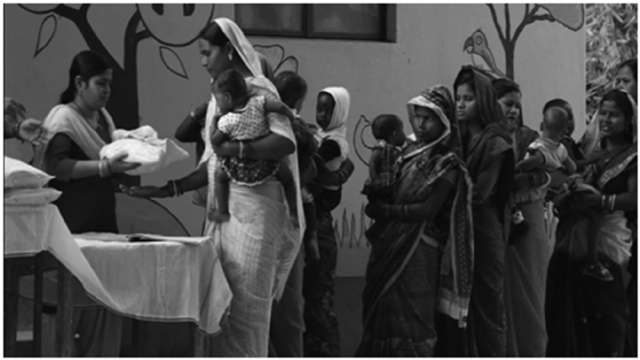
Odisha’s success in reducing infant/maternal mortality and undernutrition is because of a capable bureaucracy, an enabling policy environment, and support from civil society partners. The state has strengthened implementation of schemes like the Janani Suraksha Yojana and Mamata (conditional cash transfer scheme). This has led to improved institutional delivery, breastfeeding and immunization. Odisha has also shown a remarkable achievement in malaria control, especially in tribal areas. The government has engaged women’s self-help groups in production of anganwadi food (take-home rations) in a decentralized manner, thereby improving the access of supplementary nutrition to mothers and children. In one of the first such initiatives across the country, the state has recently initiated Nutrition Budgeting across various departments, indicating a high level of political and administrative commitment to nutrition.

The government actively encourages local innovation, and if successful, is open to adapting those practices across the state. Right now, it is rapidly expanding two programmes – creches and household-level nutri-gardens. Both of these interventions have components of local innovation. For example, the role of the village community in deciding the need for a creche and overseeing the functioning of creches, and the cascading model for establishment of nutri-gardens, leveraging the women’s groups. While these are some examples of good practices, the key thing we have seen is a commitment to the issue, and a willingness to try different ideas and approaches.


Given its stated goal of a malnutrition-free India by 2022, the central government is giving a big push to making the Poshan Abhiyan a people’s movement. What can be done to make people stakeholders in their own health and nutrition and to build more robust community engagement?

One of the key problems with stunting is that the family is unable to recognize the severity of the issue, especially because it is so prevalent. It is important to first establish malnutrition as a problem among families and communities. Therefore, community mobilization and involvement is integral to our effort in the state.

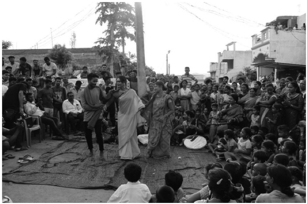
We are trying this at various levels. For instance, some parts of the state have a tradition of transgenders playing a cultural role during pregnancy and childbirth. We have partnered with a large transgender community organization to use these traditional platforms to build awareness on nutrition and health of the expecting mother and child.

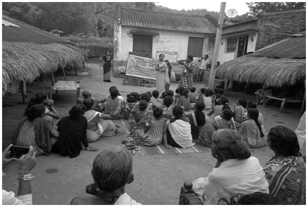
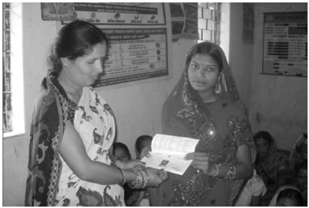
We are using Odisha’s strong network of women’s self-help groups to educate the community and change household-level practices, such as who gets to eat first at home. We feel that there is a larger need to engage men and other family members in our efforts against malnutrition and are trying to integrate this in our programme.


Are there any unique interventions or best practices that you have come across that could impact nutrition and have the potential to be scaled up?

We have seen these things work well, but they need to be adapted in context: One, village-level creches in remote geographies, that provide nutrition, healthcare and stimulation. Two, assisting poor households to grow nutri-gardens in their backyards. Three, in remote villages without a proximate anganwadi, converting raw rations from the anganwadis into hot, cooked meals for all children in the community. Four, working closely with local communities and women’s groups. Five, using appropriate cultural practices to build awareness and communicate. For instance, as I said, using the transgender network in Odisha to talk about appropriate household-level care giving for infants.


What is an effective role that philanthropies and other institutions working on various social issues can play in India’s fight against malnutrition?

The government has the first and primary responsibility of providing health and nutrition services to the people. But government efforts can be enhanced several times over with civil society contributions. To that extent, the onus of reducing malnutrition is on all stakeholders. Some areas in which the philanthropies and NGOs can contribute are improving last-mile delivery of services, ensuring inclusion of excluded populations, socially sensitive technological innovation, simplifying data and improving the quality of data and research around health and nutrition.


What can governments do to make it easier for philanthropies to work on social sector issues like malnutrition?

Genuine commitment to the issue, and an openness to work with others, like we have experienced in Odisha.

top