Malnutrition among tribal people
ABHAY BANG
THE Constitution of India recognizes the special status of tribal people – the Scheduled Tribes – and provides safeguards to protect their rights and culture. However, despite their large number, tribal people have remained marginal geographically, socio-economically, politically, and therefore, in the national psyche. For the mainstream population, tribals are ‘those semi-naked wild people who live somewhere in the forests and mountains, and who sometimes appear in the news because their children are malnourished.’
Recognizing the need for a roadmap for tribal health that is based on an understanding of the health situation of the tribal people, their needs, aspirations and rights, the Ministry of Health and Family Welfare (MoHFW) and the Ministry of Tribal Affairs (MoTA), in October 2013, jointly constituted the Expert Committee on Tribal Health, under the Chairmanship of the author. It had as its members prominent academicians, civil society members and policy makers who have long been working with the tribal people. The report of the expert committee, ‘Tribal Health in India’ was submitted to the Government of India on 9
August 2018. This article draws heavily on the relevant sections from the report.1Over 104 million tribal people live in India. Spread across 705 tribes, they account for 8.6% of the country’s population. Article 342 of the Indian Constitution defines ‘Scheduled Tribes’ as the ‘tribes or tribal communities or parts of or groups within tribal communities which the President of India may specify by public notification.’ Numerically, Madhya Pradesh has the largest ST population (15 million), followed by Maharashtra (10 million), Odisha (9 million), and Rajasthan (9 million). In fact, more than two thirds of the ST population lives in the seven states of MP, Chhattisgarh, Jharkhand, Odisha, Maharashtra, Gujarat and Rajasthan. However, the concentration of tribal population is highest amongst the Northeastern states.
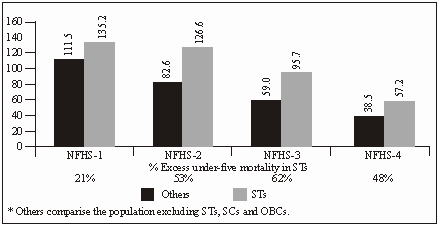
Malnutrition in tribal people is not only a health issue. It is a manifestation (as well as cause) of a gamut of social, economic, culture, political and environmental adverse factors. Let us look at the under-five child mortality among the tribal population – its level, trend and comparison, as one indicator of the total backwardness of tribal people (Fig-1). It tells us what happened over 25 years.
|
FIGURE 1 Comparison of Under-Five Mortality in STs and Others* During Past 25 Years |
|
|
|
Source : National Family Health Surveys I, II, III, IV. |
The under-five MR shows a 58% reduction in tribal areas, from 135 (in 1988) to 57 (in 2014). The percentage of excess of under-five mortality in ST when compared to others has widened from 21% to 48%. As late as in 2014, in some of the states with a large ST population, the ST U5MR was two to three times higher than in others.
T
he food habits and lifestyle patterns of the tribal population differ considerably from the non-tribal and from each other. Even within the same tribal group, the food consumption pattern varies across different seasons – from extreme deprivation during the lean season to high intake in the post- harvest period. Problems of poverty are compounded by a lack of sanitation, access to healthcare and frequent ailments leading to rampant under-nutrition. Recent times have also seen a social, economic and cultural transition among the tribal people. Lack of access to forests, loss of livelihoods, migration, acculturation and a growing reliance on the public distribution system have limited dietary diversity. This change has been associated with the introduction of lifestyle diseases leading to a ‘double burden of disease’.
L
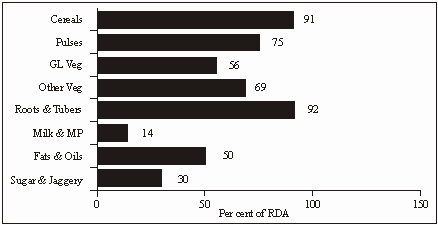
et us look at the daily nutrition intake. The third round of the National Nutrition Monitoring Bureau (NNMB) survey, aimed at nutrition of tribal population in India, (2008-09) found that the mean intake of most foodstuffs and nutrients by tribal people continued to be below the Recommended Daily Allowances (RDA) by the Indian Council of Medical Research and had in fact reduced over the years, across all age groups and for both genders. This is worrisome and may be indicative of rising food insecurity or a change in dietary habits. (Fig. 2)
|
FIGURE 2 Average Daily Household Intake by ST Population of Food Stuffs as % of RDA 2 |
|
|
O
n an average, intake of cereals and millets decreased by about 50 g/CU/day between the second (1988-90) and the third NNMB surveys (2008-09) in tribal areas. The average daily intake of proteins decreased by about 3 g/CU/day and of Vitamin A by about 117 µg/CU/day. The average intake of energy decreased by about 150 kcal/CU/day. Also, only about 29-32% of children of different age groups and 63-74% among adult men and women were consuming diets that were adequate in both protein and energy. Finally, only about 25% of pregnant and lactating women had adequate intakes of both protein and calories. This leads to undernourished mothers and children and risk-prone pregnancies.
T
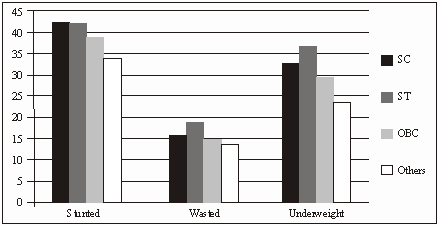
he NFHS-3 (2005-06), NFHS-4, (2015-16) and RSoC (2013-14)3 (cross sectional surveys) provide data which enables us to look at the current nutrition status of tribal children, while the NNMB surveys enable us to get a picture of malnutrition as the tribal child grows. (i) Tribal children continue to be the most malnourished. The prevalence of underweight in tribal children is almost one and half times more than in the ‘other’ castes. (Fig 3). (ii) The RSoC data shows that the overall levels of stunting, wasting and underweight among tribal children has reduced significantly from the NFHS 3 levels. In 2013-14, 42.3% of tribal children under the age of five years were stunted, 18.7% were wasted and 36.7% were underweight as against 53.9%, 27.6% and 54.5% respectively in 2005-06. (iii) The same trend is noticed in NFHS 4 , where percentage of under five children being underweight has reduced to 41.93% against 54.5% in NFHS 3. (iv) The huge disparities between the nutritional status of tribal children and those belonging to non-tribals (except in the northeastern states) can be attributed to socio-economic determinants such as livelihoods and income literacy, family size, and presence of concurrent morbidity.|
FIGURE 3 Prevalence of Under-Nutrition Among Tribal Children in Comparison to Other Population Groups, RSoC 2013-14 |
|
|
* The NNMB surveys also show that the prevalence of under-nutrition among school age tribal children reduced between 1998-99 and 2008-09. The reduction was most significant among 14-17 year olds (10%).
* Though, no gender differentials were observed in the prevalence of under-nutrition, a stepwise regression analysis had shown that the risk of underweight and stunting was significantly higher among the children of illiterate mothers, and households with lowest wealth index and children who had various morbidities.
* Breast feeding was more common in tribal mothers as compared to other groups.
* The time trend (NNMB 2 and 3 followed by the RSoC) shows some welcome decrease in the prevalence of malnutrition in tribal children. However, time and again, episodes of increased malnutrition and child deaths are reported in tribal pockets (Melghat, Nandurbar, Thane) by the media and in the state legislatures. The nature and the reasons for these tragic spurts need to be identified and suitable measures instituted. Since such episodes are reported mostly during the rainy season, they may be caused by a seasonal food scarcity, increased infections (malaria, diarrhoea) and a breakdown of access to health care during the rainy season.
* Time trend data from the last two NNMB surveys shows that the prevalence of chronic energy deficiency (BMI < 18.5) reduced across all states in the one decade between the surveys. CED among adult men reduced by 9% and among adult women by 6%.
* The data also shows an increase in the prevalence of overweight. Overweight and obesity (BMI =23, Asian cut-off levels) among men increased from 3.6% in 1998-99 to 7% in 2008-09 and from 4% to 8% among women in the same period. There is a need to study the nutritional transition that is taking place among the tribal communities.
|
Paradox of tribal nutrition 1. Malnutrition (stunting among children, and low BMI among adults) in tribal people is more than among the non-tribal population, and is unacceptably high. 2. The food intake and the intake of various nutrients such as proteins, calories, vitamins have decreased in the last decade in the tribal population. 3. Yet, the prevalence of clinical malnutrition in children or low BMI in adults has, to some extent decreased in a decade, probably because of reduced physical activity, and decrease in nutritional wastage due to infections. |
L
ooking at micronutrient deficiencies, we find that about two-third of the preschool children were consuming iron below 50% of Recommended Dietary Allowances (RDA), which is the major cause for high levels of anaemia among these people. Mothers of young children reportedly revealed that only 4.2% had received iron supplements within the past one week. Anemia: Maternal malnutrition is quite common among the tribal women, especially those who have closely spaced pregnancies. NFHS 3 shows that 65% of tribal women in the 15-49 year age group suffer from anemia as against 55.7% SC and 46.9% other women. The prevalence of anemia among children (6-59 month) is also notably higher among ST children compared to children of other social groups. According to NFHS 3, about 77% ST children were anaemic compared to about 64% other category children.
U
nder-nutrition continues to remain a major cause of morbidity and mortality among the tribal population. While family size, lack of access to appropriate quantity and quality of food due to poverty, landlessness and absence of livelihood security continue to be the major reasons behind this, it is also important to acknowledge that the food habits of the tribal communities are changing due to the economic and cultural transitions taking place within them. According to the theory of ‘Foetal origin of adult onset diseases’, if babies malnourished in-utero, and born with low birth weight gain even moderate weight during their adult life, they are more prone to develop diseases like coronary heart disease, stroke and diabetes. A sizable proportion of tribal people who were born with low birth weight are presently exposed to dietary change and modern processed foods, refined carbohydrates, salt and sugar. This is leading to a growing incidence of non-communicable diseases like hypertension and diabetes.The origins of malnutrition in tribal people are in a complex web of causes. Hence the need for inter-sectoral programmes to tackle the problem of malnutrition. Poverty, food insecurity, lack of quality food, non-use of milk and milk products by some tribes, diminishing availability of animal and plant foods from the forests, unsafe and inadequate water, lack of toilets, lack of adequate knowledge about hygiene, health, breast feeding and complementary feeding, lack of time to repeatedly feed the child, high incidence of infections, especially malaria, diarrhoea, respiratory and skin infections, low and delayed care seeking, poor health care availability – are but a few of the causes of malnutrition among the tribal population. Obviously, corrective actions can encompass agriculture, forest policy, animal husbandry and fishing, livelihood programmes, MNREGA, education, transport, connectivity, PDs, ICDS, mid-day meal programme among others.
I
t is beyond the scope of this article to examine and recommend measures encompassing such wide gamut. Hence we restrict only to a limited specific aspects and recommendations. Ensuring Food security by mapping local food patterns. While news of malnutrition deaths among tribal communities, particularly on a seasonal basis is common, there is little information on food consumption patterns of different tribal communities. The use of local foods. The National Institute of Nutrition (NIN) and the National Nutrition Monitoring Bureau (NNMB) have already carried out several studies on different tribal groups in the country to document their diet and nutritional status. This should serve as formative research for designing the nutrition menu. Instead of pushing down a standard menu, there must be an effort to prioritize those grains, and those sources of proteins and greens, which are part of the habitat and way of life of tribal communities.Use of local foods in mid-day meals, ICDS, hospitals, PDS and the Girijan Co-operative societies not only makes economic sense, it also increases receptivity as the people are familiar with the food. Moreover, it encourages them to adopt and use these readily available items in their own homes, thereby improving their nutritional status. Local PDS options have been tried with some groups in AP and Telangana and the results need to be closely monitored. The use of cassia tore leaves to check the spread of fluorosis is already being encouraged by MoTA.
Strengthening of ICDS: The expansion of the ICDS scheme and the relaxation of population norms to ensure that they reach all tribal hamlets was a welcome step in fighting malnutrition among tribal communities. To improve the quality and effectiveness of ICDS services it is important to combine food supplementation with a strong element of health education, and nutrition counselling. Nutrition counselling in tribal areas must be built on the knowledge of local foods and food habits. ICDS should be used to promote home and community based kitchen gardens.
A
centre-based ICDS grossly limits the effectiveness of the programme because only children beyond three years of age are able to walk to the centre. Epidemiologic studies have convincingly shown that malnutrition develops during pregnancy and up to the age of two years. Hence, the focus of ICDS must shift from a centre-based service to a home-based reach-out during the period of pregnancy and the two years, often called ‘the critical thousand days’. Similarly, from merely serving food to those children who walk in to the centre, the activities ought to include health and nutrition education of mothers, ANC, home-based new born and child care, immunization, protection from malaria and anaemia, prevention and early diagnosis and treatment of infections in children. This has always been the mandate of the ICDS, but in its current form, these activities have fallen off the radar and the entire focus has been on supplementary nutrition.Management of Malnutrition: Currently, there are Nutrition Rehabilitation Centres at the district level to treat cases of acute malnutrition. However, these are not very effective due to the long distances, and because they entail a loss of livelihood for the tribal families. Many tribal people are also not comfortable with the hospital-like environment of the centres. Though theoretically there can be two separate approaches to management of malnutrition: institution based and community based, both the approaches are needed. Hence a judicious mix – in which the tribal families have a choice – must be adopted. In both cases, home based follow-up through frontline workers should be carried out. Tribal PHCs, or at least CHCs, should have nutrition centres to take care of moderate and severe malnutrition cases.
T
wo community based crèche programmes are run in Chhattisgarh to combat malnutrition among tribal communities – the Phulwari initiative of the Jan Swasthya Sahyog (JSS), an NGO and the Fulwari initiative of the Government of Chhattisgarh. Both the schemes are designed to target the under three population and are demand based. There certainly is a need for special attention to children under three. Both these programmes need to be analysed in great detail. Should a young child be deprived of parental care for eight hours in a day? Is the cost structure tenable and replicable? Will women be willing to volunteer or should they be paid? These are some questions that need to be considered.Most importantly, we need to generate evidence on whether these approaches reduce the prevalence of child malnutrition in the community. While there are questions about the effectiveness of the ICDS programme and its substantial cost, is it feasible and advisable to add a parallel and cost-intensive programme for under-three year children? The intervention programs – by government as well as by civil society are widespread. Equally widespread is the lack of evidence on cost and effectiveness.
T
he Expert Committee on Tribal Health employed a policy approach rather than a budgeting exercise to estimate the financial allocation for tribal helath. Based on the two nationally accepted policy guidelines that (a) 2.5% of GDP should be allocated for health (National Health Policy – Govt of India, 2016), and (b) tribal people should receive a proportion of state and national budget equal to the proportion of ST population, as an additional allocation. (Planning Commission)Using the central and state health budgets and the national GDP, it was estimated by the committee that in 2015-16, tribal health should receive total allocation of nearly Rs 25,000 crore or Rs 2,447 per capita (ST) per year. Based on these, the expert committee recommended (i) Immediate increase by health ministries (Centre and state) in public health allocation and expenditure in tribal areas (over and above the general health budget for the whole population) in proportion to the share of ST population, to a total of Rs 15,676 crore, and ensuring that 70% of this is spent on primary health care; (ii) Strict adherence to TSP guidelines ensuring that total public expenditure on tribal health is increased to Rs 2,447 per capita. This will bring it to the level equivalent to 2.5% of national GDP, matching the goal of the new National Health Policy 2016; and (iii) Efficient fund flows from the government matched by transparent accounts, financial monitoring and reliable data.
Though such an exercise was not done for the budgetary allocation for malnutrition in tribal areas, the exercise for tribal health charts the path.
* Dr Abhay Bang lives and works in the tribal district, Gadchiroli, in Maharashtra. He was Chairman of the Expert Committee on Tribal Health, Government of India. He is a member of the Central Health Council, GoI.
Footnotes:
1. Ministry of Health and Family Welfare and the Ministry of Tribal Affairs, Government of India (2018) Tribal Health India : Bridging the Gap and a Roadmap for the Future. New Delhi. (Available at www.tribalhealthreport. in; and www.mohfw.gov.in)
2. National Nutrition Monitoring Bureau Technical Report 25, Diet and Nutritional Status of Tribal Population and Prevalence of Hypertension among Adults Report on Second Repeat Survey, National Institute of Nutrition, Hyderabad, 2009; Available online at http://nnmbindia.org/NNMBTribal Report.pdf3. Rapid Survey on Children, UNICEF India, 2015.
3. Rapid Survey on Children, UNICEF India, 2015.