China’s silk road through Central Asia
TEMUR UMAROV
CENTRAL Asia has been an increasing priority for China’s foreign policy since the collapse of the Soviet Union. In the early 1990s, the focus of Beijing’s engagement with the region was to settle the Soviet legacy of disputed territories. However, in the three decades since, engagement has been driven by a desire to stabilize and integrate China’s poor western regions into global markets via Central Asia. Since 2013, the ‘Silk Road Economic Belt’ (SREB) has emerged as an umbrella project for all Chinese engagement with the region, including ones that predate the initiative.
From the 2nd century BCE onwards, ancient cities across Central Asia formed the central nodes for caravan routes – known as the Great Silk Road – connecting Eurasia from China in the East to the Mediterranean Sea in the West. This influenced the emergence and development of trade and cultural ties between people and statehoods along the way, marking the world’s first attempts at globalization.
1 Over two millennia later, in 2013, Chinese President Xi Jinping unveiled the ‘Belt and Road Initiative’ (BRI), a revival of the Great Silk Road, in Kazakhstan’s Astana (now known as Nur-Sultan). The project includes an overland component known as the SREB and a maritime component known as the ‘21st Century Maritime Silk Road’. The fact that the flagship foreign policy project of the world’s second largest economy and the signature2 project of Xi Jinping, which he announced himself in Central Asia, highlights the region’s importance.
T
he five ‘-stans’ of Central Asia, given their historical role, hold symbolic importance in the new Silk Road. More importantly, however, geography and economic interests are responsible for the region’s continued centrality. First, the SREB would be inconceivable without them given their location at the very heart of the Eurasian continent. According to several3 BRI maps, Central Asia will serve as the main continental gateway for Chinese goods travelling westwards, thereby turning these landlocked areas into key transit points. This transition is already underway given that in 2018, container traffic along China-Europe freight railways through Central Asian countries increased by 59% in comparison with 2017.4
S
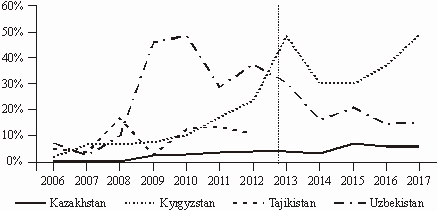
econd, the Central Asian countries’ importance as a destination for Chinese capital and as a trade partner is increasing. While the region’s share of Chinese investments is lower than that of other regions in Asia, it is growing. In some countries, this growth predates the announcement of the SREB in 2013. Beijing’s investments also represent a considerable share of these countries’ national economies. For example, China’s foreign direct investment (FDI) in Kazakhstan is equal to 12.6% of the country’s GDP.5 China alone provides 43.07% of the total FDI to Kyrgyzstan,6 44.5% to Tajikistan,7 15% to Uzbekistan.8 Figure 1 provides an overview of the share of China in total FDI flow to the region between 2006 and 2017.|
FIGURE I |
|
|
|
The dynamics of the share of China in total FDI inflow in Central Asian states (except for Turkmenistan). Sources: UNCTAD, IMF, The State Committee of the Republic of Uzbekistan on Statistics, National Statistical Committee of the Kyrgyz Republic. |
China is also a crucial trade partner with all five countries: in 2017, Beijing’s share accounted for almost 15%
9 of Kazakhstan’s total trade turnover, 21% of Uzbekistan’s, more than 35% of Kyrgyzstan’s, 44% of Tajikistan’s, and 60% of Turkmenistan’s.10 While Central Asia mainly exports mineral resources and low value added products to China, Chinese exports to the region comprise of equipment, electronics, textiles, consumer goods, and other high value-added products. Central Asia’s reliance on Chinese goods is significant. In 2017, imports from China accounted for 74.6% of Kyrgyzstan’s GDP, 18.5% of Tajikistan’s GDP, 7.3% of Kazakhstan’s GDP, 5.6% of Uzbekistan’s GDP, and 1% of Turkmenistan’s GDP.11
M
oreover, Central Asia is becoming an increasingly dynamic region. Since Uzbekistan’s unprecedented change in leadership in 2016, a process of limited political and economic liberalization has been underway to open the economy for foreign investors and businesses. In its most recent publication on Uzbekistan, the World Bank’s Doing Business project reported that the reforms are making it easier to do business in the country.12 Similarly, the recent leadership succession in Kazakhstan, while former president Nazarbayev remains the chairman of the nation’s Security Council and the head of the dominant political party, may signify further policy shifts.
T
hird, China’s interest in Central Asian states is also driven by its need for fossil fuels from the region. Since 1980, China has emerged as one of the largest consumers of non-renewable energy sources globally: its consumption of natural gas saw an almost 5-fold growth and its consumption of oil grew around six times between 2000 and 2013.13 More recently, in 2017, China surpassed the United States as the world’s largest crude oil importer14 and in the following year overtook Japan to emerge as the world’s largest importer of natural gas.15 Meanwhile, Central Asia’s energy-rich states possess abundant fossil fuels: Turkmenistan has the 6th largest reserve of natural gas in the world and Kazakhstan has the 12th largest proven reserves of crude oil.16 China’s growing demand for energy resources and Central Asia’s high capacity to satisfy it, in tandem with the geographical proximity of the two states, create perfect conditions for cooperation in the energy sector.In 1997 China and Kazakhstan agreed on the construction of an oil pipeline. Its first phase was completed in 2006 marking the beginning of the commercial operation for China’s first direct oil import pipeline.
17 In the same vein, in 2006 China and Turkmenistan signed a framework agreement for long-term supply of natural gas. In December 2009, Chinese President Hu Jintao visited Turkmenistan, where he opened the valves to inaugurate the first regional gas pipeline to China – part of the Central Asia-China gas pipeline system – along with Turkmen President Gurbanguly Berdymukhamedov, Kazakh President Nursultan Nazarbayev, and former Uzbek President Islam Karimov.18
T
his was then expanded; the second pipeline (Line B) was completed at the end of 2010, third pipeline (Line C) became operational in 2014, and the fourth line (Line D) is yet to be completed.19 Construction of Line D, which was supposed to be the largest gas pipeline out of Turkmenistan, integrating Tajikistan and Kyrgyzstan into the pipeline system, started a year after the SREB was announced. However, given multiple delays, particularly in the Uzbek segment, there has been no progress.20The Central Asia-China gas pipe-line was the first to supply natural gas to Chinese consumers from abroad and helped diversify Central Asia’s energy transport mix. Notably, the export of natural gas from Turkmenistan to China skyrocketed from less than USD 4.9 million in 2006 to USD 9.4 billion in 2014.
21 The pipeline system also served as the fulcrum of connectivity between the region and China, physically linking the latter with Turkmenistan, Uzbekistan and Kazakhstan. In 2017, Central Asian nations collectively supplied over one-fifth of China’s total petroleum gas imports: 19% from Turkmenistan (USD 5.88 billion), 1.9% from Uzbekistan (USD 587 million), and 0.46% from Kazakhstan (USD142 million).22
A
part from China’s growing economic cooperation with these countries, the question of security is also very high on Beijing’s agenda. China seeks to ensure stability in its western regions, particularly the Xinjiang Uyghur Autonomous Region (XUAR), where it is concerned about separatist movements and Islamic radicalization. China’s largest province, the XUAR shares 2,800 km of borders with Kazakhstan, Kyrgyzstan and Tajikistan. Almost half of XUAR’s population comprises of ethnic Uyghurs who are also found in the neighbouring Central Asian republics. The Uyghurs share close linguistic, cultural and religious ties with the other Turkic Muslim peoples of Central Asia.After the collapse of the Soviet Union, support for Uyghur separatist groups emerged in the newly independent Muslim states in Central Asia. At that time Beijing’s foremost priority was to build closer ties with these neighbouring states to prevent the radicalization and spread of separatist ideas.
23 Jiang Zemin was the first Chinese President to visit Central Asia in April 1996, when he signed an agreement with Kazakhstan, Kyrgyzstan and Tajikistan that included calls to oppose Islamist fundamentalism.24 From 2001 onwards, the Shanghai Cooperation Organization (SCO) emerged as the primary forum through which China coordinated with Central Asia on security issues.
A
t present, the main precondition for the BRI’s success is stabilizing these restive western regions, which in turn affects the relationship with Central Asia. Between 2012 and 2015, up to 4000 people from Central Asia travelled to the Middle East to join radical Islamist radical groups, particularly the Islamic State (IS).25 Increasingly worried about the spread of radical Islam in the region, Beijing has turned XUAR into one of the most heavily policed areas in the world.26 In Central Asia, mounting concerns about the treatment meted out to Muslims in Xinjiang, coupled with high economic dependence, have led to growing anti-Chinese sentiments, which culminated in three protests in the Kyrgyz capital, Bishkek’s central square, at the end of 2018.27
A
s a response to growing radicalization in Central Asia, China has also increased its military cooperation with states in the region. Since 2002, the Chinese People’s Liberation Army (PLA) has also participated in over 20 bilateral and multilateral military exercises with the Central Asian republics.28 Since 2014, China’s arms sales to the region stand at 284 million29 and includes unmanned aerial vehicles, personnel carriers, air defence missiles, and air search radars. Reports suggest that China may establish military bases in the region over the next five years to ensure stability in Central Asia.30 Earlier this year, The Washington Post published details regarding an alleged Chinese military base along the Tajik-Afghan border.31 However, the government of Tajikistan claims that this is a ‘border post for Tajik troops built [with] Chinese money.’32A major concern for the BRI’s participant states is whether China employs ‘debt-trap diplomacy’ or, in other words, leverages the debt dependence of developing countries to gain geopolitical influence. When government borrowing is not supported by enough capacity to service the debt, it can generate a downward spiral that inevitably ends in the need for debt restructuring, reduction, or in the worst case, loss of economic sovereignty. This problem came into sharp focus after the Sri Lankan government ceded control over its Hambantota port to Beijing in exchange for a USD 1.1 billion debt write-off in 2017.
33 Since then, countries such as Bangladesh, Malaysia, Myanmar, Pakistan and Sierra Leone have cancelled or sought to renegotiate BRI projects due to fears related to the costs of their debts.34
|
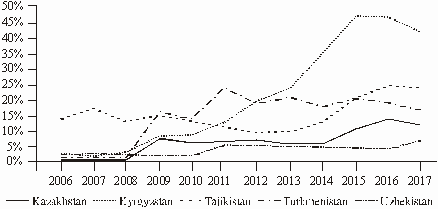
FIGURE II |
|
|
|
The dynamics of CA countries’ stocks of external debt to China as a percentage of their GDP. Source: Council on Foreign Relations. |
A
ccording to the Centre for Global Development, there are two countries in Central Asia with a high debt risk, stemming from BRI projects. From 2007 to 2016, 40% of Kyrgyzstan’s total external debt is owed to China’s Exim Bank. Similarly, Tajikistan’s debt to China accounted for almost 80% of the total increase in its external debt.35 In 2017, its total gross external debt was estimated at 67.9%, over 1/3rd of which was provided by China.36 Tajikistan cannot rely on the export of natural resources to sustain a high level of external debt due to its large trade deficit.37 Resource-for-infrastructure deals, therefore, offer an alternative for Dushanbe. In 2009, TBEA, a Chinese manufacturer of power transformers, signed an MoU with Tajikistan for the construction of a power plant in Dushanbe. In return, the Tajik government granted TBEA license to explore and develop gold deposits at two mines.38
C
oncerns about Chinese debt are also rooted in its opaque bilateral lending practices. In Kyrgyzstan, two former prime ministers, Sapar Isakov and Jantoro Satybaldiev, were arrested in 2018 on corruption charges related to a USD 386 million contract, using Chinese credit to TBEA, for modernizing a power plant in Bishkek. The case was launched after an accident at the plant left thousands without heat for several days in the winter of 2017.39
O
n the other hand, while Turkmenistan is not indebted to China, it depends on Chinese imports of natural gas, particularly for foreign currency. The rapid fall in oil and gas prices from 2014 onwards set off a currency crisis in Turkmenistan. By 2016 the average price of gas exported to China fell to USD 228 per 1,000 m3, which was USD 100 less than the previous year.40 This was alarming since almost all of Turkmenistan’s petroleum gas exports were sent to China.41 Ashgabat has passed the burden of its economic problems onto its population, which threatens social and political stability in the country.China is not the first country to come up with the idea of ‘rebirthing’ the Great Silk Road. The Soviet Union shared this ambition, but it never materialized.
42 In the post-Soviet era, Central Asia has traditionally formed part of Russia’s sphere of influence and, since 2015, its concept of a ‘Greater Eurasia’ from Murmansk to Shanghai.43 However, Russian leverage in the region hasn’t been absolute.
E
conomically, Russia does not have much to offer the region because of incompatible trade structures – both rely on the export of fossil fuels and raw materials. Further, Russian investments in the region have not focused on developing the manufacturing sector and high value-added industries, which strengthens their specialization in primary product export. However, the region relies on Moscow for employment opportunities. In 2018, almost 70% labour migrants in the Russian Federation were from Central Asia.44 Remittances from these workers amount to 35% of Tajikistan and Kyrgyzstan’s gross domestic product.45 Politically, Moscow’s geopolitical ambitions, particularly its annexation of Crimea, have caused consternation across the region. In Kazakhstan, for instance, authorities are now wary of disloyalty by ethnic Russians, who make up a fifth of the total population.46
I
n 2015, a Kazakh blogger was sentenced to five years imprisonment for posting a poll on social media, which asked if eastern Kazakhstan should become a part of Russia.47 The Crimea crisis, which was followed by the devaluation of the ruble, had another consequence. It contributed to a decrease in the number of Central Asian labour migrants, for the first time since 2009, from 2014 onwards. Nevertheless, Russia remains the leading destination for immigrants from the region.48In 2011, former U.S. Secretary of State Hillary Clinton proposed a ‘New Silk Road’ initiative to develop regional connectivity and trade between Central Asia and South Asia, through Afghanistan. This has since failed with the initiative having been under-funded and under-staffed.
49 On the other hand, China has been able to translate ambition into action. Chinese rhetoric about the BRI has focused on ‘win-win’ solutions and the concept of ‘cooperation’, rather than the assistance it provides. Unlike western assistance, Chinese aid and investment are not accompanied by political conditions related to governance, human rights and other issues, making it more attractive for the authoritarian states in the region.50
F
urther, Chinese policy in Central Asia mostly relies on bilateral agreements – instead of cooperation through multilateral institutions – which makes each state feel valued. Highlighting equality and partnership has thus been one of the keys to the BRI’s comparative success in Central Asia, with countries in the region perceiving themselves as partners in the initiative. Kazakhstan, responding proactively, integrated its own infrastructure development programme ‘Nurly Zhol’ into the SREB.51 Despite the stark differences between Beijing’s and Nur-Sultan’s economic and political weights, the latter isn’t a passive participant in China’s project. Despite their high debt risk, Kyrgyzstan and Tajikistan perceive the SREB as the primary source of resources – loans, direct investments and technology transfers – for socio-economic development.52 Turkmenistan’s primary interest in the SREB is the development of its energy reserves. Uzbekistan, for its part, expects Chinese recognition of its ambitions for regional leadership. When this is absent, Tashkent becomes somewhat indifferent.53After Shavkat Mirziyoyev succeeded to the Uzbek presidency in 2016 and undertook efforts to promote regional cooperation, international interest in Central Asia’s potential to emerge as a transit hub grew and platforms for cooperation with the region gained greater traction. This includes Japan’s ‘Central Asia plus Japan’ dialogue,
54 India’s ‘Connect Central Asia’ policy,55 the United States’ ‘C5+1’ platform,56 the European Union’s Strategy on Central Asia57 and, most recently, South Korea’s ‘Eurasia Initiative’.58 The European Union’s renewed regional strategy focuses primarily on security and stability, supporting the initiatives of individual Central Asian nations to combat poverty and develop regional cooperation in energy, transportation, higher education and environmental protection.59
J
apan has its own dialogue model, ‘Central Asia plus Japan’,60 South Korea has its ‘Eurasia Initiative’, India – its ‘Connect Central Asia’ policy,61 as well as Turkey has its own multi-lateral projects.62 However, none of these players have enough financial resources or the willingness to provide Central Asian states with credit, investments and grants.This growing international interest provides an opportunity for Central Asian countries to balance the major external actors. While President Mirziyoyev’s first state visit outside the region was to Russia, he was also the first Uzbek president to visit the United States in May 2018. When Kassym-Jomart Tokayev took charge as Kazakhstan’s interim president earlier this year, his first state visit was also to Russia. Moscow remains a key partner for nations in the region because, while Beijing provides much-needed capital, the former offers jobs. Central Asia also looks toward Russia to hedge against Chinese dominance in the region.
Nevertheless China, given the scale of its economic ties with Central Asia, will continue to play a major role in the development of the region. Rising Sinophobia among people in the region – driven by the plight of China’s Uyghurs, increasing debt burden, lack of transparency in Chinese projects, and the influx of Chinese workers – remains a cause for concern. However, for states in the region, China seems to be the ideal partner for cooperation. Beijing is increasingly welcomed in the region, given the complementary nature of their economies and similarities in their authoritarian political systems, thereby furthering Xi Jinping’s ambition to revive the Great Silk Road.
Footnotes:
1. For information, see Dmitry Voyakin, ‘The Great Silk Roads’, UNESCO. https: //en. unesco.org/silkroad/content/great-silk-roads
2. Igor Denisov, ‘China’s Belt and Road Project: What’s at Stake for Xi Jinping’, Carnegie Moscow Centre, 25 May 2017. https://carnegie.ru/commentary/70096
3. Krzysztof Iwanek, ‘The New Silk Road is Old: Why You Should Ignore Belt and Road Initiative Maps’, The Diplomat, 25 May 2018. https://thediplomat.com/2018/05/the-new-silk-road-is-old-why-you-should-ignore-belt-and-road-initiative-maps/
4. ‘The Growth in Container Transportation in the China-Europe-China Route is Ensured by the Effort of Seven Railways’, TLK Media, 4 April 2019. https://bit.ly/2K3GbGD
5. ‘World Investment Report, Kazakhstan’, UNCTAD, 6 June 2018. https://unctad.org/sections/dite_dir/docs/wir2018/wir18_fs_ kz_en.pdf
6. ‘Investments’, National Statistical Committee of the Kyrgyz Republic, n.d. http://www.stat.kg/ru/statistics/investicii/
7. Benn Steil and Benjamin Della Rocca, ‘Belt and Road Tracker’, Council on Foreign Relations, 8 May 2019. https://www.cfr.org/article/belt-and-road-tracker
8. ‘Investments in Fixed Capital’, The State Committee of the Republic of Uzbekistan on Statistics, 2017. https://stat.uz/uploads/docs/investitsiya-yan-dek-2017en2.pdf
9. ‘Kazakhstan Trade Statistics’, WITS. https://wits.worldbank.org/CountryProfile/en/KAZ
10. Alexander Simoes, ‘The Observatory of Economic Complexity’, n.d. https://atlas. media.mit.edu/en/
11. Benn Steil and Benjamin Della Rocca, op. cit., fn. 7.
12. ‘Doing Business 2019, Economy Profile, Uzbekistan’, World Bank. http://documents. worldbank.org/curated/en/19592154158 9470772/pdf/131866-WP-DB2019-PUBLIC-Uzbekistan.pdf
13. ‘China, Country Page’, U.S. Energy Information Administration, n.d. https://www.eia.gov/beta/international/country. php?iso=CHN
14. Jeff Barron, ‘China Surpassed the United States as the World’s Largest Crude Oil Importer in 2017’, U.S. Energy Information Administration, 31 December 2018. https://www.eia.gov/todayinenergy/detail.php?id=37821
15. Jessica Jaganathan, ‘China Overtakes Japan as World’s Top Natural Gas Importer’, Reuters, 12 November 2018. https://www. reuters.com/article/china-japan-lng/china-overtakes-japan-as-worlds-top-natural-gas-importer-idUSL4N1XN3LO
16. U.S. Energy Information Administration. https://www.eia.gov/beta/international/
17. ‘Kazakhstan-China Oil Pipeline Opens to Operation’, Xinhua (archived version), 11 July 2006. https://web.archive.org/web/20160303174209/http://news3. xinhuanet. com/english/2006-07/12/content_4819484.htm
18. ‘Hu Jintao Attends the Inauguration Ceremony of the China-Central Asia Natural Gas Pipeline’, Embassy of the People’s Republic of China in the Democratic Republic of Timor-Leste, 14 December 2009. http://tl.chinese embassy.org/eng/xwdt/t645828.htm
19. ‘The Central Asian Gas Pipeline’, South China Morning Post. https://multimedia. scmp.com/news/china/article/One-Belt-One-Road/gasPipeline.html
20. ‘Uzbekistan Puts Off Pipeline to China’, Interfax, 21 December 2015. http://inter faxenergy.com/gasdaily/article/18726/uzbekistan-puts-off-pipeline-to-china; ‘Turkmenistan Sees Light at the End of the Tunnel’, Petroleum Economist, 10 June 2019. https://www.petroleum-economist.com/articles/upstream/exploration-production/2019/turkmenistan-sees-light-at-the-end-of-the-tunnel
21. ‘China Product Import from Turkmenistan’, WITS. https://wits.world bank. org/CountryProfile/en/Country/CHN/StartYear/2000/EndYear/2017/TradeFlow/Import/Indicator/MPRT-TRD-VL/Partner/TKM/Product/all-groups
22. ‘Where Does China Import Petroleum Gas From?’ OEC. https://atlas.media.mit.edu/en/visualize/tree_map/hs92/import/chn/show/2711/2017/
23. Michael Clarke, ‘The Impact of Ethnic Minorities on China’s Foreign Policy: The Case of Xinjiang and Uyghur’, China Report 53(1), 2017, pp 1-25. https://doi.org/10. 1177%2F0009445516677361
24. Martha Brill Olcott, ‘China’s Unmatched Influence in Central Asia’, Carnegie Endowment for International Peace, 18 September 2013. https://carnegieendowment.org/2013/09/18/china-s-unmatched-influence-in-central-asia-pub-53035
25. ‘Syria Calling: Radicalization in Central Asia’, International Crisis Group, 20 January 2015. https://www.crisisgroup.org/europe-central-asia/central-asia/syria-calling-radicalisation-central-asia
26. Lucas Niewenhuis, ‘Re-Education Camps in China’s "No-Rights Zone" For Muslims: What Everyone Needs To Know’, Sup China, 22 August 2018. https://supchina.com/2018/08/22/xinjiang-explainer-chinas-reeducation-camps-for-a-million-muslims/
27. Olga Dzyubenko and Olzhas Auyezov, ‘Kyrgyz Police Disperse Anti-Chinese Rally’, Reuters, 17 January 2019. https://www.reuters.com/article/us-kyrgyzstan- protests-china/kyrgyz-police-disperse- anti-chinese-rally-idUSKCN1PB1LJ
28. Roman Muzalevsky, ‘China’s Long March Into Central Asia’, Stratfor, 27 April 2016. https://worldview.stratfor.com/article/chinas-long-march-central-asia
29. Stockholm International Peace Research Institute’s trend-indicator value (SIPRI TIV) – system to measure the volume of international transfers of major conventional wea-pons. For more information, see ‘Trade Registers’, SIPRI. http://armstrade.sipri.org/armstrade/page/trade_register.php
30. https://jamestown.org/program/china-will-have-military-bases-in-central-asia-within-five-years-russian-expert-says/
31. Gerry Shih, ‘China’s Long March Into Central Asia’, The Washington Post, 18 February 2019. https://www.washingtonpost. com/world/asia_pacific/in-central-asias-forbidding-highlands-a-quiet-newcomer-chinese-troops/2019/02/18/78d4a8d0-1e62-11e9- a759-2b8541bbbe20_story.html
32. ‘Tajikistan Responded to the Accusations of Deploying a Chinese Military Base’, Fergana Agency (in Russian), 21 February 2019. https://fergana.agency/news/105366/
33. Kai Schultz, ‘Sri Lanka, Struggling With Debt, Hands a Major Port to China’, The New York Times, 12 December 2017. https://www.nytimes.com/2017/12/12/world/asia/sri-lanka-china-port.html
34. Nyshka Chandran, ‘Fears of Excessive Debt Drive More Countries to Cut Down their Belt and Road Investments’, CNBC, 17 January 2019. https://www.cnbc.com/2019/01/18/countries-are-reducing-belt-and-road-investments-over-financing-fears.html
35. John Hurley, Scott Morris and Gailyn Portelance, ‘Examining the Debt Implications of the Belt and Road Initiative from a Policy Perspective’, Center for Global Development, March 2018. https://www.cgdev.org/sites/ default/files/examining-debt-implications-belt-and-road-initiative-policy-perspective.pdf
36. https://www.cfr.org/article/belt-and-road-tracker
37. Tajikistan, The Economic Complexity Observatory. https://oec.world/en/profile/country/tjk/#Trade_Balance
38. Dirk van der Kley, ‘The Full Story Behind China’s Gold Mine-Power Plant Swap in Tajikistan’, The Diplomat, 14 April 2018.
39. Elnura Alkanova, ‘Abuse of Power? On the Trail of China’s Mystery Millions in Kyrgyzstan’, Open Democracy, 24 October 2018. https://www.opendemocracy.net/en/odr/what-happened-at-bishkek-power-plant/
40. ‘China Figures Reveal Cheapness of Turkmenistan Gas’, Eurasianet, 31 October 2016. https://eurasianet.org/china-figures- reveal-cheapness-turkmenistan-gas
41. ‘Where Does Turkmenistan Export Petroleum Gas to?’ OEC,https://atlas.media. mit.edu/en/visualize/tree_map/hs92/export/tkm/show/2711/2017/
42. The Institute for Advanced Studies in Levant Culture and Civilization, Centre of Excellence of the World Academy of Art and Science. https://institutlevant.ro/en/through-cultural-diplomacy-towards-a-sustainable-peace/the-revival-of-the-silk-road-the-levantine-bridge-between-asian-and-western-civilizations/
43. David G. Lewis, ‘Geopolitical Imaginaries in Russian Foreign Policy: The Evolution of "Greater Eurasia"’, Europe-Asia Studies 70(10), 2018, pp. 1612-1637. https://doi.org/10.1080/09668136.2018.1515348
44. ‘Migration Situation in the Russian Federation’ (in Russian), Ministry of Internal Affairs of the Russian Federation, 24 January 2019, https://xn-b1aew.xn-p1ai/Deljatelnost/statistics/migracionnaya/item/15851053/
45. Saviya Khasanova, ‘Remittances in Europe and Central Asia Showed a Record Recovery in 2017’ (in Russian), Central Asia Analytical Network, 7 May 2018. https://caa- network.org/archives/13116
46. Olzhas Auyezov, ‘After Ukraine, Kazakhstan Wary of Ethnic Russians Broaching Autonomy’, Reuters, 3 March 2016. https://www.reuters.com/article/us-kazakhstan-russia/after-ukraine-kazakhstan-wary-of-ethnic-russians-broaching-autonomy- idUSKCN0W51MY
47. ‘Kazakhstan Sentenced Pro-Russian Blogger to 5 Years for Stirring "Separatism" on Social Media’, Jimmy Wales Foundation, 19 November 2015. http://jimmywales foundation.org/kazakhstan-sentenced- pro-russian-blogger-to-5-years-for-stirring-separatism-on-social-media/
48. https://bit.ly/2P0k9VE
49. https://www.scmp.com/news/china/diplomacy-defence/article/2092218/lessons-china-failed-us-silk-road-initiative
50. Aijan Sharshenova and Gordon Crawford, ‘Undermining Western Democracy Promotion in Central Asia: China’s Countervailing Influences, Powers and Impact’, Central Asian Survey 36(4), 2017, pp 453-472. https://doi.org/10.1080/02634937.2017.1372364
51. Assel G. Bitabarova, ‘Unpacking Sino-Central Asian Engagement Along the New Silk Road: A Case Study of Kazakhstan’, Journal of Contemporary East Asia Studies 7(2), 2018, pp 149-172. https://doi.org/10.1080/24761028.2018.1553226
52. Raffaello Pantucci and Sarah Lain, ‘Perception Problems of the Belt and Road Initiative from Central Asia’, Whitehall Papers 88(1), 2016, pp 47-55. https://doi.org/10. 1080/02681307.2016.1274608
53. Paul Stronksi, ‘On Central Asia’s Big Questions’, The Diplomat, 20 November 2018. https://thediplomat.com/2018/11/paul-stronski-on-central-asias-big-questions/
54. ‘Central Asia Plus Japan Dialogue/Foreign Ministers Meeting – Relations Between Japan and Central Asia Enter a New Era’, Ministry of Foreign Affairs of Japan, 21 August 2004. https://www.mofa.go.jp/ region/europe/dialogue/press0408.html
55. Martand Jha, ‘India’s Connect Central Asia Policy’, The Diplomat, 2 December 2016. https://thediplomat.com/2016/12/indias-connect-central-asia-policy-2/
56. ‘C5+1 Fact Sheet’, U.S. State Department, 22 September 2017. https://www.state. gov/c51-fact-sheet/
57. Rafael Sattarov, ‘A Needless Rivalry? Russia and the EU in Central Asia’, Carnegie Moscow Centre, 11 April 2018. https://carnegie.ru/commentary/76038
58. Kim Taehwan, ‘Beyond Geopolitics: South Korea’s Eurasia Initiative as a New Nordpolitik’, Open Forum, 16 February 2015; http://www.theasanforum.org/beyond-geopolitics-south-koreas-eurasia-initiative-as-a-new-nordpolitik/
59. Martin Russell, ‘The EU’s New Central Asia Strategy’, European Parliamentary Research Service, January 2019. http://www. europarl.europa.eu/RegData/etudes/BRIE/2019/633162/EPRS_BRI(2019) 633162_ EN.pdf
60. ‘"Central Asia plus Japan" Dialogue’, Ministry of Foreign Affairs of Japan, 18 May 2019. https://www.mofa.go.jp/region/europe/dialogue/index.html
61. Martand Jha, ‘India’s Connect Central Asia Policy’, The Diplomat, 2 December 2016. https://thediplomat.com/2016/12/indias-connect-central-asia-policy-2/
62. For more information about Turkey’s projects with Central Asian states go to the official website of the Republic of Turkey Ministry of Foreign Affairs. http://www.mfa. gov.tr/sub.en.mfa?3eefbf43-15c9-4ad7-8572-7a9fd7940659