From Glimpses of Bengal
UMA DAS GUPTA
My feelings as I sit in this boat in the noon-time all alone, in fact the idle hiatus of this entire day, will barely rate a mention in the pages of my biography. But won’t this solitary afternoon on the desolate sandbanks of the motionless Padma leave a small golden mark on my infinite past and future?
– Rabindranath Tagore
27 February 1895, Shelidah, East Bengal
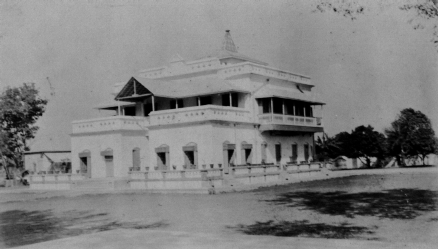
IN the years 1889-1900 Rabindranath Tagore spent more time on the river than on land. The river was the mighty Padma, a tributary of the Ganga. Rabindranath was 28 years old when his father Debendranath Tagore sent him to take charge of the Tagore family estates. These were agricultural estates that sprawled over large tracts along the river Padma in East Bengal and also up in the Cuttack district of Orissa.
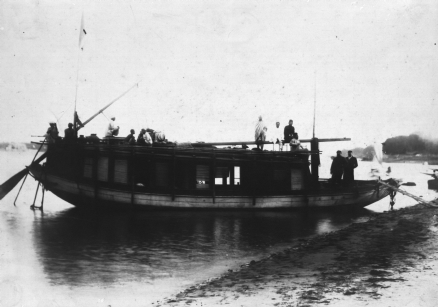
Tagore was stationed in the zamindari headquarters at Shelidah but travelled to the other estates in the family houseboat called the ‘Padma Boat’ stationed at Shelidah. That was how he came to live along a river and observe rural life closely, through a decade. Everything he saw of this life attracted him. Even seeing the calves frisking their tails as they trotted home at the end of their grazing day.
By his own admission the sites of the banks especially fascinated him, even the most unremarkable of them as he himself put it. Writing from Shelidah in 1888 Rabindranath described the sandbank surrounding his houseboat:
‘Our boat is moored to a sandbank on the farther side of the river. A vast expanse of sand stretches away out of sight on every side, with here and there a streak, as of water, running across, though sometimes what gleams like water is only sand.
Not a village, not a human being, not a tree, not a blade of grass – the only breaks in the monotonous whiteness are gaping cracks which in places show the layer of moist black clay underneath.
Looking towards the East, there is endless blue above, endless white beneath. Sky empty, earth empty too – the emptiness below hard and barren, the overhead above arched and ethereal. One could hardly find anywhere such a picture of stark desolation.
But on turning to the West, there is water, the current-less bend of the river, fringed with its high bank, up to which spread the village groves with cottages peeping through – all like an enchanting dream in the evening light. I say "evening light" because in the evening we wander out, and so that aspect is impressed on my mind.
How extraordinary and beautiful our world really is: something easy to forget in Calcutta. When the sun sets each evening behind the peaceful trees along this small river, high above the boundless expanse of sand thousands and thousands of stars suddenly appear – you have to see it to happen to grasp its wonder.’
I
n another letter he observed, ‘I have been floating along all day. The strange thing is that however many times I travel this route, or indeed any route by boat, the fact of passing between two banks gives me unique satisfaction – unrecapturable once I have been on land for a day or two. Not that the view is always fascinating: it might be of a yellowish sandbank, destitute of grass or tree, stretching away to the horizon with an empty boat tied to its edge and bluish water reflecting a dull sky flowing past: yet even this moves me strangely.’Sensations from the rivers moved Tagore frequently. He wrote for example:
‘Every morning, when I open my eyes, I see water to my left and the river bank to my right, flooded in sunshine. When we look at a painting we often think: if only I could live there! This place satisfies that kind of longing; I feel as if I am dwelling in a refulgent landscape without any of the hard edges of the real world.’
He also vividly wrote of another experience:
‘Last night the river woke me with a violent bubbling that made the boat billow in the swell – probably the inrush of a freshet: a thing that happens almost daily in this season. As I sat listening I suddenly had the impression that the whole river was alive and highly agitated. Through the planks at my feet I could clearly sense the gamut of ceaseless movement below: tremors, quakes, upheave and downturn, as if I were taking the river’s palpitating pulse. The disturbance must have been quite something to set the water racing so wildly.
For a long time I sat on a bench beside the window. Outside was a hazy light that made the excited river look even madder. The sky was spotted with clouds. The reflection of a particularly bright star glimmered on the waters like a gash of agony. Both banks were dim and drowsy with slumber but between them surged an insomniac restlessness, drunk and disoriented.
To wake up to such a scene in the small hours is to be given a new idea of oneself and the world; the normal intercourse of daytime seems false. And yet when I rose this morning that shadowy night-world seemed remote and insubstantial. Both worlds are real, though extraordinarily different.’
W
e read these descriptions and sentiments in a series of letters that Tagore wrote to his niece, Indira, his second brother’s daughter. She was the same age as him. These letters were later published in a celebrated volume with the title Chhinyo Patro meaning fragmented letters. A good number of them were translated into English and published as Glimpses of Bengal, Selected Letters.|
|
|
Tagore family estate house in Shelidah, East Bengal. Courtesy: Rabindra-Bhavana Archives, Visva-Bharati University, Santiniketan. |
H
e wrote for example about how he saw nature at her fiercest:‘I had been on deck sitting for a quarter of an hour when fierce looking clouds appeared in the west. They were dark and dishevelled, flushed here and there by streaks of lurid light. The few boats in the vicinity quickly scurried off into nearby arms of the river and anchored themselves to solid ground. The people in the fields cutting the harvest put sheaves on their head one by one and hurried away, followed by the cows and the calves frisking their tails as they trotted home.
Not long after came an angry roar; scraps of cloud flew up from the far west like desperate bearers of bad tidings from a battlefield, and then lightning, thunder, wind and water, began to execute a mad dervish dance. Clumps of bamboo seemed to howl as they wallowed, now to the east, now to the west, while above them the storm droned like a giant snake-charmer’s pipe, and to its rhythm swayed hundreds and thousands of crested waves, like so many hooded snakes. The clash of thunder was unceasing, as though a whole world was being pounded to smithereens beyond the clouds.
With my chin resting on the ledge of an open window of the boat, I let my thoughts join in the terrible revelry of Lord Shiva the Destroyer.’
He also wrote of how he saw nature at its gentlest: ‘From the bank against which our boat is moored wafts in the scent of a certain grass and the warmth of the ground. The breath of the living earth seems to blow over me, and I believe she must feel my own breath in return.’
T
agore was drawn to the ‘flowing’ river. He wrote, for example, from a small river called the Ichhamati which was a part of his regular journeys:‘I am gliding along the winding Ichhamati. It is whimsical in the rainy season, lined with green and sloping ghats, dense patches of kash reeds, fields of jute and sugarcane, and villages – almost like a few lines of some poem that I have read many times and grown to love. A big river like the Padma is too big to memorise, but this meandering streamlet flows to the refrain of the rainy season and I have gradually made it my very own.
The sky is dark with clouds, thunder is rumbling, and stormy gusts are swaying the tamarisks on the banks. The interiors of the bamboo clumps are inky-black, and over the water glimmers a pale twilight like a weird portent.
I bend over my letter, alone in the dimness, while a freakish wind flutters and scatters my papers. I want to write something that will celebrate the excitement of the rains, a letter in keeping with the penumbra that softly and sensitively enfolds me. But this remains only a wish: easily thought but difficult to execute. Such wishes either fulfil themselves or never come true. It is easy to gear oneself for a battle, but not for a quiet chat.’
|
|
|
Tagore family’s Padma boat. Courtesy: Rabindra-Bhavana Archives, Visva-Bharati University, Santiniketan. |
I
n another letter he wrote: ‘Sometime back we left the little river of Kaligram, as sluggish as the pulse of a dying man, and gradually picked up speed in the current of a new stream. It led to a region where land and water seem to merge into each other, where bank and river look akin, like brother and sister in infancy. Earth and water lie side by side; there is no dividing line. The river has lost its slimness and split into various channels, eventually fanning out into a marshy bil with green clumps of grass and transparent stretches of water interspersed. It reminded me of the planet’s youth when land had just raised its head above the waters but its separate domain had yet to be established.’
T
agore did not like the standstill water of, let’s say, a canal. He could imagine the ‘past’ in a river, but not in a canal. ‘The murmur of the waters does not speak of past ages’, he wrote, and explained himself further:‘The landing ghat at Balia is a real picture, with its fine trees on either side. The canal here reminds me somehow of our small river in Pune. When I think this over, however, I should have liked the canal much better had it really been a river. Coconut palms, mango trees and other kinds of shady tree lines, its banks that slope gently down to the water under a carpet of green grass thickly sprinkled with mimosa flowers, groves of screw-pine are everywhere. Where the trees thin out a bit, I catch glimpses of immense fields lying flat to the horizon, the emerald of their rainy season crops so soft and rich that the eyes seem to sink into the colour, and in the midst of them little villages sheltering beneath coconut and date palms; the whole scene being shadowed by the dark clouds of the monsoon. Through it the wandering canal gracefully glides between clean, grassy banks. Its current is gentle and, where it narrows, lotuses and banks of reeds cluster.
Yet the mind keeps fretting that what it sees is nothing but a canal, cut off from the land. The murmur of the waters does not speak of past ages; they know of no mysterious origin in some remote uninhabited mountain cave that have not flown since ancient times bearing an old-world feminine name while giving succour to the villages on either side. And they cannot babble, "Men may come and men may go, but I go on forever". Even the larger and the older of the artificial lakes enjoy a greater dignity.’
Tagore was of the view, ecologically and historically, that land and water were at loggerheads with each other from time immemorial. About this he wrote:
‘The unsheltered ocean heaves and heaves and blanches into foam. It reminds me of some great sightless monster straining at its bonds, watched unconcernedly by men, who build their dwellings beside its open jaws. We sail it as if we were riding a lion and pulling on its mane, but the ocean is not so helpless – with one mighty fling it can wipe us out. What immense strength! Waves that swell like the muscles of a giant!
From the beginning of creation there has been this feud between land and water: the dry earth slowly and silently adding to its domain and spreading a broader and broader lap for its children; the ocean receding step by step, heaving and sobbing and beating its breast in despair. Remember the sea was once sole monarch, utterly free. Land rose from its womb, usurped its throne, and ever since then the maddened old creature, with its hoary crest of foam, wails and laments continually like King Lear exposed to the fury of the elements.’
Sources:
Rabindranath Tagore, Glimpses of Bengal: Select Letters, 1885-1895. Calcutta, 1920.
Rabindranath Tagore, Glimpses of Bengal, Selected Letters by Rabindranath Tagore. Translated by Krishna Dutta and Andrew Robinson with an introduction by Andrew Robinson. Papermac, London, 1991.
[For ArtEast Festival, NFI-IIC, New Delhi, Panel Discussion on 15.3.2019]