The tailor who solved the riddle of the Tsangpo
PARIMAL BHATTACHARYA
AT the turn of the 20th century, Darjeeling was sometimes called the queen of hill stations. Proximity to Calcutta, the capital of British India, and a light mountain railway, had helped it gain fame and size. Pretty bungalows and villas had come up on both sides of the ridge; electricity had come; the Rink Theatre, clubs and a race course had been built. For half the year, the hill town would buzz with the lively sahib-mems and their babalogs; busy jhampani bells would jingle along deodar-lined paths all day long; in the afternoon the Mall would erupt with the flourish of regimental bands and the summer nights would echo with laughter and twinkling rickshaw lamps. The age of Queen Victoria had ended, the corset of prudishness had been loosened, the air was balmy with the promise of exciting new times. Englishwomen in India had done away with their crinolines and stays, and had learnt to ride bicycles and experiment with new dress designs. Darjeeling’s darzi mohulla was flooded with cheap American-made sewing machines, the old needle smiths there were losing jobs.
|
|
|
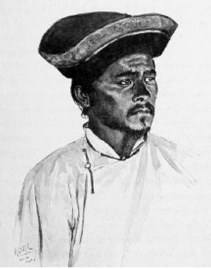
Kinthup |
In a tiny shop tucked away in this mohulla, an old tailor had been desperately clinging on to his profession. Years of hemming and darning in dimly lit shops had sapped his eyesight. This had pushed him to other errands. He now went to the bungalows around town to take measurements of the memsahibs. The ladies felt at ease as they appeared in the thinnest of vests and knickers before this doddering old man, who couldn’t even read the measuring tape as he held it around their chests and hips, and had to be told the numbers.
But the memsahibs didn’t know the old man couldn’t read. They also didn’t know he had a monstrous memory that hadn’t left him even in old age. They’d write down the measurements on scraps of paper and hand it to him, but that really wasn’t necessary. The old man would return to the master tailor, carrying in his head the numbered contours of half-naked female bodies, just as he had returned to town many years ago carrying the shapes of spurs, hills and forested valleys in a distant land.
In the afternoon the bazaar would fall quiet. The jhampani stand near the railway station would grow somnolent and wait for the four o’clock up train from the plains. The bell in the clock tower would strike the hour of three. As the tireless rattle of sewing machines echoed in the old man’s ears, the needle in his fingers would freeze, the spinning steel bobbins would be transformed into the murmur of a waterfall. It was a fall that cascaded down a sheer cliff face into a silent abyss. Clouds of mists billowed up from the depths, with a rainbow shimmering on them, and tiny scarlet mini-vets darting about to catch waterborne insects. He’d wake up from the reverie with a start, it would all seem to be the memory of a past life.
One such drowsy afternoon the tailors’ mohulla was roused by the thud of heavy military boots. The busy hands stopped mid-stitch, some even rose to foreheads to salute the handsome young officer in a khaki tunic and a blue silk scarf neatly folded around his neck. The sahib officer didn’t look anywhere but strode straight into the lane until he stopped at the shop where the old tailor worked. Seeing him at the door, the old man slowly rose to his feet, narrowed his eyes as if he was trying to thread a needle, and called forth all the lines on his face. The officer had cold blue eyes, a walrus moustache, and a revolver in his belt. He stood there for a few seconds with arms akimbo, sizing up the doddering old man, and then said in a gruff voice, ‘Kinthup, you cheat! Gimme the big waterfall!’
T
he old man shrank in fear, his face took on the pallor of death. By then, a small crowd had gathered behind the sahib. All the sewing machines stopped and a breathless silence fell over the darzi mohulla.‘I did find the rainbow, but not the big waterfall!’ the officer said. ‘Where did you hide it, old man?’
Frequent errands to the bungalows had given the old man a smattering of English. He now began to stutter: ‘I… Sahib… no waterfall… I poor tailor, Sahib!’
A mysterious smile was fluttering below the officer’s moustache, like a butterfly struggling out of a cocoon. Now it burst across his face. He guffawed, lunged forward and took the old man in his muscular arms. He shook the gaunt stunned shoulders and shouted in his ears, ‘Tsangpo is Dihang! Kinthup, you were bang on! By Jove, Tsangpo is Dihang!’
The crowd of people witnessing the scene couldn’t make out what was happening, but seeing the sahib embracing the old man they clapped enthusiastically.
Now the sahib joined them in clapping. He, Colonel Frederich Marshman Bailey, pulled the blue scarf off his neck and garlanded the old man with it.’
B
y the 1870s, thanks to the intrepid spies who were sent to Tibet disguised as Buddhist monks and pundits, the British government in India had more or less mapped the topography of the forbidden kingdom on the roof of the world. But a riddle had remained unsolved: it was the course of a mysterious river. Originating at 24,000 feet in western Tibet, the river, known as Tsangpo and Yarlung Tsangpo, takes an easterly course until it enters an impenetrable gorge. And then, within a span of 200 miles, it plunges 9,000 feet and debouches into the plains of Assam. The river is then known as Dihang and Brahmaputra. No other river in the world descends so dizzyingly steep a gradient with such a volume of water.For long, geographers had suspected that Tsangpo and Brahmaputra was the same river, but nothing could be proved conclusively until someone had actually explored the gorge enclosed by towering, almost vertical cliffs. The forbidding topography, politically sensitive frontier and the warlike tribes who inhabited the region made this a difficult, high-risk job. But the mystery was too intriguing to let go. In 1880, the Survey of India picked up a 30-something Lepcha man, an illiterate tailor from Darjeeling, for the job. His name was Kinthup, and he had accompanied a pundit-spy to Tibet on an earlier assignment.
This time Kinthup was sent disguised as the servant of a Mongolian lama who was then camping in Darjeeling. But on entering Tibet, he had a series of harrowing experiences. The lama turned out to be a lazy debauch; he abused Kinthup, and finally sold him to a village chief and vanished. The wretched tailor worked for many months as a slave until he escaped, was caught, and then bought again by the abbot of a monastery in Marpung.
But during the series of misadventures, Kinthup never forgot his assignment. He mapped the river into the Tsangpo gorge as far as he could and, since he couldn’t read or write, stored all the topographical data in his memory. Now he prayed for, and was granted, leave from the monastery to fulfil his final objective. He carved five hundred wooden sticks, tied specially marked seals given to him by the Survey of India, and tossed them into the swift-flowing river. Before that he had sent a letter through a Sikkimese merchant in Lhasa to the Survey of India office, detailing the dates of his tossing. The plan was this: men were to be posted at places on Brahmaputra and, if a single stick could be recovered, it would have solved the mysterious course of the river.
His job done, Kinthup returned to Darjeeling after four years, only to find the officer who sent him on the secret assignment had died. The letter had never reached the Survey of India office, the sticks had floated away unobserved, and nobody was ready to give much credence to the incredible story of an illiterate native spy.
T
hirty years later, Eric Bailey, an army officer, retraced Kinthup’s route and was greatly impressed by the accurate observations of an illiterate native spy. It was the time the McMahon Line was being drawn. Kinthup, an old man now, was summoned to Shimla. There, before the members of the Tibet Frontier Commission, Kinthup reeled out from memory the vivid description of the places he had visited three decades ago. This time the government awarded him a medal in recognition of his great achievement, but refused him a pension. Kinthup died a year later, in 1915.
* Excerpted with permission from Bells of Shangri-La: Scholars, Spies, Invaders in Tibet by Parimal Bhattacharya. Speaking Tiger, New Delhi, 2019.