Nodir Kul Nai
PARASHER BARUAH
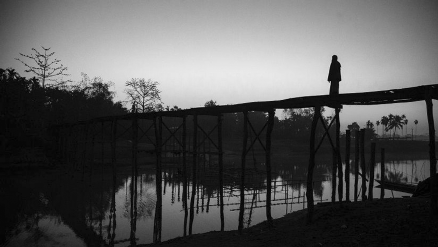
IN the morning, singer Kurajat Ali leaves his village Boroarikati for the ghat. The shape of betel nut trees and Ali stand out in sharp contrast against the sky. In silhouette, man and tree are the same. By the time he reaches the ghat the sun has risen and villagers are gathering, waiting for a boat to take them across the river. Ali sits in a boat and sings about the mad river which eats into the banks, turns the village into an open sea and sends the villagers running for a little piece of dry land. ‘You have broken someone’s land, you have broken someone’s tin house, and you have broken my budding love’, Ali sings.
You mad river
In a strange illusion you have trapped me
In a life of happiness
You have drawn a ravine.
You mad, mad river…
– Kurajat Ali
A majority of the inhabitants of the chars of the Brahmaputra are known as ‘Miyahs’ or Bengal origin Muslims who may have migrated from erstwhile East Bengal, now Bangladesh, or have lived here for generations. After all, it was one contiguous land and it is the same river on either side of the man-made border. The river doesn’t know boundaries, it just flows. Through their songs and poetry, the Miyahs explore their relationship with the river, their struggle for survival and the larger issue of migration and identity that has drowned all other voices in the recent past. They are as much outsiders as is water to land.
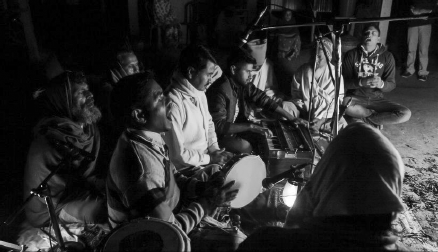
I must have been ten or eleven years old when I started singing. My name is Kurajat Ali. I am from Boro Arikati. Let me tell you about the Baithal songs. When the river carries away our homes, when we go from one char to another with our belongings on the boat, that is when we sing Bhatiyali songs to express our grief.
|
|
|
Still from the film, Nodir Kul Nai. |
Manik Kana (Manik the blind), used to sing. When Goruchar was eroded by the Brahmaputra, he came to this char and sang these songs. I learnt from Manik Kana.
A
hmed Ali, a schoolteacher from Kacharipam, who is also one of the musicians, says: Around us is the river. Sometimes the river takes away our homes. Then land rises in the middle of the river and we shift there. During the monsoon there is only water around us. Then the erosion begins from upstream. Some houses are washed away and then some more. We get separated. Then we end up not knowing what to do. Our minds turn to God who is the only one who can help us. We have no one to turn to. We are people from the chars. Who will come to look for us? Then we look up to God. Our songs come from that bewilderment.
|
|
|
|
Still from the film, Nodir Kul Nai. |
Still from the film, Nodir Kul Nai. |
O
ur condition becomes like that of a person clutching for straws in the middle of the sea. We turn to our maker – our Allah, our Bhagwan to rescue us. These songs are called ‘paargeet’. The gist of the songs is that even if we can’t make it to the shore, may there be place for us in God’s land. Our ancestors, grandparents and parents, sang these songs before us. People from the riverbanks have these songs of pain as their legacy and heritage.Old Man
When water fills the lands around the river, the river becomes boundless like a sea.
Even our boat is broken.
We don’t have the heart to travel from one bank of the river to the other.
Out of fear we sing these songs.
These songs are messages to God.
We call out to him and say: this river that has turned into a sea, which bank do we go to?
We have become mobile, transient.
There’s water inside the house, water outside the house, water all around.
O God, we say, there’s no way out except through you.
Out of the pain in our hearts we sing our songs.
A
t the weekly market at Panikhaiti, very close to the ghat, people are setting up shop. A young man fries fritters; a pony cart owner drives children to the market; and older men sit at leisure outside tea stalls waiting for more vehicles to arrive, more dust to rise and for the market to truly manifest itself. The market is just a few meters wide. It stops abruptly at the ghat where women are drying chillies on the sand.|
|
|
Still from the film, Nodir Kul Nai. |
I
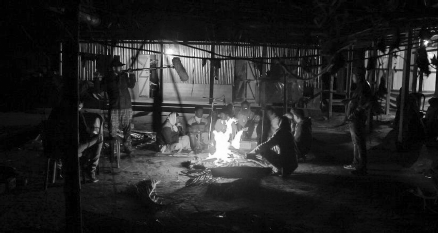
n the village the market is almost exclusively a male space. As the sun goes down, Kurajat Ali and his troupe lay out a mat in front of a fire and sing. ‘I have charred my bones black’, goes the song. The woman who has to clean up after the men leave, looks on patiently.
Nodir Kul Nai
The river has no bank, no edge.
Which bank should I leave and where should I go
Who do I ask?
The big river’s waters rock my boat
Now I see the face of beauty and now it’s gone
The river has no bank, no edge.
The winds are roaring
And my boat is broken
How can I reach the bank?
Have mercy on me o merciful Allah
And take me to the bank.
The river has no bank, no edge.
T
he songs describe the many moods of the river, as a mad ravaging force during the floods; as a source of livelihood, a constant companion for the people of the sandbanks; and describes stories of displacement and of impermanence of the river people:
You mad river
In a strange illusion you have trapped me
In our happy lives
You have drawn a ravine.
You have broken someone’s land
You have broken someone’s tin house
You have broken my new love.
You mad river
In a strange illusion you have trapped me
In our happy lives
You have drawn a ravine.
You have broken someone’s land
You have broken someone’s tin house
You have broken my new love.
You mad river
In a strange illusion you have trapped me
In our happy lives
You have drawn a ravine.
Some go to Mondira
Some go to Goruchar
Some go to Norikata reserve
You mad river
In a strange illusion you have trapped me
In our happy lives
You have drawn a ravine.
Amar Har Kala Korlam Re
I have charred my bones
As black as my skin
Charred my soul too
The farmer’s plough is bent
The waters of the river are bent...
* A transcript from the short film Nodir Kul Nai that was shot on the chars of the Brahmaputra with singers and boatmen and poets who have created a new genre of music that emerges from Bhaitiali sangeet and Paargeet. The film commissioned by ArtEast 2019, was shot in the backdrop of the National Register of Citizens in Assam. The Miyahs or Bengali Muslims find themselves in the middle of this divisive campaign that has courted adequate controversy. Evicting and deporting alleged illegal migrants from Bangladesh has been the soundscape of Assam politics for decades, driving a wedge between communities. Filmmaker Parasher Baruah in collaboration with Miyah poet Shalim Hussain raise pertinent questions on identity and home, migration and homelessness and the indifference of the river that is at once a source of sustenance and despair.