Majuli: a land between two rivers
KISHALAY BHATTACHARJEE
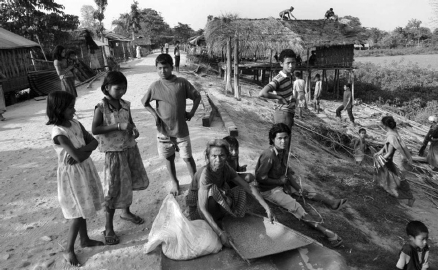
KANHAI is a boat maker in Majuli, who lives by the river and is a passive witness to the water that has arrived at his doorstep. He is set to shift home and move inland before the next wave of floods. Eighteen years after he settled there, Kanhai and his three children will have to find a new home. Kanhai watches his house being pulled down; his concern, however, is about Podumi, his daughter, who is appearing for her board exams.
Som, a potter from Salmora is an apprentice training to be a mask maker, a traditional craft that is hardly practiced any longer. Som was introduced to the traditional craft of mask making by master craftsman Guru Hem Chandra Goswami, of the Natun Chamaguri Satra.
1 Som, however, is an ‘outsider’ to Majuli but has become a part of the island. He is busy preparing for the Raas Festival.|
|
|
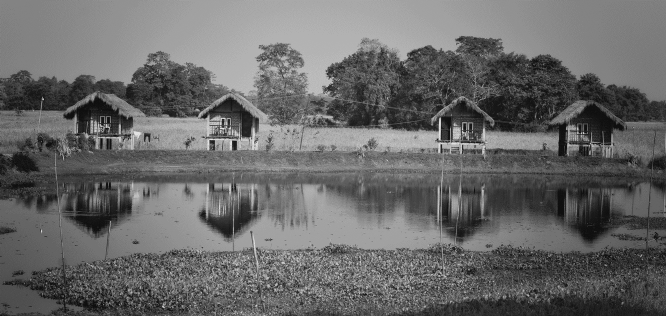
The disappearing island: Majuli in Assam. |
In 2017 ArtEast commissioned a film, ‘Majuli – Land between Two Rivers’, to explore the challenges in physically preserving the island and its culture of mask making that is as threatened as is the island. The film is a searing narrative of the survival of art and life, told through masked characters drawn from mythology. The film became a representation of the predicament that the people of Majuli are confronting everyday; survival of the river island and holding on to an art form that is also their livelihood.
|
|
|
Majuli, the world’s largest river island to go plastic free. |
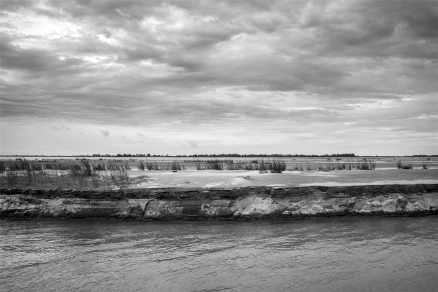
The central theme of the film is man’s complex relationship with land and how this notion is being questioned, threatened and put to test at every step on an island. In Majuli the depletion of its physical land due to erosion has led to a cultural erosion – of the arts and craft of the island. Pottery, mask making, hand fans and sculptures are directly dependent on clay, bamboo and wood. As Kanhai stares into the watery horizon that will soon eat up his home, he is stoic and dignified in his loss. The islanders go on with their lives moving between hope and homelessness.
T
wenty-three years ago a civil society volunteer, Sanjoy Ghosh, came to Majuli with a team of foot soldiers to turn the tide that engulfs massive chunks of earth every few seconds. One of the largest mid-river deltaic islands in the world, erosion has been Majuli’s biggest challenge, reducing it to half its original size. But Sanjoy’s civil society movement mobilizing public opinion soon revealed a deeper and sinister nexus; of contractors, government and the terrorist group ULFA (United Liberation Front of Assam) that would prevent any permanent solution to the island’s shifting fate. In July 1997, Sanjoy was allegedly abducted and killed and his team soon disintegrated. Majuli was again at the mercy of the Brahmaputra and a corrupt system of ecological governance.
|
|
|
The sorrow of Majuli. |
The devastating flood of 1998 increased the intensity of erosion that was recorded at 8.76 square kilometres per year over four decades since the earthquake of 1950 that changed the river’s course. Sixty-seven villages have disappeared over the years. Hundreds and thousands of people are awaiting rehabilitation. The prime minister’s campaign enlisting the Hindu support of the monastic island and the subsequent victory of BJP in Assam, with the election of a chief minister winning from Majuli, should have helped the island’s fight against all the obstacles and odds, but instead, on the ground, the river is encroaching at a frenetic pace turning those who live in Majuli into climate refugees.
Footnote:
1. Majuli is home to several satras or Neo-Vaishnavaite monasteries set up by the socio-religious reformer Shankardeva.