Visions of paradise
IAN BAKER
I would like to start with a quote from the historian Simon Schama who wrote in his book, Landscape and Memory: ‘There’s always been two kinds of arcadia: shaggy and smooth; dark and light; a place of bucolic leisure and a place of primitive panic, the idyllic as well as the wild.’ So, this wonderful sense of paradox that we associate with the idea of paradise is really what Tsangpo Gorge invokes. You really have the sense of heaven and hell in one. It is a part of its charm and it is a part of its challenge. This is about Padmasambhava who is revered by the Tibetans as the second Buddha who came there in the 8th century and established Buddhism in its tantric form. In other words, it was a form of Buddhism that originally had developed as an outgrowth from the monastic communities in India at that time to make it relevant to help yogins, both male and female.
His wonderful accounts and stories of his own designation of so-called hidden lands or Beyul across the Himalaya is what the story of the Tsangpo Gorge is really about. Pemako, means the hidden land or the blissful land, arrayed like lotuses. And in one of the first texts of Padmasambhava, there is a wonderful passage from the text. It says that ‘those who contemplate journeying to the hidden lands will fall prey to their doubts and lack the requisite courage, while those who are overly pious lack the means to open the way to the secret places, for all those who lack the auspicious circumstances to enter the hidden lands, they will remain as imaginary paradises, or imagined paradises. They will not manifest simply through idle talk.’ So, the idle talk that follows will just be a hint of what this area is. Of course, the search for paradise is something that goes across cultures.
Taking off from an 18th century image of Hieronymus Bosch’s earthly paradise, the Vatican believed there was a remnant of the lost Eden somewhere in the east in the Himalayan zone. So, they actually sent out expeditions to look for it. There were early expeditions deputed by the Catholic Church to look for this lost person called Prester John who is believed to preside over some trace of Eden, as it were. But they came back not with the accounts of a lost Eden, but of Shambhala, which had already entered into the western imagination in the 1700s as a kind of legendary Buddhist kingdom. We see this depicted in a painting by Nicholas Roerich from the early 20th century. Shambhala was a kind of earthly paradise that was both in this world and beyond it. And it was the story of Shambhala that had inspired the writer James Hilton in his novel, The Lost Horizon, in which the word ‘Shangri-La’ first appears. This, in the English language, is a synonym for an earthly paradise. It was a very influential book that was written in 1933 at the time of the great depression in America when people needed some kind of vision or some hope of change. It was also the time between the First and the Second World Wars. The whole course and confidence in western civilization had come into question and people had begun looking to the East for answers that the West was not providing. This is where the notion of an earthly paradise was embodied in the idea of Shangri-La, which was completely fictional.
|
|
|
Abu Lashu, the sacred mountain. Photo: Ian Baker. |
It first arose as an assumption, of which many are aware. An adaptation of Lost Horizon, a film by Frank Capra made in 1937, is when he brought the story of Shangri-La to Columbia Pictures. He stated that the story of Shangri-La held a mirror to the faults of every person on this planet. That was the pitch he made to Columbia and it became the most popular film of all times. The original is still wonderful.
T
here were adaptations of Lost Horizon, of how a group of westerners come into the area and their plane crashes. They are at the northwest frontiers of India and are rescued by a group that comes out from a remote monastery where the best of East and West has been preserved for posterity. That is the myth of Shangri-La we have inherited by virtue of the book and the film.What is little known however, is that the story of Shangri-La written in the 1930s, was essentially plagiarized by James Hilton. If it happened today it would be a case of plagiarism. It was from a lesser-known novel called Om, the Secret of the Ahbor Valley by Talbot Mundy, published originally by the Theosophical Press. What is fascinating about his account is that it invokes the falls of the Tsangpo River. All this takes place in what one now calls Arunachal Pradesh. One enters through a tunnel behind the waterfall into a kind of promised land. It is a place where longevity and the treasures of the East and the West have been preserved for posterity.
I
highly recommend this book for anyone who is interested in the literary origins of the story of Shangri-La. The book in itself was an adaptation in some ways, or let’s say deeply inspired by a play called The Green Goddess (1921). It has the same story of a group of westerners who crash-land in their plane in a remote valley where they are kept as prisoners but in the midst of extraordinary luxury. So there is a deep tripart development of the myth of Shangri-La through a series of three works of literature that appeared in the 1920s and 1930s. The idea of Shangri-La resonated during the 1930s at the time of the great depression and at the time between the two world wars.It is just an idea, an idea of the search for paradise and all the associations that go with it. This is a back-story to understand the deeper literary history of a hidden land in the Himalaya. It goes back to the 8th century, to Padmasambhava. He left a literary record of texts or travel guides to hidden lands in the Himalaya.
I became obsessed with these texts, which are written in a surreal poetic manner, but which invoke literal sanctuaries in the midst of extraordinary landscapes. It became a challenge to find some of those, to identify them, and to travel to those places. These accounts were written by Padmasambhava and his consort Yeshe Tsogyal in the 8th century, who according to the text transcribed Padmasambhava’s oral transmission of these routes leading into hidden lands. As I became involved with the exploration of the greatest of these hidden lands called Pemako, for about 10 years, I wrote a book about The Heart of the Journey to Tibet’s Lost Paradise. His Holiness, the Dalai Lama, wrote an introduction to the book. In the introduction, he writes that hidden lands like Pemako are not places to escape the world but to enter it more deeply. The qualities inherent in such hidden places reveal the interconnectedness of all of life and deepen the awareness of hidden regions in the mind and spirit. By visiting such places with greater motivation and appropriate merit, a pilgrim can learn to see the world differently from the way it commonly appears.
A
s mentioned, these are hidden lands that appear in the creases and crevices of the Himalaya, across the range in the west from Ladakh, to the east through Nepal, Sikkim, Bhutan, and into Arunachal Pradesh. The texts are very cryptic, written in a kind of surrealist language, and they describe the ways in which they will be revealed by particular treasure revealers. And then once they are discovered, the treasure revealer will often go into meditative retreat to decipher what were short, cryptic texts and then create elaborate versions of them. They will then once again conceal them to be discovered centuries later – still a very living tradition in Tibet. In Tibetan Buddhist tradition, there is a cave that is about 18,000 feet high where Padmashambhava came from, claiming he gained enlightenment from the practice, a sort of inner fire, an inner heat.
|
|
|
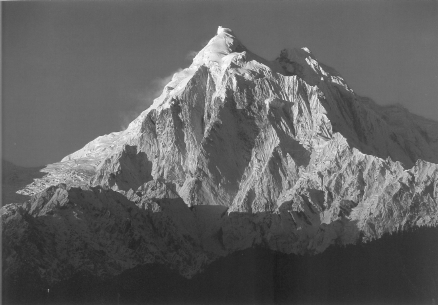
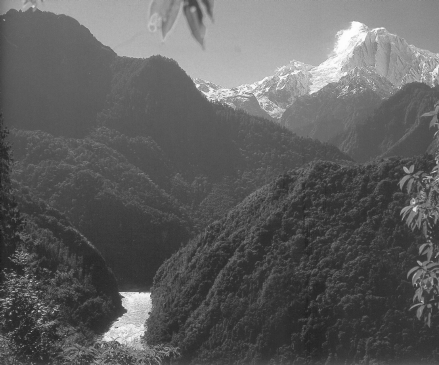
Dawn over Gyala Peri. Photo: Ian Baker. |
Of the people that we observed during our journey, women were from non-monastic, non-celibate and yogic traditions, which are rare in Tibet now. The robes that they wear are red and white rather than the pure red robes of celibate monks or nuns. The idea of the hidden lands is described as mandala – like rounds that are also equated with the idea of Shambala as a hidden world.
A
s mentioned earlier, the hidden land of Pemako is a tribute to Padmasambhava, the king of all hidden lands in the Tibetan texts. The very eastern end of the Himalayan range is where the Tsangpo Brahmaputra river makes this great bend, a hairpin bend, around the peak of Namcha Barwa, at the very terminus of the Himalayan range. These are described as the texts that provide liberation, by hearing about the great and blissful land of Pemako in words atttributed to Padmasambhava. That is the path to enlightenment.These are the texts that inspired me to go to the roots and to some of the other hidden lands. When the opportunity came to visit Pemako, the area had been opened for the first time, and I went and continued to go over the next nine years. Every year I tried to follow what is called the sequence of the outer and inner circle into Pemako, leading into a kind of a paradisical round at the very heart of the circumambulation.
G
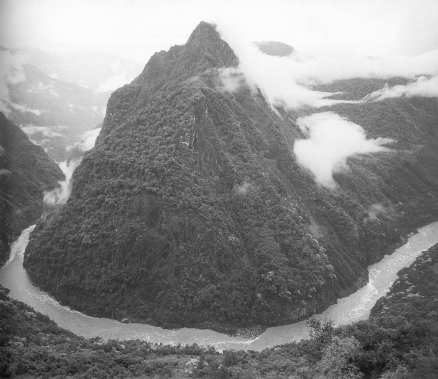
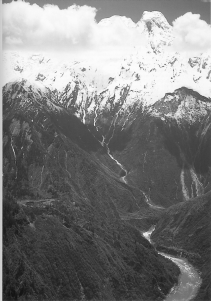
yala Peri at around 23,891 feet, and Namche Barwa at more than 26,000 feet, is what makes it to the Guinness Book of Records claim of being the world’s deepest point. And if you draw a line between the summits of these two peaks on the eastern edge of the Himalaya, the distance is 11 miles. Then if you drop a line down from the other line into the heart of the gorge, it is 5,500 feet which gives one a vertical rise in a relatively short distance of 11 miles between the two summits that are over 19,000 feet. That is why it is considered the world’s deepest gorge or the deepest point, although it is not a canyon like the Grand Canyon. It is the overall sense of the vast scale which is very hard to capture in a photograph. This makes it an extraordinary place.Tsangpo is also a direct translation of Brahmaputra. Po means ‘son’ in the same way ‘putra’ means son. So Tsangpo Brahmaputra are etymologic, not just interconnected as rivers or the same river and the same source but the names are also linguistically completely related. However, this side of Tibet is outside of our usual associations with Tibet: that it is a high altitude plateau with a river being less than 5000 feet and a subtropical zone, with a very deep, dense forest.
S
hambala was represented as the mandala, a paradisical centre, with different ways leading into it from the peripheries. This was the way in which hidden lands and Shambala were both represented, a kind of template for an initiation into Buddhism. As one enters the mandala, it is a transforming as well as a transformed space and condition. In Pemako, people describe the body of a particular tantric Buddhist goddess called Vajravarahi in Sanskrit.The pilgrim symbolically journeys through the body of Vajravarahi from top to bottom if they follow the course of the Tsangpo River to the Mahanadi. That is the central channel of the goddess which is, at the same time, the central channel of the pilgrim. The whole idea of pilgrimage here is to go through a tantric initiation, which is seen from the beginning of the peak. It is associated with Vajravarahi’s crown, shakha, and Vajravarahi, literally meaning the diamond sow. You see the same feature replicated at the summit of Gyala Peri representing the apex of Pemako as a mountain, symbolic of a crown, shakha.
Again, you can really get a sense of the extraordinary depth of the inner gorge with Namche Barwa behind it, going into an area which has a very convoluted landscape. And once you have come out of that and gone down south into parts of Pemako lying across the line of control and in Arunachal Pradesh, it is a gentle and deeply forested region. The area which is on trickier terrain is called the river Yarlung or the innermost secret river. There were small monasteries established here, mostly by the people who came from Bhutan following the prophecies.
Crystal glaciers, the sky and rainfall were nectar from the guardians of this land. Rainbows filled the sky, and the peaks touched the sky. It was believed that this hidden land of Padmasambhava is from where fortune and gain would finally come. This is the kind of evocation that describes the Tibetan Shangri-La. It wasn’t just a place in literature or in a Hollywood movie, it was a place where people could actually try to get to or imagine going to. It was not symbolic of the western tradition of a lost paradise; it was a paradise that was simply well hidden and difficult to reach, but one that existed on the planet.
I
n a wonderful account by a Tibetan, Lelung Shepe Dorje, in 1729, called ‘The Delightful True Stories of the Hidden Land of Pemako’, he says: ‘There’s a constant menace here of poisonous snakes, leeches, flies, clawed and long-snouted animals with fangs, dangerous wild men and vicious savages. Those without courage or those with lingering doubts, too many mental conceptions, or who are strongly attached to conventional appearances, or who out of ignorance, fall into accepting and rejecting, such people will have difficulty reaching this land and getting through unscathed.’ This is a wonderful challenge that he presented to pilgrims of that period in time. It is extraordinary, but on the side of Pemako which lies in Arunachal Pradesh, there is a very strong living tradition or Adi culture. The Adi headman of the village where we stayed referred to some obstacles; the rustle viper, Himalayan pit vipers, saying that they blend in all too well in the rocks that we walked over. But it is also a place where the texts describe all beings as gods and goddesses. Again, there is always a sense of darkness and light, a sense of this beautiful lush landscape that you enter, particularly on the Arunachal side.My journey into this region was inspired by my first Tibetan teacher in Nepal in 1977. There was an opportunity that came when the region of Pemako first opened in the late nineties. I was living in Nepal at the time, travelling overland to Lhasa, an extraordinary part of the Tibetan Buddhist world.
In our first opportunity to go into the Tsangpo Gorge, we saw a wall of snow and rock that hid the innermost gorge and gave one a sense of dizziness. The mystery remained of how this river could travel through a labyrinth of ridges and peaks in Tibet, and relate to this vast expanse of snow and the river Brahmaputra, as it flows.
N
onetheless, it was a place that the British became obsessed with because of their interest in the Great Game. They wanted to have reliable maps of the frontiers. Where they did not have any direct access to Tibet, they trained so-called ‘pundits’ who would be the surveyor spies trained in Dehradun to look like pilgrims but with surveying instruments concealed inside their robes. The rosary beads they carried numbered one hundred, and not one hundred and eight, and were used by them to measure their steps. That resulted in an energetic fervour to trace this area. The knowledge of the Tsangpo Gorge increased in the 1880s as the British deputed a man called Kinthup to survey it. We know a lot more about him today; there is a book written about him.This illiterate tailor from Darjeeling was trained as one of the pundits and deputed, along with a Mongolian lama, to follow the course of the TsangpoRiver from Tibet down into Assam through this kind of no-man’s land of the Tsangpo Gorges. For a variety of reasons, they were not able to make it. But he did come back and present an oral report to the British surveyor in India where he described the waterfall with an image of a deity in a drawing found in the Royal Geographical Society journal. This led to a new quest for the waterfall that obsessed the British. They thought that they might find a waterfall to rival the Victoria Falls in Africa. This could become a symbol of might and power of the colonial empire. But the area was extraordinarily difficult to reach and Kinthup was not able to retrace his steps going back to Lhasa and then, back to Darjeeling.
O
ur attempt was to go beyond where Kinthup had been in the 1880s. Frank Kingdon Ward in Riddle of the Tsangpo Gorges describes the Tsangpo Gorges as having two climates and two weather patterns; wet and more wet. Kinthup’s travelling companion was also an employee of the British surveyor. As the surveyor had gambled away all the expedition funds, he sold Kinthup and his companion as indentured servants and took off on a horse leaving them behind. Eventually Kinthup escaped and travelled down the Tsangpo River, continuing on his original mission, which was to travel the British territory. The head lama of a nearby monastery bought him for 50 rupees so he wouldn’t be sent back as a slave and he became a tailor at the monastery.
T
he British quest to try and link the Tsangpo and the Brahmaputra had begun. In 1904, we see the Young-husband expedition that led to another expedition in which Bailey, with Henry Morrison, try to penetrate into this unknown area in 1913. As far as the western world was concerned we were exploring a country about which nothing was known, but much was speculated. That one of the last remaining secret places on earth may have a waterfall rivalling the Niagara Falls or Victoria Falls in similar grandeur, was the great hope and dream of the British at the time.They came back from their expedition not having reached the innermost part of the Tsangpo gorge. But at the same time, they speculated that the great falls of the Tsangpo that Kinthup had reported, did not exist. They told the President of the Royal Geographical Society posted in London in 1913 about the non-existence of these falls. The question of the falls remained in the air. There was a deep investment in this idea of the falls; it was so strong in the imagination that it was always talked about by explorers.
|
|
|
|
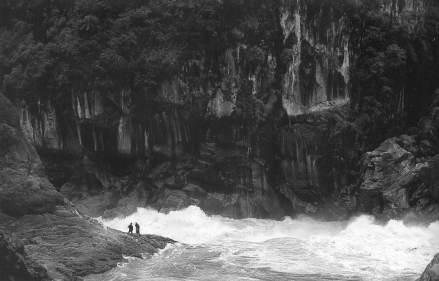
The world’s deepest river gorge, Tsangpo, Southeast Tibet. Photo: Kenneth Storm, Jr. |
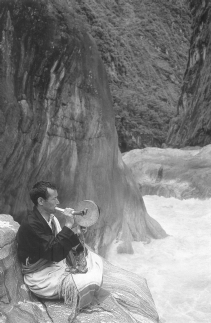
On the ledge above Ward’s ‘Falls of the Brahmaputra’, a lama pacifies local spirits by blowing on a trumpet fashioned from a human thigh bone. Photo: Ian Baker. |
Frank Kingdon-Ward’s primary sponsor for the expedition was 24-year-old Lord Cawdor from Scotland. When Frank Kingdon-Ward made his expedition he wrote in his book The Riddle of the Tsangpo Gorges: ‘There remained a gap of about 50 miles in which nothing was known. Was it possible that hidden in the depths of this wonderful gorge is a hidden waterfall? Such a thing was quite possible and it was this question we would resolve to answer. Was it possible to ride through the gorge and tear this secret right from its heart?’ The falls of the Brahmaputra remained a geographical mystery for more than a century.
A
gain, as Frank Kingdon-Ward wrote after his expedition: ‘Every day the sea would be more savage, the mountains higher and steeper and the great river was plunging down and down more deeply into the barrels of the earth. The snow peaks enclosed us in a ring of ice. Dense jungles surged over the cliffs.’They reached a point from where they were not able to travel further. And it is an extraordinary account. Lord Cawdor kept a journal throughout the expedition. There were six volumes of them and at one point he wrote that by his reckoning, the idea of the falls must have been imagined and invented. How many people had a tough and miserable time looking for this mythical marvel!
|
|
|
Kingdon-Ward’s ‘Falls of the Brahmaputra’. Photo: Kenneth Storm, Jr. |
James White had written in Far Horizons: An Unforeseen Destiny, that the search for the falls of the Tsangpo can be characterized as one of the great romances of geography and the most obsessive wild goose chase of modern times. That is essentially a prelude to my quest – to resolve this because 10 miles of the gorge remained completely unknown and unexplored up to the end of the 20th century.
I
t is not just that Pemako is extraordinarily difficult, it is far more difficult to penetrate and explore three sides by the gorges of the Tsangpo, with the fourth side blocked by a mighty range of mountains. Those passes are only open for few months in the year. Beyond the immediate barriers to the east and west and south, there were dense forests inhabited by wild and friendly tribes. Add to this the climate which varied from the sub-tropical to the arctic. The only consistent thing was the perpetual rain, the snakes and wild animals, giant stinging nettles, and a number of biting and blood sucking ticks. It is a wonderful passage because it parallels the accounts from the 18th century by the travelling lama who Kingdon-Ward would have known.
|
|
|
Below the ‘Falls of the Brahmaputra’. Photo: Ian Baker. |
What was extraordinary about this region, despite the difficulty my guide mentioned from his delightful accounts of Pemako from 1729, was ‘when journeying into these sacred places, fear naturally transforms into great splendour and remains perfectly at ease. A new spiritual awareness flares up in one’s stream of consciousness. The conception free unity, bliss and emptiness.’ On our first expedition we were not able to get into the heart of where the waterfall would possibly be. Crossing over snow covered passes, we reached a point beyond which we couldn’t continue. We had to build bridges over raging waterfalls and eventually found a hunter who showed us through this extraordinary jungle with magical plants, mushrooms and snakes.
W
e spent six weeks on this trip. It was a journey over multiple passes and snowfields, over rivers on single cables. Finally, we could see a mountain in the distance surrounded by lakes, like a mandala, and each ritual had to be performed in each of the lakes according to the texts. And the vision lay at the base of it. One of the pilgrimage guides said that Padmasambhava was one of the most fortunate beings who had directly perceived the deities.
W
e were at the heart of the goddess. We had to travel down to the navel which is where this monastery was, and which had the first human habitation. We came out of the jungle and there was a rainbow in front of the monastery. We saw a yogi already half way to us, crossing the field. We just sat there mesmerised by the sky and the rainbow. He came up to us with a huge copper bowl full of fermented grain alcohol. We asked him where he was going. ‘The only time a rainbow ever comes in front of the monastery is if visitors are coming, so I am coming to meet you.’ It was a kind of place where you felt a world apart.Texts suggest that an extraordinary animal, unique to the eastern Himalayas, the Takin, guides you into the hidden land. And it is a coincidence that satellite images show this innermost part of the gorge that looks almost exactly like the head of the Takin.
There were sections where we had to use skating ladders to rappel down till we reached a point beyond which we couldn’t continue, and the lama who was tra-velling with us performed rituals to appease the local deities we might have offended. We also travelled with a yogini from central Tibet who performed her own rites. This was why it took a series of 10 expeditions before finding a way of going back to this lama who had said that there was absolutely no way to get into the innermost gorge.
However, having heard that we had been to the mountain to look for the key, he understood that we were insiders rather than just adventurers or explorers. He told us of a text that describes the waterfall in the area that we were looking for. The Chinese had forced us to throw the text into the river at gunpoint, but fortunately I had the original and real text under my belt. He read this extraordinary passage of a series of waterfalls with a centre in the tunnel. All this he said would lead to the the hidden land behind it.
W
e were excited and headed down to the area he had described from the ancient texts. The lama said there was actually a track, a hunter’s trail that he could get some people to take us on. This was the area that we were heading to, to get to the inner gorge. But the trail was not quite user friendly. Some were wet cliffs with tufts of grass, difficult to hold on to. At times there were vines on the slabs that we had to batman down.
|
|
|
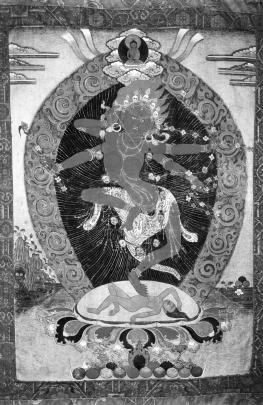
The Tantric deity Vajra Yogini in her form as Dorje Pagmo. Photo: Ian Baker. |
A
s we got deeper and deeper into the gorge, there was a point where the clouds came in and there was no visibility. Our guides took that as a very bad omen. They said, ‘look we have to get out from here, maybe we are not welcome.’ But then suddenly in the midst of the clouds there were three circular rainbows that appeared. Obviously, it was a meteorological phenomenon, but the way our guides understood it was: ‘beyul beyul, hidden land, hidden land’. For them it was an extraordinarily positive sign. They felt that just when they had lost faith in the journey, these rainbows appeared, and after that the clouds cleared. We were the recipients of this meteorological coincidence that allowed us to look into the depths of the gorge in a way that they said, had never been seen before.Trying to find a way down from that point led to confronting many precipitous drops. We did see the rainbow falls. They had been seen from up-river by Frank Kingdon-Ward and Lord Cawdor in 1924 and 1925. So when they had this 10-mile gap they had said that the waterfall could not exist. We heard this incredible roaring but the only way we could get down was to rappel down. We had been able to get to the base square with a clinometer to measure a waterfall which was over a hundred feet high. This would fit the criteria established by Frank Kingdon-Ward or Lord Cawdor of a waterfall of 100 feet or more in this unknown section of the gorge. There were sheer cliffs on both sides, but we were questioning where the tunnel, supposed to be behind it, could be.
The topography made it impossible for us to photograph but the waterfall was hidden behind a ridge. Opposite the waterfall was this perfect oval doorway which was exactly how it was described in the ancient texts. These are also evocations of the same kind of phenomenon of a waterfall concealing a passageway into a promised land. From across the river looking at this door, there was this incredibly compelling oval portal that was described in the text. It said that if you follow this trajectory down for five days you will enter a completely parallel dimension. It was impossible for us to reach there. This is described as being the route into the innermost core of goddess Dorje Pakmo.
This form of Padmasambhava – Dorje Pakmo riding on the back of a pregnant tigress – represented extreme danger. He rode with iron all over his body representing a transformed vision. That was the only way by which such terrain could ever be accessed. The idea of waterfalls, the flow of water swaying into another parallel, without being able to cross the river, into that tunnel that exited the gorge leading into an extraordinary hidden land, would lead us to greater and greater wonders. There was an idea of a mandala in the landscape.
National Geographic sponsored the last expedition to find this hidden paradise and the Tibetan gorge. There was a confluence of two narratives, the western narrative of a search for numerous landscapes, and the Tibetan quest for a paradise in which the human condition could be transformed.
I will end with a quote from Mircea Eliade and his book Myths, Dreams, and Mysteries: ‘The commencement and at the end of the religious history of humanity we find again the same nostalgia for paradise… the myths by which this ideology is constituted are among the most beautiful and profound in existence. They are the myths of paradise the fall and the immortality of primordial man and his conversation with God, of the origin of death and the discovery of the spirit.’
*An edited transcript of an illustrated presentation by Ian Baker, Himalayan and Buddhist scholar and author of seven books on Tibetan cultural history, environment, art, and medicine including The Heart of the World: A Journey in Tibet’s Lost Paradise (Penguin Random House, 2006). Transcribed by Ashima Sharma, Jindal School of Journalism and Communication.