The Brahmaputra tea trail
DHRUBAJIT CHALIHA
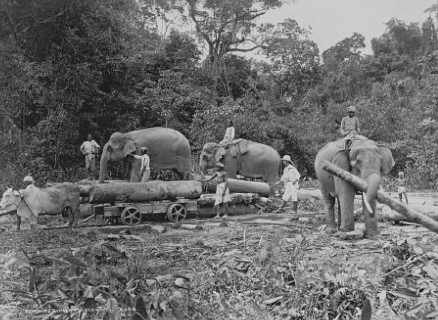
THE year is 1824 and Lieutenant Charles Alexander Bruce of the Royal Navy is commanding a 100-ton paddle steamer up the Brahmaputra, carrying in it supplies for the Assam Company, the first tea company of India. This included tea machinery, cutlery, agricultural implements and large quantities of coloured beads and mirrors to be gifted to the native chiefs in Assam, who previously had not had the good fortune of seeing their own faces. These gifts were provided in exchange for labour and elephants, because unlike the British masters who ran their vehicles in England on horsepower, their subjects in Assam ran on far advanced elephant power. Tea plantations were vast tracts of landscape, most often spread over more than three hundred acres, amidst dense jungles and wild terrain. Roads were non-existent and the only tracks were those of bullock carts and the wider tracks of elephant paths.
|
|
|
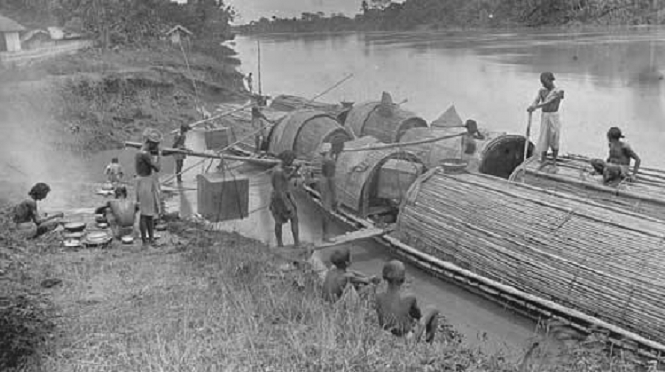
A Peep into History... This is how tea was transported from Assam to other states before the advent of the railway. |
A healthy and happy elephant could carry six chests of tea in a specially designed howdah, while an average sized country boat could carry 150 chests. So, it took a convoy of 25 elephants to load one country boat to its full capacity; and at most times there were three, moored to each other by rope. Having been loaded, the country boats, running on sheer muscle power, would start on an arduous journey downstream from their tributary source to the Brahmaputra, a week or ten days away, if lucky enough not to encounter storms and illness along the way. Braving pests, wild animals and malaria along the journey, these country boats would finally reach the Company’s godown at Guwahati, where the consignment would be stored indefinitely, until the uncertain arrival of the Honourable Company’s steamer. The steamer herself had endured a mammoth sea journey of 5000 miles and 45 days from England.
T
he shipment would then be loaded to sail back home in this giant ship, a tiny speck on the great river, whose expanse of water spread two miles from bank to bank. The journey back to Her Majesty’s arms was no picnic and the river voyage would start at the Brahmaputra in Guwahati, continue until the river changed from male to female with the Meghna in Bengal and onwards to meet the great wide ocean that would take her home to England. Our good old nauka, meanwhile, embarked on its own upstream journey home to its tributary ghat, a journey of another fortnight and sleepless nights, to refill and return to its mother ship the following month.
|
|
|
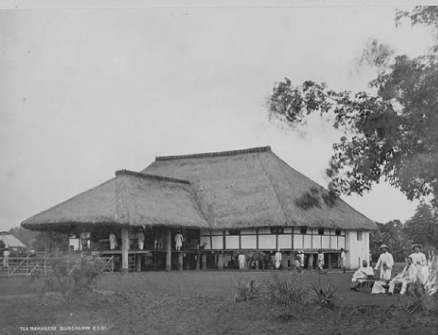
Tea garden manager’s bungalow, with a retinue of servants, 19th century. |
Fast forward to 80 years later. It is 1926, and my grandfather, Jadav Prasad Chaliha has planted a clearing of land with tea in North Assam’s Dibrugarh district and named it Korangani, after the Koranga trees that were cleared to make way for tea. Despite the change in the millennial, not much has changed in the conditions of life in Assam since the first river voyage. However, the country boat has been replaced by the paddle steamer and it now takes half the time point to point carrying ten times the load. Tea estates have started to mushroom in many districts, tea companies were formed under Her Majesty’s banner and the river is a sea of trading activity. Tributaries swarm with loaded country boats and paddle steamers, and barges have been introduced to carry the weight of the tea shipments.
|
|
|
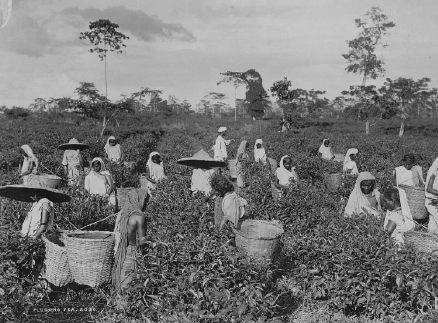
Tea plucking at a plantation in the 19th century. |
After the East India Company’s steps to establish the Inland Water Transport Industry, many private companies began to operate an efficient and profitable trade in passenger and cargo movement on the river. Labour movement became crucial to feed the rapidly growing industry and they were transported on the river by the thousands. With limited availability in Assam, labour was sourced by the British from Bengal and the Chhotanagpur tracts and had to be brought via Calcutta by the river. These river voyages of over 600 miles took upto 30 days from the river ghat at Goalundo in Bengal to its destination of Dibrugarh in north Assam and passengers often shared seating space with chicken, goats, the occasional pig or anything that the captain of the steamer fancied useful to his trade. These included generous quantities of tinned food, cigars, cartridges, brandy, Hollands Gin and quinine (until then not called Tonic, as we now know it).
|
|
|
Elephants at work in clearing of forest to make way for planting tea. |
A
s the boat docked to unload its passengers and cargo, European planters from adjoining tea estates would swarm to the captain’s floating retail store and buy out his inventory. This included pre-ordered provisions made the previous year. Life as the steamer’s captain was as smooth and as rough as the river. The Brahmaputra is all male and he flaunts his muscles and his charm with equal panache. The tea industry owes its existence to this mighty water and continues to exist for and despite it.Lohit or Luit is colloquial for the Sanskrit word Louhitya or blood red. It is this image that endures in the hearts and minds of the millions who have prospered or suffered by it. As the immortal bard of Assam, Bhupen Hazarika sang his ode to the river (in translation): ‘Despite the reigning chaos and confusion around you, why do you so calmly flow on?’ If he had a reply to that, Burha Luit would likely say: ‘Because I must’.
* Transcribed from a presentation followed by a tea ceremony by Dhrubajit Chaliha at ArtEast Festival, 2018.