Indian modern dance
SUNIL KOTHARI
WITH a staggering number of eight classical Indian dance forms that no other country can boast of, people always ask if India has an Indian modern dance form.
It all began at the turn of the last century. The father of Indian modern dance was the legendary Uday Shankar. Born on 8 December 1900, Uday Shankar is credited as the creator of modern Indian dance. Though he was not trained in any particular or specific Indian classical dance form, as a young man he had seen dance performances in the court of Jhalawar, Rajasthan, as Uday Shankar’s father, Pandit Shyama Shankar, was a minister in the state.
At some point Pandit Shyama Shankar went to London for a court case. When young Uday Shankar, a student of painting, turned 20, his father invited him to study at the Royal College of Art in London. Uday Shankar’s teacher was the painter William Rothenstein, who was a friend of the Russian ballerina, Anna Pavlova. Looking for someone to partner her choreograph an Indian theme based dance work, Rothenstein sent Uday Shankar to Pavlova for an audition and she found him perfect.
Rothenstein advised Uday Shankar to visit the British Museum and study miniature Rajput painting to draw inspiration from them for dance movements. Besides watching court dances as a young student, Uday Shankar had only seen a folk dance by Matadin, whom he used to imitate. However, for Anna Pavlova he created a pas de deux, yugal nritya based on the theme of Radha and Krishna. A young Bengali musician, Comolata Banerjee, played the piano, and had composed the music. It was presented on 20 September 1923 at Covent Garden. The history of Indian modern dance began there. But what Uday Shankar had created was not based on any particular classical Indian dance form; it was essentially drawn from his own imagination.
In India, Gurudev Rabindranath Tagore had introduced dance at Santiniketan, Visva-Bharati University, encouraging young students to perform joyous dance movements in celebration of spring. Later, Tagore sent his disciple Shantidev Ghose to Kerala to study Kathakali, the classical dance form, which the Kerala poet Vallathol was attempting to revive. In Tripura, Tagore saw Manipuri dances and requested the Maharaja, Buddhimant Singh, to send a teacher of the Manipuri dance tradition to Santiniketan.
After Shantidev Ghose returned from Kerala, Tagore invited Kelu Nair, a Kathakali dancer, to teach his students. He wrote the dance-dramas, Chitrangada, Chandalika and Shyama and asked dancers to select suitable Kathakali and Manipuri dances and other appropriate movements for those dance-dramas. Thus began a new dance movement. Dancers, along with painter Nandalal Bose, devised the costumes, and Tagore, who had created Rabindra Sangeet based on classical ragas, fused the two to develop a new genre of dance and music.
Uday Shankar and Tagore had sown the seeds of Indian modern dance. Of course, there were numerous classical dance traditions that had flourished in the royal courts of India. In South India, the devadasis, servants of God, traditionally performed in the temples. Later, with the patronage of maharajas, they danced at the courts as well. It was termed sadir nautch at the time when the Marathas ruled Tanjore.
T
he thirties saw a fresh approach to the dance traditions of India. Uday Shankar created his own choreographic works, conjuring up imaginative movements as he travelled in the US and Europe with his dance repertoire. By 1936, Rukmini Devi had established Kalakshetra in Madras to train young dancers in Bharatanatyam. As a matter of fact, Uday Shankar, Tagore, Vallathol and Rukmini Devi made history by creating Indian modern dance. Dance was subsequently institutionalized in the training centres that each one of them had established.|
|
|
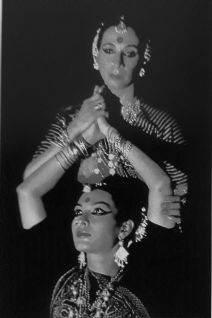
Ranjabati and Manjushree Chaki Sircar. Photo by Avinash Pasricha. |
There was a major shift to learning dance in a classroom; very different from the way hereditary dancers had learnt, imbibed and lived their craft. Those who now enrolled were educated young men and women from the middle class, who came to learn dance from traditional teachers. The decades that followed saw a revival of classical dance forms. The creatively choreographed dances of Uday Shankar and Tagore were quite different even though they drew their movements from the classical dance traditions, and from traditional gurus. Uday Shankar later studied Kathakali and invited the gurus of Kathakali, Manipuri, and Bharatanatyam to his Uday Shankar Cultural Centre in Almora. However, both Uday Shankar and Tagore were well aware of the realities of the changing times. Their knowledge and awareness about the conditions of the poor and backward masses was real. They felt the need to preserve our indigenous cultural treasures, which they used effectively for nation building activity by dovetailing dance into the political movement – a revolutionary step.
|
|
|
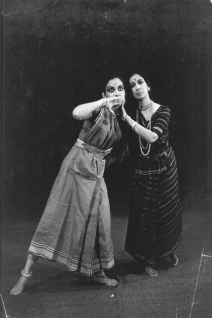
Dancers Guild, Kolkata. Photo by Avinash Pasricha. |
W
here classical dance depended heavily on mythological themes, Uday Shankar and Tagore wove the contemporary into their dance. This major shift was noticed in Uday Shankar’s shows where he addressed through dance, issues of social injustice, untouchability, exploitation of the masses by the capitalist class as a result of the industrial revolution, and other social themes. In Tagore’s dance-drama, ‘Chandalika’, he touched on the plight of women born in a low class, who were treated as untouchables. In ‘Chitrangada’, using the story of a Princess of Manipur, he spoke of the self-awareness of women. He did not believe in tying down the movement of the body only to what was prescribed in the shastras, and encouraged new and imaginative expression. Uday Shankar produced, directed and acted in his magnum opus film, Kalpana. Through that film he addressed issues of education that had been influenced by British rule, the plight of women, child marriage, women marrying old men, and a major theme built around labour and machinery.Kalpana remains a major landmark production, depicting how the capitalist class exploited labour, about the police and its proclivity to corruption, about people who curry favour with industrialists and politicians, and how one should endeavour to be free from such afflictions and rebel against such forces. This was a significant shift from the past in terms of the thematic content.
A
nother creative choreographer who worked with the Uday Shankar troupe was Shanti Bardhan. Uday Shankar, along with Gul Bardhan, choreographed the Ramayana using puppets. Human dancers performed and moved like puppets, using masks to represent the various characters, with excellent music accompanying the show. It was another shift to modernity, even though the theme was mythological. Equally engaging was the choreography of the Panchatantra stories using the movements of birds and animals, selling the message through its fables.In the wake of Uday Shankar, his associates like Narendra Sharma, Prabhat Ganguly, Sachin Shankar and others, selected contemporary themes from everyday life. Narendra Sharma’s Wolf Boy, Death, Conference and Child, have been remarkable productions. His son Bharata Sharma has worked in his footsteps, choreographing new themes. Prabhat Ganguly and Gul Bardhan, with their Little Ballet Troupe, choreographed themes like freedom from British rule, the evils of drinking, which were a departure from the usual mythological stories and became a part of the Indian modern dance repertoire. Sachin Shankar choreographed Cricket in dance, which was a huge success. Also Statue Coming to Life, the sequence of a Train and Ghost, which were based on contemporary novels.
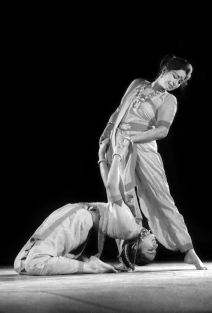
Along with these stalwart dancers trained in the classical dance forms there were others using traditional dance techniques and forms to explore social, cultural and other abstract themes. They worked independently, but contributed to the larger movement of Indian modern dance. Prominent among them were Mrinalini and her daughter Mallika Sarabhai, Kumudini Lakhia in Ahmedabad, and Chandralekha in Chennai. In West Bengal, Manjushree Chaki Sircar and her daughter Ranjabati Sircar were exploring movements creating Navanritya, a new dance, using Tagore’s dance-dramas to convey the message of empowerment of women (Chitrangada), injustice faced by Dalit women (Chandalika – ‘Ami Tomari Matir Kanya’), fighting against regimentation (Tasher Desh), and environment (protecting trees). ‘The ideas of Tagore’, says Manjusri, ‘form a strong basis from which to approach contemporary dance. In terms of a textual and intellectual framework, they affirm an aesthetic that is very modern and very Indian.’
U
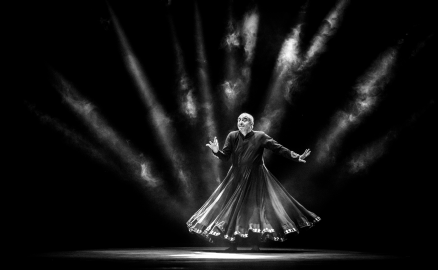
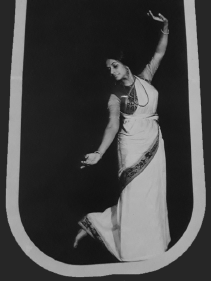
sing western dance movements, learning from choreographers from the West like Martha Graham, Uttara Asha Coorlawala has studied and written about the dancers mentioned above and their choreographic works. She studied western modern dance under Martha Graham, Bharatanatyam under dancer Kadirvelu, and Kathak under Kallianpurkar and sought to extend the boundaries of dance using physical traditions like yoga. Her choreographies of Yakshi, Drauapdi’s Saree, and Wind of Shiva are important landmarks in Indian modern dance.Astad Deboo, a Parsee male dancer from Jamshedpur, studied Kathak. He was keen on exploring movements to project contemporary themes in dance. He studied Kathakali under Krishna Panicker in Mumbai, travelled to Europe, met Pina Bausch and studied modern dance in London, but developed his own style dealing with themes like Drug Addict, a story of a clerk living in a slum; the theme of death in Thanatamorphia; Prayer, using Dhrupad music; a spoof on politicians using a larger than life-size puppet that turns into a menacing creature; Goddess Kali and her fury.
|
|
|
From Astad Deboo Choreography Rhythm Divine 11. Photo by Amit Kumar. |
Astad Deboo’s canvas is vast and varied placing him in a class of his own. His collaborations with martial artists from Manipur have produced outstanding works like Celebrations. Performing both in India and abroad, Astad has succeeded in making audiences aware of how the physical apparatus, the body, can be more mobile, flexible, expressive, even sensitive, among the hearing-impaired in India, China, Mexico, and the US. He is an unstoppable ‘one man Indian modern dancer’ who has extended the horizon of Indian dance.
T
he two major historic conferences, ‘East West Dance Encounter’, in 1984 and ‘New Directions in Indian Dance’ in 1993, both organized by Georg Lechner, Director of Max Mueller Bhavan, Goethe Institute, included Chandralekha, Mrinalini Sarabhai, Kumudini Lakhia, Uttara Asha Coorlawala, Astad Deboo, Yamini Krishnamurty, Sucheta Chapekar, Avanthi Meduri, Chitra Sundaram, Sonal Mansingh, Bharat Sharma, Sunil Kothari, Shanta Sarabjit Singh, Daksha Sheth, Devissaro, Sharon Lowen, Susanne Linke, Sadanand Menon, Dashrath Patel, Ranjabati Sircar, Rustom Bharucha, Maya Krishna Rao, Navtej Singh Johar, Ileana Citaristi and several others. Their interactions have contributed a great deal to the Indian modern dance movement.Mrinalini and Mallika Sarabhai’s choreographed works dealt with social issues like dowry deaths; untouchability, inspired by Tagore’s Chandalika; women’s empowerment; a reinterpretation of Kalidasa’s Shakuntala as ‘Curse of Durvasa’ where Shakuntala challenges Dushyanta; works which are related to happenings around the world. Mrinalini’s work, This Mahabharata, was drawn from the devastation depicted in the Mahabharata. The words of Bhishma, as he lay on a bed of arrows resounds even today, observed Mrinalini: ‘Because men will not leave their wickedness, because they will not learn to love instead of hate, to give instead of to grab and grasp, there has come about the mighty holocaust in which there is indeed neither victor nor vanquished but only death and destruction.’ Mallika in her Shakti – the Power of Women, V for…, and Sita’s Daughters has shown how dance can be used as a medium for social change.
|
|
|
|
Mallika and Mrinalini Sarabhai in ‘Mira’. Photo by Darpana Archive. |
|
K
umudini Lakhia trained in traditional Kathak under the great masters, Shambhu Maharaj and Sunder Prasad. She danced with Ram Gopal, questioning the way Kathak was presented. Lakhia was inspired to look at dance in a different way when she saw that in all other art forms such as music, painting, architecture, and sculpture, artists were thinking progressively; their mindsets were attuned to a contemporary aesthetic need, and were futuristic in their approach. In dance, she observed that the dancers were rooted in one place, forming a mutual admiration society. She felt this spelt the end of dance or at least of Kathak as a form.|
|
|
Kumudini Lakhia. Photo by Kadamb Academy of Dance and Music. |
Interested in various other arts, Kumudini tried to correlate Kathak to miniature paintings in productions like Venu Naad; to contemporary poetry in The Coat; to architecture in Atah Kim, where space was used to create shapes and design. She had excellent support in her collaborator musician, Atul Desai. Kumudini succeeded in freeing Kathak from its feudal background and gave it a fresh direction, maintaining the core values of the form while demonstrating that creative possibilities were inherent in the form itself. Her disciples, Aditi Mangaldas, Maulik Shah and Ishira Parikh, Vaishali Trivedi, Prashant Shah, Daksha Sheth, Sanjukta Sinha to name a few, have reached artistic heights showing the world the modern face of Kathak.
C
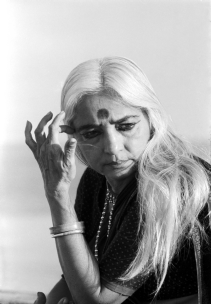
handralekha was also trained by the great masters in Bharatanatyam like Elappa Pillai, but soon realized that her guru’s sensibilities were quite different from hers. It was her very first public recital that was to shape her response and attitude to dance. She was dancing to a song ‘Mathura Nagarilo’, depicting the river Yamuna, the water-play of the maidens – the sensuality, the luxury and abundance of water. Suddenly she froze with the realization that she was portraying the profusion of water in the midst of a raging drought. Her recital was to raise money for the drought stricken. Newspaper reports and photographs of cracked earth, of people in long queues waiting for water, flashed in her mind. Art and life seemed to be in conflict. The paradox was stunning. ‘For that split second’, Chandralekha writes, ‘I was divided, fragmented into two people.’
|
|
|
|
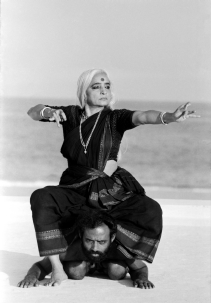
Chandralekha in the Naravahana sequence from her pathbreaking 1985 production ‘Angika’. (Courtsey The Chandralekha Archive, SPACES, Chennai). Photo by Sadanand Menon. |
|
What Chandra (as she was known) found missing in the dance world was a dialogue within the discipline as well as its interdisciplinary strength. She was keen to pose concepts and critique them, to initiate a meaningful discussion. She realized that the potential of aesthetics and cultural forms needed to liberate the human body and mind from inertia. She was conscious of the mediation of the West in the shaping of our approach to the traditional arts. The problems of revivalism, nostalgia, purity, exclusiveness, conservation, preservation, among others, she felt needed to be examined. She was convinced that the East, in order to be contemporary, modern in its expression, should not carry the burden of using the West as a crutch or as a ready reference. For her, being modern was to understand and express the East on its own terms, to explore the linkages generated by the interdisciplinary principles that are common to all arts and central to the creative concept of ‘rasa’.
C
handra was an intellectual and believed dance to be an expression of physicality. For her the vital link between body and nature had snapped, with dance becoming almost a spectacle. The questions she posed were: ‘What role does dance play in society? Can it recuperate energies? Can it infuse people with a joy for life, radical optimism, hope, courage and a vision to negate all that is ugly and unjust and hurtful?’
|
|
|
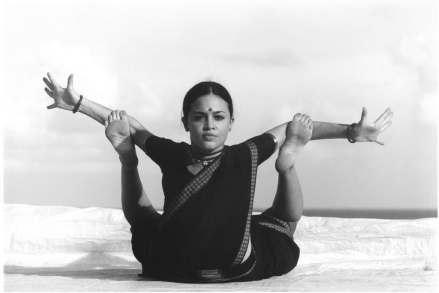
Tishani Doshi in Chandralekha’s last choreographed production ‘Sharira’, 2002. Photo by Sadanand Menon. |
Chandra began exploring the physical in Indian traditions, like yoga and the martial arts. She rejected those values where women were seen to be ‘objects of pleasure’, where patriarchy broke women’s backs, spine, and introduced in her dance a new vigour, an energy. The spine became a metaphor for her radical thoughts. She admired the poetry of the nayika, but as a nayika – not as ‘an object of male gaze’. Her productions from Angika to her last one, Sharira, demonstrated her originality as a choreographer of exceptional brilliance. She redefined modernity from an Indian perspective. A feminist and crusader for human rights, especially women’s rights and secularism, Chandra liberated Indian dance from its overtly romanticized religiosity and instead spoke of dance as a celebration of the body. She left a legacy of work that is themed on the indivisibility of sexuality, sensuality and spirituality.
A
mong members of her troupe, Padmini Chettur has further explored the concepts that Chandra posed and discussed. Chandra’s intervention influenced many in the dance world. Indian modern dance came to be measured with reference to her works like Prana, Mahakal, Rag, and Shree. She explored the potential of Indian dance traditions, of abstractions, in her work like Yantra. A visual artist, she incorporated several geometrical elements in her works in the Bharatanatyam interventions like in Alarippu and Tillana.
|
|
|
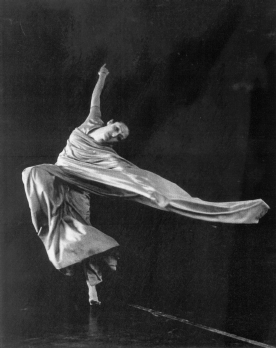
Uttara Coorlawala in ‘Draupadi’s Saree’, 1985, Sooterijn Theatre, Amsterdam. (Courtesy ‘Dans Magazine’, Netherlands.) Photo by Hans Gerritsen. |
Over the past two decades Indian modern dance has made many strides. Visit Bangalore where Jayachandran Palazhy’s Attakkalari has trained a generation in modern dance or visit Gati Dance Forum in New Delhi, where Mandeep Raikhy, a modern dancer and choreographer, has with his dynamic leadership opened the world of movement that international dancers and choreographers bring to young enthusiastic dancers. Also, Ambedkar University in Delhi has modern dance taught in both practice and theory.
Indian modern dance has become part of mainstream international dance festivals, be it the Brooklyn Academy of Music or the Bangalore International dance festival, the Mumbai Dance Festival or Malaysian Dance Festival. Perth, Japan, Taiwan, Mexico, Mauritius, in fact across the world, Indian modern dance has made its presence felt. It exists with pride and legitimacy, along with the traditional dance forms of India.