Modernist Maharaja
RICHARD HOLKAR
IN September of 2019, one of France’s greatest museums, Le Muséé des Arts Décoratifs, part of the Palais du Louvre, will present to the public an exhibition titled ‘Moderne Maharaja, un Mécène des annéses 30’ (Modern Maharaja, an Indian Patron of the Arts of the 30s).
That Modern Maharaja was my father, Yeshwant Rao Holkar. How did a young prince, brought up traditionally as was fitting for the son of a Maharaja, become the Modern Maharaja now to be brought into the public eye through this exhibition? Who could imagine that he would be remembered by the world at large as the consummate and elegant aesthete, who brought the finest of western avant-garde taste to Manik Bagh Palace, the home that he built in Indore?
Who was this man? ‘Major General Maharaj Adhiraj Raj Rajeshwar Sawai Shri Bahadur Sir Yeshwant Rao Holkar II Grand Commander of the Indian Empire, Maharaja of Indore’ was the official title used by the British in their correspondence with him; ‘Andatta’, Provider of food, as his subjects addressed him; ‘Sir Holkar’ as he was known in the United States; ‘Le Maharaja d’Indore’ as he was known in Republican France; ‘Bala’ the affectionate name for a young boy, as he was known as a child and as his wife called him; ‘Junior’, as my mother called him, and ‘Daddy’ as my sister and I called him. So many names for the same person, but that person inhabited all those personas, albeit at different times and in different places.
My father’s upbringing was anything but modern. The House of Holkar dates from the early 18th century, and by the beginning of the twentieth century was one of India’s premier princely states. Yeshwant Rao was the son of Maharaja Tukoji Rao Holkar, one of the last of the very traditional maharajas. Till then, Yeshwant Rao’s life had been normal – that is for an heir to the Holkar throne. At the age of 12, he was sent by his father, at the behest of the British, to England to be indoctrinated into the proper colonial spirit. He went to Cheam and Charterhouse, schools of the British nobility.
|
|
|
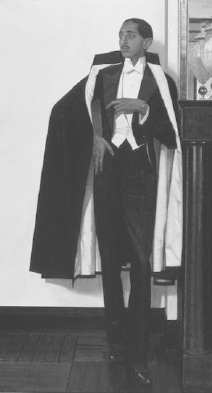
Maharaja Yeshwant Rao Holkar in evening dress, by Boutet de Monvel. |
H
is father, Maharaja Tukoji Rao Holkar was the absolute ruler of 16,000 square kilometers and 10 million subjects. Devoted to the welfare of the people of his state, he brought industrialization to Indore by promoting the cotton industry and Indore became known as the Little Bombay. He developed the Indore Agricultural College, attracting as its dean the agronomist Sir Albert Howard, inventor of the world famous Indore Compost method widely used today. Patrick Geddes, the famous town planner was called in to make a plan for the city of Indore. The resulting urban structure of Indore withstood the rise in population till the late 1950s.The absolute monarch was never far from the surface. He was enraged when his favourite courtesan Mumtaz Begum ran off with a wealthy Bombay businessman. Tukoji took a lesson from Henry VIII’s dictum: ‘Will nobody rid me of this troublesome priest?’ His minions overheard his musing, and three of them traced the rival suitor to Bombay’s Hanging Gardens. At noon on January 12, 1925, as the businessman was strolling along, they shot him dead. The assassins were promptly tackled by passing Tommies. The Maharaja was offered the choice of appearing before Britain’s House of Lords, the only institution allowed to judge a maharaja, or abdicate. Tukoji Rao chose to abdicate and was banned from his home, Indore. The reasons for his decision never came before the public eye, or to his son Yeshwant Rao, the seventeen-year-old heir to the Holkar throne.
My father was an intelligent and sensitive young man. We do not know how he reacted to his British upper class school or college mates, or indeed how they reacted to him. It is likely that his Indian roots and dark skin made him an outsider. Surprisingly, he never once mentioned any friends to me from his time in England.
M
y father, age 17, studying in England, must have been stunned and furious with the English. His father, after all, was the anchor of his young life. Suddenly he was at sea without a rudder. He remained anti-British all his life, and rejected much of the world which Britain stood for. Upon his father’s abdication, he was recalled to Indore, and assumed the title of Maharaja, but without the powers of a ruler, as he was still a minor. Indore was governed by a British appointed Regency Council, until he turned twenty-one.So long as Maharaja Tukoji Rao Holkar was in power, my father showed no signs of an intellect and spirit that would break the mold of a traditional Indian prince and reinvent himself as a modern maharaja.
The young Maharaja, age seventeen, was assigned a guardian, Dr Marcel Hardy, whose tutelage would have a profound effect on him. Marcel Hardy, an architect by profession, was in Indore as an assistant to the renowned town planner, Sir Patrick Geddes. Hardy was a brilliant architect, who passed out of Oxford with the unusual commendation of his examining board, ‘...that in our unanimous judgement, the best thesis, the best addition to knowledge, in this department, presented to the university, within our experience.’ Yeshwant Rao spent the next two years under Dr Hardy’s tutelage, and attended Holkar College, founded by his grandfather Shivaji Rao Holkar, in the late 19th century. At the age of 19, he was sent back to attend Christchurch College at Oxford, accompanied by Dr Hardy.
I
t was at Oxford that the transformation of the traditional prince of the Empire began, and the seeds were sown of Yeshwant Rao Holkar ‘Modern Maharaja, an Indian Prince of the 1930s.’ While attending Christchurch College Oxford, Yeshwant Rao lived with Dr Hardy. Hardy’s daughter was married to Eckart Muthesius, son of the famous German Architect Hermann Muthesius, a proponent of the Modernist Arts and Craft and Bauhaus movements. Charles Rennie Mackintosh, famous exponent of the Arts and Crafts movement, was Eckart Muthesius’ godfather. Eckart and his wife were frequent visitors in Hardy senior’s household. He and my father became close friends.|
|
|
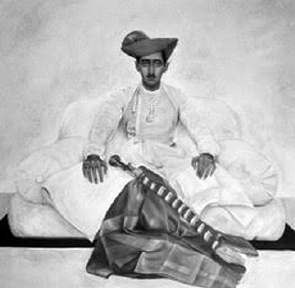
Maharaja Yeshwant Rao Holkar in Darbar dress, by Boutet de Monvel. |
T
he shock of his father’s abdication forced by the British must have made his mind a fertile ground for the wish to distance himself from British tradition and the colonial spirit. A profound friendship with a thoroughly modern Eckart Muthesius became the catalyst that opened my father’s intellect and aesthetic to the avant-garde world of Europe in the 1930s. Christchurch offered scholars lengthy vacations, as did all Oxford colleges. During these times, my father and Muthesius would visit the senior Muthesius’ home in Berlin, at the time the centre of both the Bauhaus and Modernist aesthetic. The two visited all the important cultural centres of that city.In his father’s home, Muthesius as a young man was exposed to Modernist luminaries such as Le Corbusier, Walter Gropius, Ludwig Mies van der Rohe and Marcel Breuer. In 1927 father and son visited the path-breaking Werkbund exhibition, ‘Die Wohnung’, the dwelling. Hermann wrote, ‘In general, however, the exhibition with its sparing, clear cut design is full of potential and our aesthetic categories are clearly developing in this direction’, and again, ‘our chairs, tables cupboards and other functional objects will be the abstract-realist sculptures of the interiors of the future.’ (Quoted in Retto Niggl, Eckart Muthesius Indien/ India 1930-1939)
|
|
|
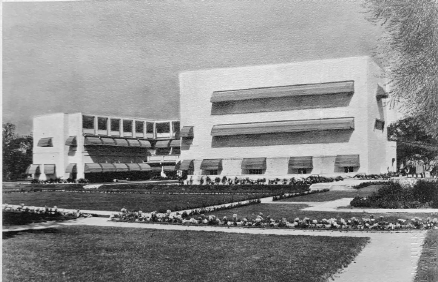
Artist’s view of Manik Bagh Palace with flat roof as the architect Eclhart Muthesius wanted, while the Maharaja insisted on a pitched roof. |
Yeshwant Rao certainly did not want to live in Lal Bagh, his father’s palace. Lal Bagh was a grand palace, a mixture of 19th century French Versailles and British palace architecture, whose gates were modelled on the gates of Buckingham Palace – all the symbols from which the young prince wanted to escape. Muthesius, whom I knew towards the end of his life, told me that it was during this time in Oxford, and the visits to the continent that the two young men dreamed of, and then planned, a new palace embodying the exciting modernist aesthetic which was unfolding before my father’s eyes. The result of the collaboration between Yeshwant Rao Holkar and Eckart Muthesius produced a large home that was one of the most important modernist buildings of the twentieth century. And it was in Indore, the capital of princely India’s Holkar state.
T
he two had such a meeting of minds that my father gave Muthesius pretty much a free hand in detailing what was to be his home and his palace. Yet, even here it was so different from what the world thought of as an Indian palace. Only nine bedrooms and only twenty-four rooms in all! This really was a family home rather than a maharaja’s palace. My father put his foot down on only one major design element. Muthesius wanted a flat roof, much in the style of Le Corbusier and the modernists. My father vetoed the idea; such a roof was not appropriate for the heavy monsoon rains that lashed Indore. Muthesius designed a sloped roof with specially created green ceramic tiles.Furnishings for Manik Bagh were chosen from the great designers of the day: Le Corbusier and Eileen Grey chairs, Ruhlmann desk and beds, Djo-Bourgeois tables, de Silva Bruhns carpets, Jean Puiforcart silverware, and Baccarat crystal. It is interesting that almost all of these pieces were not unique. Muthesius’s biographer, Retto Niggl, in his 1996 book, Eckart Muthesius Indien/India 1930-1939, says ‘the use of such serially produced items clearly distinguishes the brand of modernism clearly favoured by Muthesius and his client, from the representative decorative style of the 1920s, which sought to revitalize interiors with elaborate and exclusive pieces’ (p. 41). Muthesius himself designed much of the furniture and fittings, manufactured in Berlin.
T
he two years before taking power in Indore, Yeshwant Rao spent time in Paris as well as in Berlin. He was based in his chateau in St. Germain en Laye, just outside Paris. I believe he preferred the Gallic lifestyle to the more austere Germanic tradition of Berlin. He met Henri-Pierre Roché, the diplomat, author and art dealer, a man who was to have a marked influence on my father. Roché is best known for his semi-autobiographical novel Jules et Jim, made into a famous film by François Truffaut in 1962. My father and Pierre Roché became close friends, and they were frequent visitors to the bright lights of Paris.
I
n 1959, I recall seeing my father unusually sad. I asked him what was wrong and he said, ‘my best friend Pierre has died.’ Roché was very well established in the Paris avant-garde scene. It was he who introduced Picasso to the important American art critic, Leo Stein. Roché introduced my father to three artists of the time who had a major impact on him: the Romanian sculptor Constantin Brancusi, the famous photographer Man Ray, and the society painter Bertrand Boutet de Monvel.
|
|
|
|
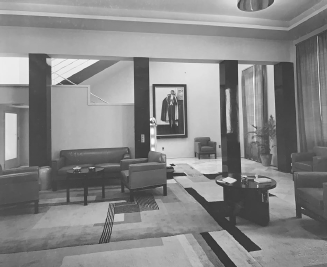
The reception hall at Manik Bagh Palace with the portrait of the Maharaja in western dress, which shocked his visitors. |
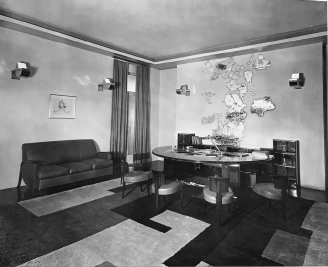
The Maharajas office with a desk by Emile Ruhlmann. Behind the desk is a relief map of the territories of Holkar State. |
My father had a strong spiritual, almost mystic sense about him, as I know from his fascinating library that I am fortunate enough to possess. Visiting Brancusi’s studio, he immediately knew that he wanted the three soaring ‘Bird in Space’ sculptures displayed there, one each in bronze, black, and white marble. He and Brancusi worked together to plan what my father called ‘The Temple of Solitude and Meditation’, a single round structure with a dome. This would be the Indore home for the two marble sculptures, one black and one white, entitled ‘Bird in Space’. A slender opening was to be made in the dome, which would turn with the sun, and the sun’s rays would light up the two birds. Only one person at a time was to be allowed entrance. The temple was never built, and as a child I remember seeing them in Manik Bagh’s banquet hall.
B
rancusi visited Indore to ensure the final polish of the marble birds. Our family secretary, H.S. Tiwari, who was a young librarian at the time, was asked to see that all the great sculptor’s needs were met. Tiwari recounted to me how the trunk of a banana plant transfixed Brancusi. He also took Brancusi to visit Ahilya Fort in Maheshwar, the 18th century capital of the state. In the 1950s my father visited Brancusi and the two pondered over the vicissitudes of life, which had prevented the temple from being built.Man Ray produced a series of wonderful portraits of the Maharaja, his wife Sanyogita, and both of them together. Sometimes serious, sometimes stark, and sometimes loving, these images give an insight into both Man Ray’s vision and what my father wanted to have shown.
Boutet de Monvel was commissioned to paint four portraits of my father and his young wife, Maharani Sanyogita: one of each in Indian dress and one in Indian clothes. The portrait of my father in our family ceremonial dress is a study in white. The large square portrait (180 x 180 cm) of a seated Maharaja Yeshwant Rao Holkar, white background, white angarkha, and white cushion gadi, the only colour being the pagdi, the sword, the dupatta and my father’s face and hands with his enormously long fingers, is certainly one of the finest realist portraits of the twentieth century. This painting was in stark contrast to the many royal portraits of other maharajas, in colorful brocades, festooned with jewels, numerous orders and medals. None of this was in de Monvel’s painting. The only jewels were the famous matching 45-carat diamonds known even today as the Indore Pears, mounted in perfect simplicity by the Parisian jeweller Chaumet.
A
further step into modernism: the paintings were hung in my father’s main reception room. On the palace’s inaugural day and then thereafter, his many visitors were stunned and often appalled to see something so different from what they expected. This was not at all royal! During the 1930s, Maharaja Yeshwant Rao Holkar supervised the creation of each: the photograph, painting and jewel. It is very clear that he had embraced the modernist aesthetic, and had broken from the traditional aesthetic of his peers. As a modern maharaja, he was much more than the person described above.He was also ‘Andatta’: It is important to know that he firmly believed in the advancement of his subjects. He was of a democratic bent and empowered village councils, panchayats, and their elected heads, the sarpanches. These elected heads would meet regularly with him, which gave him grass root knowledge of his people. He was also a keen shikari. During his frequent shikar trips around the state he would always hold mini darbars, open to all, which gave him ample opportunity to personally meet with the people of his state. He would dispose off pleas immediately, which endeared him to his people. He opened the temples to all his subject, male and female, high born or low. Albert Howard was the dean of Indore’s Agricultural College, and developed the Indore compost method, which even today is the basic method for turning farm waste into a fertile addition to the soil. The maharaja’s agricultural service promoted this throughout the state.
H
e continued developing Indore’s infrastructure on the lines established by Patrick Geddes, and created Yeshwant Sagar, an important water supply reservoir for the city.‘Sir Holkar’: He much appreciated the freedom of the United States of America and built a house in Santa Anna, South of Los Angeles. He was referred to as Sir Holkar, which he preferred to Your Highness. My mother often told me that he would have preferred to be a country gentleman.
‘Bala’: My father was married when he was fifteen, as was the custom in those days, to Princess Sanyogita Ghatge of Kagal, a principality in Maharashtra. They started life together in 1932, after Sanyogita finished her education, also in England. Elegant, charming and lively, the couple was the toast of the town wherever they went. While out of India, Yeshwant Rao and his wife wore western clothes, no doubt in an effort to avoid the attention that they would attract were they to dress in royal Indian clothes. Sanyogita referred to him as Bala. Very sadly, Maharani Sanyogita died in 1938. They had a daughter, Usha, my half sister.
‘Junior’: My father was remarried to my mother, Euphemia Stevenson, whom he met at a party in Bangalore. Euphemia was known as Fay, and she called him Junior. My mother was much the California woman, and her easy going modern ways provided my father relief at home in Indore from the responsibilities of shepherding his state through Indian independence and the accession of his Holkar state to the Indian republic. My mother hated the modernist geometric of Manik Bagh, and transformed several rooms to reflect her western American roots. She and my father frequently visited America where the nickname Junior stuck.
M
y father died when he was fifty-one and I was seventeen. His life story started at the height of colonial princely Indian tradition, as heir to the Holkar gaddi. Unhappy as a child in a hidebound British education, he was further uprooted when the British forced his father to abdicate. Between nineteen and twenty-one, he was exposed to the Modernism of the West. Rebelling against the colonial tradition, which he loathed, he eagerly absorbed Modernism and much of what it stood for. He created for himself a home in Indore where this Modernism was fully expressed, and where he could find refuge from the traditions that were required of a maharaja. Outside his home, he brought modern ideas to the management of his state, encouraged education for all, local self-government, religious freedom and temples open to all sexes and castes.It is my father, Le Maharaja d’ Indore, a dramatically modern and unorthodox Indian prince of the 1930s, who will be the subject of the coming exhibition.