Chandigarh: a modern experiment
NYNIKA JHAVERI
ON 15 August 1947, the Indian subcontinent was finally declared independent after almost two hundred years of British rule. This independence resulted in the creation of two nation states, India and Pakistan, intended by the British to provide for India’s two main religions, Hinduism and Islam. Sir Cyril Radcliffe, who was given the task of redrawing the map (his meager knowledge of India viewed as an impetus for impartiality), split the subcontinent into two sections.
The rapid, chaotic, and violent exodus of Muslims from India into Pakistan and vice-versa is said to have affected the lives of 88 million people. Given that Punjab was split down the middle, and its capital Lahore now lay in Pakistan, India required a new city to act as the state’s administrative centre to cope with the barbaric aftermath of Partition, and provide for its refugees. Thus, in March 1948, Chandigarh was conceived by the Government of India to serve as both the new capital of Punjab and as an emblem of the country’s new future.
1India’s first Prime Minister Jawaharlal Nehru, who commissioned Le Corbusier for the job, was a man on a mission to modernize India by combining western and Soviet principles of industrialization and development respectively. Given that Chandigarh was one of the country’s first large-scale projects post-independence, Nehru hoped to use it as a symbol of India’s progress and modernity and set the standard for what was to come. For Corbusier on the other hand, the project provided him the opportunity to actually realize large-scale schemes he had long been working on. His notions of the human body, the modular, green space, and speed, are seen to culminate in Chandigarh’s master plan. In addition, P.L. Verma (Punjab’s chief engineer) ascertains the need to provide the people of Punjab with a beacon of light and comfort succeeding an agonizing recent past with the help of this new and ‘magnificent city’.
|
‘Let this be a new city, unfettered by the traditions of the past, a symbol of the nation’s faith in the future.’ – Indian Prime Minister, Jawaharlal Nehru
‘Like the rising Phoenix from the ashes of its own fire.’ – Architect, Aditya Prakash
‘The city of Chandigarh is planned to human scale... Here the radiance of nature and heart are within our reach.’ – Le Corbusier
‘[Chandigarh can] possess sufficient magnificence and glamour to make up for the psychological loss of Lahore suffered by the strife stricken but proud Punjabis.’ – Engineer, P.L. Verma
‘Here is the city with its crowds living in peace and pure air, where noise is smothered under the foliage of green trees... There are gardens, games and sports grounds. And sky everywhere, as far as the eye can see.’ – Le Corbusier |
This questions the consequences of such top-down approaches in planning a city and how such seemingly lofty and abstract intentions eventually manifest themselves in its physical, urban fabric. Is it possible for the built environment to simultaneously act as a symbol, a means of rehabilitation and a centre to carry out the civic and political needs of a state capital?
|
|
|
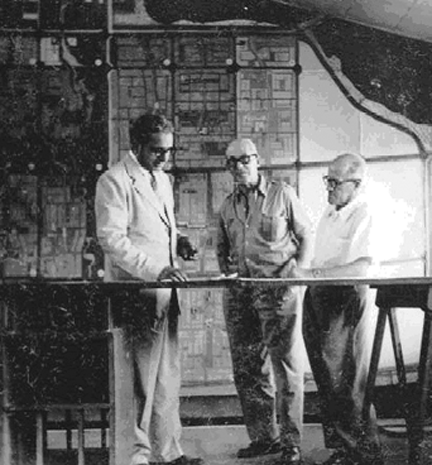
P.L Verma, Le Corbusier and Pierre Jeanneret at the drafting table. |
Although Le Corbusier, and his colleague Pierre Jeanneret, are those most associated with the master plan of Chandigarh, the American planner Albert Meyer was initially appointed to lead the project given that he was already involved in numerous smaller projects around India (in Uttar Pradesh and Bombay). In collaboration with Polish architect, Matthew Nowicki, Meyer set forth to design a plan that was ‘strongly Indian in feel and function, as well as modern.’ Based on Ebenezer Howard’s Garden City Movement, Meyer and Nowicki’s plan organized Chandigarh into ‘super-blocks’ or organized, self-sufficient residential neighbourhoods, defined by green space and vehicular circulation.
2
W
hen Nowicki passed away in a plane crash in 1950, the Indian bureaucracy took the reins to find a new team – leaving the ‘fan-shaped’ Meyer-Nowicki plan unrealized. Joined by Maxwell Fry and Jane Drew to design Chandigarh’s housing, Corbusier and Jeanneret began to design a master plan. While they retained some elements of the original plan, Corbusier definitively ‘held the crayon and was in his element’ (as said by his colleague M. Fry).3
S
ituated on a sloping site between two seasonal rivers, Patiala-ki-Rao and Sukhna Choe, Chandigarh was planned to be built in three distinct phases of construction (starting to accommodate the current population of 150,000 inhabitants (1951-76), eventually growing to sustain 500,000 (1980s onward). Being the first Indian city that was planned from the get-go, it boosted efficiency and modernity through its service infrastructures (water, sewage and transportation).
|
|
|
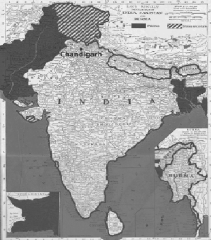
Rand McNally’s late 1947 view of Partition (edited). |
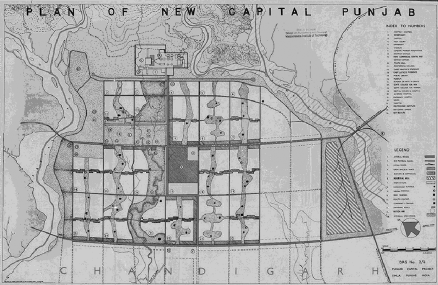
Corbusier’s organized and highly rational plan started from the typical western Cartesian grid (similar to that of Manhattan), where the bounds of each unit are defined by the roads that surround it. Similar to Meyer’s super-blocks, each of these units or ‘sectors’, were to be ‘containers of family life’, with vertical green belts running through them. Corbusier also imposed an anthropomorphic intimation to the various elements of the city to further rationalize its scalar relationships (perhaps by way of his ‘Modulor Man’): the Capitol was Chandigarh’s head, the city centre its heart, the commercial centre its stomach, industrial and cultural institutions its arms, the parks and open spaces its lungs, and the network of roads its arteries. The sectors with its residential areas would thus comprise the greatest footprint, or the body of the city.
4
G
iven that Chandigarh was one of Corbusier’s later projects, the way in which it incorporates various elements from his previous works and draws parallels to other modernist paradigms, is intriguing. While the organization of the city occurs proportionally to the human scale, Corbusier’s tendency to equate city life to that of the ‘living machine’ – where work, leisure and residential life are strictly segregated into zones was also elucidated in his Ville Radieuse (The Radiant City). However, while Ville Radieuse saw the imposition of seemingly artificial ‘nature’ as the spaces in between these zones, Chandigarh’s emergence from farmland allowed its vertical belts to maintain a lush green landscape, perhaps similar to how Ebenezer Howard envisioned his Garden Cities.
|
|
|
Le Corbusier’s Chandigarh, Punjab Capital Project, 1951. Source: MIT Rotch Library Archives. |
In a means to structure circulation between and within these zones, Corbusier also developed a hierarchy of roads (les sept voies) diminishing in scale and speed. While V1-3 comprised vehicular roads connecting Chandigarh to other cities, the main arteries within the city and the roads surrounding the sectors, V4-6 comprised those within each introverted sector, whether serving as shopping streets, or residential roads. Finally, V7 and V8 were specifically designated for pedestrian and bicycle traffic or a means to achieve the ‘Indianness’ that Corbusier aspired for.
5
I
n zooming in further to the typical ‘Sector’, it is surrounded by V2 and V3s such that each unit is enclosed, yet not exposed – residential blocks open inward onto V6s, while the V5 that cuts across the centre is the secondary circulation within the sector. Thus, it is clear that the city was laid out using the ‘modern’ automobile as a priority. While Corbusier may have believed that automobiles were ‘the mark and beauty of the age’, is it possible that there was almost a lack of intentionality for pedestrians? While the green belts, and meandering streets that had been set aside as V7s (for pedestrians) and V8s (bicyclists) may have been enjoyable and picturesque in their function – these streets were hardly practical when it came to reaching a specific destination. Given the large Indian propensity to walk to and from work or school, this could be seen as adversely affecting some of Chandigarh’s inhabitants.In considering the ‘Sector’ as a part of the larger Chandigarh footprint, and its variations, the different inhabitants that Corbusier set out to provide for become more legible. Schematically, each unit measured 1200 x 800m, and was surrounded by the hierarchical road system. In a means to be a ‘container of social-life’ – each sector comprised of shops, schools, hospitals, and temples, in addition to the residential units. The variation occurred in the way the different social classes were segregated across sectors – some housed 5,000 people in larger homes (ministers, senior officials) while others housed almost 20,000 people on smaller plots (government workers and laborers).
6
S
imilarly, the location of each sector was also prescribed – further away from the Capitol, the higher its population density. While India’s class disparity is prominent in all its cities, it has been a consequence of years of organic, and informal growth. However, Chandigarh was perhaps the first time when this class distinction was so purposefully manifested with such distinct boundary conditions. In addition, while the planners were ‘providing’ for all classes (whether problematically or not), the large immigrant population that would emerge in the informal sector as a byproduct of Partition was not given heed to, resulting in the unequal development that occurs on Chandigarh’s periphery as will be addressed later.
N
ehru envisioned Chandigarh as ‘a modern and efficient city... with open spaces liberating Indians from the tyranny of overcrowded and filthy cities, as well as from the confines of agricultural life.’ Perhaps one of Corbusier’s greatest achievements in Chandigarh, was to manifest the above through green landscapes across scale – from the Leisure Valley (a series of continuous parks that spanned the city), to green belts within sectors and the house/garden unit.These multi-functional spaces provided Chandigarh’s subtropical climate with a series of cooling micro-climates with flood control potentialities that allowed space for public programming and private consumption, whilst adding to the overall character of the city.
7 While the landscape plans may not have been completely realized, Chandigarh’s success as India’s first intentional Garden City, set a precedent for India’s formal and informal developments for years to come.
|
|
|
|
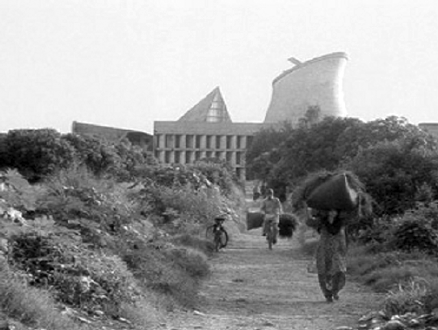
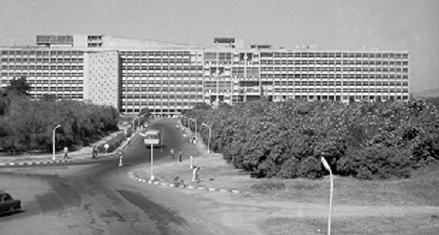
Road leading to the Assembly. |
Roads leading to the Secretariat. Source: Vikramaditya Prakash, Chandigarh’s Le Corbusier: The Struggle for Modernity in Postcolonial India. University of Washington Press, Seattle, 2002. |
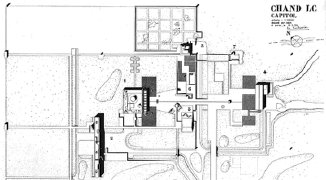
Given that the conception of Chandigarh was a byproduct of Punjab’s need for an administrative centre and Indian polity’s (Nehru’s) need for a state-driven symbol of progress and modernity, Corbusier’s design decisions for the Capitol are especially intriguing. Located North of the city, the Capitol lies between the foothills of the Himalaya and the artificial dunes that Corbusier designed. Similar to the boulevards and follies of Haussmann’s Paris, the buildings of the Capitol are oriented and framed by the roads and paths that lead to them, without any visible obstructions impeding the gaze of the approaching inhabitants. In like manner, in elevating the Capitol above the rest of the city, permitting it to function as a seeming surveyor, along with the processional approaches to the dominating, large-scale, concrete, buildings, Corbusier was able to assert the authority of the state and its powers on the otherwise small-scale, subdued cityscape.
8
W
hile the ability to establish physical, and thus symbolic dominance of one part of the city over the other can be seen through Corbusier’s various decisions in the Capitol’s placement, orientation, scale and material treatment, we must also consider the impact on visitors, and their experience at a more human scale. Although the large plazas situated in front of and around the Capitol buildings were a means of enhancing their effect on visitors, combining them with Chandigarh’s hot and dusty environment prohibited them from acting as public spaces of social-gathering as was intended. Furthermore, while their placement away from the city centre was meant to secure their status as above that of the rest of the city, it significantly reduced the number of Chandigarh’s citizens that may actually visit the Capitol to enjoy its surroundings.
W
hile considering the role of the Capitol and its presence within the greater city of Chandigarh, we question what it means to act as both planner and architect. While Corbusier was at the helm in planning Chandigarh, could his typical role as architect have precipitated some of his planning decisions? Given Chandigarh’s smaller scale architecture (housing) were eventually carried out by Maxwell and Fry, could Corbusier’s aggrandizing of the Capitol also be seen as a means to self-serve his own creations?
|
|
|
|
Plan of the Capitol. |
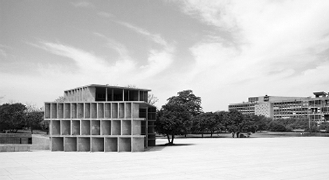
The Tower of Silence. |
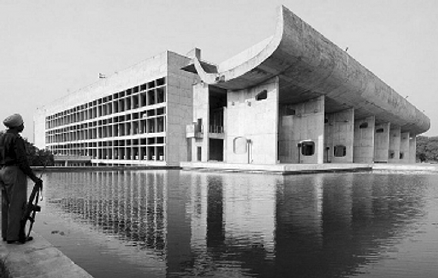
Nonetheless, when thinking about Chandigarh’s role within the contemporary modernist paradigm, its architecture at the Capitol is perhaps most identifiable. In culminating his concrete, somber, modernist aesthetics from Unite d’Habitation or Ronchamp, with vernacular techniques of climate control (brisesoleils), Corbusier did assert his mastery at inserting into an unfamiliar landscape, works that were new and modern, yet contextual.
C
orbusier had begun Chandigarh’s planning process by establishing three distinct phases of development – while the first would cater to Chandigarh’s initial population of 150,000 inhabitants in the 1960s, the last would include an increased number of sectors to serve the intended 500,000 people by the early ’90s.
B
y 1986, however, when Chandigarh had reached its intended target of 86 sectors, its population was at 800,000 (while today, it is over one million). As a result, Corbusier’s highly rational plan has had to compete with patterns of urbanization and migration which he failed to consider when gearing this model toward the less fluctuating populations of western cities with established middle classes. Given the specificity, and rigidity with which the sectors were planned, their over-densification began to obstruct the lives of residents. While the city was planned with the automobile in mind, it has been unable to compete with the high-volume traffic that Chandigarh now sees. This rapid growth of the city has both forced its boundaries further outward in a more informal manner as well as further inward (encroaching on areas delineated for other functions).9
|
|
|
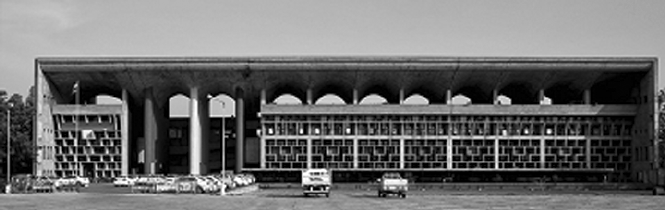
The High Court. |
I
n addition to an increase in population within the city, it is also interesting to analyze the means in which this population increased. While the ‘elite’ classes continued to hold a large footprint within the city (despite being a minority), the middle classes have expanded into varying housing typologies – institutional, governmental or those built by the housing authorities. Similarly, while the ‘elite’ continue to have quick access to both the city centre and the capitol, the other classes fade out toward the cities edges. The sharp class distinction that Corbusier and the state had established in the ’50s has continued to dominate the city’s urban fabric.10As mentioned earlier, the impoverished populations displaced to the peripheries of the city have only increased in number. It is said that almost 40 per cent of the cities population today consists of this demographic that Corbusier and his team failed to consider, resulting in the need for special housing boards and subsidies. On the other hand, the slum settlements growing within the city have begun to encroach on the green belts, open plazas and wide roads that Corbusier and Nehru deemed the most significant aspects of the plan. The above challenges the extent to which a planner must consider the past, present and future of a city. While Corbusier provided Chandigarh with a framework at the time of its conception, did this framework allows scope for growth?
Chandigarh also holds great merits. While in 2016, it was named the ‘greenest city in India’ with a negative deforestation rate, it also ranks first in India in the Human Development Index, given its urban infrastructure is the most up to date from any city in the country. On the other hand, while Chandigarh retains the highest per capita registration of vehicles in the country (true to Corbusier’s desires), it is because the V Road System prohibits the existence of an efficient public transportation service, and not because the city hopes to perpetuate its modern ideals. These dualities challenge what it may mean for a city to be successful, how long it takes for a city to settle into itself before it may be judged successful, and to what extent the planners are responsible for this so-called success, especially given a city within the Indian context.
W
hile Corbusier’s master plan was conceived as a broad framework, the extent to which his ideals came to fruition begin to answer the latter. While his directives included using brick, concrete and stone as the only materials in Chandigarh’s construction, the way they are ornamented through signage, cultural iconography, vernacular jaalis or latticed screens, are that which allows Chandigarh to regain the ‘Indianness’ familiar in other cities. While Corbusier, Maxwell and Fry had set aside specific housing prototypes for Chandigarh’s expansion at each phase, it was the citizens that took agency into developing later Sectors into the multi-family housing units that they were accustomed to. Similarly, although each Sector was meant to serve as a ‘container of family life’, some began to serve as more specifically institutional (for colleges) or commercial, with the changing needs of the city.
I
n Corbusier’s Edict to Chandigarh, he mentions: ‘The seed of Chandigarh is well sown. It is for the citizens to see that the tree flourishes.’ In saying this, perhaps he was cognizant of his master plan as a framework that would be modified as required. His greatest service to the city was undoubtedly its service infrastructure and its green landscape that have allowed Chandigarh to develop an identity as a new and modern city, yet one that is undoubtedly Indian by virtue of its inhabitants and their ways of living.Vikramaditya Prakash writes about Corbusier and Nehru’s efforts in Chandigarh as the ‘mimicry of the colonial project, of the aims and aspirations of colonization, imitated and re-legitimized by the English educated, Indian elite… mimicry and imitation however, do not ensure that the end product will always be identical to the original.’ What is most intriguing about Chandigarh today, despite its similarities with paradigms such as Ville Radieuse, the Garden City Movement or even Haussmann’s Paris, is how its physical manifestation is different in that it is both a byproduct of its ideals and the context within which it came to being. While it can be judged as a postcolonial experiment that may not have prioritized its people, it can also be that it is far too early in Chandigarh’s lifespan to judge its efficacy as a city.
|
|
|
The Assembly. Source: Ghinitoiu, Laurian. AD Classics: Master Plan for Chandigarh / Le Corbusier, https://www.archdaily. com/806115/ad-classics-master-plan-for-chandigarh-le-corbusier |
Over the last 60 years, Chandigarh has begun to settle into its own and define its identity in addition to that set forth by Corbusier and his team. While traffic, and poverty may have increased, so have its green landscapes and its standards of livability. Similarly, while some of its inhabitants are concerned about the city’s density, others stand tall in proudly speaking to its distinct identity within India’s recent history. These dualities signify the inability to deem a city of this scale as uncontestably successful given its rapid evolution thus far, and that which is still to come. However, perhaps its success is more a product of its experimentation within developing countries, the new requirements it may suggest for planners, and its better developed criteria for their appraisal. Perhaps India’s Prime Minister, Jawaharlal Nehru, one of the greatest proponents for Chandigarh, sums it up best: ‘It doesn’t really matter whether you like Chandigarh or whether you don’t like it. The fact of the matter is simply this: it has changed your lives.’
Footnotes:
1. Edward J. Mallot, Memory, Nationalism, and Narrative in Contemporary South Asia. Palgrave Macmillan, New York, 2012.
2. Vikramaditya Prakash, Chandigarh’s Le Corbusier: The Struggle for Modernity in Postcolonial India. University of Washington Press, Seattle, 2002.
3. Ibid.
4. Ibid.
5. Le Corbusier, et al., Oeuvre complète; Le Corbusier Et Son Atelier, Rue De Sèvres 35. Vol. 6, G. Wittenborn, 1957.
6. Ibid.
7. Ibid.
8. William J. R. Curtis, Modern Architecture Since 1900. Phaidon Press, London , 1996.
9. Hasan-Uddin Khan, Julian Beinart and Charles Correa, Le Corbusier: Chandigarh and the Modern City: Insights Into the Iconic City Sixty Years Later. Mapin Publishing, Ahmedabad, 2009.
10. Ibid.