One hundred years ago
NONIE NIESEWAND
BAUHAUS, which opened its doors in Germany in 1919, was the most influential yet short lived design school in history. In just 14 years Bauhaus made the modernist movement mainstream all over the world, proof that the Nazis, who shut it down in 1933, could not suppress its ideas. ‘Form follows function’, ‘Less is more’ and ‘God is in the details’, were pithy mission statements that underpinned their aesthetics. It revolutionised what our homes looked like then, and now, and how our buildings are made.
As the Bauhaus celebrates its centenary, the important part India played in its legacy and influence on global modernism can be traced in two historical movements: the arts and craft approach at the beginning, and its industrial training programme for mid last century modernists long after its doors had closed in Germany, adopted by Jawaharlal Nehru, Prime Minister of India post-independence when he installed training programmes at a time of rapid industrialisation.
When architect Walter Gropius founded the Bauhaus campus in 1919 in the ultra-conservative Weimar Republic, its prospectus promised ‘to bring together all creative efforts into one whole, to reunite all the disciplines of practical art – sculpture, painting, handicrafts and the arts – as inseparable components of the new architecture.’
When Rabindranath Tagore (1861-1941) visited the Weimar Republic in 1921 for his poetry recitals, the Bauhaus school was just two years old. Bauhaus corresponded with Tagore’s ideas of a non-hierarchical artistic community at the Kala Bhavan art school in Santiniketan, some 100 miles north of Calcutta. This ashram within an art school opened in 1921, the same year that Gandhi launched his Non-Cooperation movement, inspiring many to boycott colonial institutions. Tagore was in sympathy with Walter Gropius’ educational ideals of integrated life and his preference in those days for handicrafts to mechanised work.
Its history of art teacher, Stella Kamrisch (1898-1993), asked the monkish, mystical master at the Bauhaus, Johannes Itten, to send 250 artworks to the Society of Oriental Art in Calcutta. Thus, the first ever Bauhaus exhibition outside Germany took place in Calcutta in 1922 under the curatorship of Abanindranath Tagore. It was not a success. Only one artwork sold, despite drawings by Wassily Kandinsky and water colours by Paul Klee on sale for £10, in today’s currency worth about £540 GBP.
‘The immediate impact of the show was obvious but it sounded the death knell not only for academic art in India but also for Orientalism and its engagement with the past’, writes Partha Mitter, Professor of Art History at Sussex University, reviewing India’s artists and the avant-garde (1922-1947) in his book, The Triumph of Modernism. ‘Today we perhaps take modernism for granted as the natural style of the twentieth century’, he writes. ‘However, in the 1920s, even in Britain, modernism was still a minority affair, let alone in colonial India. At the same time, the initial unease about the new syntax began to give way to its gradual acceptance.’ Indian artists like Gaganendranath Tagore and his younger sister Sunayani Devi had their first public exposure alongside the Bauhaus artists.
As the Bauhaus became more interested in architecture and industry, Santiniketan developed over 98 years into a cultural centre, university and department for agriculture and an institute for rural development. This progression can be viewed in a 2018 film O Horizon by the Otolith Group, subtitled ‘the place where India meets the world.’ Flames leap from the forest to flicker around mechanical excavators at the start, as lines from Tagore’s poetry are read. Produced in West Bengal, the film celebrates through music, dance, poetry and literature an ethos of modernism, cosmopolitanism and ecopolitical awareness.
By 1925 when the nomadic school was removed from the Weimar Republic and moved to Dessau, the focus by Gropius was on a ‘contemporary design for housing’ ranging from ‘simple domestic equipment to a complete residence.’ Gropius designed the new campus in three and five storeyed blocks linked by bridges. Glass curtain walls allowed onlookers to see inside the workshops and studios where tubular steel frames slung with leather seats on Marcel Breuer’s ‘Wassily’ chair (1925) landed lightly. ‘Any object properly and practically designed should fit into any room in which it is used, as would any living object like a flower or a human being’, Marcel Breuer was convincing.
M
ies van der Rohe’s patented cantilevered stainless steel MR chair (1927) which sprang from the ground in a sinuous S bend was so popular with householders swapping ornate Biedermeier for steely Bauhaus that he lived off the royalties. Some of the Bauhaus designs still in production include the frosty domed bronze table lamps by Wilhelm Wagenfeld, geometric carpets from Benita Koch-Otte, and Anni Alber’s weaves. Cups, saucers, forks and spoons, childrens’ toys, salt and pepper shakers, you name it, the Bauhausians made it.Bauhaus was not a laboratory-like discipline. Sometimes it held Haus parties in the building they called the Festive area. At the Metal Ball in Dresden in 1929, Paul Klee and Wassily Kandinsky made their entrance coming down two huge metal slides. Dressed as skyscrapers, automobiles, antennae and various forms of cutlery, the cutting-edge design students and staff danced the night away.
J
ust how Bauhausian principles in design and architecture adapted to different social and political contexts is the subject of ‘Moving Away’, an exhibition commissioned by bauhaus imaginista. Staged at the Kiran Nadar Museum of Art (KNMA) in New Delhi at the end of last year, the exhibition moved to Berlin to celebrate the Bauhaus centenary between March and June this year. The title makes the point: Bauhaus ideas were never a case of pure dissemination: ‘How these ideas were accepted and rejected in relation to local conditions set against a backdrop of geopolitical change in the twentieth century is the aim of this particular exhibition’, says Grant Watson, curator with Marion von Osten of four separate exhibitions for bauhaus imaginista with photo documentation corresponding with four chapters: Moving Away, Corresponding With, Learning From, and Still Undead.‘Moving Away’ begins with Marcel Breuer’s 1926 film strip collage ‘ein bauhaus-film, funf jahre lang’ (a bauhaus film, five years long). In that timespan chairs shown evolve from a crafted, exotic throne-like African Chair (1921) by Marcel Breuer with Gunta Stolzl; progress to industrial prototypes with a modernist steel chair by Breuer, again with Stolzl; then a modular de Stijl chair that explores various materials, and a seminal tubular steel chair. The fake film clips end with a woman sitting on a column of air which dematerializes the very notion of a chair and heads towards a future where designed objects become obsolete.
B
reuer designed this filmstrip poster for the first Bauhaus journal sent to friends of the Bauhaus by founder, Walter Gropius. As financial struggles and political pressures from the right put Bauhaus on a precarious footing, the journal was intended to make links with industry. Less art, more architecture. The magazine’s contents introduce the basic principle of Bauhaus design, going beyond individual objects – cups, chairs, textiles, wall colours and flooring – to think about the building as a whole, featuring campus architecture, houses and housing estates.Just how these disciplines were integrated and related to the idea of social function and reform, all feature in ‘Moving Away’. Text heavy information conveyed through journals, diagrams, posters, and graphics are displayed on hinged structures specially designed by Berlin based KDP architects. Films and photographs document the master houses and the new school designed by Walter Gropius in his own practice when Bauhaus moved from Weimar to Dessau in 1925. The construction of Turten housing estate by Gropius is also studied for the efficiency of mass produced affordable housing.
The architect Le Corbusier, whose legacy in India is legendary, was not showcased in the KNMA Delhi exhibition, partly because his modernism was not linked to Bauhaus, and partly because his influence at Chandigarh and the Sarabhai house in Ahmedabad is well documented. More surprising in the exhibition’s coverage of the architectural legacy of the Bauhaus following India’s independence, was the omission of Habib Rahman. In the early 1940s the young engineer won a scholarship to the Massachusetts Institute of Technology where he was taught by a visiting professor, Walter Gropius, who found him work in the USA with Marcel Breuer after graduation.
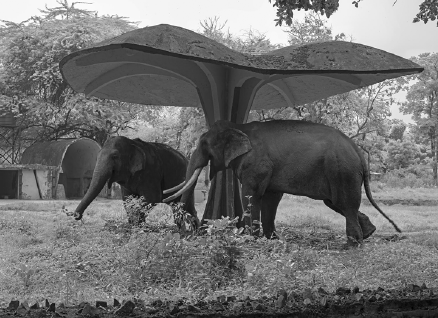
Habib Rahman’s first building after his return to India in 1947 was a modern memorial to Mahatma Gandhi on the banks of the Hoogly near Calcutta which so impressed Jawaharlal Nehru, India’s first prime minister, that he was invited to design government buildings, apartments, New Delhi’s first steel framed skyscraper and even its zoo (1955-74). The National Zoological Park as it is called today is in poor condition but inescapably illustrates the timeless influence of the Bauhaus. Elephants sheltering beneath a great concrete umbrella, which springs from a single cement stem in an old seventies photograph taken in the Delhi Zoo, illustrates Rahman’s inventive use of materials and originality of design. Inexpensive concrete was the solution for a country that needed to build new institutions in a hurry.
‘The focus of our exhibition in India and seminar which occurred alongside the exhibition, was the historic example of design and art schools from Kala Bhavan in Shantiniketan defining early modernism in art and culture and active at the same time as the Bauhaus, and to the Baroda school, the National Institute of Design in Ahmedabad and Industrial Design Centre in Mumbai’, Grant Watson explains. ‘The contents are as much about Bauhaus entanglements and its reception abroad as to how it was received internationally as one of the streams of modernism.’
C
ase studies in the exhibition compare different responses to the Bauhaus filtered through cultural translation, and grounded in the conditions of a particular locality. One study focuses on the Jawaja collaboration between the National Institute of Design and a business college, both based in Ahmedabad, to help weavers and leather workers in Rajasthan find new markets and to improve their standard of living through craft. Others feature vessels and how they are used, tools, cookware and the use of bamboo in architecture. A collection by fashion designer David Abraham, who trained at the National Institute of Design in Ahmedabad, puts khadi handloomed cotton on the catwalk with intriguing weaves and patterns.
T
he exhibition follows the influence of Bauhaus globally as politics catch up with the original founders. After his politically motivated dismissal in 1930, Bauhaus director Hannes Meyer, with seven students, travelled to Moscow at the invitation of the Soviet government. They worked on projects designing educational facilities, interiors and housing schemes and large-scale planning of new towns such as Orsk in the southern Urals. Under Stalin’s regime their avant-garde ideas were rejected. Worse, several Bauhaus architects were imprisoned and some even sentenced to death. Many left for Europe, Asia, South America where these Bauhaus trained refugees worked as city planners and educators.
T
wo decades after the Bauhaus closed, the HfG design school in Ulm was founded in 1963 to continue and contest Bauhaus ideas. Its ideology was design as a tool. Their traditions of integrated art, craft and technology were given a good dose of sixties’ zeitgeist: sociology, psychology, philosophy, politics and economics were all added to basic design. Bauhaus masters and students were hired to teach a version of the preliminary course based on visual and tactile training in colour and form. It ceased operation after 15 years but its links with the National Institute of Design (NID) in Ahmedabad, founded in 1961, and the Industrial Design Centre (IDC) in Mumbai, founded in 1960, resonate today.|
|
|
Habib Rahman, Elephant Umbrella, Delhi Zoo, 1970s. Photo by Ram Rahman |
Two celebrated contemporary international designers who trained at NID and IDC respectively, Nipa Doshi and Satyendra Pakhale, both pinpoint the legacy of Bauhaus in India as a ‘disconnect’. Student of furniture design at NID for four years before joining the Royal College of Art in London as a postgraduate, Nipa Doshi says, ‘There was a disconnect between real life and design. Industrial design for everyone was a disconnect. For example, industrial design students at NID had to make coffee makers but in Gujarat we drank tea, not coffee. Form follows function I found highly limited, so Germanic in the context of India. No emotion, no joy or ornamentation.’
D
isconnection for Satyendra Pakhale, founder of SPA in the Netherlands who trained at the IIT, the Indian Institute of Technology in Bombay and later, at the Art Centre College of Design Europe in Switzerland, relates to the student intake and social inequality. ‘It’s hard to pinpoint any legacy today in India of the Bauhaus. But there is a huge disconnect between the majority of students coming from privileged backgrounds that go through the premium design schools with hardly any concern for social conditions around them. There has been some change but not as much as one would expect. The sons and daughters of artisans hardly get to enter such places of design education.’As one half of the internationally renowned London based design studio Doshi Levien, Nipa Doshi with her husband Jonathan Levien has designed products for major international brands – Swarovski; Italian companies Moroso, Capellini, B&B Italia; Spanish Kettal, Nani Marquina and B.D. Ediciones; Danish Kvadrat and limited artwork edition pieces for Gallery Kreo in Paris and also, Sevres porcelain. Their designs for many products are showcased in museums all over the world.
Not everything Bauhausian at NID was wasted on her. ‘For me, the NID resource centre filled with prototypes from the original Bauhaus brought a real sense of the important relationship with the workshop, bringing design into manufacture’, she says. Chairs designed by Gropius, Mies van der Rohe, Breuer copied in India were already familiar – her father’s office chair was a copy of the famous cantilever – but studying the originals at close hand, alongside Gunta Stolz’s original weaves shown with great big wooden looms of the Weimar Republic, was influential.
‘Learning from the Bauhaus stayed with me in the way I draw on graph paper’, Nipa Doshi says. ‘My geometric shapes that show the rationale behind the design, look behind the pattern, are all part of my education.’ In 2017 a Doshi Levien installation, ‘Wool Parade’ for Danish textile manufacturers Kvadrat, was inspired by Oskar Schlemmer’s designs for costume parties at the Bauhaus. Twelve geometric fabric shapes twirled as conical capes, hats and skirts in an animation film by Studio AKA.
‘It was Ray and Charles Eames who breathed life into the NID with their manifesto that celebrated the plurality and complexity of Indian culture,’ Nipa Doshi believes. In 1957 the American industrial design duo, Charles and Ray Eames, were invited by the Government of India with the Ford Foundation and Pupul Jayakar, founder of the Handicrafts and Handlooms Export Corporation, to recommend a training programme in design at a time of rapid industrialization. The Eames’ poetic celebration of an everyday vessel, the lota, as a thing of beauty underscored their manifesto for an institute that they wrote ‘will hasten the production of the "lotas" of our time, generating an attitude that will appraise and solve the problems of our coming times with the same tremendous service, dignity and love that the lota served in its time.’
Fifty years later Satyendra Pakhale believes that there is a lot more machine manufacturing at the industrial level in India than handcraft. ‘I think, with few exceptions, there’s a huge disconnect between handcraft and machine manufacturing. One hardly sees a genuine innovative approach of integrating handcraft and machine manufacturing. Perhaps it has a lot to do with the disregard for handwork in Indian society. Handcraft may be celebrated in isolation but one hardly sees a true integration with other technologies. India has a great heritage of handcraft but those need to be updated and brought into the 21st century to create contemporary design.’
At Design Miami 2019, staged during Art Basel, a seminar on ‘Remapping the Bauhaus’ was held with Deyan Sudjic, Director of London’s Design Museum, Vitra Museum Director Mateo Kries, Fine Arts gallery owner Paul Hughes, who is an expert on the textile designs of Anni Albers, and award winning designer Satyendra Pakhae whose monograph, ‘Culture of Creation’, explores his work for international companies in many disciplines. Their objective was to consider the Bauhausian legacy in thinking of modernity as a social act to influence society.
T
oday Satyendra Pakhale believes that ‘modernity came to India merely as a visual modernity. Even today, more so than ever, social modernity in India is still a work in progress with little success on the scale of India. There is still a long way to go.Impact on many levels needs to happen, such as fundamental ideas of modernism that are deeply rooted in the local cultural context from ancient times that need to be revived and implemented in education to bring about social equitability and create a renewed entrepreneurial culture.’