Living with modernism
MAYANK MANSINGH KAUL
IN 1941 an artist, who had briefly spent time in Iraq painting portraits of King Ghazi I of the Hashemite dynasty and his family, arrived in Bombay (now Mumbai). Stefan Norblin was already of some renown back home in Poland as a graphic illustrator and portrait painter, when the Second World War pushed him and his actress wife to find a safe haven in British India. Within a span of five years, he received and delivered four major commissions by Indian royalty, producing a significant body of drawings, oil paintings, murals, and furniture designs in their residences. These were for the Morvi Palace in present day Gujarat, Ramgarh House in Patna, Bihar, and the Umaid Bhawan Palace in Jodhpur, Rajasthan. In addition, he created the interiors and mural paintings for a royal hunting lodge in Sardar Samand, also in Rajasthan, for the Maharaja of Jodhpur.
Norblin’s artistic style, identifiably Art Deco from Eastern Europe (to begin with), underwent a major transformation in these commissions: he combined its starkly bold style with that of Indian art and architecture, taking inspiration from historical references such as the sculptures of Khajuraho and the frescoes of Ajanta, as well as the emerging strands of modern Indian art. His work alluded, at the same time, to the Orient and East Asia, creating an eclectically exciting oeuvre, vividly colourful and syncretic of myriad aesthetic influences. Today, when the word modernism evokes for most, images of starkly geometrical buildings and industrial minimalism, Norblin’s work can be seen as belonging to a range of its plural manifestations. These evolved their own unique trajectories in the Indian context, reflecting the zeitgeist of the time, borne out of local responses to global ideas.
Almost two decades before this, in 1922, an exhibition at the Indian Society of Oriental Art in Calcutta (now Kolkata) presented the works of European and Indian artists together, which included Wassily Kandinsky, Johannes Itten, Lyonel Feininger, Gerhard Marcks, George Muche, Nicholas Roerich, Gaganendranath Tagore, Abanindranath Tagore, Sunayani Devi, Nandlal Bose and Abdur Rahman Chugtai. The European artists had come together under the Bauhaus, an art and design school and movement in Germany, founded in 1919 in Weimar. The exhibition offered a chance to the Indian public to look at European art, which till then had been typically associated only with naturalism, landscape and portraiture. The work of the Indian artists were bound by a fresh figurative style which looked to miniature painting for inspiration, largely referred to as the Bengal School.
W
hile both sets of artists showed stylistically different works of art, they were expressions of a new identity in both countries: in Germany, a new republic founded in the immediate aftermath of the First World War; and in the Indian subcontinent, the creative modern response to British rule through a sense of patriotism for a new idea of a country itself. The inherent internationalism in such nationalism, had informed the founding of Vishwa-bharati in Santiniketan in Bengal, Rabindranath Tagore’s utopian learning commune which looked east-wards to Asia as much as to the West, at the height of European colonialism in Asia and Africa.
T
hese unique developments, often seen as avant-garde for India at the time, can be seen as belonging to longer traditions when art and design in the Indian subcontinent evolved through wide-ranging international dynamics. Such assimilations can be traced periodically to the time of the Harappans and further, to the 6th century B.C. Whichever point one may chose to stop at in Indian history from then till now, we encounter the expected or unexpected – whichever way one wishes to look at it – creative occurrences between cultures which are often larger than the sum of their parts. From the mid-18th century, when British colonial rule began to establish itself in the Indian subcontinent, this foreign encounter produced its own curious mixes. Whether in art, architecture, design, fashion or textiles, these built upon the remnants and residues of the subcontinent’s more immediate past.|
|
|
|
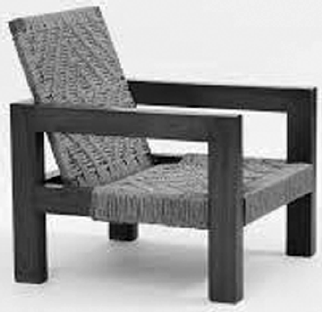
Minnie Boga designed chair. |
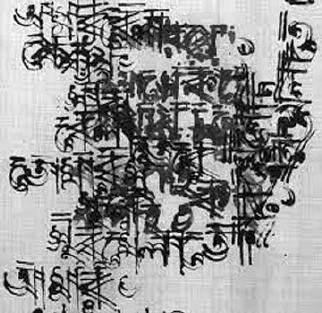
A Riten Mazumdar tapestry. |
From the perspective of elite patronage, whether royal, aristocratic or mercantile, the decline of the Mughal style, which had united a major part of the subcontinent from the 16th to 18th centuries, had given way to new genres, which combined its legacy with the provincial. In the ensuing political contestations, the Marathas rose in the Deccan, eventually claiming almost as much territory as the Mughals, reaching out further to Tamil Nadu in South India. In southwest India rose the Mysore state, in the Deccan the Nizams, and the nawabs in Awadh and Bengal, even as the Rajputs held their own in parts of Gujarat and Rajasthan, with Sikh dynasties ruling in Punjab. These, and several other courts of the subcontinent, produced their own aesthetics and styles in art and design.
A
s the British consolidated their empire in India, western influences were seen in these courts. Many of their palaces, private and public buildings brought in an eclectic mix of the foreign, and were designed by European architects and furnishing firms – tiles and marbles from Italy, chandeliers from Belgium, decorative porcelain from China, stained glass from Germany, furniture from France, British crockery and cutlery, among other elements. They collaborated with indigenous designs at these courts, adding layers to the palimpsest of their already syncretic styles and aesthetics. These new Indo-European tastes were reflected in the textiles and fashion of the Indian elites as well.While it remains unassessed how these various western influences impacted the life of Indians among other sections of society, imports from Britain were to become aspirational among the rising professional middle classes. So popular were they that traditional manufactures, especially cloth, deteriorated to such an extent that a boycott of such imports became central to the Indian national struggle for freedom from the early 20th century. An affirmative Swadeshi movement, meant to encourage the consumption of locally made products accompanied this. The popularity of British imports among Indians was also achieved through strategic colonial policies, and despite such nationalist measures, by the time India became independent, colonial rule had been observed to have destroyed Indian manufacture so devastatingly that its resurrection became a significant focus of the new post-colonial government in 1947.
I
ndian businessmen had seen the importance of building Indian industries through British rule, and from the late 19th century, some Indian cloth mills did come up, especially in the regions of present day Tamil Nadu, Maharashtra and Gujarat. Many of them took the challenge of further industrialization and employment generation in independent India. Equally, the government realized that a majority of Indians lived in rural areas, and were involved with hand manufacture, in many cases linked to agriculture. Regeneration of their livelihoods became the concern of institutions such as the All India Handicrafts Board, All India Handloom Board, and the Khadi and Village Industries Commission.Thus, modern India inherited both the legacy of mechanized and hand production, which continues to inform its current realities. The negotiation between them has created modes of production which often use a combination of industrial and hand skills, offering semi-mechanized possibilities, perhaps unparalleled anywhere else in the world. In more recent years, this has come to be seen as innovative in its own right, and studied in international forums as shaping improvisational jugaad based technologies. Few things define the world of the Indian middle classes as them, where a repair or solution exists for everything, and nothing is wasted in an endless cycle of re-appropriation and reuse.
|
|
|
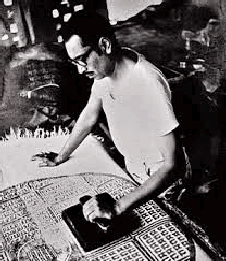
Riten Mazumdar at work. |
H
owever, well into the second decade of India’s independent strides, the country looked westwards for inspiration to channel the development of its modern utilities: in January 1959, three hundred objects from the Museum of Modern Art in New York formed a major exhibition in New Delhi titled ‘Design Today in Europe and America’, with a reported footfall of 100,000 visitors over three weeks. The collection comprised of furniture and other products of everyday use, designed by some of the most well known international designers of the time. It was subsequently donated to the National Institute of Design (NID) in Ahmedabad, which started functioning in 1961, and where for decades the collection has served as an archival resource for its students and curricula. In recent years, parts of the collection – largely forgotten now by the burgeoning design environment outside of the NID and its alumni – have been regularly showcased in a small, permanent gallery, accessible to the public at large.
T
he establishment of the NID itself conveyed the ambitions of the Indian government at the time, in an immediate post-independence environment, to participate in global conversations in several cultural fields and economic sectors. It was aimed at primarily developing a learning programme, which could help the country evolve a mandate for industrial production borrowed from a Euro-centric pedagogy. Over the next few decades, however, it struggled to convince Indian industrialists and business leaders to invest in its ideas and innovations. Many of them found it far easier and inexpensive to import technology, and adapt it to Indian requirements. Such improvisation, whether in automobiles or electrical gadgets, the Ambassador car or Sumeet mixie for instance, became the foundation for the world of Indian domesticity for several decades.By the 1980s, NID’s activities seemed to have moved far from its original, industrial mandate. It was seen as obsessed with grass root and rural concerns, largely initiating social impact campaigns. Simultaneously, it became involved with government communication design projects to position India internationally. Politically, the country had seen the rise of a renewed Socialist movement through the 1960s and ’70s, as well as extreme forms of youth-led communist agitation. Widespread unemployment and poverty led to a rethinking of independent India’s policies. Many of the cultural and economic gaps in society were attempted to be addressed through non-government organizations that came to be during this time.
T
he cause of creating livelihoods for rural Indian artisans and craftspeople, with that of emerging affordable objects for everyday use in urban cities, became a preoccupation for several such organizations. Early experiments included Tilonia and Bare-foot in Rajasthan, the Self Employed Women’s Association (SEWA) in Ahmedabad and state government supported cooperatives like Co-optex in Tamil Nadu. Central government initiatives like the Handicrafts and Handlooms Export Corporation and Central Cottage Industries Emporium, as well as state government retail brands like Gurjari from Gujarat, took the lead in further providing marketing opportunities. As India industrialized, and polyester and synthetics were offered as the new material for a new India, these initiatives in the hand-made continued to offer an alternative.
I
n the accompanying private sector of nascent Indian brands from this period, the names of a few individuals stand out for their role in sharing a particularly Indian praxis. They were products of unique Indo-European encounters themselves, and suggest the emergence of a post-colonial modernism in India, to which contemporary events and aesthetics in design may be traced. Foremost among them is Shona Ray, who graduated in textile design from the Royal Academy of Arts in London in the late 1950s, and became involved with the setting up of NID in Ahmedabad, before moving to Delhi. An interior designer, she is credited for having involved Indian craft in her projects, at a time when wealthy Indians were still fixated with European inspired colonial aesthetics. Working in the ’60s, her contribution can be seen as pre-empting the wave of ‘ethnic revival’ in design and fashion that was to take over Indian urban-ism in the decades to come.|
|
|
|
Nalanda, Single Bedsheet for Fabindia. Design by Riten Mazumdar, Handblock Print on Handloom Cotton. Image Courtesy: Anil Mazumdar, Ushmita Sahu. Photos by Arpita Akhanda |
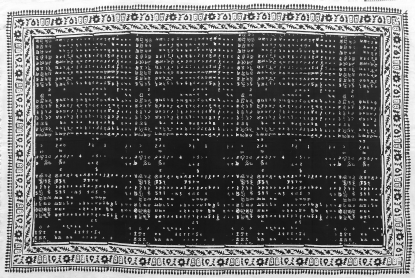
Ashutosh, Tablecloth with Serviettes for Fabindia. Design attributed to Riten Mazumdar. Image Courtesy: Anil Mazumdar, Ushmita Sahu. |
T
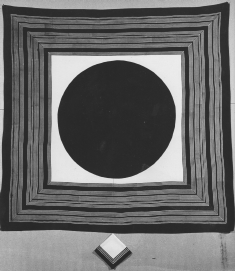
his was around the time that an American Indophile, John Bissell, saw the opportunity in connecting Indian hand made products to European markets. Fabindia, a well known brand with hundreds of retail outlets across the country today, was started by him to export innovative textiles to famous international brands such as Habitat. It was Bissell who brought Terence Conran to India and led the durrie rejuvenation in Panipat. In its early years, the company collaborated with two exceptional individuals, Suraiya Hasan Bose in Hyderabad and Riten Mazumdar in Delhi. By defining Fabindia’s early product collections, they inspired several future generations of spin-offs. While Bose, in her early 90s today, went on to build a reputation as a revivalist of distinctly Deccani traditional handlooms like Himru, Mashru and Paithani, Mazumdar retired to the life of an artist in Santiniketan, having introduced dramatic shapes and colours to hand painted textiles.It was in Santiniketan that Mazumdar had trained as a painter, moving on to work with the renowned Swedish design brand Marimekko, in the ’60s. Returning to India, he started a small studio specializing in hand painted, hand block and screen-printed textiles for home and apparel in cotton, which for a brief period, he exported. It was the collaboration with Bissell and Fabindia that allowed him to express his designs, creating in a bold sweep a distinctly recognizable oeuvre of work. His large geometrical patterns, in a simple palette of colours, patterned the entire expanse of bed-sheets and cushion covers. In later years, when he focused more on his arts practice, Bengali calligraphy was combined with minimalist renditions on tussar silk and saris.
There were other designers of the time who deserve mention such as Ratna Fabri, on whom little is written even as her friends and colleagues fondly remember her and her art historian husband, Charles. Craft traditions were renewed for a contemporary market: Shona Ray, Pupul Jayakar, Prem Bery, Sina Kaul and many more, worked to create a fresh range of textiles and sourced handcrafted objects for house and home institutions and public domains, in a determined effort to begin a conversation with the traditional roots, connecting them to modernity. They created the platform for the ‘now’.
Together, these designers belonged to a cosmopolitan community of Indian creative persons who articulated an Indian modernism before the liberalization of the Indian economy in the early ’90s. They mark a definitive phase in the country’s post-independence history; part of a broader culture through which Indian makers have constantly responded to any new stimulus and contemporary ideas. This culture of assimilation is millennia old, no matter how strenously we deny its absorbtion into our design directory.