Santiniketan architecture and its discursive orientations
ANSHUMAN DASGUPTA
SANTINIKETAN, in the overall cultural scheme of India, by common expectation, is often made out to be local and national, despite the presence of, on site at its inception and through presumably its prime years of growth (1919-1951), some of the most global Indian intellectuals of the colonial period. The most prominent among them was Rabindranath Tagore, whose thinking, influences and transnational interactions helped shape the nature of the place. Santiniketan’s foundational and operational ideas were universal, making it very much a part of the global scheme of thought at the time.
One could trace the relational map between the then contemporary colonial state policies and the decisions taken by Tagore as a counter-colonial thesis – a scheme of resistance. This might be observed in some connected accents in the life of the nation and in Tagore’s life, between 1916 and 1921. Tagore reacted to the introduction of a new education syllabus in Calcutta University in 1916 by writing ‘Parrot’s Tale’, one of his best known allegories on education. In 1919, the Jallianwala Bagh massacre happened in Punjab, in response to which he gave up the Knighthood that the British had conferred on him four years earlier. It was also in 1919 that Tagore founded Kala Bhavana and Sangeet Bhavana, the two institutions related to visual arts and music, respectively, in Santiniketan.
The last significant remnant of the British empire, the Victoria Memorial, was inaugurated in Calcutta in 1921. This was also the founding year of Visva Bharati. The draconian memorial project, purposed to leave a permanent imprint of British India, pained Tagore, compelling him to write: ‘Mughal Delhi and Mughal Agra show their human personalities in their buildings... but the British government in India is not personal. It is official, and therefore an abstraction. It has nothing to express in the true language of art. For law, efficiency and exploitation cannot sing themselves into epic stones’ (‘What is Art?’).
1 And he came to treat Santiniketan as a shelter, away from the ‘gumor’ – the suffocation of the colonial culture and its oppressive play of power.
T
he architecture of Santiniketan could be regarded as an inspired antidote to the mammoth conceit of imperialism personified in intrusive colonial undertakings like the Victoria Memorial and Lutyen’s Delhi (1911). The assumption that it was born of a nationalist programme would seem preposterous, as Tagore was an internationalist, who critiqued the narrowly defined concepts of nationalism and patriotism in his book of essays published in 1917. He nurtured a larger international vision of universal humanism.Tagore’s vision for Visva Bharati was reflected in Yatra Visvam Bhavatyekanidam – ‘Where the whole world can find a nest.’ In many ways, the architecture of Santiniketan became a structural symbol of its educational paradigm, with a synthesis of elements from diverse sources. Though contiguous elements do exist that are obviously culled from Indian architectural traditions of various origins, straddling multiple time periods in history, from ancient Brahmanical and Buddhist to Sultanate and Mughal, these are to be found in easy cohabitation with transnational spatial ideas, making the enterprise a genuinely grounded eclectic.
When the Tagores came to Santiniketan in the 1860s, the land was a wild, undulating, laterite zone with an arid landscape and not many trees. Debendranath Tagore built the first Santiniketan griha (house) in 1861-62, a concrete and brick structure modelled after 19th century central Calcutta manor houses, an indigenous hybrid born out of the Palladian model. Taming the atmospheric extremes was the primary problem at the time, and a beautiful garden was laid out around the house with rows of shade trees and fruit bearing ones. For this, arable soil had to be brought in from elsewhere.
This first building was followed by the innovative gazebo-like architecture of the Kanch Ghar (Glass House) or Mandir, also built by Debendranath in 1891. Partially reminiscent of a Victorian greenhouse and a bandstand, with a tiled roof and marble floor, this is an intricate, prefabricated metal and stained glass structure with decorative trellis work. The metal frame was made in Calcutta by Sikdar & Co., while the glass was from Belgium. This non-denominational prayer hall opens on all four sides and, in a way, it anticipated the universal spirit of the subsequent founding principles of Rabindranath Tagore’s Santiniketan.
W
hen Rabindranath settled in Santiniketan in 1901 and founded his Ashram Vidyalaya, it was modelled on a Vedic hermitage, where an intimate knowledge imparting system prevailed. This was to encourage learning in a space contiguous with nature. The houses built subsequently were very different from Debendranath’s manorial house. Some of the earlier constructions were modest structures echoing local Bengal architecture, which included the simple thatched cottage, Natun Bari (1902), built as Rabindranath’s residence. Another mud construction, Dehali, was built in 1904, a place where Tagore stayed for a while. There was also a building that housed a Bramho library.From 1919 onwards, with the creation of the Kala Bhavana and Sangeet Bhavana, and subsequently, the development of the Visva Bharati University as a centre for culture with its various arts and humanities institutes (1921), there was a proliferation in the construction of buildings. The old library was enhanced to a double storey to accommodate the Kala and Sangeet Bhavanas (1919-21), before these two hitherto combined institutes were split up and assigned their own campuses. This building was then dedicated to the erstwhile Brahmacharya Ashram school, reconfigured as the Patha Bhavana in 1921. However, in their new campuses, the two art institutes did not have their own permanent buildings. They were gradually built over the years, as and when the situation arose and resources permitted. This was true of all the departmental complexes.
Thus, the overall layout and architectural development of Santiniketan happened in a clustered manner. These clusters formed several complexes – the Patha Bhavana, Kala Bhavana, Uttarayan (Tagore’s houses comprising of five buildings – Udayan, Konark, Shyamali, Punascha and Udichi), the Cheena and the Hindi Bhavanas, and then the Sriniketan cluster formed the totality of Santiniketan. If there was a plan, it was constituted with connections and overlaps between the various clusters.
T
he architecture was primarily governed by environmental factors, the flow and mingling of ideas and influences, the sociality and interactivity requirements, and a permeating aesthetic instinct combined with pragmatism. Most of the houses built after 1919 were designed under Tagore’s guidance by artist Surendranath Kar, who successfully negotiated the need for economy, functionality, quiet elegance, environmentally appropriate and thoughtful design. A frequent companion in Tagore’s travels, Kar had an exposure to the best of the West and the East, and was able to creatively draw upon widely different architectural resources.With the advent of Nandalal Bose around 1919 and 1921, the architecture acquired a distinct character through the collaboration of the two artists, who worked together drawing on Rabindranath’s vision. His arrival also resulted in the incorporation of frescoes and sculptural reliefs in the buildings, enriching them further.
T
he buildings were designed in symbiosis with the environment, not as intrusive monoliths, but rather like gentle intercessions melding in with the landscape, seldom challenging the horizon. The careful thought bestowed on the balance between the environment and construction is evident in the stone seating under trees in the wide, circular open air classrooms of Amrakunja, in the open front verandahs of the houses with low parapet-like built-in seating, with quirky elements playing on inside-outside experiences. Windows placed in exterior walls in punascha, or multilevel openings on the same wall, brought the outside in, from different angles, as found in Konark. Taladhwaja, an unusual round mud hut with a thatched roof was built around a toddy palm with part of its trunk and its huge leaves stretching out over the top, for a lover of trees.|
|
|
|
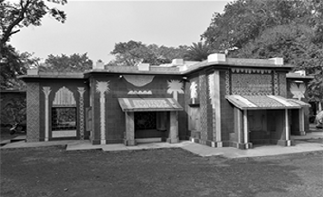
Simha Sadana complex. |
Patha Bhavana building. |
There were experiments in mud architecture with local, rural building materials and techniques. In 1934, Chaiti, a small mud and coal tar structure resembling a thatched Bengal hut, was built near the Patha Bhavana compound. It had a glass-paned showcase that was used as a news board for displaying posters and the latest art works. This was one of the ‘overlap’ spaces for communication between the various architectural clusters. Another space for social interaction was Dinantika, built in 1939, an octagonal two-storeyed structure with the staircase on the outside, resembling a Japanese tea house. The inner walls of this building have frescoes by Nandalal Bose. Also known as the ‘Cha Chakra’, this was a place where the university staff met in the evenings for a cup of tea and to relax.
P
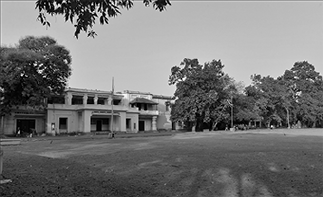
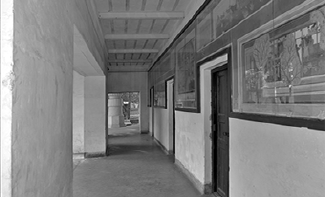
atha Bhavana is housed in one of the oldest buildings, which had many additions over the years with double-storeys and split-level floors on the upper storey. The south facing, lower and upper verandahs resemble the pillared porch-like entryways of the Ellora caves. Their walls are decorated with frescoes executed in the Jaipuri technique by Nandalal Bose and his students. The most interesting of these murals are on the ground floor verandah, where the theme of the birth of Sri Chaitanya of the Bhakti movement shares space with the Birbhum landscape and everyday life scenes of Santiniketan. The architecture takes part in the meaning and making of Gour Prangan (named after Gour Gopal Ghosh, a dedicated member of the community) – open space in front that was the central congregation area for various occasions, including public performances and informal stagings in the verandah.
T
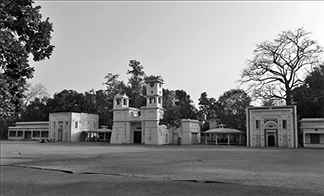
he Simha Sadan building constructed in 1928 under Kar’s supervision, stands across from Patha Bhavana, to the southern edge of Gour Prangan. Its imposing façade, arched gateway and the tapering contours are reminiscent of Sultanate architecture. The doorway is flanked on either side by a clock tower and a bell tower (Ghanta Ghar). Many remarkable plays by extraordinary people were staged in the Simha Sadan, including Ramkinker Baij’s production of Parasuram’s (Rajshekhar Bose) Bhushudir Math (the field of Bhusundi) with minimal tech support, using petromax lamps to light up the scene. Ramkinker’s student, artist Riten Mazumdar, once recounted how the master had effectively created a scene of the moon rising from behind a dilapidated building to reveal a craggy tree, with a ghost’s dhoti-clad pair of legs dangling from its branches.
|
|
|
Veranda of the Patha Bhavana with murals. |
Initially, due to a dearth of space, the only existing building in Kala Bhavana housed an office and a museum, also doubling up for a while as a hospital. In the mid-1930s, the Havell Hall wing, planned by Tagore as a museum in commemoration of E.B. Havell, was added to it. The frescoes in this extension were painted much later by Nandalal and his students. Mastermoshai Studio came up in the 1940s. It was Nandalal Bose’s studio that he shared with colleagues like Benode Behari Mukherjee. The design was planned, over years, by Suren Kar, Rathindranath Tagore and Bose himself. This building is a low, symmetrical adaptation of the Greek-cross structure. It has openings on all the walls, with one of the four main arms of the cross forming the shaded entrance.
T
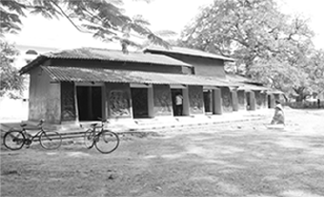
he Kalo Bari (Black House), built over a span of two years (1934-1936), as a hostel for Kala Bhavana students, is another significant architectural project, which was a principal public intervention of that time. An architectural design comprising of three interconnected rectangles arranged in an asymmetrical manner, it is a unique mud structure with a coal tar finish, and originally had a thatched roof. It has multiple rooms with the entrances opening on three sides of the building. The walls and corridors of Kalo Bari are adorned with Bharhut, Mahabalipuram, Mohenjodaro, Eqyptian and Assyrian motifs. Rendered largely by students from South and Southeast Asia, it is annotated with the names of the artists in their own scripts (Sinhalese, Thai, Bengali, Tamil etc.). Several stylistic types prevail in the sculptures, and despite being supervised by Nandalal and Ramkinker, the building seems somewhat free-flowing and thus expressive of the spirit of the multiple.
T
he five buildings of the Uttarayan complex came up between 1919 and 1938. In their overall presence and details, they are signatures of Tagore’s design experiments. In terms of style, they are cumulative and eclectic, and in spirit, deeply experimental. Konark, originally a mud brick house with a thatched roof, was the first of the dwellings to be completed in 1921-22. Multiple floor and roof levels of rooms opening into one another make for a unique spatial experience in this house. There is an east facing verandah with rows of pillars, where plays and dance dramas were staged. Regular poetry reading sessions were held by Tagore on the verandah of the wall-less central room, which opened on to the garden. This public-private porosity in Tagore’s intimate space was in continuity with the philosophy guiding the overall ashram architecture, which made the incorporation of spaces for social interaction so important.
|
|
|
|
Black House in the Kala Bhavana campus. |
Mastermoshai Studio (now) with a mural by K.G. Subramanyan. |
T
he largest of the houses, Udayan, was built over a period of several years, between 1921-1938. It was designed around his modest living quarters by Tagore’s son, Rathindranath, and gradually evolved into the sprawling ship-like form, which was locally identified as ‘Jahaj Bari’. The building has many suites and multiple levels, and its undulating contours along with its horizontal spread, seem to resonate with the subtly undulating khoai landscape.Despite the complicated layout, there is a sense of flow on the inside – one could walk through the house without feeling limited by a closing wall. It was possible to enter from a point and exit from another, as was true of most Santiniketan houses. Both the exterior and the interior are a synthesis of styles. The split-level design is found in fort architecture, the railings are similar to the jharoka in Gujarat and Rajasthan havelis. The portico-like verandah and the corbelled capitals are reminiscent of Indian cave monasteries, and the interiors – the use of wood panelling on walls and ceilings, and internal pillars – of the Far East.
There is a range of variation between Udayan and the final house, Udichi (1938) (meaning, ‘rising’ and ‘risen’, respectively). Shyamali (1935) and Punascha (1936) are both structurally close to the ground, while in Udichi one has to climb a flight of stairs. Shyamali was an interim experiment with a lot of exotic organic material like cow dung, wood apple, hay, rice husk, and potsherds. Rabindranath wanted to build a low cost mud hut as a prototype for villagers, with a permanent mud roof replacing the traditional thatch which was always a fire hazard.
I
n accordance with his innovative suggestion for keeping the rooms cool, the roof and walls of one of the rooms was constructed with clay pitchers arranged inside plaster casings. Surendranath Kar prepared the architectural plan for the house based on Tagore’s ideas, and the visual perspective was prepared by Nandalal, with inspiration from Javanese Chaityas. The entrance to Shyamali is flanked by two sculptures of ‘Dwarpalas’ by Ramkinker, modelled after Bourdelle. Though the construction was not a technical success, and needed to be repaired more than once, records state that the masons indicated to Tagore that the introductory model was successful. Apparently the masons had told him that the project had given them new ideas for building their own houses, which Tagore gleefully transmitted to Rathindranath as a sign of success.A remarkable aspect of Shyamali is that the modular architectural relationship in the planning of the interior spaces is very modern – the economy and maximum utilization of space is comparable to western modernist architecture. The adaptation of space was in accordance with the specifications and needs of the dweller; the size of the floor to fit the seating mat, and the height of the window planned in relation to the desired height of furniture. This approach was modernist.
T
he metadiscourse of Santiniketan’s architecture began from its constructional phases, but the preparation had begun before the art and music school and the university concepts were germinal. The Scottish architects, father-son duo, Patrick and Arthur Geddes, were familiar with Tagore, especially Patrick, who offered to design Sriniketan and a part of Santiniketan – which was just a nascent idea in 1919-20.The curious connections that Santiniketan did have with global thinking at the time was through the efforts of Rabindranath and some of his colleagues. Patrick Geddes met Rabindranath amid a circle of thinkers, who were liberal humanists in England in the 1920s and then in Santiniketan in 1923 and thereon. Geddes believed in the organic cohabitation of the built environment and nature, as was reflected in his town planning, and elaborated in his books.
At the same time, we have the theses of Lewis Mumford, Frank Lloyd Wright, Bauhaus and later CIAM with reference to individual architectural edifices, as well as planning of the complete environment. The Bauhaus and other independent architects participated in the European and trans-territorial move to redesign the future for dwellers of the earth. But, Santiniketan, during Tagore’s time, rearticulated the environmental concepts in relation to architecture emphasizing national self-dependency and pragmatism vis-a-vis the environment.
Suren Kar and Nandalal, who had contributed to this growing environment, had translated and interpreted the voice of the poet, sometimes adding to the pragmatics in terms of aesthetics, sometimes adding to the aesthetics of the environment in terms of experimental dwellings like Shyamali and the Black House.
The transnational connection of Santiniketan architecture as a built environment can be seen from various points of view. The most valiant entry point is associated with Patrick and Arthur Geddes, interested practitioners in environmental planning and architecture, and active scrutinizers of the geographies of India, especially Bengal, of that time.
G
eddes was a widely known and an influential figure in Euro-American contexts of architecture in the 1920s and ’30s, which was also the foundational period in Santiniketan. Among his other influences, that of Lewis Mumford is the most discussed apart from his generic contribution to city planning, the new urbanization projects, and his reverential and friendly collaborative relations with Rabindranath and Santiniketan.Along with the Geddes, there were collaborations between Rathindranath and Japanese woodwork specialists like Kim Taro Kasahara which shaped many edifices with their ideas and execution of the interiors and exteriors, such as the Japan suite in Udayan building and the furnishing of the interiors with their low height arrangements, the Pampa Lake and the cave house in the Uttarayan complex along with the Sriniketan experiments. Thus, these transnational interactions with the local and pan-Indian design ideas not only contributed new inputs to the growth of Santiniketan, but also helped in its creative planning.
Footnote:
1. Rabindranath Tagore on Art and Aesthetics. Orient Longman, Calcutta, 1961, p. 20.