The use of social media
JOYOJEET PAL, AZHAGU MEENA, DRUPA DINNIE CHARLES and ANMOL PANDA
MUCH has been said about politicians and what they have talked about on social media. Cambridge Analytica made election manipulation an international sport, while Donald Trump elevated ‘Fake News’ to verboten status in the mainstream media, the very target of his attacks. The corresponding promotion of social media to the preferred line of output for political actors has highlighted one significant change in political communications in this generation – politicians want to carefully manage the discourse in terms of what they talk about, when, and how. Narendra Modi mastered this style of output in the run up to the 2014 election when he more or less stopped all interaction with professional journalists and moved exclusively to communicating on social media.
In the aftermath of Modi’s extremely successful 2014 campaign, much post-mortem analysis was done on the style of social media discourse – brand management, consistency of outreach, and politicization of online publics have all been topics of extensive scholarly and journalistic research. By mid-2017, riding on the dominant discourse of disinformation in the US and elsewhere in the world, WhatsApp came to symbolize deception and political skullduggery, often served with passionate tenor. The risks of stirring frenzies through social media messaging became fatally apparent when misinformation about child kidnappings led to a series of lynchings throughout India. More importantly, politicians had essentially shifted the space of discourse on political issues – social media became the inaugural location for many debates, which were shaped or given outcome by crowds than commentators.
While the mainstream media was rife with concerns about social media and its ability to enable an angry, misinformed, polarized public, parties and individual politicians alike amped up their presence online, many hiring professional social media managers to set up ‘war rooms’ for their online campaigns. By the 2019 elections, in 455 of 543 constituencies, at least one of the top two candidates were on Twitter, and in 191 constituencies, both the winner and the runner-up candidate had active Twitter accounts.
A
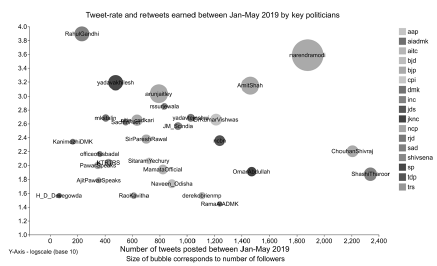
look at Figure 1 below gives us an idea of the extent to which the top leadership across parties took to Twitter. Narendra Modi, boasting the largest bubble (following), consistently gets among the highest rates of retweets, but also tweets frequently compared to his political colleagues. Rahul Gandhi, on the other hand, tweeted a lot less, but got much more throughput in terms of retweets to his messages. Others like M.K. Stalin and Akhilesh Yadav, also consistently scored high on retweet rates despite their relatively modest following. The vast majority of the leading politicians tweeted over five times daily in the campaign period between January and May 2019.|
FIGURE 1 |
|
|
A cottage industry of tech savvies now offers services to politicians and parties, expanded to professional status with consulting fees in the lakhs for very short consultations, to longer-term annual contracts that allow a long-term strategy and execution. Parties across the ideological spectrum and both at state and national levels invested in social media plans, and in many cases, in dedicated apps, following the lead of Narendra Modi’s 2014 campaign ‘NaMo App’. Social media companies themselves increased their attention to India, Twitter, YouTube and Facebook, and even apps with a smaller political footprint like Instagram, ShareChat and TikTok invested in professionals to liaise with the government and parties in Delhi.
T
he 2019 report on social media and the elections by CSDS presented statistics on the use of social media by the voting public, and found that the vast majority of voters did not use social media, and furthermore that Twitter, the widely discussed ‘preferred medium’ of politicians, was the least used among citizens, and the only medium that was declining in use. While concerns about the extent of social media impact in the actual vote process are important, such thinking underestimates the second-order impacts of social media outreach.It does not matter, a priori, whether citizens are getting their political information on social media, or believing what they see online en masse. What matters is that the mainstream media operates on social media. Every major journalist is on social media – many media houses use journalists’ online following as a metric to understand their value to the organization. At the same time, journalists writing stories frequently turn to the social media commentary to compose their arguments sometimes since it is inexpensive, at other times because it is the only means of communicating with a political actor.
As Narendra Modi showed in 2014, if anyone – whether citizen or journalist – wants to know what he has to say about a topic, they need to go check his Twitter feed. Many other leading politicians have since followed suit. Indeed, as some studies have already shown, this style of communication does not diminish a politician’s online footprint – both television and print news relay what politicians say online, even when they do not communicate directly with professional journalists. The use of social media in the 2019 election by politicians has to be seen as part of this changed media ecology in which social media is fundamentally indistinguishable from mainstream media in terms of the net effect.
T
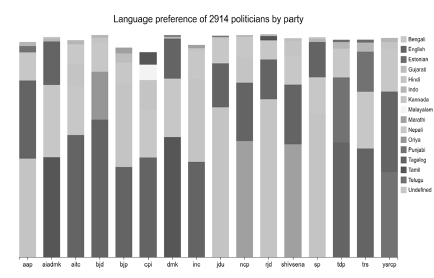
he second argument frequently posed against the relevance of social media is the linguistic diversity of India. A look at Figure 2, from the tweets of 2914 sampled politicians, shows that politicians are rapidly moving away from using English to local languages. This is especially true for regional parties, several of which already primarily tweet in the local tongue. Social media such as Share Chat are now primarily oriented towards local Indic-language material, and have several hundred verified political accounts.
|
FIGURE 2 |
|
|
Major national politicians operate largely on Twitter, and the BJP has played a leading role in pushing this adoption especially following Prime Minister Modi’s call for all MP candidates to show significant following online. A large number of national politicians are also on Facebook, where the Twitter messages are essentially mirrored. In contrast, WhatsApp has emerged as the last line of communication at the level of citizens and booth workers. While the vast majority of elected MPs and candidates for Lok Sabha from the national political parties use Twitter, only a small fraction of MLAs and state legislature hopefuls do. This number falls further at the level of local elections.
T
he differentiation between what media is used for what purpose is partly dictated by the affordability of the medium. Twitter, which is fully public, serves as an ‘official spokesperson’ for the politicians. Instagram and YouTube serve the same purpose for official accounts for social media teams that have multimedia sophistication, while WhatsApp serves mainly as a means of last-mile communication that comes from election workers rather than the leaders themselves.Modi himself serves as a good archetype for the differentiated use of social media channels. Starting with Orkut and Google Plus, Modi’s team has invested in a presence in practically every mainstream social media channel, and done so effectively using the specific affordability of that media. For instance, Modi invested in a LinkedIn presence well before his 2014 campaign caught steam, and while it may have seemed odd at first that a politician would be on a professional services forum, we find that the image Modi projects there is one of a technocrat who stands on his credentials, arguably much like young Indians presenting themselves on social media. By 2014, Modi was an ‘influencer’ on LinkedIn, offering management and administration advice.
O
n YouTube, Modi mirrored his nationwide radio missives by setting up a channel for ‘Mann ki Baat’, along with over 100 playlists, including beneficiary testimonies of his schemes, videos of his global visits, and even suggested yoga poses for various physical problems. Modi uses Instagram with a variety of celebratory gif images of himself, but also as a place to highlight his interactions with everyday citizens, where the images serve to humanize him and reward the citizens who interact with him. No other Indian, or arguably global leader, compares to Modi on this level of platform differentiation. However, his example has led to other politicians following his lead on one or another format.Outside of leadership, the means of political outreach that is not purported to be directly from an individual, is a murkier space. On WhatsApp, content is often not linked back to an individual, and research shows that encrypted formats contain higher levels of malicious content. Similarly formats that capture a style of informality such as ShareChat (which boasts the largest spread of Indian-language options) or TikTok (which builds on short video format output) lag mainstream channels, so fewer politicians get on them directly, though these very channels are useful in satirizing content that is aimed at political rivals. In the 2019 election, these were sites of aggressive attacks on various key figures including Rahul Gandhi and the Gandhi family, Mamata Banerjee, as well as Narendra Modi.1
T
he physical landscape of a political election includes posters, painted walls, and stages for elections. Posters are expensive to design and print and are often accompanied by a range of political concerns around who gets to be featured on a poster from among the local political establishment of a region. These remain important concerns because getting one’s face on a poster that is publicly displayed is important for local politicians even in a Lok Sabha election. It helps them get noticed, indicates their closeness to the parliamentary candidate or even the party leadership with whom they appear on a poster. The local politicians who appear on these posters may even be the ones who pay for them, especially if it impacts their political futures.Likewise, walls to paint on, or any kind of real estate available for political outreach may be hotly contested for control by one party or another. During the core period of campaigning, decisions on where to invest in physical events is critical – whether this involves driving through neighbourhoods with loudspeakers or setting up stages for public gatherings. Each of these are also ticket items that have traditionally been temporally regulated and tracked for expenses by the Election Commission.
W
hile all of these remain critical to the ways in which an election is fought, social media impacted which to spend on and how. Unlike with the comparatively smaller area spans for coverage in municipal or legislative assembly elections, for parliamentary seats candidates must choose areas to focus on and areas to touch lightly. For a good candidate, coverage is important, since even minority voters in the weaker neighbourhoods need to be assured that their votes are important. Public meetings are also spaces where candidates acknowledge local leaders, who are usually the ones who move votes in the neighbourhoods where the meetings take place. These are also events that allow such local leaders a platform of their own, by sharing space on a stage or even giving a short address to the crowd prior to the candidate’s speech.These are important clientelist exchanges that galvanize local leaders to work energetically, consequently giving them up would take away some of the important drivers for election work. However, with social media, candidates can compensate by creating new means of low-touch interaction with voters in non-strength areas where physical presence, as seen through voter turnout drives, may be less worthwhile. In particular, the expensive work of setting up stages and rallies can be focused on areas of more likely vote throughput, with social media brought in to reach out to other areas.
The shift to social media for some activities has also meant that aspiring local politicians create new ways of building an image among voters, above and beyond showing up on large flex posters alongside senior leaders. The campaign period is marked by a great deal of social activity and interaction with the people. Ward councillors record their public activities on phones and post them on their social media pages, and hope they find viral outreach. These pages also serve as public relations signalling for both voters and the party machinery for the current election, also as archives for their future political careers.
A
mong the critical and least covered areas in which social media made an impact in the 2019 elections, was grassroots worker mobilization. The field work, and workers of election campaigning were widely regulated using technology. Off the shelf and customized apps were used in the 2019 elections for keeping track of progress on the ground.First, GPS tracking on mobile apps allow booth committee managers to keep track of the outreach squads working under them – each field worker can be tracked, and through bar-coded pamphlets, data on the homes visited and literature delivered can be maintained. Each field worker is in turn on social media (which is often a requirement), arranged into groups based on their regional assignments. The messaging at the household level is conducted through these social media channels – often using numbers that are collected through the field visits, or through a range of sources, including outright ‘purchased’ groups, which can easily be purchased through aggregators. Social media teams using WhatsApp must also expect to have several social media accounts, some of which will be suspended for breaking the terms of use through spamming. Likewise, workers must be careful to regulate the amount of traffic they generate online by adding citizens wantonly to WhatsApp groups – overloading peoples’ personal devices and potentially alienating voters.
A
precondition for election work in 2019 has been the unspoken requirement of being a thoughtful and adept technology user. Outreach by party workers is now subject to surveillance for the frequency and regularity by which they forward messages that come from the party machinery. At the same time, apps that allow citizens to interact directly with a candidate or party – invariably involve the party workers, who are expected to be responsive to citizens’ outreach. Some apps, for instance, are GPS enabled and allow citizens to escalate complaints directly to the nearest party worker in their constituency.WhatsApp is used for coordination activities by the party, and groups are maintained in layers by party members for strategy discussions. Using voter data from the Election Commission of India app, the party workers also maintain lists of voters from their assigned booths, annotating those with likely votes for their parties. These lists are then used on the day of polling to keep track of which voters showed up, and those that did not. Such information can then be communicated hourly through WhatsApp groups to update local election workers on immediate outreach tasks, such as urging a specific voter to show up and vote within the time remaining to vote.
In the 2019 elections, the INC was frequently outperforming the BJP in terms of the number of trending topics that were in its favour, as well as the median retweet rate of its leadership. The INC turned to some of the textbook strategies of the BJP in terms of the style of online outreach – for instance, Rahul Gandhi getting much more aggressive in his online discourse. However, the social media strategy of the BJP went a lot deeper than just the language or retweeting – copying its voice from the 2014 campaign was not enough without understanding the infrastructure that stood behind it. The BJP invested in long-term ideological alignment, online, much as it has organized offline, and listened for the citizen pulse. For instance, till early February 2019, the Congress was doing much better than the BJP on Twitter, cornering attention for Priyanka Vadra’s entry into politics as well as a fairly strong mobilization behind the ‘Chowkidar Chor Hai’ hashtag. Yet, in the days following the Pulwama attacks and the Balakot incident, the tide had turned strongly nationalistic online. Here, the BJP turned to Chowkidar as its brand, turning on its head the very concept that the Congress had been using to attack it.
It is here that the scale of investment in social media can be a critical differentiator. While the BJP was successful in consistently winning the attention game, this success was built on years of careful brand cultivation, and organized, disciplined outreach both from party cadres and the millions of citizens who supported its mission. The BJP understood early that the approach to social media is not unlike that to any other tool of election management. Rather than replace their traditional on-the-ground organization, social media has only augmented it and made it a sharper machine. For parties seeking to emulate its success, social media must be understood as more than a retweet game.
Footnote:
1. The choice of social media can also depend on the perception of linkages between the corporation that owns the platform and the government. We found, for instance, that some of the smaller parties engaged during our research felt that Facebook was a difficult platform to break into due to the ruling party’s relationship with the company, and consequently they needed to focus on other social media.