‘Solving’ nuclear fear
MISRIA SHAIK ALI
KUDANKULAM, a district in the Indian state of Tamil Nadu, houses a total of six nuclear reactors making it the largest nuclear power station in the country. Unit 1 and Unit 2 of the Kudankulam Nuclear Power Plant (KKNPP) were commissioned in the year 2013 and 2016 respectively, with Unit 3 and Unit 4 under construction since 2016. India signed a deal with Russia, in 2017, for the supply of equipment for the construction of Unit 5 and 6. Unit 1 and 2 of KKNPP are products of a 1988 Inter-Governmental Agreement (IGA) between the erstwhile Soviet Union and India. The disintegration of the Soviet Union in the early 1990s stalled the project until it was kick-started again in 1998 when the Russian Federation and India signed a supplement to the 1988 IGA.
Russia’s support to India on the nuclear energy front, especially as the first country to do so after the Pokhran test
1 in the international nuclear power race, needs significant emphasis. The shared trust that the countries have for one another, specially in moments of crisis, has made them value each other immensely.‘India-Russia relationship is one of deep friendship and mutual confidence that would not be affected by transient political trends. Russia has been a pillar of strength at difficult moments in India’s history. India will always reciprocate this support. Russia is and will remain our most important defence partner and a key partner for our energy security, both on nuclear energy and hydrocarbons.’ – Former President Pranab Mukherjee.
Hence KKNPP became a symbol of decades-old Indo-Russian friendship. The geopolitical significance of Kudankulam cannot be understated in this regard. The Indian government’s intolerance towards dissent voiced against the KKNPP project, which will be discussed in the following parts of the paper, should be seen in the light of the geopolitical significance of India’s relationship with Russia.
|
|
In the institutional history of KKNPP, the years between 1988 and 1998 were dormant when the project was viewed as a ‘non-starter’ by the Atomic Energy Commission (AEC) of India. However, it was during this so-called dormant decade that land acquisition was at a high point. Immediately after the 1988 Inter-Governmental Agreement was signed, land was being acquired from the people of Kudankulam, though they were still not clear about the nature of the power project. Interestingly, the actual nature of the project and the way it was communicated to the people was caught in a phonemic confusion. The people claim that they were told by authorities at the construction site that the project was for making an anal min nilayam (thermal power plant) whereas it was for constructing an anu min nilayam (nuclear power plant).
S
imilar to the above story from the field (villages around KKNPP), the many developments that are not documented in the institutional history, tell a different story of the Kudankulam nuclear project. This reveals much about the nature of the Indian security state that ‘acts’ on the dissent against the nation’s nuclear institutions. The ‘performative acts of (the Indian nuclear) policy’2 can be revealed through an act of storytelling that traces the history and nature of the movement against KKNPP, not recorded in the institutional history of the project. In understanding the stories of the resistance, we will slowly unravel the way in which (people’s concern about) ‘nuclear safety’ is approached by the nuclear institutions of the country.
I
n 1988, a few college students from the Madurai district of Tamil Nadu, India, performed street plays in the villages around the Kudankulam Nuclear Power Plant, warning people about the ill effects of radioactive emissions, and illustrating these warnings with images from the Chernobyl disaster. These performances became the first source of information regarding the ill effects of radioactivity for the people of Kudankulam. A few months later, people from the coastal villages of Ramnad, Kudankulam, and Kanyakumari districts went on a march along the coast holding black flags in Kanyakumari, a tourist town near Kudankulam, demonstrating their disapproval of the construction of the nuclear power plant. One of the pleas of the demonstrators was that the people whose lands were acquired should be duly compensated.Despite the effort of the protestors to conduct a peaceful demonstration, a fight, for reasons unrelated to the protest against nuclear energy,
3 broke out between the policemen and protestors. At the end of the violence, six people were shot and charges of sedition were slapped on the protestors present at the point of violence.4 The local people construed the event as a ploy by the state to construct the protest as a rebellion against the state. The fear of sedition charges, or being considered ‘enemies of the state’, discouraged them from carrying out any major demonstration for nearly two decades.
A
fter the dormant decade between 1988-1998, construction of the plant resumed in 2002. It is important to note here that in 2001, the Anu Vijay Township, residence for the employees of KKNPP and their families, was inaugurated.5 This was followed by the construction of a port in 2004 at the site location to import over-dimensional equipment from Russia.6 After 2002, the Kudankulam management made an effort to reach out to the local community and organized many events to build trust between the new occupants of Kudankulam, i.e. people from the township, and its native population. Even today, the local people express their admiration for the commitment of the then KKNPP site director to build rapport with the local people. In 2012, community engagement was institutionalized under the KKNPP Neighbourhood Development Programme.However, the tension between the local people of Kudankulam and the KKNPP accelerated when public hearings for the construction of Unit 3 and 4 did not follow adequate process and hence failed to obtain the consent of the local people. The advertisement flyer calling for public hearings stated that a hearing would be conducted to acquire people’s consent (i) for Unit 3 and 4 construction; (ii) for the project using water from a nearby dam which was the main source of water for the local people; and (iii) for possible displacement that may follow land acquisition for Unit 3 and 4.
S
ince consent was not acquired before the deal was signed for Unit 3 and 4 by Prime Minister Manmohan Singh and President Putin, the local people demonstrated their resistance in April 2007. There is, however, barely any information on the 2007 protest. S.P. Udayakumar, leader of People’s Movement against Nuclear Energy (PMANE), noted: ‘The local press and other media who are pampered by the nuclear ads and booze do not want to report anything that is unpleasant for the nuke bosses.’7 There had also been protests in 2004, and at other public meetings demonstrating resistance against KKNPP before the historic protest of 2011. These demonstrations, however, were kept out of the popular media for years, while the media has had a huge depository of the 2011 historic protest of Kudankulam people against the plant.The Indian security state and the nuclear institutions, using the documentation of the 2011 protest in the media, constructed the protest as being irrational and the protestors as lay, violent people. The following sections will detail how people involved in the Indian nuclear policy arena were constructed and categorized by policy elites and the general public. Lastly, the paper will identify the problematics of structuring the safety problem as something inherent in the design of the plant by weaving in the radiation concerns articulated by local people.
I
n March 2011, the people of Kudankulam watched the images and video of the blast in Fukushima Daiichi NPP after suffering major damage from a 9.0 earthquake and Tsunami and spewing ‘radiation’ into surrounding areas. This accentuated the already existing fear and paranoia among the local people of Kudankulam about ‘radiation’. The fact that the people located around the plant have to be moved in case of a ‘radioactive’ leak, added to their fear of being displaced due to a possible nuclear disaster in the future. Following the Fukushima disaster, around 8000 people, including the local people of Kudankulam, mobilized and demonstrated – a protest that lasted nearly two years, until 2013.During the initial days, the protestors gathered at the gate of the power plant to demonstrate their resistance to the project. This hampered the everyday operations of the two reactors, one of which was reported to commence operation in November 2011. As days went by and the protest failed to weaken, the state reciprocated with force and restraining measures to curb the mobilizing power of the protestors. Section 144 was imposed in the locality prohibiting any assembly of people. Protestors who engaged in demonstrations were charged under Section 124A, the law against sedition in India, and other laws for waging war against the Government of India and for promoting enmity between different groups. They were labelled ‘terrorists’.
‘I was among seven women and 63 men arrested on the 10th of September 2012. While four women got bail in 45 days, another two were released after 80 days. Since I was a ‘terrorist’, I had to move the Madras High Court to get conditional bail after 98 days.’ – Sundari, local resident of Idinthakarai village, Kudankulam.
A
s a restraining measure, any movement between the villages was prohibited and transport to and from the villages was suspended. This led to starvation and hunger. However, the protests never ceased and during the 12 months of active protest, the local people demonstrated on land and at sea; carried out a symbolic siege against the power plant from the Indian Ocean end of the NPP with boats they use for fishing;8 wrote letters to God9 and staged relay hunger strikes. To disperse protestors, police beat them with lathis, opened fire from time to time, and used tear gas on the gatherings.For over 15 months, the entire region was in unrest and tumult, with sedition and terror charges being slapped back to back on protestors. By September 2016, over 8,956 people were charged with sedition, making Idinthakkarai village a land of traitors and enemies of the nation.
10 At the moment, cases against local people are slowly being dropped.However, the larger narrative, that the people in Kudankulam are being funded by the international anti-nuclear lobby and other forces that do not want the nation to progress, have led to the anti-nuclear protestors being considered, constructed and categorized as traitors or terrorists of the Indian nation, or simply to be not acting in the interest of the nation.
‘There are NGOs, often funded from the United States and Scandinavian countries, which are not fully appreciative of the development challenges that our country faces. The thinking segment of our population is certainly supportive of nuclear energy.’ – Manmohan Singh, Prime Minister of India, 2012.
B
esides being constructed by the state as traitors, the protestors are also constantly framed as ‘pamaramakkal’, that is illiterate, lay people or people who lack thinking, as communicated by ex-Prime Minister Manmohan Singh in the above quote. The act of categorization and framing of a policy’s affected population has become an efficient tool of policy making. In policy making concerning Big Science projects, like KKNPP, populations who are already vulnerable to (the threat of) radiation contamination are also made vulnerable by acts of policy making. Such acts of policy making frames the optics for how the affected population is regarded by others.
|
|
The general attitude of an urban middle class pro-nuclear person towards the protestors, who live immediately around the power plant, is clearly communicated in the following comment on an anti-KKNPP news article:
11 ‘Well, it’s a good pt. (...) If you are (do) not want to be superpower, then jump in Bay of Bengal or Arabian Sea coz weakest never survive… and peace never prevails without anything. So, as per electricity is concerned there is a high demand. And India had no alternative to go for other source, why the f***ing some morons who don’t even know anything, with the help of idiots protesting and delaying things... by the way I supports the people agitation if the proper compensation is not being provided which can impact the life of people surrounding there.’
T
he above quote shows that pro-nuclear sentiments are centred on and sustained by a need for world class facility, uninterrupted electricity, spirit of nationalism and in the privilege of having obtained a formal education which makes the pro-nuclear groups seem – or be seen as – ‘reasonable’ enough to make the appropriate and informed choices. The deeply rooted problem in the nuclear policy of India lies in its framing as a policy in the national interest, intertwined with narratives that emphasize the lay-expert divide and narratives of national progress.Framing, as an act of policy making, provides the necessary optics for a citizen to see the everyday, thereby leading to bureaucratization of everydayness where voices of the marginal communities are silenced or barely listened to. Hence, ways of being in a bureaucratic state, become ways of seeing through the optics of policy making. Further, in handling matters of nuclear energy, the Indian state acts like a security state thereby making nuclear energy, a public facility, impossible to achieve without nuclearization and securitization working hand-in-hand.
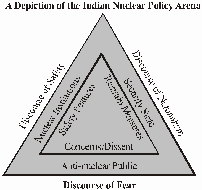
The co-production of ‘the subjects’ in the Indian nuclear policy arena through the narratives of policy science and nationalism, leaves patrons of nuclear policy to be looked upon as patriots and dissenters as being anti-national. This subjectification is also informed by many other categories of subjectification that work through binary opposition between local versus non-locals, lay versus experts, enemy within versus ‘actual’ citizens, radiation contaminated (irradiated) bodies versus the informed body. These categories are superimposed on a primary category, actual affect versus imagined affect, of those affected by nuclear energy, and those who imagine how nuclear energy affects them through the rhetoric of national progress and energy generation.
I
n weaving together the voices of people, both pro and anti-nuclear, from the ground, we can try to understand the complexity of fear that operates and is being performed within the nuclear policy arena of India. The fear that the local people feel around the power plant is manipulated by the state and tinkered with by the nuclear institutions to (a) categorize anti-nuclear groups as irrational and lay people and, (b) construct a new category of ‘post-Fukushima safety measures or upgrades.’The fear amongst local people has less to do with their irrationality and safety measures in the power plant; their fear instead, is driven by the possibility of a disaster in the future from a ‘radiation’ leak. Their fear is not centred on what happened in Fukushima. The 2011 ‘historic’ protest was merely a response to it. Their fear is, rather, centred on their experiences of living, becoming, with radiation; the oppression by the state, the vibrations that spread through their land when the power plant begins operation and the way in which their cattle, children and livestock react to these vibrations, the ‘visible’ smoke that comes out of the chimneys of the power plant that might be ‘radioactive’, the increasing spontaneous abortions in the area that the elders talk about.
Their fear is informed by the lived experiences of other people who live in other nuclear cultures
12 and them living and becoming with radiation. In the following sections, we will see how fear is manipulated and tinkered with, in order to keep the Indian nuclear industry going.
T
he 2011 protest was one of the largest that the Indian state has witnessed against a state project. It was also one that was severely oppressed and widely publicized. Images of local people throwing sand at the police, who were throwing teargas bombs, and fishermen standing gloriously on the ships that surrounded the KKNPP in the Indian Ocean; the laws that made them traitors and terrorists were important mechanisms of the Indian state to influence the minds of citizens who were watching the performance as it reeled out as a spectacle. Hence, the dissenting bodies became ‘the body of the condemned’,13 deserving punishment; members of the public watched as dissent was met with the certainty of punishment, sowing the seeds for suppression of dissent by right wing nationalists in today’s India.
T
herefore, state measures against the 2011 protest were mechanisms of ‘othering’, where the people who were watching the protest felt very far away from the people performing it. The performative acts of dissent and policy were categorized as ‘primitive’ and uneducated, and the tears of the dissenters were considered emotional and not rational. Hence their (emotional) dissent was not considered a part of policy making but rather as an act against the country’s nuclear policy. This also led to the educated people of Kudankulam feeling as spectators of the protest, as they considered the protests to be ‘uneducated’.‘Since I am educated, I do not like the opposition to the plant. There should be a campaign that fish will not die’ – Anthony Jesiah, Kudankulam.
14This, in addition to the statements made by state authorities, rigidified the categorical contour of otherness that was constructed around the local people of Kudankulam and other anti-nuclear protestors.
‘We are all caught too much with the disease of fear and danger. History is not made by cowards. Sheer crowd cannot bring about changes. Only those who think everything is possible can create history and bring about changes.’ – A.P.J. Abdul Kalam, the then President of India
15Abdul Kalam, an inspiring president who called the nation to dream,
16 aligned the citizens’ side to be with the pro-nuclear groups/imagination than the primitive, diseased, traditional and parochial population, who were needlessly protesting against the power plant. This created a strong pro-nuclear sentiment among the ‘citizens’ of the nation.‘(The) two reactors (of Koodankulam Nuclear Power Plant), if started, will instantaneously transform Tamil Nadu, from a beggar to a millionaire as far as power is concerned. For the common man, this will mean no more load shedding, no more missing afternoon TV. It will enable students to rediscover the lost tradition of the afternoon nap. The industry will begin to function at peak capacity finally, resulting in the progress and prosperity of Tamil Nadu (…) Where is a report/paper/study for Kudankulam, on the basis of which Dr Udayakumar is fighting? A report that provides the scientific justification for the protest.’ – Kaipullai
17
S
econd, in historicizing the fear of the local people to Fukushima, Chernobyl and other accidents, events, and ruptures in the history of nuclear energy, the state suggested to the larger population that protestors were reacting to earlier disasters and that their fear was not valid if the plants were safer than the Fukushima reactors.Since the dominant discourse and media maintained that the 2011 protest was centred on the Fukushima power plant disaster, the solution for addressing these concerns was constructed by policy elites to be centred on tinkering with the safety design of KKNPP. This now brings us to analysing the discourse of (enhanced) safety in the Indian nuclear policy arena that followed the Fukushima disaster.
I
n this section, we will see how key institutions involved in the production and regulation of nuclear energy in India, namely the Atomic Energy Commission (AEC), Atomic Energy Regulatory Board (AERB), Nuclear Power Corporation of India (NPCIL), Bhabha Atomic Research Centre (BARC), constructed the discourse of (enhanced) safety in the aftermath of the Fukushima Daiichi nuclear disaster. Then, I will illustrate how the discourse on safety constructed by policy elites, disguises the actual concerns of people about the safety of nuclear reactors, that is centred on fear of radiation contamination using the rhetorical trope of ‘post-Fukushima safety upgrades’ in the power plant. This has led the state and nuclear institutions to assume that if safety of NPPs are addressed with upgrades in the plant, the fear among people about ‘nuclear energy’ as a whole, would wash away consequentially without any sincere effort at engaging with the lived experiences of the people in nuclear cultures from which their actual concerns stem.The annual reports published by AERB in the years 2011 and 2012, laid specific emphasis on the ‘Measures taken post-Fukushima nuclear accident in Japan’. Bulletins and newsletters published in these years indicated that the AERB was directly responding to the concerns about safety in NPP ‘post-Fukushima’. In the annual reports of 2011 and 2012, ‘safety review of nuclear facilities’
18 focused on ‘post-Fukushima safety upgrades’ in the nuclear facilities. The Fukushima disaster hence became infused into the imagination of safety in NPPs, showing that our nuclear institutions were reacting to nuclear safety questions that were raised in the aftermath of the Fukushima disaster.‘They are all well designed to withstand earthquakes and floods but this time, the Board had to imagine a Fukushima-like situation where all normal cooling provisions collapsed due to a loss of electrical supply.’ – Chairman of the Atomic Energy Regulatory Board.
19
A
s we can see in the words of the AERB Chairman, the safety response by policy elites to the concerns of the anti-nuclear public were epistemologically reactive. This sort of reactive knowledge production marked the discourse of (enhanced) nuclear safety henceforth. This seriously constrained the actual concerns of the public – the fear of radiation being (ever) addressed.Alongside the post-Fukushima upgradation procedures and processes in NPPs, the institutions also felt that they lacked effective communication skills of the anti-nuclear groups as shown in the quote below.
‘If anti-nuclear power groups spread information about the dangers of nuclear power plants that is entirely speculative and not based on evidence, then it is almost impossible for scientists (…) to counter them successfully. Another difficulty is that nuclear power is too complicated for most ordinary people to understand, so when scientists speak in their own language – beyond a certain point, a layperson’s vocabulary becomes inadequate – the public struggles to grasp the technical details.’ – Chairman of the Atomic Energy Regulatory Board
20Hence, besides the safety upgrades undertaken by the nuclear institutions in(side) the NPPs, the AERB felt that they had to be more effective in communicating the safety of the plant to the local people. The Chairman of AERB acknowledges that the nuclear establishment did not succeed in conveying reassuring messages about nuclear power in India, largely because of a lack of communication skills and also because it woke up rather late to the need to communicate information to correct misconceptions.
21Thereby, the problem of (enhanced) safety was conceived to be about (a) making the nuclear power plants safer, learning from the lessons of Fukushima disaster (where they installed passive cooling systems in the plants
22), and (b) communicating the safety of the plant, thereby making the safety problem of nuclear energy one of communication.
T
he two-fold manner in which safety concerns about nuclear energy were conceived and hence addressed, rather ignores the actual concern of the people, thereby making the policy elites’ ignorant of the real concerns of the people, i.e. the fear of radiation contamination, an ‘epistemic, political and nuanced problem.’23 The fear among the local people is rooted in their experiences when they encounter ‘invisible’ radioactivity.
|
|
|
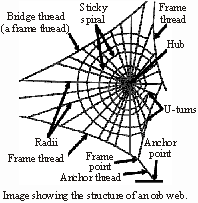
As shown in this paper, people’s fears are centred on ‘the oppression they face by the state, the vibrations that spread through their land when the power plant begins operation and the way in which their cattle, children and livestock react to these vibrations, the ‘visible’ smoke that comes out of the chimneys of the power plant, the increasing abortions in the area that the elders talk about.’ They share these experiences with other people living in nuclear cultures, people living around mines and other NPPs in the country. They share their experiences with other sufferers of nuclear cultures and are informed by these experiences, making an epistemic web that is formed out of experiencing and becoming with radiation.
I
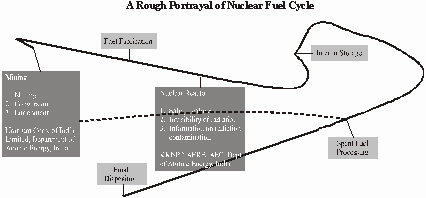
n the epistemic web that nuclear cultures form, lived experiences flow as information through the threads of the web, knitted by fear of radiation in nuclear cultures. At the joints of the web exist many nuclear cultures, namely cultures that are located around uranium mines, cultures that are nourished by nationalism and security state discourses, cultures that are formed around NPPs, cultures that come up in spaces where radiation and nuclear related research happens. The lived experiences from these nuclear cultures inform one another.The following section looks at the nature in which the discourse of safety (as discussed above), constructed by the state and nuclear institutions, seeks to address the concerns of cultures that form the web, knitted together by a discourse of fear, using the logic of problem solving. The discourse on safety, however, fails to knit itself to the web; rather it only succeeds in imposing a ‘framing thread’ around the web, via state oppression and scientific arrogance,
24 and its lack of engagement with the lived experiences that make the discourse of fear which knits the web together.
W
e need to remember that information that flows between a nuclear culture that forms out of an NPP, like Kudankulam and a nuclear culture that is based around a uranium mine, say Jadugoda, share ‘the fear of radiation contamination’, and not the fear about the safety design of the plant. It is important to note that the people resisting KKNPP, and the local people living around uranium mines, consider each other as solidarity groups in fighting the harmful effects of radiation contamination. The people around NPPs and uranium mines arrive at information about radiation contamination by anecdotes like the following.‘I didn’t even have money to take all of (the cattle) to the vet. Each injection costs more than Rs 175 and the vet himself was 12 km away in Pulivendula. I just sat and watched them die one after the other.’– Bhaskar, resident of Kanampalli village (a uranium mine).
25‘I have never seen land turning white before. This is all due to the uranium mine. I would get 25 to 35 tonnes of banana as output with profits of up to Rs 3 lakh. But now everything is gone. I borrowed money from a private moneylender at an interest of 18 per cent per annum and I have nothing to pay him back with.’ – Oodanaagi Reddy, 60, resident of Mabuchintalapalle village (a uranium mine)
26
T
he above experiences of people around uranium mines inform those people around NPPs and other nuclear facilities about the effects of radiation contamination. However, as we have seen, the discourse of (enhanced) safety addresses the safety problem by tinkering with the NPPs’ design. Mere tinkering is then presented as though this action addresses the problem of safety in nuclear power itself, as we see in the following quote by the Chairman of Atomic Energy Regulatory Board.‘The period post-Fukushima has heralded nuclear power into a regime of enhanced safety in design, operation and management. It has also triggered increased international cooperation in safety and regulatory practices. The global nature of nuclear power and the common concern for utmost safety in nuclear power have contributed to these renewed interactions.’ – S.S. Bajaj, Chairman, AERB
27
H
ere, S.S. Bajaj contains the imagination of nuclear safety within the design, operation and management of the power plant, as he reflects on the Convention of Nuclear Safety, a treaty under the auspices of the International Atomic Energy Association that India has ratified. He adds:‘One such forum was the extraordinary meeting of the Convention for Nuclear Safety (CNS), held at Vienna in August 2012, wherein a congregation of sixty-four contracting parties of the CNS, including India, participated. The deliberations were on topics related to nuclear safety such as external event, reactor design, severe accident management and recovery, emergency preparedness, emergency response and post-accident management.’
The treaty states that CNS places certain obligations on the (member) states operating ‘nuclear power plants’, hence its objective ‘to establish and maintain effective defences (…) in order to protect individuals, society and the environment from harmful effects of ionizing radiation’
28 applies only to the effects of ionizing radiation that are ‘produced from NPPs’ on individuals, society and the environment. Thereby, the ‘safety-ness’ of nuclear energy is framed within NPPs and not as a matter of radiation around which the ‘riskiness’ of nuclear energy is constructed by the local people.The fear of local people is conceived by policy elites as fear of ‘risks’ involved in the construction and operation of nuclear power plants. It is then immediately translated into the logic of safety. Whereas, in the everyday experiences of people becoming irradiated, the risk of nuclear energy is perceived through experiential accounts of radiation contamination, like high incidence of miscarriage, which accounts for what the concerns of local people about nuclear safety actually are. It is not only safety that needs to be enhanced in the power plants, but more so radiation contamination that needs to be addressed. There is a sort of epistemic breakage that happens in this quick translation of risks into safety under the current problem solving logics of scientific episteme that frames today’s nuclear energy discourse. This scientific episteme does not have an adequate vocabulary to understand, let alone address, concerns about radiation contamination amongst local people.
T
he misinformation spread through generalized statements by policy elites that the ‘period post-Fukushima has heralded nuclear power into a regime of enhanced safety in design, operation and management’29 also reinforces the public’s belief that nuclear power is clean, green and safe. Hence, it is not the discourse of fear among the local people that is centred on Fukushima, but rather the discourse of (enhanced) safety that is centred on the Fukushima disaster. Hence the responses in the discourse of (enhanced) safety to the concerns of the nuclear safety problem, as noted earlier, should be regarded as epistemologically reactive. Local people are not the only ones who are reacting; other players in the Indian nuclear policy arena are doing so as well. This may strategically be used to break the logic behind categorization and characterization of local people as being emotional and irrational.
A
lso, if nuclear safety is a problem of communication, then policy elites need to understand the dynamics of the flow of information between nuclear cultures that form the nuclear web. If communication is seen as a problem, scientists should then engage with the flow of information rather than inject into the threads of some tokenistic artifacts, like bulletins and newsletters, through which information flows claiming that nuclear energy is clean, safe and green.‘This annual bulletin is yet another initiative by Atomic Energy Regulatory Board to enhance its transparency and openness and reach out to public more effectively. This is an attempt to present information contained in the Annual Report 2011-2012 in a simplified and attractive format for easy grasping.’
30Needless to say, these artefacts are in English and the local people in nuclear cultures barely speak in English. This raises the question, ‘For whom are these artefacts produced?’ The above rhetorical acts identified in the action of nuclear institutions and oppressive action by the state, stand testimony to the fact that policy elites have imposed a frame onto the actual lived experiences of people around nuclear cultures. Policy elites, i.e. the state and nuclear institutions, have constructed fear among the people emanating from the event of nuclear disasters while ignoring fears of radiation actually experienced by local people in nuclear cultures. This has led to the real concerns of the people not being met at all.
R
esistance to nuclear energy in India existed much before the Fukushima disaster and is based on lived experiential accounts of radiation contamination as the following words by a member of the constituent assembly on ‘safety-ness’ of nuclear energy in Kalpakkam reactors testify to.‘In 2012, the Department of Atomic Energy (DAE) for the first time admitted that the deaths of some employees and their dependents at the Kalpakkam nuclear site were caused by multiple myeloma, a rare form of bone marrow cancer linked to nuclear radiation. The DAE acknowledged that nine people, including three employees working at the Madras Atomic Power Station (MAPS) at Kalpakkam died of multiple myeloma and bone cancer between 1995 and 2011. Within the 5 km radius of MAPS, approximately 30,000 workers are living in five villages. The DAE Township accommodates thousands of permanent workers and their families. There are more than 60 villages within 20 km in the vicinity of MAPS and more than one lakh people are living in these villages. As per reports, incidents of cancer and autoimmune thyroid diseases are common in the surrounding villages. I request the DAE (Department of Atomic Energy) to establish a multi-speciality hospital, to cater to the needs of the villagers in and around DAE Township immediately on priority basis since the existing DAE Hospital is meant only for their employees.’
31If the intent is to really engage with people, then managers of nuclear institutions must understand the complexity of their fear rather than manipulate and tinker with it to form rhetorical tropes like ‘enhanced safety features’ and regulating the flow of information through securitarian acts. What the local people living around mines and plants need is a good public health system that addresses radiation contamination rather than clubbing their symptoms under the epidemiological ignorance in cancer studies just to keep the nuclear industry going. For this, there is a need to understand the problem associated with the framing of safety in nuclear energy, as discussed above. If safety of nuclear energy is to come out of a clear understanding of radiation fear, nuclear institutions must reimagine nuclear safety by accounting for the lived experiences of the local people that speak of radiation contamination.
I
n nuclear cultures, everydayness is defined by fear of a probable disaster. The local people, rooted in their fear of possible radiation contamination, directly attribute any abnormality in their surroundings to the presence of nuclear machineries in their surroundings. This alters the ontological perception of their life world by keeping radiation fear at the centre of perceiving their world. For example, for Melrit, a resident of Kudankulam, water today is less so a source of sustenance for the fishing community, but more so a symbol that signifies her fear about the ‘safety-ness’ of nuclear energy when she says, ‘When we realize that the KKNPP will release water at temperatures that will harm life in the ocean, we feel that our mother is being desecrated.’In a way, the ocean water which has always been a source of sustenance for the fishing community that Melrit belongs to, when mixed with hot water which is drained out of the power plant, makes it non-conducive for fish to survive. The fishermen hence learn to fish in other pockets that are far away from the plants. This is not only an act of marking off spaces that belongs to KKNPP, but one that forces the local fishing community to learn to exist in the newly constructed territories. They learn to exist (along) with harmful effects of nuclear energy, and radiation in their environment.
Bhaskar sits and watches his cattle die one after the other, as he cannot afford to treat his irradiated cattle. This new way of life makes these marginal communities more vulnerable as their concerns are only met with state oppression and the rhetoric of safety constructed by policy elites. These new ways of living with radiation add an additional layer of vulnerability to their being, that is, they are living as irradiated bodies. The constant fear of radiation, and the lack of engagement by policy elites with the actual concerns of local people about radiation, marks their everydayness, living and becoming with radiation, as irradiated bodies. The local people in nuclear cultures are left to find ways to coexist and become with radiation thus creating nuclear graveyards all across the country.
I
n this paper, I have emphasized the need for policy elites to stop linking fear to disaster events like Fukushima and Chernobyl. Fear is centred more on the experience of local people when they encounter radiation or abnormal events that indicate radiation contamination. It is not single events of disaster occuring far away from the mines and NPPs of India from which lessons can be learnt and ‘safety-ness’ in NPPs enhanced and upgraded, but rather it is the everydayness and experience of radiation contamination that constitutes the discourse of fear in nuclear cultures.Hence, disaster in these places is not a sudden rupture in everydayness but rather it is everydayness. Nuclear disasters should not be seen a one-off event, a sudden rupture; rather they should be reimagined as slow disasters, thereby reframing temporality and typology of disaster outlook in nuclear cultures.
32 Living with the fear of radiation and radiation contamination, and being an irradiated body, should not be as fatalistic as it sounds in today’s Indian nuclear policy arena. Safety from ionizing radiation should be addressed less with rhetorics and more with effective policies addressing health and environmental issues caused by radiation contamination.
I
f the worlds of local people and policy elites are to be reconciled, engagement with policy elites should be focused more on respecting ontological perspectives and the language of the anti-nuclear public. As Hannah Arendt puts it, ‘Respect, not unlike the Aristotelian philia politike, is a kind of ‘friendship’ without intimacy and without closeness; it is a regard for the person from the distance which the space of the world puts between us, and this regard is independent of qualities which we may admire or of achievements which we may highly esteem’.33Respect is a tool for conviviality, as Ivan Illich puts it, ‘large institutions can quite suddenly lose their respectability, their legitimacy, and their reputation for serving the public good’.
34 Constructing a rhetoric that nuclear power is safe in generating electricity, a public good, by ignoring the increasing reports of irregularities in NPPs and radiation contamination among local people, nuclear energy institutions in India are slowly losing their credibility and respect. The lack of respect for the language of local people shows the hegemonic ignorance of local radiation conditions by such ‘large’ institution whose legitimacy gets lost when sustained only by lacunae of power, namely the rhetorical tropes constructed by the policy elites.
T
o respect becomes an act of translation between two different languages, that of expertise and lay, and hence two different life worlds. As Shiv Visvanathan puts it, ‘Translation is a process requiring that a truth to be a truth must be articulated in two languages’.35 Nuclear energy should not suffer from its technicality but should learn to converse with other social worlds. Nuclear safety should stop being ‘a technical answer to a technical question’.36 For the coexistence of plural life worlds and epistemologies in an ideal state of cognitive justice,37 we need Arendt’s notion of respect as a translator between life worlds. Such a translator will enhance the dynamics of the discourse of nuclear energy safety in India, by engaging various factors at play, eventually escaping the monotony of rhetorical production just to sustain the discourse of nuclear energy than actually addressing its problematics, regardless of the radical means needed to address it.
I
f the local people are expected to translate their fears into reports that show scientific evidence of contamination, as the one called forth by Kaipullai, ‘a report that provides the scientific justification for the protest’, it will immediately be dismissed as a product of fear, manipulating evidence and hence not scientific enough. Scientific knowledge, in its hegemonic position, when used to translate risks into safety does it through massive investment in safety features and overlooks the logic of risk and language of fear as communicated by local people.The overwriting of one epistemic notion of radiation risks by another notion of safety features in NPPs are made possible by the hegemony that policy elites have over local people and is based on a lack of understanding of actual concerns of the local population. In restoring respect, which was taken out of the life worlds of the resisting groups by state oppression and categorization, the first act should be to allow the local people to speak in the language that is familiar to them. To ask them to speak in scientific language that will eventually be dismissed for its invalidity, is clearly a strategic act of silencing their dissent.
When dissent is no more an element to be feared and is no more dealt with, by categorizing it as an uprising against the nation, then ‘we could begin to challenge the tyranny of modern India, bring back to citizenship a memory that flows, revive the power of the storyteller and the hospitality of listening’ to the voices of the irradiated bodies by the policy elites of today’s Indian nuclear policy arena.
38
Footnotes:
1. The test of the nuclear bomb ‘Smiling Buddha’ in Pokhran, Rajasthan, in 1974, led to India establishing itself as a global nuclear power although being a third world country.
2. Shiv Visvanathan, ‘In Search of Remedies’, Deccan Chronicle, 24 November 2016. https://www.deccanchronicle.com/opinion/columnists/241116/in-search-of-remedies.html
3. Personal archives.
4. Vidya Venkat, ‘The Story of Kudankulam: From 1988 to 2016’, The Hindu, 10 August 2016. Accessed 30 November 2017. http://www.thehindu.com/news/national/The-story-of-Kudankulam-From-1988-to-2016/article14564027.ece
5. ‘Birds Started Nesting in Area Surrounding NPP of Kudankulam’, India Infoline News Service, 2 September 2013. https://www. indiainfoline.com/article/news-business/birds-started-nesting-in-area-surrounding-npp-of-kudankulam-113110817474_1.html &cd=1&hl=en&ct=clnk&gl=in
6. ‘Koodankulam Port Becomes Operational’, The Hindu BusinessLine, 17 January 2004. https://www.thehindubusinessline.com/2004/01/17/stories/2004011700940600.htm
7. S.P. Udayakumar, ‘India: Protests Against Koodankulam Nuclear Project’, Nuclear Monitor 652, 8 February 2007, pp. 1-2.
8. ‘Anti-Nuclear Protestors Stage Day-Long Siege of Kudankulam Plant’, The Hindu BusinessLine, 8 October 2012. https://www. thehindubusinessline.com/news/national/anti-nuclear-protestors-stage-day-long-siege-of-kudankulam-plant/article20512166.ece1
9. ‘Koodankulam Protestors Write to God, Urge Him to Stop "Nuke Disaster",’ Refiff News, 29 June 2013. https://www.rediff.com/news/report/koodankulam-protestors-write-to-god-urge-him-to-stop-nuke-disaster/20130629.htm
10. Arun Janardhanan, ‘8,856 "Enemies of State": An Entire Village in Tamil Nadu Lives Under Shadow of Sedition’, The Indian Express, 12 September 2016. Accessed 10 November 2017. http://indianexpress.com/ article/india/india-news-india/kudankulam-nuclear-plant-protest-sedition-supreme-court-of-india-section-124a-3024655
11. S.P. Udayakumar, ‘Thirteen Reasons Why We Do Not Want the Koodankulam Nuclear Power Project’, Dianuke.org, 25 August 2011. Accessed November 28, 2017. http://www. dianuke.org/thirteen-reasons-against-the-koodankulam-nuclear-power-project/
12. Nuclear culture comprises of cultures which form out of and which exist around nuclear project, including research projects, power plants and mines.
13. Michel Foucault, ‘The Body of the Condemned’, in Discipline and Punish, Arbor House, New York, 1987, pp. 3-32.
14. T.S. Subramanian, ‘Shadow of Fear’, Frontline, 9 August 2013. Accessed 13 September 2018. https://www.frontline.in/the-nation/shadow-of-fear/article4945295.ece
15. ‘Kalam Suggests 10-Point Action Plan on Kudankulam Nuclear Project’, The Times of India, 7 November 2011. Accessed 28 November 2017. http://timesofindia.indiatimes.com/articleshow/10641563.cms?utm_source= contentofinterest&utm_medium=text&utm_ campaign=cppst
16. ‘"Dream, Dream, Dream!" 10 Quotes from Kalam That Ignite Minds’, Hindustan Times, 28 July 2015. https://www.hindustantimes. com/india/dream-dream-dream-10-quotes-from-kalam-that-ignite-minds/story-IvhhmqoucInttWZV8o82vJ.html
17. Kaipullai, ‘Why the Kudankulam Protesters Have it all Wrong’, First Post, 24 March 2012. https://www.firstpost.com/india/why-the-kudankulam-protesters-have-it-all-wrong-253669.html
18. Safety review of nuclear facilities is a section of Chapter 2 of the annual reports published by AERB between 2001-2017.
19. S.S. Bajaj, ‘Extracts from an Interview-cum-Article of Shri S.S. Bajaj, Chairman, AERB, PowerLine, October 2012.’ AERB 25, December 2012, p. 12.
20. Ibid., p. 11.
21. Ibid., p. 12.
22. Sasikumar, ‘Koodankulam Nuclear Plant: Risk Analysis and What to Expect – Part 3’, Dianuke.org, 5 December 2011. http://www.dianuke.org/koodankulam-sasikumar-3/
23. Charles W. Mills, The Racial Contract. Cornell University Press, Ithaca, 2014.
24. Refer to Ashis Nandy, ‘Science as a Reason of State’, Science as Culture1(7), 1989, pp. 69-83. doi:10.1080/09505438909526260
25. Krishna Shree and Rajesh Serupally, ‘The Real Cost of Uranium Mining: The Case of Tummalapalle’, First Post, June-July 2018. Accessed June-July 2018. https://www. firstpost.com/long-reads/the-real-cost-of-uranium-mining- the-case-of-tummalapalle-4749521.html
26. Ibid.
27. S.S. Bajaj, ‘From the Chairman’s Desk’, AERB 25, December 2012, p. 12.
28. ‘Convention on Nuclear Safety’ opened for ratification on 20 September 1994, International Atomic Energy Agency treaty series. https://www.iaea.org/sites/default/files/infcirc449.pdf
29. S.S. Bajaj, op. cit., 2012, p. 12.
30. Parikshat Bansal and Anuradha, AERB Bulletin 2011-2012. Edited by R. Bhatta-charya. Compiled by Soumen Sinha. December 2012. Matunga, Mumbai. Refer to the preface.
31. Refer to Lok Sabha debates. ‘Need to Set Up A Multi Speciality Hospital at Kalpakkam in Tamil Nadu to... on 11 March 2013.’ https://indiankanoon.org/doc/79696589/
32. Kim Fortun, Scott Gabriel Knowles, Vivian Choi, Paul Jobin, Miwao Matsumoto, Pedro de la Torre III, Max Liboiron and Luis Fellpe R. Murillo, ‘Researching Disaster from an STS Perspective’, in The Handbook of Science and Technology Studies (4th ed.). The MIT Press, London, 2017, pp. 1003-28.
33. Hannah Arendt, The Human Condition. University of Chicago Press, 1958, p. 243.
34. Ivan Illich, Tools for Conviviality. Marion Boyars, New York, 1973, p. 1118.
35. Shiv Visvanathan, ‘The Search for Cognitive Justice’, Seminar 597, May 2009. https://www.india-seminar.com/2009/597/597_shiv_visvanathan.htm
36. Shiv Visvanathan, ‘Between Pilgrimage and Citizenship’, in Indigenous Knowledge and the Integration of Knowledge Systems. New Africa Books Ltd, Claremount, 2002, pp. 39-52.
37. Shiv Visvanathan, 2009, op. cit.
38. Shiv Visvanathan, ‘The Sadness of Silence’, The Hindu, 8 September 2018. https://www.thehindu.com/opinion/lead/the-sadness-of-silence/article24896868.ece