Making fiscal space for spending on public health
M. GOVINDA RAO
THE concept of ‘development’ is meaningful only when the people are free from poverty, hunger, malnutrition, and have the freedom to work and lead a healthy life.
1 Thus, access to healthcare is an essential component to empower people to secure ‘freedom’. Government intervention in ensuring good healthcare is essential not only because of its ‘categorical equity’ and characteristics of externality, but also due to the prevalence of a high degree of asymmetric information. Not surprisingly, governments worldwide have a significant presence in providing and regulating health services and their role is particularly important in developing countries with a large concentration of vulnerable and poor.The important features of the Indian healthcare system are: (i) Low levels of public spending. In 2016-17, government spending on healthcare relative to GDP was about 1.4% and is lower than the expenditures in low human development countries (1.7%); (ii) wide inter-state inequalities in public health spending. The states with low per capita income and large concentration of poverty spend abysmal amounts; (iii) low level of spending on health has resulted in poor quality of preventative care and poor health status of the population in general and more severely in low income states; (iv) inadequate public health provision has forced the population to seek private health providers resulting in large out of pocket spending. Out of pocket spending in India is over five times the public spending on healthcare; (v) the predominant private sector share in healthcare provision requires strong regulation, particularly when the sector is riddled with asymmetric information. However, the prevalence of a weak regulatory system has meant exploitation of consumers and unhealthy practices.
Considering these factors, reforms in the health sector will have to address the issue of increasing allocation to healthcare, focusing on preventative care, ensuring greater access to healthcare for the poor and significantly improving the productivity of public spending in India. This paper attempts to evaluate the prevalent transfer system for the health sector in the country
Indian fiscal federalism is characterized by a high degree of vertical and horizontal imbalances. The Constitution assigns the states with the predominant responsibility of providing social services and a co-equal responsibility with the Centre for providing economic services, but they do not have the powers to levy taxes from broad based tax handles. Furthermore, there are wide differences between the states in terms of the capacity to raise revenues. Even if only the large general category states are considered, in 2016-17, Haryana (Rs 180174) with the highest per capita income (NSDP) had more than five times the per capita income of Bihar (Rs 35590), the lowest income state. Wide disparities in incomes causes disparities in taxable capacity and the ability to undertake expenditures.
C
onsidering the large and growing vertical and horizontal imbalances and wide inter-state differences in public health expenditures, there is certainly a case to be made for giving both general and specific purpose transfers in the Indian context. The objective of general purpose transfers is to enable every state to provide comparable levels of public services at comparable tax rates which requires transfers to offset revenue and cost disabilities.The Constitution provides for the appointment of a Finance Commission every five years to assess the finances of the Centre and individual states as well as recommendations on the transfers through tax devolution and grants to the states. So far 14 Finance Commissions have made such recommendations. In addition, specific purpose transfers are given by various central ministries for public services considered meritorious and to those with significant externalities.
The 14th Finance Commission recommended the transfer of 42% of the divisible pool of taxes to the states.
2 The higher share was mainly to take account of the plan transfers given earlier by the Planning Commission. The commission adopted a formula for distribution comprising of a mix of variables representing revenue and cost disabilities. It gave 50% weightage to deviation from the highest per capita income, 27.5% weightage to population, 15% weightage to the area and 7.5% weightage to forest area.
T
o ensure a normatively minimum level of services, a specific purpose grant is necessary. The National Health Mission (NHM) is a specific purpose grant given to the states to augment their healthcare system to provide ‘accessible, affordable, accountable, effective and qualitative’ healthcare. The core values of the programme are to (i) safeguard the health of the poor, vulnerable and disadvantaged persons; (ii) strengthen public health systems as a basis for universal access and social protection against rising costs; (iii) build the environment of trust between the people and health service providers; (iv) empower the communities to become active participants in attaining the highest possible levels of health; and (v) improve efficiency and optimize the use of resources.These are intended to be achieved by building an integrated network of primary, secondary and a substantial part of tertiary healthcare facilities and to achieve inter-sectoral coordination to address food security, nutrition, access to safe drinking water and sanitation, education of female children, occupational and environmental health determinants such as women’s rights and employment, and different forms of marginalization and vulnerability.
T
he NHM support to the states/ union territories has five key components. (i) The National Rural Health Mission – Reproductive and Child Health (NRHM-RCH) Flexible Pool extends financial assistance to two components namely (a) Reproductive, Maternal, New-born, Child and Adolescent Services (RMNCH+A) which is a continuum care approach covering all stages of life, and (b) health system strengthening under NRHM to augment infrastructure, human resources, programme management and patient transport services; (ii) The National Urban Health Mission (NUHM) provides financial assistance to address the health concerns of the urban poor; (iii) Control of Communicable Diseases includes programme assistance to control communicable diseases such as tuberculosis, vector borne diseases and leprosy in addition to the Integrated Disease Surveillance Project; (iv) Control of non-communicable diseases such as cancer, diabetes, cardiovascular diseases and stroke, national programme for control of blindness, national mental health programme, national tobacco control programme, and national programme for healthcare of the elderly; (v) Infrastructure maintenance is the assistance given to the states to meet the salary on Family Welfare Schemes.
W
hen the NRHM programme was initiated, it was entirely funded by the central government. However during the 11th plan period (2007-08 to 2011-12), the central contribution was 85% and the states were required to contribute 15%. Later, during the three years of the 12th plan (2012-13 to 2014-15), the ratio of central and state contributions to the programme were 75:25 for the general category states and 90:10 for the special category states. However, after the 14th Finance Commission increased the tax devolution to 42% (as against 32% by the previous commission) of the divisible pool, the funding pattern was changed based on the recommendation of the NITI Aayog’s Committee of Chief Ministers convened by the chief minister of Madhya Pradesh to 60:40 in the case of general category states and 90:10 in the case of special category states.For allocating funds to individual states, the Union Ministry of Health and Family Welfare works out the resource envelope for the year and conveys it to the states. Envelopes are determined on the basis area and population weighted by socio-economic backwardness and health lag in the states. Ten per cent of the funds are given to the state that demonstrates an ability to efficiently absorb the funds as demonstrated by the progress made in key areas of institutional reform identified in the MOU. For the NRHM-RCH flexible pool, population weights for states are predetermined. The large Empowered Action Group (EAG) states (Madhya Pradesh, Bihar, Rajasthan and Odisha) are assigned the weight of 1.3, the two EAG states of Jharkhand and Chhattisgarh are assigned a weight of 1.5, the eight Northeastern states including Sikkim are assigned a weight of 3.2 and the small union territories (excluding Delhi and Pondicherry) are assigned a weight of three and the remaining states are given a weight of one. The allocation for NUHM is done on the basis of the urban and slum population by giving 50% weightage to each.
Based on the resource envelope communicated to them, the states are required to prepare their annual Programme Implementation Plans (PIPs) based on the state’s context and felt needs. These are appraised and approved by the National Programme Coordination Committee (NPCC) chaired by the Secretary, Ministry of Health and Family Welfare and the states are required to implement the approved plan.
C
onsidering that the basic objective of the transfer is to ensure minimum standards of healthcare throughout the country, the prerequisite of the transfer is to define a minimum standard, work out the cost of providing this in different states and design the transfer system to ensure that every state spends the prescribed expenditures to achieve the minimum standard. The analysis of the design and implementation of the schemes bring out a number of policy issues which need to be addressed to make the programme effective. These are discussed below.Defining a minimum standard requires clarity of the objectives. Specifying too many objectives spreads the resources thinly across many activities besides increasing the difficulties in monitoring processes. In a shared cost programme it is important that the implementing level of government should be allowed to plan and implement the programme and allocating resources across several activities within the health sector will increase bureaucratic interference without ensuring efficient resource allocation. Micromanagement of the programme betrays a lack of trust with the states.
A
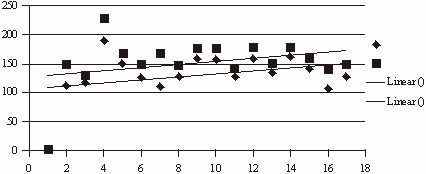
s reported in the Action Agenda document of the NITI Aayog, there are as many as 2000 budget heads. It would be useful to set targets in terms of infrastructure created, such as the number of health centres and sub-centres, the number of health professionals and availability of medicines as per the norms. Specifying the targets and providing expenditures to achieve them would help link the outlays to the creation of health facilities and make it easy to fix accountability.At present, the resource envelope is worked out and communicated to each state government. The envelope is determined for five different components predominantly on the basis of population weighted according to health lags and the area. However, the weights assigned to the EAG states at 1.3 or 1.5 and for Northeastern and Himalayan hill states at 3.2 as compared to the other states at one indicates that these are based on broad judgements rather than the actual position. Not surprisingly, it is hard to find a significant and positive correlation between the grants given and the health status in the states. Kerala, the state with the best IMR gets the third highest grant allocation as well as release, and Uttar Pradesh, in terms of grants allocated as well as released, is much lower. Thus, both the allocation and release of funds to the states are not designed to ensure minimum standards of services.
T
he analysis shows the actual release of funds was lower than the original allocation in all the states. The largest shortfall was in Jharkhand followed by Andhra Pradesh and Telangana. Among the low income states, besides Jharkhand, the shortfall was more than 15% in Chhattisgarh and Uttar Pradesh. The fact that there was a shortfall in the actual release from the original allocation implies that this was substantially due to the budget cut at the Centre. This is revealed by the fact that the actual expenditure on NHM in 2014-15 was lower than the budget estimate by 20%. Cutting the expenditure arbitrarily defeats the purpose of ensuring minimum levels of expenditure.|
TABLE 1 Grants Allocation and Release |
||||
|
States |
IMR |
Allocation |
Release |
Release as a ratio of allocation |
|
Andhra Pradesh |
35 |
147.52 |
111.81 |
75.8 |
|
Bihar |
48 |
129.50 |
117.69 |
90.9 |
|
Chhattisgarh |
54 |
227.77 |
189.33 |
83.1 |
|
Gujarat |
34 |
165.88 |
148.39 |
89.5 |
|
Haryana |
33 |
147.48 |
124.25 |
84.3 |
|
Jharkhand |
44 |
165.91 |
109.85 |
66.2 |
|
Karnataka |
28 |
146.29 |
126.57 |
86.5 |
|
Kerala |
6 |
176.30 |
158.18 |
89.7 |
|
Madhya Pradesh |
51 |
176.00 |
157.36 |
89.4 |
|
Maharashtra |
24 |
140.68 |
125.57 |
89.3 |
|
Odisha |
40 |
177.53 |
158.00 |
89.0 |
|
Punjab |
29 |
150.06 |
134.55 |
89.7 |
|
Rajasthan |
41 |
177.06 |
161.93 |
91.5 |
|
Tamil Nadu |
21 |
158.21 |
141.00 |
89.1 |
|
Telangana |
28 |
139.24 |
106.55 |
76.5 |
|
Uttar Pradesh |
64 |
148.23 |
125.91 |
84.9 |
|
West Bengal |
27 |
151.39 |
131.95 |
87.2 |
|
Source : Ministry of Health and Family Welfare, Government of India. |
||||
An important reason cited for the shortfall in the actual release of expenditures from the original allocation is the inability to provide the utilization certificates in time. At the same time, as the Union Ministry of Health and Family Welfare wants to utilize the funds, the funds allocated to those states which do not fulfil the compliances are distributed to those that fulfil them. This defeats the purpose of equalization. This issue must be addressed by building capacity in non-complying states and perhaps, introducing multi-year budgeting.
|
Distribution of Central Grants According to Infant Mortality Ratio |
|
|
The important objective of requiring the states to make matching contributions is to ensure that the funds given by the central government for augmenting health services add to the overall health expenditures and that the states do not substitute these funds with their own spending. However, an econometric analysis carried out in a recent study of regressing changes in expenditures and on changes in NHM transfers, its own revenues, general purpose transfers and priority assigned to the health sector (as shown is the share of health expenditure in total expenditure) in a fixed effects model for the period 2013-15, reveals that specific purpose transfers showed that every rupee of per capita specific purpose transfers reduces the spending by the state by 0.36 rupee when the impact of its own revenues and general purpose transfers are accounted for. Thus, a part of the specific purpose transfers are used to substitute own expenditure by the states rather than fully adding to the expenditures.
T
he foregoing analysis shows that achieving the basic objective of ensuring a prescribed minimum stand of health services requires reforms in the design and implementation of the NHM transfers. Important reform issues to make the scheme more effective are discussed here. As mentioned earlier, it is necessary to clearly define the objective of the scheme. This implies that it is necessary to avoid multiple objectives and focus on a single one – ensuring minimum levels of health infrastructure or healthcare service professionals across the country. The objective should be to ensure a prescribed minimum health infrastructure for primary healthcare including physical infrastructure, health professionals and drugs. A significant portion of the tertiary healthcare and some portion of secondary healthcare must be provided by the states themselves.Once the focus shifts to ensuring minimum standards of services, it is not necessary to have multiple interventions and give grants under a large number of budget heads. It is important to avoid micromanagement and minute categorization of transfers to minimize the transaction cost and spread the resources thinly across several interventions. Public health is a state subject in the Constitution and it is appropriate to trust the state and empower it to provide a mix of infrastructure as perceived by the state to be appropriate.
T
he resource envelope allocation to the states should be made purely on the basis of shortfalls in infrastructure as per the specified norms. The present system of allocating funds on the basis of area and population according to health lags, which could be arbitrary and not allocate resources according to varying standards of health infrastructure. As the objective of any specific purpose transfer is to ensure minimum standards of services, it is necessary to define the minimum standard sought to be equalized and accordingly make the allocations.The difference between original allocation and ultimate release creates difficulties in implementing the planned activities by the recipients of the grants. The difference largely arises on account of cuts in the central budget for the schemes or the inability of recipient state governments to fulfil their matching requirements or providing utilization certificates. Simplification of the transfers on the lines indicated above should considerably reduce compliance requirements by the states. In addition, as some infrastructure facilities in the health sector may require a longer time period to complete, multi-year budgeting could be a solution.
The creation of infrastructure facilities by itself may not improve health outcomes. It is important to institute a system of incentives and accountability. This does not fall into the realm of design of the transfer system but its implementation. To a considerable extent this has to do with the system of governance in the state.
The matching requirements from the states for NHM have been changed after the NITI Aayog Committee of Chief Ministers convened by the chief minister of Madhya Pradesh recommended the matching ratio between the Centre and states at 60:40 for the General Category States (GCS) and 90:10 for the Special Category States.
Given the large number of schemes and significant inter-state variations in health infrastructure including human resources between the states and the need to bring up the states lagging in services to the minimum level, it may be appropriate to design the scheme with varying matching requirements. The GCS may be grouped into three categories depending on their taxable capacity as either high, moderate or low capacity states and the matching ratio for the states may be fixed at 50%, 40% and 30%. This way, low capacity states will find it easier to contribute their matching requirements and avail the central transfers.
I
t is important to ensure that the grants given to the states add to the expenditure on healthcare and the states are not allowed to substitute their own spending by transfers. This would require adding a condition to availing of the grants. This could be done either by stipulating that the expenditure excluding the transfers on health does not fall short of the projected health expenditures excluding the transfer for the year, or by stipulating that the share of health expenditure in total budgetary expenditure increases by the volume of grants received.
P
roviding basic healthcare is an essential part of human development and freedom. In a country where there are wide variations in per capita incomes and the poor are concentrated in states with low per capita incomes, equitable transfers, both general purpose and specific purpose, play an important role. While general purpose transfers are meant to offset revenue and cost disabilities of the states to enable them to provide comparable levels of public services at comparable tax rates, specific purpose transfers are meant to ensure minimum standards of health services across the country. Ensuring minimum standards of healthcare, particularly primary healthcare, is essential to minimize the burden on secondary and tertiary care. In fact, the success of the proposed insurance scheme under Ayushman Bharat will critically depend upon ensuring basic health infrastructure to provide primary healthcare throughout the country.The analysis provided in this paper shows that general purpose transfers, while being progressive, offset the fiscal disabilities of the states only partially. There are a number of design and implementation shortcomings with regard to specific purpose transfers. It is, therefore, not surprising that the overall public health expenditure continues to be low and particularly low in states where they are most needed. It is important to design an efficient transfer system to ensure targeted minimum standards of healthcare services and better implementation by giving greater flexibility and autonomy to the states.
* The paper is based on a larger study done for the NITI Aayog, ‘Central Transfers to States in India: Rewarding Performance While Ensuring Equity’. See, M. Govinda Rao, ‘Central Transfers to States in India: Rewarding Performance while Ensuring Equity’, 2017. http://niti.gov.in/writereaddata/files/document_publication/Report%20on% 20CENTRAL%20TRANSFERS%20 TO% 20STA TES%20IN%20INDIA.pdf.
Footnotes:
1. Amartya Sen, Development as Freedom. Oxford University Press, New Delhi, 1999.
2. The divisible pool comprises of gross tax revenue collected by the Centre minus the revenues, cesses and surcharges and cost of collecting the taxes.