The paradox of protection
JIGNA DESAI
IF you visit Ahmedabad and happen to see the School of Architecture, now CEPT University, or if you have been a student of architecture, you are bound to be mesmerized by its North Lawns. As alumni, most of us are unabashedly nostalgic about them. As architects, we see their value as an integral part of the School of Architecture building. If you Google CEPT University, you can see these wonderful green mounds with a few students sitting and chatting (the image also includes women should that be important). Last October, a prominent architect presented a proposal for a new building on the West side of these mounds. During the post-presentation conversation, a member of the audience asked about the changes that were proposed to be made to these lawns and how that might affect the identity of CEPT. The architect ended his response by saying, ‘I assure you one thing, I love her [north lawns] as much as you do. I will protect her.’
1 The response left no doubt that the North Lawns would be protected in the wake of any change.This reminds me of another instance that occurred in April 2017, when we lost one of the significant symbols of Indian architecture – the Hall of Nations, along with the Nehru Pavilion, at Pragati Maidan, Delhi. For the uninitiated, this piece of architecture, built by Indians with local techniques, represented the Indian Modern, and captured the self-confidence of a country in its 25th year of independence. They helped create a new economic image for India.
Many architects, engineers, conservation experts, artists and citizens wrote to the authorities opposing the proposed move. The authorities called upon the court of law to take a decision, and the court in turn sought the advice of the Heritage Conservation Committee. The committee, set up for protecting heritage, concurred that only buildings older than 60 years would be granted heritage status. These structures did not qualify.
2 This incident makes it glaringly clear that those with the authority to protect also have the power to choose not to.
T
he feminist in me in situations like these cannot but help link this to the extant practice of protectionism in a patriarchal society. The vocabulary of patriarchal protectionism that calls upon men to protect women, even if born out of love, is problematic as it infantilizes women instead of empowering them to have agency over their own bodies and minds. The complete lack of agency here has led to violence, abuse, and an absence of consensus in any eventuality. So is there a parallel here? Maybe a far-fetched one. I am, however, unable to ignore that in both cases mentioned above, people who have memories, and value them, but are not in positions of authority, do not matter. Just as it is difficult to ignore the fact that more often than not gender concerns are consigned to the margins.The narrative of protecting heritage, or a particular evidence of history, or an image of identity, not unlike patriarchal protectionism attributes the responsibility and authority of decision-making to a specified set of people in positions of authority. As the process of protection of heritage plays out on the ground, an expert (or a group of them) carries out a detailed scientific study to determine the values that are attributed to the site/structure in question. The site/structure is then graded to determine the level of preservation it would warrant. The experts then make recommendations to the patron on the future of the site/structure. As seen in both examples above, this narrative mostly denies agency to anyone with a direct or indirect association to the place if they are not in a position of authority. This process disregards the dynamic nature of places that have living and ever-changing relationships.
T
hese processes of conservation and preservation have often been criticized for not being successful or meaningful where the site of heritage is a living city. In the world heritage city of Ahmedabad, one sees a constant negotiation between an authoritarian diktat to protect and the need to change. The walled city, with more than two thousand listed domestic buildings, has seen hundreds of them pulled down under the pretext of being in a dangerous structural condition. On the one hand some experts demand stricter rules and better policing.3 Other experts cite the denial of agency to those involved in giving meaning to the site as a reason for apathy and point out that the meaning of heritage is destined to change with society itself.4 It is only natural that sites and structures in a city are affected by social change. They need to constantly adapt by being in a direct relationship with the people whose memories and associations are built around them.This direction of thinking suggests that the practice of heritage conservation should be more inclusive/ participatory. Rather than merely scientific preservation, it treats heritage conservation as a social and economic process of transformation, with the acceptance of plural values of a site, and its multiple possible futures. The idea here is not to protect the values of the place through authoritarian intervention, but to enter into a democratic discourse of continuity and change. This dialogue is carried out with the assumption that the acceptance of plural histories, aspirations for the future, and issues of quality of life are bound to create conflicts among associated groups, but that there is also valid knowledge and social capital within the group to resolve these conflicts. The rest of the article demonstrates an academic exploration of transforming a site in the Walled City of Ahmedabad through such a process, and examining the potential and possible limitations of an inclusive process of attributing values to a place.
L
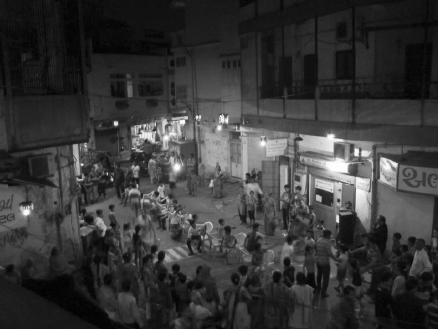
ocated in one of the neighbour-hoods in the walled city of Ahmedabad, this engagement process has been tried out in two instances, with two more already planned by way of teaching and research engagement through CEPT University. The first instance was in collaboration with the Centre for Environmental Education (CEE) through a course – ‘Streets for People’.5 The objective of this exercise was to bring to the fore the value of a street square as a public place rather than as a parking place that it has become, and to study the meanings of the place through various points of view.After having carried out the standard exercise of activity mapping using surveys, interviews etc., a one-day event was planned in the street square. The neighbourhood youth group supported the event by helping secure permissions and the collective agreement of all residents. The idea was to convert the street square into a play space, a hang out space, and a place for discussions on one Sunday. Activities were planned through the day to encourage residents of different age groups and gender to come out of their houses and participate. All organizational material (lights, paint, stationary, etc.) was provided by the shopkeepers of the area. By the end of the day, the square was transformed into an active public place with various residents claiming access to it.
I
n the long run, through negotiations between residents and shopkeepers, it was decided that the space would be used as a parking space on weekdays till 7 pm. In the evenings and on Sundays, the square would serve as an area for public activities and events that residents may wish to organize.This engagement proved to be only the first of many initiatives. The youth group of the same neighbourhood then approached us with another situation. It was the site of a dilapidated house of a resident who had donated it to the Municipal Corporation for it to be run as a maternity home. The ruins were already a landmark in the memory of people living in the neighbourhood. They had cleaned up the place for it to be used for political and social gatherings.
M
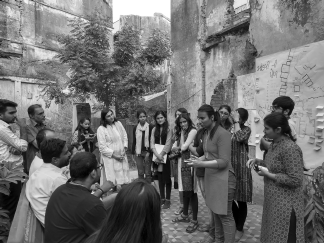
any remembered it as a maternity home and wanted a new structure built there that would revive the use of the place. Some residents thought that it was time to move on and introduce a new function to the place that would help the neighbourhood move into the future. A few felt that the neighbourhood needed to become a part of the World Heritage narrative as it is one of the oldest neighbourhoods in the city, and has much to say. Among these many points of view, it was also to be kept in mind that the remains on the site were of a listed building, graded by experts as having a ‘high’ historic value in a World Heritage City.|
|
|
|
Discussions with various groups. Photo: Sweta Kandar. |
|
Considering the complexity of the situation and conflicting ideas about the value of the place and aspirations for its future, it was decided that this engagement was, to begin with, to be limited to building a consensus around the future of this site. And through that discuss the values of history. A twelve week design studio, titled ‘Culture and Co-production’ was planned as a part of the Faculty of Architecture, CEPT University’s academic activity.
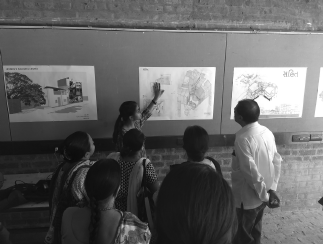
6 As a part of this process, a group of students identified four different proposals for the future: women’s wellness centre, a co-working space, a history club, and an open accessible space. Each idea was discussed, developed and designed as a scenario. This was done through various public meetings and focus group discussions.
A
s processes of participation go, there was a conscious effort made to ensure that we got maximum representation from diverse groups of the neighbourhood. One of the most useful ways to ensure this was to organize activities for children. Residents who otherwise would not socialize with one another due to class, caste or religious barriers came together for this. However, not all of them participated actively in public meetings, and thus focus groups became important.What started off as day-to-day issues of conflict between shopkeepers and residents for access to parking space, lack of opportunity for young people, lack of water and waste management, discontent with commercialization and renting of houses, soon turned into meaningful debates on access, quality of life, memory and aspiration. Some interesting debates, though at times heated, were:
* Can the Wellness Centre for Women also look into aspects of emotional health faced by women all over the city? Can it address issues of loneliness, abuse and alienation?
* Does the place have the potential to become a platform where various activities for children can be organized by the residents themselves? Can it become a safe place for kids to play and breathe clean air – especially in the context of congestion and pollution?
* Can the place provide a space for young men and women to explore their career trajectories? Can it be a work space, close to home for working mothers?
* Should this place invoke a sense of the city’s history? Would that have any effect on the way people relate to or belong to the place?
* Who will fund it? Who will maintain it? Should neighbourhood residents take on the responsibility? Will they have complete autonomy?
A
fter three public meetings and six focus group discussions generating eleven scenarios for the future, it was concluded by the residents present that questions of who would maintain the place and have access to it were the most important ones. A large building requiring big money would, by default, mean involving an external agency or giving greater power to the corporation. This, supported by voices that pointed out to a rationale that programmes like wellness centres and co-working spaces could be housed in other empty structures in the neighbourhood, led to the decision that the space would have minimum intervention to support and enable children’s activities.
|
|
|
Getting to know the neighbourhood, games and discussions. Photo: Purvi Vyas. |
A few residents meanwhile had seen value in one of the scenarios that proposed a ‘history wall’ – a place where residents of the neighbourhood could share their histories. This, as pointed out, might also help various groups understand one another better and foster a sense of community. All, however, agreed that this place would have to be autonomous in terms of meeting its resource and maintenance requirements. Everyone agreed that this was an important lesson from history which needed to be revived and emulated. Possibilities of further engagement to take up the history wall as an academic exercise, or to look at other similar places in the neighbourhood are being discussed within the realm of ethical academic engagement. Outlined below are some valuable lessons that can inform further engagement and larger debates on the value of historic built environments.
O
ne of the first lessons learnt in this process was that even the smallest neighbourhood in a city is not made up of a homogenous ‘community’ with a singular voice. The issue of dominant voices that reflect the attitude of patriarchal protectionism also dominated discussions. Many women, especially middle aged and from the dominant class, eventually found their place in these conversations owing to the programmes and scenarios that were specially designed for women. However, there was a group of temporary residents – young men who were here in search of job opportunities and lived in the neighbourhood because it was affordable – who did not find a voice until the very end of the process. They participated only when the final discussions of the ‘history wall’ and who would have access to it were taking place.Not all associations that inhabitants form with places are enduring in nature; nor are they singular, clear, or easily definable. The value of the place that was arrived at through this engagement included its history, its use, emotions attached, the potential it has for the future, and many other loosely and closely held attributes. The time bound record of a certain past that is studied through sites and buildings in a city not only takes away the agency of access (emotional and social) from the people around it, but also results in an alienation of people’s consciousness of their environment.
The values of a place arrived at through this process are ambivalent and plural, the result of situated knowledge. The values are ‘active’, and of the past, present, and future. Having said this, one then needs to reflect upon the role of an expert: is it as an architect of the future who will, through her understanding and human sensibilities, protect what is deemed valuable? Or as one of the co-producers of the place, with an agency to study, understand, and transform historic environments? In the context of historic places and environments, are we the authoritarian protectors or enablers who will engage the imagination and exercise agency in the processes of creating values for continuity and change?
Footnotes:
1. The entire presentation, along with the post presentation discussion is available at: https://www.youtube.com/watch?v=TY_ aB4TLsUA (as accessed on 28
April 2018). For all concerned, the North Lawns are intact as of date and the project has not gotten off the ground yet.2. News on the HC ruling. https://timesof india.indiatimes.com/city/delhi/hc-rejects-plea-on-hall-of-nations/articleshow/58288304.cms (as accessed on 28 April 2018).
3. E.B. Keough, ‘Heritage in Peril: A Critique of UNESCO’s World Heritage Program’, Washington University Global Studies Law Review 10(3), 2011.
4. F. Bandarin and R. van Oers, The Historic Urban Landscape: Managing Heritage in an Urban Century. Wiley-Blackwell, Oxford, 2012.
5. The course was a part of the activities conducted under the UNESCO Chair for Education of Sustainable Development of Human Habitat (2014-2018). The course was conducted by the author of this article along with Madhavi Desai and Purvi Vyas. The students involved were: Shailja, Jankis, Khyat, Priyanka, Khushboo, Jigar and Unnati. Details available on: http://portfolio.cept. ac.in/streets-for-people/
6. This studio was conducted by the author with Ramya Ramesh. Students involved were – Sweta Kandari, Aahna, Khushi, Komal, Prarthi, Vidhi, Maitri, Anokhi, Jui, Drashti, Archan and Tejas.
References
N. Awan, T. Schneider and J. Till, Spatial Agency: Other Ways of Doing Architecture. Routledge, Oxon, 2011.
M. Castells, The City and the Grassroots: A Cross-Cultural Theory of Urban Social Movements. University of California Press, Berkeley and Los Angeles, 1983.
J. Desai, Problematizing Heritage in Context of Sustainable Development. Unpublished doctoral thesis, CEPT University, 2016.
D. Hayden, The Power of Place: Urban Landscapes as Public History. MIT Press, Cambridge, 1995.
A. Parr and M. Zaretsky, New Directions in Sustainable Design. Routledge, London and New York, 2011.