A people’s museum ‘beyond the wall’
MOUSHUMI CHATTERJI
AWAY from the quiet and exclusivist spaces yearned by many museums, a People’s Museum touted as the aggregator of stories, attempts to step ‘beyond the wall’ to find its bearing amidst the chaotic, thriving, loud and bustling historic urban spaces of Amritsar, where the old jostles with the new, much like the notion of Indian democracy. It sees itself as a change agent, where reimagination and interruption in activating dialogue are viewed as critical goalposts in democratizing processes and practices of museums, essential to remain relevant in their local as well as global environments.
The settlement of Amritsar and the evolution of its growth, is firmly tied to its sacred bearings. When on the beckoning of the third Sikh Guru Amar Das, Guru Ram Das, his successor, chose amrit sarovar, a sacred tank to be built around which the entire sacred complex of Sri Harmandir Sahib took shape, the city of Amritsar took its first breath. Reflected in the spirit and form of the foundations of the city is the universal appeal of Guru Nanak’s teachings, the founder of the Sikh faith, who preached equality of all human beings, service (sewa) to the other, collective brotherhood and nature-culture harmony (‘Pavan guru paani pitaa, maata adharat mahat’: ‘Air the guru; Water, the father; and Earth, the great mother’).
On the one hand, an invitation extended by Guru Ram Das to 52 different artisan, craftsman and trading communities to make Amritsar their home laid the foundation for diversity of cultures, expressions and practices; dharamsal and langar set up to offer shelter and sustenance; green spaces and sacred water bodies dotting the landscape to celebrate the symbiotic relationship between people and nature; realignment of the historic trade route of Badshahi Sadak during the British reign due to the strategic importance of the city itself, speaks of the pluralistic, secular and inclusive nurturing of an environment.
On the other hand, the city’s strong parallel narrative of the memories of pain and loss, positions a difficult and contested layer. From facing continuous onslaughts of conquerors from the Mughals to Ahmad Shah Abdali; unfolding of the horrific massacre witnessed at Jallianwala Bagh on 13
April 1919 where more than a thousand peaceful, unarmed protesters, men, women and children, were riddled with bullets by Brigadier General Dyer of the British Army; the brunt of a heart-wrenching Partition in 1947 which saw millions displaced and killed; post-independence military operation conducted inside the sacred precinct of Sri Harmandir Sahib during Operation Blue Star, the city indeed has been chequered with loss of life, property and displacement.
H
owever, despite the pain and loss fused into the city’s very own fabric of existence, what has stood out is the resilience of the people standing tall against the test of time. The fierce zeal to stand up for justice is exemplified as the city’s pivotal role in resistance against British tyranny and sounding a clarion call for the liberation of India. Each time the city was attacked and devastated, the people rose to protect, rebuild and resurrect it.V.N. Datta sums it up beautifully in his book: ‘As contrasted to other cities like Varanasi and Delhi, what is striking about Amritsar is not its antiquity but its rapid and sustained transformation into a modern city, its special and warm flavour, its verve and dynamism. Its origin is steeped in the faith of Nanak, and from a tiny seed it has grown into a bustling and overcrowded city… to the nationalist it is a place for inspiration and memory, to the religious, of the pilgrimage and reverence of the past; and to the business minded, still quite a flourishing market.’
1 Where else then would a People’s Museum find more relevance than a landscape so incredibly complex in its layered and chequered narrative? Where else would the need be so pressing to engage a mediator to forge together partnerships and collaborations with the people to establish meaningful dialogues, that could often be loaded and even contested, to co-create exchanges and experiences?
T
he journey began early in 2015 when Aparna Nambiar (exhibition designer) and I were roped into the HRIDAY Scheme,2 by the City Anchor for Amritsar, a Cultural Resource Conservation Initiative led by Gurmeet Rai, to support the conceptualization of a city museum. Early in the conversation what became clear was the need for a city museum and urban revitalization programme under HRIDAY to seamlessly intertwine as a larger whole, one feeding the other. A city steeped in spatial memories, where each element from its people, place and environment embeds its own unique narrative with cross-sections of connected layers, seems today to function within a space of muted isolation from each other.A city primarily identified by certain dominant discourses and identities and the glaring absence of subaltern perspectives; continuous and rapid loss and apathy towards memory, historic layer, inter-generational knowledge and practices; unresolved postmemory
3 trauma, rapid and decontextualized urban growth, required an approach that sees an interruption from the usual. To capture the ‘city’s unique character’ as positioned in the HRIDAY mission statement, what was needed was to unlearn and learn.
T
he notion of an alternate approach had to get its footing right – amongst the people. Encouraged by the consultative and participatory approach driven mandate of HRIDAY, a massive undertaking began of identification and integration of local knowledge bearers across different sectoral spectrums (people and institutions), diverse area specialists, host of students from varied streams to undertake a nuanced process-led comprehensive cultural mapping exercise. Identifying histories, connections and associations, the inventories and mapping of oral stories; local traditions and practices; built and natural heritage; historic and local architectural, artistic, craft related vocabulary; green and open public spaces; religious, social, cultural and educational institutions; civil organizations, all became relevant in building an invaluable compendium spearheading a ‘place-based approach that attempts to utilize local resources, link local constituencies and interest groups, and fulfils local needs’ (City HRIDAY Plan, Amritsar).With this nuanced understanding, as new partnerships forged, slowly building the chorus and participatory consensus, it became clear that the museum had to situate itself right amongst the palpable and living cultural and natural landscape of the city, rather than be confined to one physical space. What it needed then was a nodal orientation point that would provide a new lens with which to interact with the city and to strategically support navigation by creating various points of entry into memory and space by integrating thematic trails into the historic walled city and peripheral areas. The landscape of Amritsar itself donning into a master storyteller through compelling stories, provocative insights, engaged conversations.
T
o unfold the complex and somewhat invisible layers, expounding on dominant linear patterns with a single narrative tone, was deviated from. The focus of the People’s Museum was to build upon the evolutionary layer of the city through people’s stories, connections and aspirations. Connecting the nodal orientation point to explorative trails, a conceptual inspiration was sought from the symbolic power of ‘Ek Onkar’ (‘One With Everything’) said to be the first composition uttered by Guru Nanak upon enlightenment. Encompassing the complex theology of the Sikh faith, resonating the universal truth, it was seen as pivotal in holding the powerful narrative together. While interweaving the cross-layering of narratives of the people and its city, what was required was a value based thematic approach that saw light through the concept of the ‘5R’s’, number ‘five’ being symbolic to the Sikh faith, adding a reasoned layer.Reverence: Acknowledging Amritsar’s deeply entwined spiritual bearings with holistic living, through elements of social responsibility, cultural pluralism, ecological harmony and protecting the oppressed that are well expounded within the Sikh tenets.
Revelation: Unfolding the unique layers of town planning, particularly the composite urban built form of Amritsar through the lens of creation-destruction-recreation.
Resonance: Celebration of the people of Amritsar who continue to embrace diversity and creativity, carving a niche of excellence, unfettered even through the many tribulations of separation and loss. At the crossroads of diverse cultural assimilation, Amritsar offers the world an assemblage of unique cultural facets from folk and contemporary traditions in arts, craft, music, dance, theatre, literature, that need to be given their due platform.
Remembrance: Commemorating the memory of thousands who have displayed the grit, resilience and tenacious spirit against trying circumstances and acknowledging the stories of suffering and loss, giving a face and voice to each.
Reconciliation: Healing the scars of the past, of attacks and persecutions, suffering and loss, displacement and memories of humanity’s shared heritage of catastrophe, by embracing the profoundness of Nanak’s teachings that places a value on ‘Universal Brotherhood of Man’. As a tool for reconciliation and mediation, the theme with its powerful messaging reverberating ‘Nirbau, Nirvair’ (‘Without Fear, Without Hate’) urges all to contemplate and reflect and come full circle to engage with the deep meaning of Ek Onkar.
|
|
|
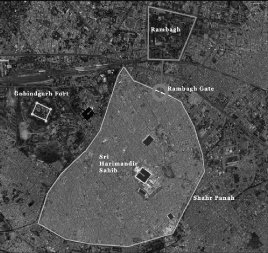
Historic alignment between Rambagh Gate, Rambagh Garden and Sri Harmandir Sahib. (Image: CRCI) |
A meaningful engagement in celebration, acknowledgment, reconciliation and powerful mediation is the reverberating language chosen for the People’s Museum. Assets of the city so meticulously inventoried were all mapped to one or more of the five key themes, uniquely intertwining a connected landscape of compelling stories.
R
ather than looking inwards within an isolated institutional framework, museum ‘beyond the wall’ aims to link and aggregate people, places and stories, each feeding one from the other. It brings together the storytelling experience spaces through a connected narrative across the layered geography of the city – from historic buildings, thriving traditional markets, religious places, educational institutions, museums, archives, libraries, public spaces and parks. With the lens to acknowledge all as creative partners and co-creators, any activity, event or investment in the cultural landscape is seen as adding to the city’s experience and knowledge sharing platform – injecting an egalitarian approach, hoping to induce a more participatory and reciprocating spirit, hence, fundamentally interrupting and challenging the elitist and exclusivist model.
T
he approach of integrating the ideological framework and working practice of upgrading civic and social infrastructure with the museum under HRIDAY is a master stroke. It helped align in principle and practice the recovery of memory by identifying, conserving and revitalizing sites lost in public memory and apathy like the Rambagh Gate and its physical connection with Rambagh Garden and Sri Harmandir Sahib; historic walls and gates surrounding the walled city; 40 khoo and UBCD canal dated to the industrial legacy of the British era; Gol Bagh that once symbolized the idea of discrimination by the British, of a physical barrier created between them and the Indian quarters, as well as dissent where freedom fighters rose to garner support for an independent India. Civic improvement through road, sanitation and drainage upgradation of the historic inner roads of the walled city leading to Sri Harmandir Sahib, a vibrant repository of living heritage, has created physical conditions for access to interpretation.Reclaiming public spaces like Gol Bagh, Rani ka Bagh, Beri Gate have reactivated under-used green spaces for social and cultural exchanges. In all this, negotiation continues to remain a powerful tool to re-imagine meaningful dialogue and activate engagement among diverse stakeholders. Rambagh Gate that was initially chosen to host only the nodal orientation point for the museum, has organically evolved as the prime interpretive precinct for the city, demonstrating a unique model as an outcome of this integrated approach that needs mention.
N
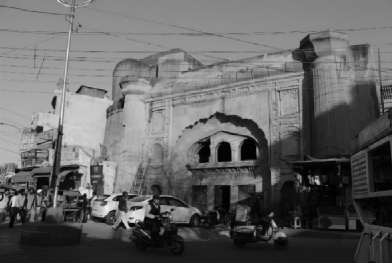
ineteenth century Amritsar saw a historic wall being constructed under Maharaja Ranjit Singh, fortifying the walled city, hence called Shahr e Panah. The walled fortification originally had 12 gates, of which 11 were demolished on occupation of Amritsar by the British. However, it was the Rambagh Gate that survived the onslaught considering it housed a local kotwali (police station). Hence, as the only surviving gate of the Sikh period, it is of immense historic significance. Although it continued to serve as an important entry point for access to the walled city, this historic connector through which Maharaja Ranjit Singh passed while visiting Sri Harmandir Sahib from his summer palace, was lost in the public memory.
|
|
|
Historic Rambagh Gate, proposed nodal orientation precinct for the People’s Museum. (Image: CRCI). |
Operating discreetly inside the almost crumbling edifice, an important vestige of the British era, the printing press, with machinery and equipment dating to more than a hundred years ago, survives. The silence is broken from time to time by cackling voices of students and teachers of the primary school serving the underprivileged, established in 1953 alongside the press. Encroaching the rampart, a bustling market, and surrounding precinct hosting a police station, religious and secular structures, busy traffic roundel with high noise and visual pollution, making for a dense mixed use historic space.
I
t was soon realized that the critical spatial positioning of the gate and the precinct within the context of the historic walled city, its unique architectural vocabulary, existing physical link with Rambagh Garden visible from the top of the gate, police station housed opposite to the gate and along the remnants of the historic wall, bustling character of the market, old jostling with the new, contemporary meanings given to older forms, demonstrated a larger potential for the entire precinct to develop as an interpretive node to the city.Hence, the conservation and retrofitting of Rambagh Gate to house the People’s Museum orientation space; retaining the existing printing press and school within the structure and providing for the much needed improvements of access, sanitation and water; aesthetic upliftment to the market introducing colour schemes and motifs on the façade of the shops inspired from the Sikh artistic vocabulary; proposal of the integration of a police interpretation centre along the historic wall, an attempt to humanize relations between the protector and the protected; reducing visual clutter, enhancing safety and proposed community-led art installations along the mobility corridor, is an incredible demonstration of a collaborative approach between the local community, implementation agencies and area specialists. Additionally, it is a fitting example of close interaction and engagement fostered with the community leading to behavioural change that is palpable on the ground.
W
hile the dovetailing ensures the conditions are being made ready for the first level of interpretation to be integrated, a multilayered dynamic experiential network of multimedia interpretation through technology adaptation that includes interactive mobile app, website and technology assistive signage is underway through HRIDAY. Upscaling GIS map data, which is woefully short on the cultural layer through a cultural mapping exercise has been planned. An extension of the pilot cultural mapping exercise done earlier, it aims to expand on the systemic identification and assessment of the understanding of place, community and its continuity through a layered approach (economic, social, environmental, spiritual dimensions; people and practices; urban, built, natural, buried landscape).Engaging the community, especially students, in the cultural mapping exercise has been planned to ensure crucial data of local knowledge systems, stories, memories and oral history being fed into the existing GIS system through a crowdsourcing exercise. Strengthening the community knowledge and participation base through this exercise, it aims to build a strong sense of collective ownership towards cultural assets, promote capacity building, and thus reinforcing democratic and participatory governance and planning processes of the city.
Parallelly, the arts and crafts project conceptualized under the programme aims to deliver a major new community arts based project, including public art installations that allow for a ‘range of creative lenses and approaches with a strong focus on inclusive, environmentally sensitive and ethical arts-based practice… seeing the people and communities of Amritsar as vital creative vehicles’ (City HRIDAY Plan, Amritsar).
Outreach activities like organizing arts workshop that gathered more than 1500 young, enthusiastic participants, especially students, giving wings to their creativity; a heritage walk throwing light on the treasures of the city jewels, especially those brought to light through heritage revitalization under HRIDAY, have been key components to building a chorus for the idea of a People’s Museum.
T
he groundwork has been laid to re-imagine the character of a city museum that speaks the voice of the people. What is required hereon is a continuous and sustained effort in building a strong participatory framework towards developing physical and virtual spaces of interpretation, strengthening local knowledge systems, democratizing processes of governance and institutional mechanisms at the city management level to support and invigorate the art and business of storytelling and rightful custodianship. Focused on empowering grassroots connections and networks by linking local constituencies, allowing them to engage and design experiences is a transformational change the museum strives towards. Hence, it would need to always engage in a process of unlearning and learning – a constant work in progress.
Footnotes:
1. V.N. Datta, Amritsar Past and Present. Kurukshetra University Press, 1967, pp. 1-2.
2. Ministry of Housing and Urban Affair funded urban regeneration programme HRIDAY (Heritage Rejuvenation Infrastructure Development Augmentation Yojna) aims to ‘Preserve and revitalize the soul of heritage city to reflect the city’s unique character by encouraging the development of an aesthetically appealing, accessible, informative and secured environment. To undertake strategic and planned development for heritage cities with the aim of improving the overall quality of life with a specific focus on sanitation, security, tourism, heritage revitalization, livelihoods, and retaining the city’s cultural identity.’ One of the mandates being the development of a museum or cultural park.
3. Marianne Hirch coined the term ‘Post-memory’ to describe the ‘relationship that the "generation after" bears to the personal, collective, and cultural trauma of those who came before – to experiences they "remember" only by means of the stories, images, and behaviors among which they grew up. But these experiences were transmitted to them so deeply and affectively as to seem to constitute memories in their own right. Postmemory’s connection to the past is thus actually mediated not by recall but by imaginative investment, projection, and creation. To grow up with overwhelming inherited memories, to be dominated by narratives that preceded one’s birth or one’s consciousness, is to risk having one’s own life stories displaced, even evacuated, by our ancestors.’