Messy urbanism: an ecological perspective
JULIAN SMITH
THE term ‘messy urbanism’ was used in informal discussions at the 2016 Bangalore meeting of the ICOMOS Theory and Philosophy Committee. The theme of the meeting, convened by Jyoti Hosagrahar, was ‘Conserving Living Urban Heritage’. The term was used – by A.G.K. Menon, if my memory serves me correctly – to set up a contrast with the ‘smart city’ mantra being pushed in India and elsewhere by planners and development agencies. In the ‘smart city’ worldview, Singapore is often singled out as an example to follow, but that example carries within it a rather authoritarian rejection of messiness in any form.
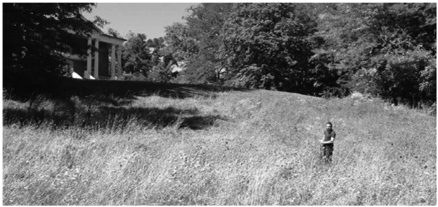
The concept of ‘messy urbanism’ struck a chord because my home institution in Canada – the Willowbank School and Centre – was facing a challenge at that time not unrelated to this debate. Students at the campus, which is a beautiful 14-acre National Historic Site, had decided to change the sweeping lawns on the eastern half of the estate into wildflower gardens and a more sustainable bird and bee habitat. There was immediate condemnation from the community, because the neat mowed lawns were being replaced with the messiness of a more diverse ecosystem.
The question of lawns is not an insignificant issue in North America. The idea of neatness was crystallized in the 1950s with the spread of suburbia, and with it the appearance of carefully mowed, weed-free expanses of grass. Today, more than 5 billion gallons of treated drinking water is used every day to water lawns in North America – an astonishing use of resources to ensure neatness. And, every isolated attempt to replace a front lawn in suburbia with a modest wildflower or native species garden is met with the same concern – a messy intrusion into a neat system. Many suburbs still have bylaws on their books preventing any natural drying of laundry on outdoor clotheslines, because of the potential visual messiness in an ordered landscape.
|
|
|
Willowbank School and Centre: East Lawn. |
The issue runs deeper than lawns, of course. The spread of suburbia in the 1950s was accompanied by a broad range of other initiatives to create order. The preference for ‘monocultures’ – in both the botanical and social versions of this term – became evident in many spheres. In botanical terms, idealized landscapes were created across North America irrespective of local climate and soil types. In social terms, women were pushed back into homemaker roles and out of the employment activities they had participated in during the war. When credit cards were introduced, they were not available to married women, only to their husbands. Afro-Americans and Afro-Canadians were not given access to mortgages to build suburban homes, in either Canada or the U.S. Interracial marriage was illegal in many states, and was condoned by less than 5% of the population.
I
n both Canada and the U.S., boarding schools were used to assimilate the Aboriginal population to the dominant Eurocentric culture. This included separating the children from their traditional communities and cultures, changing their names, and prohibiting the use of their native languages. The goal was to both ‘civilize’ and Christianize these populations.The increased application of zoning bylaws in the 1950s reflected a similar attitude. At the end of the 19th century and into the 20th century, there had been an understandable concern with the social and environmental issues created by the industrial revolution, particularly the health impacts of large industry. And the two Great Wars in Europe only heightened a wariness of disorder. But the tendency towards a more ordered environment went well beyond these concerns. There was an underlying shift towards an exclusive focus on utopian planning models.
An utopian rather than organic approach to urban development is at the heart of the Modernist movement. It is not an approach that favours organic or natural processes. To quote Le Corbusier’s famous dictum (from L’esprit nouveau en architecture, 1924): ‘Order is the manifestation of mankind ...a struggle against Nature to conquer her, to sort things out, to make life comfortable and, in brief, to live in a human world which is not the stronghold of hostile Nature: our world of geometrical order.’
I
t is well known that zoning in North America was used to separate urban functions, creating boundaries between residential, commercial, institutional and industrial zones. Less well known are the social consequences of zoning. Urban immigrants in the 20th century often came from rural backgrounds and lifestyles. They attempted to sustain small agricultural operations in the city, with a few animals or small garden plots. There were also many types of living arrangements, sometimes involving extended families or ethnic groupings in urban ghettoes.Zoning was used to regulate and order the residential experience. The nuclear family unit in its own home was chosen as the most moral and upstanding arrangement. Architects and planners in the early 20th century led the fight to stigmatize multi-family living arrangements such as triplexes and apartment hotels. Tenement houses were understood as breeding immorality, and were disallowed. Zealous reformers and public health officials were able to outlaw urban agriculture in many cities, even though the resulting increase in starvation among immigrant and marginalized communities required the introduction of food stamps to try to cope with the problem.
One of the clearest example of the imposition of order was the destruction of ‘slums’ in the 1950s and ’60s. Large swaths of older downtown areas were demolished, ignoring the pleas of their low-income residents, and replaced with high rise complexes reflecting Le Corbusier’s urban ideal. The social consequences of this approach were devastating. The ecology of low-income neighbourhoods, where mixed uses are fundamental to survival, was completely undermined.
Perhaps the deepest concern related to the imposition of order was the threat to democracy. The 1950s was the era of Joseph McCarthy and the famous House Un-American Activities Committee. Under the umbrella of anti-communist fervour, there was an attack on all types of alternative lifestyles and belief systems. The FBI, under J. Edgar Hoover, kept close track of Martin Luther King and other activists wanting to challenge the system. Those activists who were imprisoned could have their voting rights taken away, a direct attack on the principles of democracy.
T
he 1960s and the 1970s saw clear signs of resistance to the order being imposed on North American social and political life. Two separate movements, focused on the future of human habitat, emerged out of this resistance – the environmental movement and the heritage conservation movement.Interestingly enough, both movements owe a significant debt to the work of two women with similar temperaments – Jane Jacobs and Rachel Carson. Jane Jacobs pointed to the innate richness and sustainability of older urban neighbourhoods, areas that met hardly any of the criteria of the ‘New Order’. She was asking that people understand the concept of order in a different way: ‘Under the seeming disorder of the old city is a marvellous order for maintaining the safety of the streets and the freedom of the city. This order is all composed of movement and change, and although it is life, not art, we may fancifully call it the art form of the city and liken it to the dance – an intricate ballet in which the individual dancers and ensembles all have distinctive parts which miraculously reinforce each other and compose an orderly whole.
1
H
er strength was understanding the city as a set of relationships among its many parts, social and cultural as well as physical. In doing this, she was breaking free of the ‘order’ assumed by those promoting a Modernist view of urbanism. Her approach is the essence of an ecological perspective – a focus on relationships, rather than objects in isolation. Rachel Carson used a similar approach. She knew it was necessary to break free of the rationalist grid that separated the world into distinct parts.‘Future generations are unlikely to condone our lack of prudent concern for the integrity of the natural world that sustains all life. There is still very limited awareness of the nature of the threat. This is an era of specialists, each of whom sees his own problem and is unaware or intolerant of the larger frame into which it fits.’
2Not unsurprisingly, both women were attacked by guardians of the New Order. Of Jane Jacobs, it was said: ‘As a mother and a female writer who criticized experts in the male-dominated field of urban planning, Jacobs endured scorn from established figures, who called her a "housewife" and a "crazy dame". She did not have a college degree in urban planning, and was also criticized for being unscholarly and imprecise.’
3And as Linda Lear says in her biography of Rachel Carson, ‘In 1962 the multi-million dollar industrial chemical industry was not about to allow a former government editor, a female scientist without a Ph.D or an institutional affiliation, to undermine public confidence in its products or to question its integrity.’
4Despite these attacks, both women lived to see their ideas taken up by social movements that began to change the very nature of the political and economic establishment. These movements – the environmental movement and the heritage conservation movement – were community-based, grassroots organizations. Many important non-profit organizations emerged. The movements reflect what can best be termed an organic rather than utopian view of development, one based on an ecological worldview.
T
he results of these movements was new legislation, new interdisciplinary academic programmes, new opportunities for urban and rural communities to plan their futures in diverse ways. Main Street programmes were initiated to give life to traditional mixed-use zones at the heart of many neighbourhoods. Community development corporations were established to give communities more control on urban development funds. Heritage conservation districts, and more recently, designated cultural landscapes, became tools for celebrating unique identities rather than pushing everyone towards a uniform future.At a broader social level, the changes have also been profound. Where interracial marriage was supported by 5% of the North American population in the 1950s, that figure is now more than 80%. Pluralism and cultural diversity have become a more accepted reality in North American society. Increased immigration rates have resulted in first and second-generation immigrants making up more than a third of the population in some urban populations. The links between social change and the emphasis on natural and cultural heritage conservation are documented in recent studies. In particular, these studies have helped establish the relationship between older urban areas and economic, social and cultural sustainability.
T
he Green Lab was established in 2009 by the U.S. National Trust for Historic Preservation. Its 2014 publication, Older, Smaller, Better, is an important example of taking an ecological approach to human habitat. It is a study of the connection between the regeneration of older neighbourhoods and economic, social and cultural growth. Its most important findings are that historic urban areas, in contrast to contemporary urban development, have a smaller, more diverse, and richer texture. This in turn provides more flexibility for economic creativity and entrepreneurship, as well as attracting younger residents and creating better places for walking, shopping and social interaction. These in turn lead to sustainable communities in every sense of the word.The study uses statistical analysis to show that the median age of residents in these areas is lower than in areas with larger, predominantly new buildings. There is also more age diversity. There is more evening and night-time activity. The creative economy is more concentrated. These areas host a significantly higher proportion of new and non-chain businesses. They also have more women and minority-owned business than in areas with larger new buildings, twice as many in some cities. They host a significantly higher proportion of jobs per square metre – 30% more in San Francisco, for example, and 40% more in Seattle.
This is a clear reflection of an organic rather than utopian approach to understanding and developing human habitat. It is an approach that accepts the messiness of disorder, and within that recognizes the potential for sustainable growth. It is an appreciation of the wildflower garden in juxtaposition to the mowed lawn.
At its best, the emergence of an organic and more ecological approach has been accompanied by more community involvement in the fundamental questions of human habitat. The democratic process has become more open to a variety of voices, and less concerned about privileging the calls for uniformity and order.
G
iven this interplay between what is here described as utopian and organic approaches to development, it is useful to examine where we are in North America today. The situation is complex, and not always reassuring. ‘Messy urbanism’ is not a broadly accepted way of thinking. In fact, in recent years, there has been an evident nostalgia and re-embrace of the ‘order’ so evident in the 1950s. The tension between alternative views of the future is perhaps most evident in the politics of the U.S., but the same tensions exist across North America.
A
t a social and cultural level, the embrace of diversity is still fraught with resistance and suspicion. Debates on immigration highlight questions about how much cultural diversity the ecosystem can sustain. And in terms of biodiversity, the environmental movement has made great strides but continues to be seen as a damper on personal and corporate freedom. Furthermore, almost no one is studying the relationship between biodiversity and cultural diversity, although it is in some ways one of the most critical questions facing those who are interested in fully sustainable development.
|
|
|
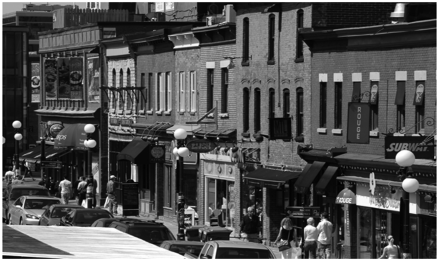
The fine-grained, mixed-use texture of the Byward Market, Ottawa. The entire area was slated for demolition as a ‘slum’ as late as 1990. |
Many actions both inside and outside the heritage movement can seem well-meaning but contradictory. To limit urban growth into valuable rural farmland, governments in North America have adopted ‘intensification’ as a new byword in urban planning. But rather than consider a broad range of intensification strategies – particularly low-rise, high-density development – the emphasis has been a return to 1950s principles. Inner city areas are being slated for ‘slum clearance’ and the erection of massive high-rises, despite very little evidence for more sustainable urban living as a result. Planning schools in North America are still firmly rooted in utopian models of development. Almost all the urban models touting ‘sustainability’ as their core feature are new greenfield developments. This contradicts the idea of sustainability at its core, since it involves demolishing everything that exists and taking it to landfill, or using currently open rural land.
T
he heritage field has not necessarily been much better. It has often tended to restrict its activities to areas of clear historic or architectural significance, and to areas of uniform rather than diverse heritage character. This only confirms the attitudes of contemporary planners that the new and the old are separate issues. This is not a recipe for true diversity in the urban environment. The heritage field has also reflected the dominant culture, in many cases, and has failed to address larger social and cultural issues. It is interesting that the very first heritage conservation district in the U.S., in Providence, Rhode Island, was the result of a surprising and unexpected coalition between an advocate for low-income housing and a rich matron in a large Victorian mansion. It turned out that both wanted to celebrate diversity and choice. But we seem to have forgotten the power of that type of connection.And even democracy is seemingly under threat, with the enormous sums being spent to shape public opinion in subconscious ways. There are increasing concerns in North America about the fragility of the democratic process. When things are messy, a benevolent dictatorship can be seen as a more comfortable and ordered alternative.
T
here is a focus today on conversations about sustainability. Although these conversations are often narrow in scope, the best of them embrace a broad range of cultural, social, environmental and economic dimensions.It is also a fact that some of the best conversations are being generated by youth, and by emerging professionals in all fields. Some of the best and the brightest of North America’s recent graduates are choosing careers in the non-profit sector as a way to embrace new and interdisciplinary ways of thinking about the world. The sectors that have traditionally dominated the employment field – the private sector, the public sector, and the academic sector – are often behind the curve in terms of investigating and adopting new and more sustainable ways forward.
|
|
|
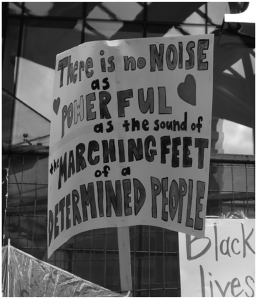
Women’s March, Vancouver, Canada. |
Young people are also taking a more active role in the political realm. This is important for the heritage field, because most cultural issues are political at some level. If uniformity and diversity are seen as two alternative ways of approaching the world, representing among other things the difference between utopian and organic approaches to design and development, then it is my view that diversity, although it is messy, is the more rewarding and the more important.
And as an optimist, I would say that ‘messy urbanism’ is something young people understand and adopt. The term is perhaps not appropriate – as Jane Jacobs points out, it is the order behind the disorder that is important – but it at least includes the concept of diversity. Perhaps ‘diversity urbanism’ is a more accurate term. But the terminology is less important than the sense of being open to difference.
T
here seem to be political marches almost every month in North America these days, dealing with one cause or another. One of the phrases often used in these marches is the following:Leader: Tell me what democracy looks like.
Crowd: This is what democracy looks like.
And, of course, all around you are the myriad of handmade signs promoting not only the cause at hand but all the interrelated issues of social justice and equality. This is quite a powerful message, particularly when you are in the middle of a crowd of 10,000 people or more. And to me it says something deeply meaningful: democracy is messy, but here it is and it is not going away. Heritage and democracy, at their best, are essential to each other, and to a worldview that is inclusive and diverse.
Footnotes:
1. Jane Jacobs, The Death and Life of Great American Cities.Vintage Books, New York, 1961.
2. Rachel Carson, Silent Spring. Houghton Mifflin Harcourt, Boston, 1962.
3. https://en.wikipedia.org/wiki/Jane_ Jacobs
4. Linda Lear, Rachel Carson, Witness for Nature. Henry Holt & Company, New York, 1997.