Gendered encounters, engendered places
JIGNA DESAI
DOES World Heritage status do cities more harm than good? Does the World Heritage tag take the life out of cities? These questions are regularly posed in articles and newspapers across the world. The specific ones mentioned here were published in The Guardian (Laignee Barron, 30 August 2017) in the context of the number of visitors coming to George-town, Malaysia every year. Venice, Barcelona and other cities in Europe have seen active protests by the inhabitants urging to reduce tourism. The main contention of the residents is that tourists claim their day-to-day spaces in a way that takes away their own accessibility.
The historic city of Ahmedabad has become the first in being designated as a World Heritage City in India in July 2017. Among many other challenges of development and conservation, it faces the constant negotiation between the day-to-day and the extraordinary (or universal) values of the heritage of the city. The walled city of Ahmedabad has seen a surge in ‘heritage projects’ that would provide an authentic experience to visitors and have focussed on the innermost, smallest neighbourhood units as expressions of universal value of the city. Formally, the intention of these projects is to build a respectful relationship to the place and foster cultural exchange. This article argues that these projects and many other such initiatives, despite the best of intentions, have infringed upon the only public places that have social potential of bringing place attachment for women residing in that part of the city and thereby started a downward spiral of diminishing the day-to-day values and associations.
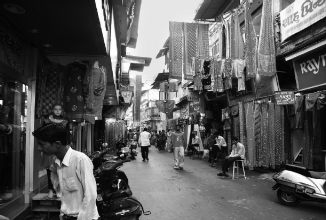
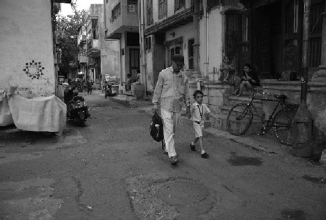
The structure of the walled city of Ahmedabad is made up of more than three hundred pols. The pol is a neighbourhood unit, traditionally inhabited by self-governing social group of residents based on family ties, caste or occupation. A pol can be identified through place name. In some cases these place names also denote the topography or location with reference to the city, though more often they are named after an important person from the pol. Owing to the fact that groups of people from diverse backgrounds came and stayed in the city, and that at various times were also in conflict with one another, each of these pols were structured to function as a fortification. The overall structure of the city reflected a hierarchical system of movement, administration and social relationships where the main streets of the city led to the sub-streets (sheri) that led to the residential pol, which led to more specific family/community domains called khancha, khadki or dela.
|
|
|
|
Ratan Pol – Bazaar streets. Photo source- Danish Kinariwala (2009). |
A typical pol street. Photo source: Mrinal Bhatt (2016). |
T
his primary, most visible structure of the city is underlaid with two other path-structures that were a result of specific gender and caste hierarchies society. As documented in the narratives of various historians, and as discussed with the inhabitants, the primary streets were bazaars that were essentially accessed by traders coming from outside the city. The secondary streets were either special markets (for utensils, clothes, jewellery, paper products) or markets for domestic products accessed by the residents of the pol.Women of the city, generally, were discouraged from stepping out onto the streets unless for some specific purpose. Their places for interacting with other women were the streets and chowk (space created at crossroads) within the pol. While most of these pols only had one visible access at the pol gate, there were small connections, sometimes through a khadki and in some cases through within a house to the other pol. The women of the city usually accessed other pols through these small connections, forming another layer of path structure.
The third layer of path structure is formed by the back alleys that were accessed by the people who cleaned the city. The caste structure dictated that they were not to mingle with the ‘higher castes’ and thus their movement was carefully restricted. Throughout the history of the city, these path structures were used as alternative ways for subverting the dominant power structures. Their usefulness during the time of conflict has been highlighted in many stories of Ahmedabad.
T
he pols of the walled city of Ahmedabad have been studied and analysed as an extended living space by sociologists and urban historians. What is not discussed, however, is that these living spaces also carry invisible territorial demarcations informed by the gendered hierarchy of Indian society. The streets and squares of these pols became places for patriarchs to gather and discuss the issues of the world during the evening time. During the day and sometimes late at night, however, women occupied these spaces without having to justify a purpose for being out of their domestic spaces. These were usually accessed through the safe back connections.The walled city has seen a surge in ‘heritage walks’ since the first one that started over two decades back. The Heritage Street Project is one such initiative that has extended itself to a possible formal and full-fledged heritage-led tourism economy. The origins of the Heritage Street Project at Sankadi Sheri (a narrow street) can be traced to various parallel and possibly unrelated events that converged into an intention of conserving a partially gentrified area of the walled city. Almost a third of the residents of the sheri into which many pols opened had already moved out at the time of the proposal. Only the residents who could not afford houses outside the walled city, or had years of individual associations with the place, still lived here. The gentrification can be attributed to the gold and silver jewellery shops and workshops that sprung up in the pols, resulting in foul smell, water pollution and fire risks in the residential areas.
1
T
he street was selected to be a ‘model heritage street’ and economic incentives were offered for conserving the historic structures for a potential World Heritage City. Significant among them were four heritage residencies, three of which were havelis (large houses, typically with one or two courtyards) bought over by developers, public and private, and one haveli that the owner had already converted into a small hotel that was part of a larger network of other heritage businesses. These residencies found support in the municipal policies for transfer of development rights and homestay tax exemptions.|
|
|
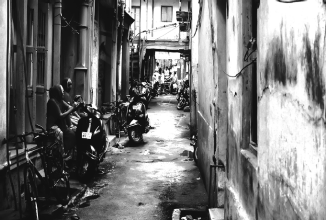
Women’s place being pushed to the inner streets. Photo source: Sebastian T. (2015). |
T
he Heritage Street Project was proposed by a non-government organization (NGO) as part of an agreement with the Ahmedabad Municipal Corporation (AMC) to promote and protect the urban heritage of the city. As explained by the architect, the project intends to organize the street by identifying specific areas for parking, streamlining vehicular movement, designating spaces for vending activities, designing lighting and street furniture and, most importantly, to provide an authentic experience of the historic urban environment to visitors. The architect was to work with all stakeholders with economic or non-economic interests and arrive at an inclusive design. This suggests an intention to arrive at a street design that would take into cognizance the potential economic restructuring of the street due to the new ‘tourism economy’ and its effects on the existing users of the street.The havelis that were adapted to be residencies for visitors were imagined by their architects and developers as a ‘quiet place that has a serene feel’, much like the European streets as experienced by the investors and developers of these projects. Aspects of the havelis that were considered to be ‘valuable’ and worth reviving or restoring were: the façade that was most intricately carved and with large overhangs, and the plan form of the haveli that was open from three sides and thus provided a unique sense of place in the pol and chowk. The tanka that represented a response to the environment also became a unique feature.
A
n interview with the architect brought out two prominent negotiations related to the understanding of ‘heritage’ and the ‘place’. The first relates to his discussion with the residents and shopkeepers about their accessibility to the street. While interacting with the inhabitants to eventually arrive at a design, the architect found that most people inhabiting the place were not as concerned about the aesthetic decisions that were being made but more about how this might change their rights and accessibility to the street. On the other hand, the clients (NGO, developers) and other agencies with a direct economic stake in the project, felt the need to maintain and design for the ‘heritage aesthetics’ of the street to provide an authentic experience of the city’s urban heritage to visitors. The new furniture, lights and so on were expected to add to the historic ambience of the street.Focus group discussions with men and women of Sankadi Sheri revealed that most residents felt that the gendered access to public places, while originating in traditional practices, has continued due to the absence of a ‘sense of security’ in the streets outside the pol. An ingression of commercial activities and fast-paced changes in ownership of houses has resulted in this apprehension. The inhabitants, in this process of changes in Sankadi Sheri, are concerned with their day-to-day access to places where they carry on with their life. The inhabitants of the pol where one of the residencies is located, have already accepted that the chowk will no longer remain a place for their meetings. Their day-to-day activities have already shifted further into the interiors of the pol.
B
ack alleys and accesses to the pol are being cordoned off, some by the developers to maintain safety in the streets where visitors will come and some by the inhabitants for fear that these may result in routes for enthusiastic visitors wanting to explore the innermost structures of the city. Both these steps together have resulted in the blocking off of a substructure that allowed women to subvert the traditional hierarchies and move around the city. Their further concerns are about whether they will have access to the chowk for parking their vehicles for family events? Or whether they can create temporary structures for those events? Will they be able to dig up the paving of the chowk to allow for infrastructure upgradation and repair in their houses? Their concerns reflect their need to change and adapt the place to carry on with their lives without being dependent upon or being dictated by aesthetic concerns that they otherwise have no qualitative opinion on.‘Sense of Place’ is understood by the scholars of architecture, cultural geography and anthropology mostly as an aesthetic concept that talks about the ‘personality’ of a geographic location and people’s perceptual engagement with it. From a phenomenological perspective, Schultz defines a ‘place’ as a space felt, understood and associated with memories. Therefore, the feeling towards a place commonly called ‘sense of place’ is formed as human feelings and memories. As a result of this view, Schultz calls place a space where a human ‘knows their presence’. The concept of ‘sense of place’ has been thought through from various perspectives from then on.
D
olores Hayden, in her book The Power of Place, brings out the discourses that relate the political and social meanings of the ‘sense of place’ to the context. She emphasizes that the notion of ‘place’ also carried a ‘sense of right of a person to own a piece of land, or to be a part of a social world’, which is emphasized by phrases used in social interactions: ‘knowing one’s place’, ‘woman’s place’, ‘not in your place’, etc. She suggests that an individual’s sense of place is both a biological response to the surrounding physical environment and a cultural creation. In addition to that, Hayden points out the definition of ‘place attachment’ – a psychological process similar to ‘parental figures’, as outlined by environmental psychologists. Fast paced transformation of day-to-day built environment or inaccessibility to spaces that are catalysts to forming this place attachment can result in alienation from social and cultural networks. The right to access, change, transform a place is key to individuals or a social groups ability to grow emotionally and culturally.Places such as these in the living city of Ahmedabad, when engendered as ‘world heritage’, face an expectation that they will get reconstituted, restructured and redesigned to make the universal values legible to visitors. The effort put into Sankadi Sheri is also a reflection of these expectations. However, the limited focus of aesthetic redesign and selective restructuring for the tourism economy can easily result in a valorization of only the visual aspects of cultural values. The most apparent aspect of a place, that is its perceived personality, gets discussed, addressed and designed for. The argument being that visitors would not have the time to engage in anything more than get a sense of the place since the idea of cultural exchange for visitors is usually limited to experience of a physical place. This is very different from the residents’ own investment in anything not making business sense. Inhabitants and their concerns for access to places and rights to change thus become issues to be managed rather than addressed democratically. Many cases of conservation/adaptation/revival/restoration, through their processes and design, alienate the residents and other inhabitants. The extraordinariness of a world heritage city takes over the ordinariness of life.
I
t has been widely accepted that a sense of citizenship, sense of belonging (spatial as well as political) and the ability to choose between continuity and change are key to sustainable development of any city. Cities that foster these invariably have their citizens take care of their built environment and have a greater civic sense. Heritage discourse, in order to respond to this, needs to move from a dominant or classical or ‘high culture’ history narrative (that may be tolerant towards alternative histories), to plural histories that include a multiplicity of stories. The discourse needs to shift from participation that builds consensus to active involvement that gives equitable agency to all who associate themselves with the place, especially the inhabitants, by accepting social processes and providing a platform for negotiation and conflict resolution.
Footnotes:
1. Responding to the High Court orders to keep a check on commercial use, especially the hazardous ones, the AMC has shut down around 1800 gold and silver foundries in the walled city (as reported by TNN on 21
January 2016). Some of them are located in this street – Sankadi Sheri. At the time of the survey in the second week of February 2016, many shop owners were on strike against this move of the AMC.
References:
Laignee Barron, ‘Unescocide: Does World Heritage Status do Cities More Harm than Good?’ The Guardian, 30 August 2017. Accessed on 25 March 2018: https://www.the guardian.com/cities/2017/aug/30/unescocide-world-heritage-status-hurt-help-tourism? CMP
Will Coldwell, ‘First Venice and Barcelona: Now Anti-Tourism Marches Spread Across Europe’, The Guardian, 10 August 2017. Accessed on 25 March 2018: https://www.theguardian.com/travel/2017/aug/10/anti-tourism-marches-spread-across-europe-venice-barcelona
M.S. Commissariat, History of Gujarat (Vol III). Gujarat Vidyasabha, Ahmedabad, 1957.
H. Doshi, Traditional Neighbourhood in Modern Ahmedabad: The Pol, in MSA Rao, C. Bhat and L.N. Kadekar (eds.), A Reader in Urban Sociology. Orient Longman, Delhi, 1991.
A. Forbes, Ras-Mala: Hindoo Annals of the Province of Goozeral, in Western India (Vol I). Richardson Bros, London, 1856.
K. Gillion, Ahmedabad: A Study in Indian Urban History. University of California Press, Berkeley and Los Angeles, 1968.
D. Hayden, The Power of Place: Urban Landscapes in Public History. MIT Press, Cambridge, 1995.
W.J. Neill, Urban Planning and Cultural Identity. Routledge, London and New York, 2004.
C. Noberg-Schultz, Genius Loci: Towards a Phenomenology of Architecture. Rizzoli International Publishing, New York, 1979.
S. Phadke, S. Khan and S. Ranade, Why Loiter? Women and Risk on Mumbai Streets. Penguin Books, Delhi, 2011.
C. Pugh, Sustainable Cities in Developing Countries. Earthscan, Oxon and New York, 2000.
B. Ratnamanirao, Gujarat nu Patnagar Amdavad. Gujarat Sahitya Sabha, Ahmedabad, 1929.
D. Rodwell, Conservation and Sustainability in Historic Cities. Wiley Publishing, New Jersey, 2007.
M. Vakhatchand, Amdavad no Itihas: Isuvisan 1850 Sudhino. Gujarat Vidyasabha, Ahmedabad, 1850.