Reminiscences
TRILOKESH MUKHERJEE
I remember receiving a telephone call one morning from Romesh to tell me that our mutual friend Satyajit Ray had asked him to contact me. This must have been in August 1967. I went over to the Seminar office and that was the first time I met Raj and Romesh. There was something about the couple, though individually quite different from each other, which I found reassuring, attractive and unusual.
We spoke about our interests, experiences and dreams. This last word was not sentimental or emotional in any way. For that was my initial reaction on meeting this unusual couple. I left the office convinced that they did have amazing dreams about India, about humanity, about politics, about economics, culture and about life. An unusual, and at times what must have been a difficult combination. But their horizons were wide, big enough to accommodate all their interests and even, I dare say, disappointments.
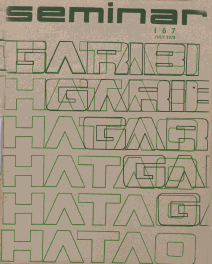
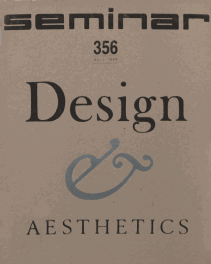
I was about to leave for the UK, when Raj asked me if I would consider designing some covers for their magazine. She showed me a few copies of the magazine and I was pleasantly surprised to find that the designs were all based on typographic solutions, rather unusual and not only for India. The initial design for the Seminar magazine was done by Dilip Chowdhury (1959), a designer I had come to admire. Also by an exceptional designer, Abhijit Barua whom I had met only a few months earlier in Bombay. Later, after Dilip’s death, I learnt that the magazine’s covers were designed by his wife, Madhu Chowdhury.
I remember the atmosphere in the Seminar office well – airy, clean, tidy and very well organized, the warm coffee served in pottery mugs, a big black and white photograph, almost bleached without tones, of a flying kite against a modern building on the wall and shelves full of books and files.
And I remember how Raj came over from her table and joined us, how warm and welcoming her smile was. I felt at ease. She had a kind of quality which I found rather enchanting. I would like to think of that as dignified, civilized and rather humane.
I
t was obvious and, for me, very pleasantly surprising that both Romesh and Raj were interested in design. They were able to sustain their interest amidst all their other involvements: social, political, friends, or family. I would drop in at their office whenever I was in Delhi. They always received me with a cordial welcome, warmth, smile, and coffee. I would leave the office with the challenge of designing covers for the magazine. My mind would already be exploring the design problem as I would walk down Janpath. They enjoyed posing challenges; I accepted them and responded with the best I was capable of.Generally I would make a few sketches and take them round for them to see, comment on, and/or take a decision. Raj would often make the final call, but I would first take it to Romesh for his views. Sometimes they would ask me to come over to see the first proof, though that would hardly be necessary. They had a long enough experience to deal with the printers and typesetters. As the covers were printed on the rough side of the cardboard which is generally used for the cigarette packet, the design had to be suitable for line print, clear of tones or shades. The final product, on the whole, turned out to be satisfactory.
|
|
|
|
Cover: Trilokesh Mukherjee |
Cover: Trilokesh Mukherjee |
Being invited to their home for a meal was a delightful privilege. I never knew who I would come across as other guests. Sometimes it would be artists like Krishen Khanna, or a guru like Sri Madhava Ashish or historian Romila Thapar, Romesh’s sister. The food was chosen by Raj and prepared by her expert chef. My wife Margaret loved the cumquat oranges and vanilla ice cream as desert.
A
fter visiting Basle and Ulm design schools, I discussed with Romesh the possibility of starting a design school in India. He had forwarded the correspondence to Ashoke Chatterjee, then director of the National Institute of Design in Ahmedabad. Thus it was that I found myself teaching at the institute, and I have since kept the connection alive.It was also Romesh who had suggested to Ashok Advani in 1986 that he get in touch with me for designing a new magazine he was contemplating about business in India. I owe it to their daughter, Mala who amazingly had tracked me down in Guwahati in Assam where I had gone with my family to show them where I was born. Thus began another project, Business India, and it was quite a project. I worked rather hard for it, partly because I was not aware of what was possible in Bombay. At the time the state of technology was such that the headings had to be cut and pasted, letter by letter; fortunately Ashok had a wonderful team to help execute it.
S
ometimes I flew in from Ahmedabad just for a day to do the designing or talk to the printer. One evening as I was about to leave, Ashok asked rather casually if I would consider designing a new magazine about India to come out of New Delhi, with Mala as the editor, assisted by Ritu Menon. I loved this challenge and was happy to undertake it too. This time the studio was Mala and Tejbir’s dining table. I remember one afternoon when I was in the midst of doing some layouts for the cover of the magazine that Raj and Romesh walked in. I was somewhat nervous and uneasy, not quite ready to show the design. But they were casual and easy-going about it and because of their long experience with the print world they picked up the design quickly and fortunately approved of it.Thus began another challenge. I loved the work and put in a lot of effort on the project. It stalled and was postponed a bit because Mala was expecting, but once the child was born we began earnestly with Mala as the editor. The first issue of the magazine was published in December 1980. I still believe that The India Magazine was one of the most worthwhile projects I have been involved in. I was very happy with the design. Its success was also partly due to the enthusiasm and good wishes of Raj and Romesh; they never meddled in our work but encouraged us all the time. Alas, it did not survive the pressures of the commercial world and its last issue was published in November 1997.
|
|
|
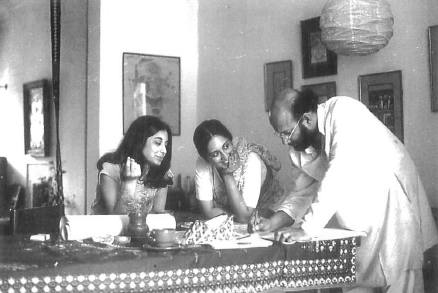
Ritu and Malvika with Trilokesh. |
Romesh and Raj once visited us in a village in Kent. It was rather an embarrassing moment of my life. Normally there are buses or taxis available at the station. For some reason that day there were none. So they walked nearly four miles without complaining and spent a day with us before taking a taxi back to the station.
I
n 1986, Margaret and I went over to see Raj who was on her way back to India after her medical treatment in London. It saddened and shocked me a bit to see her with all her lovely long hair cut. She saw my expression and said, smiling, ‘You are shocked! It was not in my hands.’ Her smile was still the same, warm and generous. She hadn’t lost any of her charm. Alas, that was to be our last meeting as she passed away in April 1987.
R
omesh asked me to do another design job while I was in New Delhi once. This was to design a journal/magazine called Social Change. This assignment was, in a strange way, more challenging, in part because there was no one to help with carrying out the design. Nevertheless, we did achieve some success. The final design, typographic, was printed brown on craft paper, and the inside pages were standard newsprint. Romesh and Raj had an incredible and unique inner sense of adventure and ambition to alter the understanding and acceptance of graphic design. Their attempts laid down the foundation of modern Indian understanding of graphic design.Romesh had been to London a few times. I remember once we went to the Serpentine Gallery together and afterwards we sat on the first floor of a restaurant looking at the Serpentine lake. Rather unexpectedly, I found Romesh rather moved and emotional as he spoke about his own life, about India, about his children, about Seminar. We spoke for some time with warmth. It was a moving experience for me too.
That was the last time we met. But in my mind I carry their faces, their voices, their smiles, laughter, their provocations, and think of their truly amazing idealism and their beliefs.
O
ne of the traits of character that made the Thapars rather unusual and special is their extraordinary sensitivity towards aesthetics in every form. Their house was like a gallery, their life a moving sense of design. Even in India, the world of truly great artistic and craft traditions, design as we know it today was rather new. In those days the idea and concept of design was just emerging as a mature discipline. This was a significant departure from the earlier situation where painters and artists were used to trying their hand at designing. The fledgling discipline of commercial art evolved and matured as graphic design.Raj and Romesh were one of the very first to understand, appreciate, respond, welcome and seriously promote the idea of design through every channel or opportunity that came towards them, but particularly through their own magazines. They created a standard, an ethos, an amazing atmosphere where graphic design and typography almost came to life, grew and flourished. Anyone interested in design would have been pleasantly astonished to see a copy of Seminar and appreciate how different it was from other newspapers or magazines of that period. The space, the grid, the headings, black only typography, the drop initials, and the use of only typeface on the covers. They were the pioneers of what we now see, and take for granted in the Indian newspaper and magazine world. The face of the publishing world would not have been the same without Raj and Romesh.