A continuing struggle for democracy and secularism
SHAHIDA LATEEF
FOR the generation that inherited the newly created Indian state in 1947, there was to be a short respite in which to contemplate the gains made. The difficult path to Independence had been cataclysmic in its violent and horrific partition of the country born of the raging political rivalry and mistrust between Hindu and Muslim communities. The inheritance was now to be based on a Constitution that promised equality for all citizens and secularism within the parameters of universally accepted norms of governance. It was in these propitious circumstances that Romesh and Raj Thapar began their married life and their intellectual collaboration in Bombay. This spawned Seminar, the unique monthly magazine that brought together a variety of opinions on a single policy issue being contemporaneously debated in governmental and intellectual circles.
In 1961, when Seminar moved from Bombay to an office on Janpath in central Delhi, it quickly became a destination for academics, politicians, bureaucrats and activists of all stripes where discussions on politics, or economic policy, were always lively and sometimes contentious. My husband Sarwar and I returned to Delhi in 1966 and were fortunate to meet Raj and Romesh almost immediately and to become part of the Seminar family. From this vantage point we were witness to the revolution taking place in every sphere as a new polity grappled with the challenges of governance. The media was actively involved in informing and moulding public opinion across the political, economic and social landscape. In this mix, the more measured and multifaceted nature of Seminar was to play an important role, airing ideological polarities and strategies that could be employed.
Seminar’s nuanced and informative articles in the decade after 1966 reflected the changes that were taking place a scant couple of miles away in the Lok Sabha and in the corridors of government. This article focuses on three issues which embroiled the government in controversy then and continue to reverberate even now. These are the ban on cow slaughter, efforts to change the personal laws governing the Muslim community, and the role and freedom of the media as an important pillar of a democratic and free society. All three issues impact economic, social and democratic institutions and have the potential to disrupt the delicately balanced social contract between competing interests. In the 1970s there was a growing recognition and fear that all three issues were part of a political arsenal that could be used to control and manipulate public opinion to the detriment of state stability as had already been demonstrated in the period leading up to independence.
I
n November 1966, Delhi witnessed a well organized demonstration on Delhi’s Parliament Street (Sansad Marg) demanding a ban on cow slaughter. It was a joint effort by the Vishva Hindu Parishad, the Jana Sangh and other like-minded groups. Among the slogans that roused their supporters was ‘garv se kaho hum Hindu hain’,1 a call to fellow Hindus to take pride in their religion even as it excluded non-Hindus and secular Hindus to whom the Constitution rather than Hinduism was the guiding principle of the state. The aim was to reject constitutional secularism, focusing instead on Hinduism as the sole guiding principle of state.
T
o put pressure on government ‘some prominent religious figures went on fast’.2 As they prepared to storm Parliament, the police intervened, resulting in violence and death for some demonstrators and destruction of public property. The difference between now and then is that law and order was maintained and Home Minister G.L. Nanda had to resign. In contrast, the incumbent BJP government, in its attempts to enforce the beef ban, has outsourced its efforts to gau rakshaks, or civilian cow protectors, belonging to militant Hindu groups. In deference to these politically protected groups, the state law and order machinery even turns a convenient blind eye to punishment or death to be meted out to suspected cow ban violators. It is only recently that Prime Minister Narendra Modi finally spoke out against such violence unleashed in the name of the cow mostly on Muslims and Dalits.It was in the period preceding the 1971 election that those of us concerned about its political outcome came together to form a group called POWER or Progressive Organization for Women’s Equal Rights. Fittingly, Raj was elected chairperson of our group. The objectives were to educate ourselves and others about the issues that were at stake for the country in the event that the Congress Party and Prime Minister Indira Gandhi were to lose the election. There was a perception at the time that secularism, the constitutional glue that had managed to bind together a diverse country, was the only way to control India’s inherently fissiparous tendencies. POWER organized a meeting with Nandini Sathpathy, a minister in the government, to talk to our group about the party and its forthcoming election campaign. She spent most of her time recalling the history of the Congress party rather than on the issues on which the party would fight its campaign. Our group motivation was such that we remained undeterred, and because our efforts were to be independent of the propaganda of political parties, we concentrated our messages on the broad themes of development goals, elimination of poverty, and secularism versus communalism.
|
|
|
|
Cover: Trilokesh Mukherjee |
Cover: Dilip Chowdhury Associates |
A
s POWER had no access to funding, creativity was to be our leitmotif. To spread our message, we approached Habib Tanvir, an activist and theatre personality who wrote and produced plays that were widely acclaimed. We were certain a theatre production would reach audiences with an immediacy that mere speeches lacked. We thought that we may have to persuade Tanvir to take our request seriously, but he was enthusiastic about the idea since the election and its outcome were important to him as well. Tanvir’s play, Indra Lok Sabha, a comedy, was previewed by Raj and Romesh with a small audience on the Thapar lawn.3 We hoped the play’s multiple performances would help the candidacy of Subhadra Joshi, the founder of the Sampradayikta Virodhi (Anti-Communalism) Committee, who was the candidate from the Chandni Chowk constituency of Delhi.The results of the 1971 general elections met our expectations and at POWER we hoped that this would enable government to concentrate on its development agenda, helped along by the majority in Parliament. Subhadra Joshi was instrumental in supporting the government’s efforts in Parliament. In 1972, she also strengthened the forces of secularism by sponsoring changes in the 1930 law, specifically Section 295-A of the Criminal Procedure Code intended to broaden the scope of the legislation beyond individuals to include groups of people as well. She introduced Bill No. 5 arguing that Section 295-A was insufficient to stem disruption of communal harmony by organized bodies whose ‘sole objective was to create an order in the country which has for its base purely communal and racial consideration.’
4
I
n 1970 a Committee on the Status of Women was set up to evaluate the gains made by women under India’s 1950 Constitution and the passage of the Hindu Code Bill that further strengthened their inheritance and marital rights. The committee was interested in extending its findings to cover minority women. It wanted to include Sikhs, Muslims, Parsis, et. al. to explore any disparities that might exist among different communities after the passage of the Hindu Code Bill. I was asked to write the report on minority women. Upon surveying the existing literature on minority women, it became clear that there were no studies on which such a report could be based. I informed the committee that to write a report would involve conducting a survey across several states in order to cover regional differences that influenced differing practices as much as, if not more than, religious differences.5 The committee agreed. As I planned the survey, taking cognizance of the linguistic and regional diversity of India, I spent time with Raj at the Seminar office discussing the project and its possible ramifications for minority women and for government policy.
T
he Report of the Committee on the Status of Women6 came as a shock to both the establishment and women’s groups as it revealed that despite legislative changes, very little had changed for women. Constitutional equality and rights enacted in the Hindu Code Bill had proven ineffective because of the entrenched attitudes and practices relating to women. My survey on minority women and the ensuing report was to confirm the committee’s findings that rights bestowed by government were unlikely to be realized without changes in society. Thus, contrary to the commonly held view that minority communities were disadvantaged by a lack of rights, the survey findings showed that their practices and attitudes were in keeping with regional practices and attitudes and squarely within the Indian mainstream.Armed with these findings, POWER turned its attention to Muslim attitudes to the proposed secular Adoption Act that would be applicable to all Indians. The proposed legislation quickly became a ‘Muslim issue’. Politicians deemed it too controversial, since it was assumed that Muslims and their leadership would oppose legislation on religious grounds. POWER, armed with newly acquired knowledge on Muslim attitudes, was determined to take on the politicians. At the time, while adoption was allowed among Hindus, Muslims had no legal recourse to it under their personal law. Despite opposition, we were convinced that the Muslim public would support any bill enabling adoption that was brought forward by the government. To test this premise, POWER turned to Imtiaz Ahmed, a political scientist at Jawaharlal Nehru University, to conduct a small survey in predominantly Muslim neighbourhoods in Delhi. The survey confirmed our belief that without the noisy attention of the so-called Muslim leadership with its political agenda, Muslims in general would endorse common sense solutions to normal problems confronting them. Their reactions would be with the mainstream.
POWER publicized the findings of the survey through newspaper articles and lobbied Members of Parliament to press ahead with the legislation without referring it to a select committee, which we knew would result in it being shelved for the foreseeable future. Unfortunately, despite our best efforts, the matter was referred to a select committee.
N
evertheless, our efforts gained attention. Raj and I were invited to appear before the select committee to present our case. We had hoped that this could be an opportunity to persuade law makers to bypass political manoeuvring to reach a decision that would be based solely on what would benefit the politicians’ constituents. We were naïve. None of the members of the select committee had any interest in hearing our opinions. The chairperson asked members whether they had any questions for us. None did. Reluctantly we got up to leave when a member said, ‘Stop you haven’t eaten your cake.’ Refreshments had been served to all present. We left anyway. The Juvenile Justice Act was finally passed in 2014 by the Supreme Court. It was based on a petition to the court by Shabnam Hashmi, a Muslim social activist.7
S
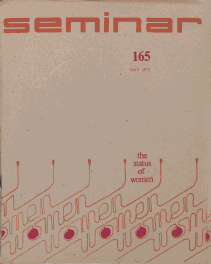
eminar’s focus on the Report of the Committee on the Status of Women did not waver. It highlighted the issues dealt with in the report that included personal laws, education, legal and employment. By taking a more holistic view of women, it acknowledged their ability to affect real change in social practices.8 The current issue of Muslim divorce practices has been brought to the fore by a Muslim women’s group, the Bharatiya Muslim Mahila Andolan, whose affidavit to the Supreme Court in support of Shayara Bano declares triple talaq as un-Quranic and calls on the Supreme Court to pronounce it unconstitutional.9 The Mahila Andolan is to be congratulated for fighting against Muslim male violation of women’s rights in Islam and for Muslim women’s constitutional rights.Should the Mahila Andolan succeed, it will mean a defeat for the All India Muslim Personal Law Board which has never shied away from speaking on all issues concerning Muslims, despite having no standing either in theology or elective office. The AIMPLB has prevented the Muslim community from moving ahead on social issues and ignored the demands of Muslim women for changes in divorce, marital and economic rights. The board even opposed the proposal of awarding indigent women maintenance rights as proposed by the Supreme Court judgement in the Shahbano case. This attitude has resulted in Muslim women having to continuously fight for their rights in court.
T
he idea that Muslim laws, as they are currently understood in India, cannot be touched by the Indian legislature or courts is patently absurd. The 1937 and 1939 Acts jointly referred to as the Shariat Acts on which the rights of all Muslims are based were passed by the Legislative Assembly of India and debated on by all members, Muslims, Hindus, Parsis, Christians etc. More recently, the Muslim Women’s (Protection in Divorce) Act of 1986 which was designed to negate the Supreme Court judgement in the Shahbano case, was debated and passed by the Lok Sabha due to an agitation mounted by the very same All India Muslim Law Board and their political collaborators.Immediately after the China war, in 1963, Raj and Romesh met Joan Robinson, a professor at Cambridge University, who had just visited China. According to Raj’s memoir, Robinson, who was very familiar with India, felt that China appeared to be a freer society while India felt like a police state.
10 Raj urged her to express her views in the forthcoming issue of Seminar devoted to China. Raj writes: ‘Robinson said, "Can I write what I want"? "Certainly," I said. "But the Jan Sanghis will be after you and your office will be stoned…." Her article arrived. It was published. It was a glowing account of China… No one protested, no one stoned our windows… it was a matter of great pride to us that one could say what one liked in India, at any time anywhere.’
T
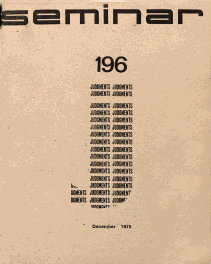
his was soon to change as Prime Minister Indira Gandhi declared a state of Emergency when the Allahabad High Court found her guilty of electoral malpractices and invalidated her electoral victory from her constituency of Rae Bareli. This would debar her from holding elective office for six years.10 Indira Gandhi’s response was to proclaim a state of Emergency giving her extraordinary powers over all institutions. The media and civil society were muzzled. This was achieved by cutting electricity to newspaper outlets and arresting their editors. Critics of the government were similarly treated. Vague external threats were cited and retroactive legislation was enacted to invalidate the Allahabad court judgment against her. Censorship was enforced banning all critical publications. In December 1975, the Seminar issue entitled ‘Judgments’ comprised Nani Palkhivala’s address to the Supreme Court and the text of Rangarajan’s judgment. Raj’s memoir contextualizes this in a conversation she had with the government’s Chief Censor, Harry de Penha, on 27 December 1975 in which he said, ‘I understand that Seminar has published some objectionable material.’ Raj replied, ‘What kind, Harry, because I don’t know what is objectionable.’ ‘This is serious, Raj. Have you published any court judgments?’ ‘Yes, we have. Haven’t you seen the issue?’ ‘No, I couldn’t get a copy from the bookshops. They said they were all sold out. Have you published Rangarajan’s judgement?’ ‘Yes, we have.’ ‘And Palkhivala’s address in the Supreme Court?’ ‘Yes, Harry, we have. Don’t you know what the issue is called?’ ‘No, I don’t.’ ‘Judgements,’ I said. There was a hush over the receiver. ‘You don’t seem to realize how serious this is...’12
T
his exchange brings into focus the point at which the reality of Indira Gandhi’s attempt to stay in power by manipulating India’s institutions was to confront Raj and Romesh’s belief in precisely those institutions to deliver the promise of India to its people. Seminar continued to publish and to deal with the issues raised by the Emergency until July 1976, when it was served with a pre-censorship order. At that point they took the decision to stop publication. ‘How right Gandhi was,’ Raj quotes Romesh, ‘to be clear on never accepting any kind of censorship because it would mean bluffing the people.’13Since the advent of Seminar in the 1960s, the news media has exploded in its reach and diversity. Indians are now overwhelmed with information which can be ideologically tilted or false, often leaving readers and viewers perplexed. The desire to control the political message and limit debate is not confined to a particular government. The current government, despite enjoying a clear majority in Parliament, still finds it necessary to control the media message. Frequently, television talk show hosts feel pressured to invite at least three participants who are either representatives of or sympathetic to the majority party, irrespective of what topic is to be discussed.
T
he relative innocence of the period when Seminar was launched was soon overtaken by political realities and compulsions that drove politics and policies in directions that were sometimes at variance with the interests of the country. People and institutions were tested, and the debates generated were to change attitudes and electoral outcomes. In the intervening 40 plus years, however,the issues relating to cow slaughter, Muslim women and media freedom continue to be important because these issues continue to remain in flux. Perhaps they should remain unresolved since debate, discussion and change are the hallmark of a vibrant democratic society. Each generation must ensure a good fight to preserve and strengthen the structure and institutions of India’s remarkable Constitution. Raj and Romesh’s Seminar will continue with its mission, being ably carried forward by Malvika and Tejbir.
Footnotes:
1. Anupama Rao, ‘Testifying to Violence – Gujarat as a State of Exception’ (Chapter 15), in Elizabeth A. Castelli and Janet R. Jakobsen (ed.), Interventions: Activists and Academics Respond to Violence. Palgrave Macmillan, US, 2004, p. 149.
2. Christophe Jaffrelot, Refining the ‘Moderation Thesis’ Regarding ‘Radical Parties’: The Jana Sangh and the BJP Between Hindu Nationalism and Coalition Politics in India. Research in Question, No. 34, December 2010. Centre d’etudes et de recherches internationals, Sciences Po, Section 1.2.
3. Habib Tanvir, Memoirs (translated from Urdu by Mahmood Farooqui). Penguin Viking, Delhi, 2014.
4. J.K. Chopra, Women in the Indian Parliament: A Critical Study of their Role. Millan Publications, New Delhi, 1993, p. 59.
5. Shahida Lateef, Muslim Women in India – Political and Private Realities: 1890-1980. Kali for Women, New Delhi, 1990, p. 15.
6. Government of India, Department of Social Welfare, Ministry of Education and Social Welfare, Towards Equality: Report of the Committee on the Status of Women in India, New Delhi, December 1974.
7. Nilanjana Bhowmick, http://time.com/8876/india-finally-allows-minorities-to-adopt-children-with-full-rights. February 2014, Time.com.
8. The Status of Women, Seminar 165, May 1973.
9. Javed Anand, ‘Some Personal Questions’, The Indian Express, 28 April 2017.
10. Raj Thapar, All These Years. Seminar Publications, New Delhi, 1991, p. 205.
11. Katherine Frank, Indira: The Life of Indira Nehru Gandhi. Harper Collins, London, 2001, p. 371.
12. Raj Thapar, op. cit., p. 422.
13. Ibid., p. 430.