Proofreaders of the nation
KRISHNA KUMAR
THE first half of the 1980s feels like a closed chapter of post-independence history, but that cannot be an accurate observation. Even as a feeling, it has to be personal, implying that everybody’s feeling about this period must be a bit different. Mine was coloured by the fact that I had returned to India after half a decade. Many aspects of life seemed sharply different from how I had known them before leaving Delhi in the mid-1970s. For one thing, everything was far more expensive, including the rent one paid for a modest flat. Between the rents of the late 1970s and the early 1980s, there was a biting discontinuity, especially if you didn’t have a steady job. Indira Gandhi’s return to power had brought with it a sense of bewilderment and crisis. It was a silent crisis in some contexts, and not so silent in others.
The recovery from the Emergency (1975-77) under the Janata Party had not been as wholesome as had been wished. How could it be? Every institution had been shaken up during those unprecedented twenty-one months. To believe that the country would simply resume its pre-Emergency rhythm of life was like saying that a cardiac patient should start push-ups after returning from ICU. Yet, that is what Delhi was preparing for in the middle of political and economic turmoil. Vast parts of the city were dug up to get it ready for the 9th Asian Games. The damage Delhi suffered more recently to prepare it for the Commonwealth Games of 2010, was a repeat of the Asiad digging and damage.
As a returnee, I felt hungry for explanation of everything. Of what? To begin with, how could Indira Gandhi be voted back to power after being voted out so decisively less than two years earlier? A corollary of this question was: how could the Janata coalition blow it up so fast? The old Jana Sangh had recast itself as Bharatiya Janata Party, having adopted some unfamiliar entrants and a new, somewhat broader, discourse. An ominous cloud had gathered over Punjab and the resourceful Mrs. Gandhi didn’t seem to have a clear idea of what she was going to do about it. It felt as if nothing could stop her, and the country, from a fatal concussion.
This thumb nail sketch of Delhi 35 years ago helps me to recall and convey what Romesh and Raj Thapar, and their office at Janpath, meant to me and my wife when we first visited it. How could the Thapars mean so much so suddenly is one of those things that mysteriously surface in life and soon start to look normal. They came across like welcoming neighbours each time we visited them. As a young couple, my wife and I slipped into the larger India the Thapars had known by living it. They didn’t have to translate it for us. Talking to them was like soaking the story of India’s political history, of its struggle to become a modern nation. I can spend hours reassembling their perceptions and beliefs, their integrity as human beings, and their faith in the little instrument called Seminar that they had jointly invented as a device for nation building.
How can a magazine, that too so small, build a nation as vast and complex as India, a youngster might ask today? And how can anyone believe that running a magazine is a nation-building act? If the magazine was meant to serve as a venue for routinely sculpting controversies, was its publication a nationalist act? This last question might help to land this memoir in the present moment.
T
he Jawaharlal Nehru University is soon going to display an old tank. I can imagine it standing peacefully near a suitable bougainvillea, with its gigantic wheels tied to a chain, and the raised long nose through which it once spewed fire to kill India’s enemies. To think that regularly maintained monthly issues of a magazine could do the same job, or at least share it, is to get lost in a lonely fantasy. By today’s standards, a great deal of memory and history of India in its first three decades after independence might sound like fantasy. The early 1980s represent a period during which India was turning a bend. Nothing symbolizes it more than the manner in which Indira Gandhi decided to handle the Punjab crisis. The aftermath of her handling of it was terrible. Little could be rescued from the debris that her assassination and her son’s takeover created. And in between came the riots.
I
n my mind’s album of Delhi, the towering columns of smoke rising from the houses of Sikhs where they were being killed by mobs in the pleasant sunlight of early November, will never fade. After those four days of unprecedented horror had passed, everyone who had not participated in the killing was asking, ‘how could that happen?’ The young prime minister who had succeeded his mother, said that when a big tree falls, the earth around it does shake a little. This was the inaugural of a new era of politics and culture. Rajiv Gandhi was fond of talking about the 21st century and how he wanted to prepare India for it. That comment of his, about the big tree falling, did give more than an inkling of the new century, it now seems. Words that belittle violence were to characterize the new times in India.A few days after the riots were over and the new prime minister had settled into teamwork, Raj Thapar told me about the conversation she had with a visitor whose importance as a public figure grew rapidly in the years that followed. Talking about the riots, he had remarked that the Sikhs had gone too far. Raj Thapar had said in reply, ‘Then why don’t you pick up a gun and shoot my son-in-law?’
After she died of cancer in 1987, Khushwant Singh wrote that he felt her cancer was triggered by the riots. I can hardly disagree with him or say that cancer is a complex phenomenon, with no definitely known causes, and so on. As a person, she was solid to the core, someone who, like her husband, lived a life organized by her convictions and imagination of an India that meant more to her than what we, born after independence, can believe. Mass killing of Sikhs in their homes and on the streets of Delhi, and the news that the killers were led by men from the ruling party who stayed in their positions afterwards, must have shattered her sense of herself in relation to the India she had known and loved.
D
uring the difficult days when her cancer was being treated and spreading, she was given a proposal for heading a foundation to, initially, facilitate the adaptation and telecasting of Sesame Street in India. It was an attractive idea, for Sesame Street did have interesting characteristics as a children’s serial. But it was debatable too, and Raj Thapar was keen to understand both sides of the debate before she signed on in her role as an enabler of the powerful American serial’s entry into India.I recall my last conversation at her house, sitting in the garden. She was an experienced editor of children’s literature, but was puzzled, and was not sure what it might imply – importing the exotic images and humour of Sesame Street into Hindi and other Indian languages. She knew the deeper value of indigenous creation of aesthetic resources, especially for children. We discussed and briefly wondered about the thin cover that a good translation might provide for an otherwise totally alien set of themes and characters. By the time we had finished tea, she felt convinced that she was not going to proceed further. ‘My own life is no more certain, so why should I support something so uncertain,’ she said.
My association with Seminar had started with a short letter to its editor. It was about one of issues in mid-1981, perhaps the May issue on ‘Concepts in Change’. I had read it in the library of J.P. Naik’s institute in Pune. After going through the articles, I shot off a brief hand-typed letter to the editor, conveying my disapproval and surprise over the indifference shown to education, that it was typical of Indian magazines to do so. This was clearly not a letter for publication; in any case, there was no regular ‘communication’ column in Seminar those days. I could hardly expect a response either, as the letter merely conveyed a general complaint.
T
he response signed by Romesh Thapar was short and clear, asking me why don’t I write on education for Seminar. He also asked me to see him when I visit Delhi. I left for Delhi soon after losing my fragile job in Pune after J.P. Naik’s death. In the middle of my hectic autorickshaw rides across Delhi in search of an institution that might give me something to do, I found myself in Connaught Place one day and thought I might as well find out where the Malhotra Building, mentioned in Seminar’s address, was. The winding, somewhat dark staircase took me, finally, to the office of Seminar.
O
n introducing myself, I was led towards the desk where Romesh Thapar sat. He took seconds to recall my letter, introduced me to Raj (who from that day onwards I addressed as Mrs. Thapar, flatly against her wishes) and we three sat down to have a coffee. It was incredible. It felt as if they had known me for a long time. We discussed ideas for Seminar, and what all was happening in my life and around. I returned with the responsibility to write a piece on rural schools.|
|
|
|
|
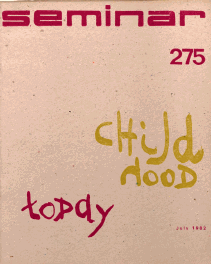
Cover: Chanda Singh |
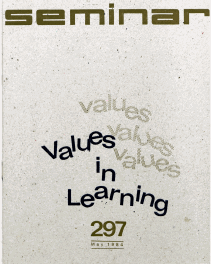
Cover: Madhu Chowdhury |
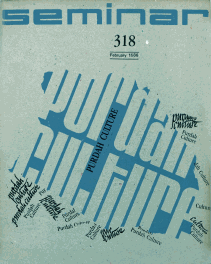
Cover: Madhu Chowdhury |
During the months that followed – it is hard to fit them all into a total of six years, till 1987 – my wife and I visited the Seminar office so often that it began to feel as if we were contemporaries of the Thapars. I can’t recall even a moment when they conveyed how much older they were and how deeply they had engaged with India’s political and institutional makers. No; all that they conveyed was curiosity about life being lived by the new generation to which I belonged.
Both of them must have sensed my aloofness from the public spaces and discourses where English was the language of business. One day, Romesh asked me whether I would like to become a member of the India International Centre. I must have said something like, ‘What is that?’, unabashedly displaying my shoes with their heels on the Hindi side of the linguistic divide of Delhi’s writing world. He endorsed my membership as if it was necessary for him to do so.
H
e was quite concerned that Seminar was not known to the Hindi world. We planned a tie-up with Hans, and at some point it produced an experimental link-up. Conversations with Romesh Thapar were usually very brief, conveying a figure who was relaxed when he talked but never stopped worrying about things – everything, from the wasteful expenditure made on Asian Games, to patronage prevailing over merit in the appointment of NCERT’s director. He wrote about such matters in his weekly column in the Economic and Political Weekly.As for Raj, her interest in the way my wife and I were negotiating Delhi’s life was unending. Unlike others who never failed to ask my wife, ‘Why don’t you do something?’, she appreciated the full-time attention our baby was getting. I had little interest in women’s issues, and no awareness or embarrassment about my lack of awareness about the grave implications of these issues for education. Nor had I ever thought about the daily discrimination that girls face at home and school. Instead of chastising me for such ignorance, Raj Thapar gently asked me to recall my boyhood and send a piece on it by next day. I went home.
On the bus from Connaught Place, I evoked scenes from my school and college days. There was hardly any time to think and plan this article. That evening, I sat down to clank away on my manual Underwood my little contribution to the forthcoming issue of Seminar. Next morning I gave it the title ‘Growing Up Male’ and left it at the Seminar office. Within ten days it was composed, proofread and published. Soon after its appearance in February1986, that essay acquired historical notoriety. It not only received unending attention, it also broke my indifference to gender as a subject of study. One of its admirers was the late Leela Dubey whose writing on gender changed me decisively. My long ongoing, struggle to properly estimate gender issues in education had begun in the Seminar office.
T
hat, I believe, is the gist of Romesh and Raj Thapar’s legacy: faith in the power of ideas and in words that sort out ideas and create a debate. Remembering the Seminar of the Thapars’ era is instructive in many ways. For one thing, the old Seminar was designed to stretch the readers’ orbit of concerns, but it was also designed to prioritize basic realities and fundamental problems to which it returned frequently. If you were an annual subscriber in those times, you felt that the theme of every issue was quite directly relevant to you. Specialized interests had not matured into becoming exclusive or technically academic.As we softly battle through a globalized, digitalized world, we might also feel less lucky three decades after the Thapars left, in having to carry on with a project that is no more popular. It was the project of inventing India. Even Nehru thought that India existed, so it could be discovered. In the ‘idea’ of India discourse, we are currently perplexed about the extent of openness we are obliged to exercise. Are we worried about an idea or an ideology of India that we assumed was only an idea while others had an ideology?
A lone monthly, Seminar seems woefully inadequate at a time when more densely and zestfully inhabited left-liberal spaces are imploding on their own volition. It brings minor relief to think that Seminar is currently not threatened the way it was under the Emergency when Romesh and Raj Thapar preferred to close it rather than submit it to the censor.
H
owever, no one can now ignore the crisis we have voted in. The Thapars had been part of India’s attempts to transform itself. Some of these attempts had failed quite badly, but the search was on and it meant finding new companions and pursuing fresh directions. Ideological differences had not frozen into permanent polarity. The Emergency dented that ethos more effectively than any earlier conflict between those in power and others had done. Today, we live in a different kind of India.It is often hard to believe how India could have changed so much in such a short time. Sudhir Kakar’s 1976 classic, The Inner World, had reassured me that change in India would remain within tolerable speed limits. Today, when I see ideological fitness test reports being attached with every online expression of interest in an otherwise professional job, I can’t avoid the feeling of a loss of bearings. I realize that many people differ, and moreover, they are not interested in coming to a seminar on this feeling.