Activist mentors
DINESH MOHAN
I first came across Romesh Thapar in mid-1979 at a discussion at the India International Centre. I was new to Delhi and would go to any public meeting where education, science or technology policy was being discussed as no one was interested in my area of specialization – traffic safety. I had spent the previous twelve years in the USA where I had gone for further studies after graduating from IIT Bombay and recently returned to join IIT Delhi. Very few at IIT were welcoming or interested in interacting with me. They were convinced that I must have come back ‘with a lot of dollars’ and the reasons for my joining IIT was for them a mystery. Whenever time permitted I would escape the IIT environs to find people I might be able to talk to.
The discussion at the IIC was on ‘scientific temper’. I came to know much later that such meetings were being organized because many of those at these meetings were upset at the Janata Party for promoting ‘unscientific’ activities. During the discussion session, I asked some question (I can’t remember what) which did not seem to go down well with the chair, and he closed the session saying I could discuss it during the tea break with the others.
As I was leaving the auditorium, an elderly (for my young eyes) gentleman cornered me and in a gruff tone asked, ‘Who are you, I haven’t seen you around.’ I was a bit intimidated but started a conversation. Before I could finish, another person standing next to him asked me, ‘Why have you come back from America?’ The elderly gentleman snapped, ‘because he wanted to’, and steered me toward the coffee. However, we couldn’t quite continue our conversation as everyone seemed to know him and kept interrupting. After a few minutes, he said, ‘Come and see me in the Seminar office’ and was led away by his friends. I asked a knowledgeable looking lady who seemed to know him and she informed me with some inside knowledge that he was Romesh Thapar, editor of Seminar.
I came home quite ignorant of what Seminar was but intrigued that one Romesh Thapar had asked me to come and see him in his office. That evening I happened to be at a friend’s place at JNU and recounted the chance encounter with the editor of Seminar. To my surprise everyone knew who he was. Some were all praise for him and his wife Raj Thapar for taking a principled stand against the Emergency, but a few also thought that they were just upper class opportunists who would never suffer no matter what they did. However, they all agreed that I should meet them since I wouldn’t lose anything by doing so.
A few weeks later I dredged up sufficient courage to go across and see them at their office in Connaught Place. I entered a very pleasant looking office and introduced myself reminding Romesh that he had suggested that I visit him. He frowned showing irritation, ‘You should have checked before coming.’ I explained that I didn’t have a phone at home or in the office. Before he could say anything, a lady present there said with humour written all over her face, ‘Don’t bully him!’ That was Raj Thapar. I sat down nervously and went through what today would be called a thorough debriefing. It ended with sharing lunch with them and a couple of guests who were obviously their good friends. The conversation went all over the place, but exciting and full of Delhi gossip that I didn’t get anywhere else.
A
few months later we met again at a meeting at the Constitution Club and Romesh collared me and congratulated me for an interesting article on rural technology in an obscure magazine. ‘You should write more,’ he said and invited me for dinner at home. I was flattered and amazed that he could remember and invite a young stranger home. At the dinner my wife and I were a generation younger than the others and nowhere as important as them. But, Raj ensured that we were included in the conversation. At one point Romesh scolded a guest (a cabinet minister) and told him that instead of pursuing stupid ideas he should also listen to young people. Seeing my empty glass, he said ‘Young man, make yourself another drink.’ In my nervous state, I poured a glass full of vodka into my drink thinking it was water. When I discovered my mistake, I slyly went to the bathroom and poured it down the toilet. The missing vodka did not come up for discussion that dinner evening or later.
I
recount these events because I think that the Thapars were part of a very special generation who spent time with young people, encouraged and mentored them with a generosity largely absent in later generations like mine. They provided opportunity and knew how to inspire and motivate young people toward greater things. What was special about people like them was that they didn’t limit the interaction to offices, meetings and conferences, but invited you home. At home, they didn’t treat you like children like most others, but discussed and engaged. I am quite sure that if I had not met people like the Thapars soon after returning to India, I would have found my readjustment much more traumatic and my life here less meaningful and without the excitement they generated around them. My finding my feet here and enjoying it is largely due to people like them and others outside IIT where I worked.|
|
|
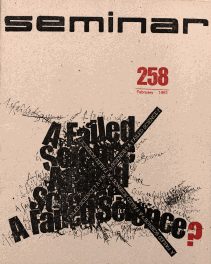
Cover: Dilip Chowdhury Associates |
It is quite incredible that the Thapars radiated this trust in young people. Though I would meet them every now and then, I didn’t get to write for Seminar for some time. Then one evening, at a common friend’s place, Romesh heard me bellyaching about the abysmal state of affairs in our scientific institutions. His immediate reaction was, ‘Don’t just complain, do something about it.’ By the end of the evening it was decided that we should produce an issue of Seminar on the state of science in India and he asked me take the lead on producing the issue. I was elated but scared. I had never done something like this before.
T
he next week I went to the Seminar office to plan the issue. Romesh insisted that it should be very hard hitting, and Raj that the contributors must have a lot of credibility. She suggested that since I was the one seeing the rot I should select the potential contributors and write to them. After a couple of meetings, the list of contributors was finalized and I was asked to write to them. I protested that I was a junior faculty member and no one would respond. Raj, however, was adamant that since I was planning the issue, I am the one who should send out the request for articles. With great trepidation, I did. Astonishingly, all agreed. It was quite clear to me that the success rate was because of the respect the Thapars commanded among the potential authors.The 258th issue of Seminar, A Failed Science (February 1981) was on the state of our technological establishment. The contributors were B. Banerjee, S.R. Ganesh, P.M. Bhargava, M.R. Bhagavan and myself. All the articles were critical of the scientific establishment and some extremely so.
A week after the publication of the issue, Romesh summoned me to the Seminar office. He was delighted. ‘It’s shaken them up. The PM has asked the Department of Science and Technology to explain and M.G.K. Menon is angry.’ But, Raj was somewhat worried. ‘Will it cause problems for you?’ she asked. Romesh retorted, ‘He shouldn’t have taken it up if he didn’t have the courage’ (polite language mine). Nevertheless, I was quite elated that something I was a part of had been noticed by the powers in the S&T establishment. Surprisingly, except for some queries from the bureaucrats in the Department of Science and Technology, I was not affected much by the controversies around the issue. That is probably because scientists and technocrats don’t read much! Nevertheless, it is surprising that twenty-three years later, a government committee on higher education reforms described the Indian Institutes of Technology as ‘islands of excellence in a sea of mediocrity’ – a phrase taken from the 1981 Seminar issue!
T
he success of that issue helped deepen our friendship. I hadn’t known them for long, but it always felt as if they were old associates and supporters. Over the next few years, I think they requested me to write only two or three articles on education and technology policy, but our interaction on other issues was more frequent. The period 1983-1987 saw Operation Bluestar, the assassination of Indira Gandhi, the massacre of Sikhs in Delhi, the Bhopal gas disaster, excitement over the new education policy, and the Bofors scandal. All these events excited debate, civil society action and young people’s need for emotional and material support.The Thapars were intimately involved in all these discussions and always there to offer encouragement and support, both emotional and financial, even though some of the activities some of us were involved in did not have much popular support, especially the issues associated with human rights. I still remember standing in the middle of a crowd of volunteers at Lajpat Bhavan in 1984 organizing support for the Sikh victims when a well known journalist sneered, ‘Oh! Do-gooders at work again!’ I heard a loud voice targeted at the journalist, ‘Get out of here before we kick you out!’ That was Romesh Thapar.
I
guess journals like Seminar of necessity reflect the character of those who founded it and ran it for years – an underlying ideology combined with an eclectic outlook, generous and compassionate. Over the last couple of decades, most of us who were associated with Seminar because of Romesh and Raj have continued to contribute. This is partly loyalty, partly agreement with what the journal continues to do, and partly the fact that it is the only place where one can discuss a specific issue in detail. There are not many iconic publications that survive for long. For example, reading the I.F. Stone’s Weekly was a must for all those against the Vietnam war in the 1960s. But the weekly, founded by Stone in 1953 had to close down in 1971 when he could no longer continue publishing it. It is to the immense credit of Mala and Tejbir Singh and Harsh Sethi that Seminar has maintained its quality and reaches its readers every month.If I had just contributed a few articles to the Seminar and got paid for them, it is unlikely that I would have all these memories. It’s the personal that matters. This is where Romesh and Raj were special. And, this is what made Seminar special for its contributors. Romesh and Raj had a New Year’s Eve party every year. We went with our eleven-month-old daughter. Raj was not irritated but welcoming and said, ‘Put her to sleep where people won’t smother her with their coats.’ We put her under one of the beds and enjoyed the party. That’s what memories are made of and also journals like Seminar.