Designing a better society
ASHOKE CHATTERJEE
THE landscape that Raj and Romesh Thapar tended through Seminar was a space inviting discourse, respectful argument and consensus around values essential to a ‘plural and intellectually energetic India’. For the Thapars, Independence had brought responsibility. New generations should flourish in an India ‘Where the mind is without fear… where the world has not been broken up into fragments…’ Raj and Romesh gave their lives to these liberating concepts, today under siege.
Yet, the era which their memory evokes was not a halcyon time. Upheavals and suffering were witnessed on a scale not experienced since, demanding resilient vision and courageous analysis. Partition, wars, the Emergency, rebellion, corruption and repeated betrayal of ‘trysts with destiny’: Seminar debated them all with an integrity that remains the finest Thapar legacy. All that Raj and Romesh cherished and did together was measured against benchmarks of freedom and justice. In the midst of screamed abuses and military tanks offered as inspiration to young minds, we are reminded today of the perilous cost of neglecting the landscapes of freedom and hope. Seminar indicates each month that we have not lost them all, and yet we may.
My first encounter with Romesh Thapar was on a sweltering Calcutta afternoon in the early sixties in my cramped office at the Metal Box Company above Chowringhee Road. Seminar had moved out of Bombay’s sophistication into what was then dismissed as village Delhi. Romesh’s immense frame filled my room, matched for size by his escort, Santi Chowdhury, film maker and partner with Romesh in one of India’s early media collectives. Santi had sent a message that Seminar was in need of support, and would my company please take a sympathetic view?
Romesh was clearly uncomfortable soliciting ads from ‘boxwallahs’ (the dignity of CSR still decades away), and made it clear that Seminar was doing me a favour by offering a uniquely influential readership: take it or leave it. My boss Jim Lindsay, an unconventional Brit, had already sent word that Seminar was one of two journals (the other was Sachin Chaudhuri’s Economic Weekly) that Metal Box must support as causes, ignoring dark whispers in some circles that Romesh and Raj were ‘commies’.
Conversation soon moved to other things: Sunil Janah documenting the lives of our factory workers, a film planned in Kerala to promote packaged seafood that I was making with Hari Dasgupta, the Thapar’s Bombay connection with the Dasguptas and Roberto Rossellini and other luminaries in theatre and cinema, the voice-of-god Films Division commentaries that made Romesh familiar to every moviegoer... and why Calcutta box-wallahs needed windows on other worlds. For that, I was invited to meet Raj over coffee when next in Delhi. So there it was, the Thapar worlds laid out: journalism, industry, the arts, the economics and politics of Five-Year Plan India, and the importance of discourse toward intelligent choices.
F
riendship begun was soon cemented in New Delhi. I would quickly discover that if Romesh was the Thapar flame, Raj was the spark that ignited it. Their exchanges across a desk they shared in Malhotra Building were the warp and weft of a fabric rich with ideas and imagined alternatives. Our conversations would bind years and careers, a thread that would stretch from Calcutta to Washington, New Delhi and finally to Ahmedabad. Raj and Romesh understood what took me away from corporates into international civil service, the holiest of grails in the troubled sixties for anyone seeking escape. They understood why I was soon reporting a sense of irrelevance from the IMF in Washington, and they approved when I shared an intention to return to desi chaos.|
|
|
|
Cover: Dilip Chowdhury |
Cover: Madhu Chowdhury |
In those years, Romesh’s ‘Capital Diary’ in the Economic Weekly would arrive by airmail. Each installment was a menu of New Delhi intrigue, concluding always with portends of worse to come. These would be repeated to me whenever I spoke to other South Asians of my urge to return: ‘You must be crazy. Didn’t you read in EW…?’ Scribbles from Raj on white Seminar postcards would share other tidings: ‘Don’t worry, Ashoke. Romesh has some better news coming.’ It finally came, but not in EW. It was an offer that Romesh knew I would not refuse: to work with him and a team he had assembled at the India Tourism Development Corporation (ITDC) of which he was now Chair.
‘Here is your chance to do something really different,’ Romesh wrote. ‘It will draw on what you know and can do. We will use Indian talent and Indian design as a strategy for promoting this country as a destination, and to professionalize tourism as an industry. It’s going to demand new ways of working, within and outside government. You know Sunil Roy who heads the Department of Tourism, and Gerson (da Cunha) is communication consultant. We have the PM’s complete backing – this is all about quality in the public sector. It’s a great chance. So pack up!’
I
t seemed an auspicious constellation for change. Socialism was the unquestioned mandate, with government at the commanding heights. Romesh believed that the public sector had the highest responsibility for demonstrating quality. Tourism was then low profile, and ITDC seemed a non-threatening space to demonstrate management professionalism and design as a development value that went well beyond aesthetics. For this, professionals would need to take charge, their ranks enriched from every source. The Thapars had access to Indira Gandhi’s ‘kitchen cabinet’ and their friend ‘Tiger’ (Dr Karan Singh) was Tourism Minister. The mix was almost too good to be true (as it would finally turn out to be). The Thapar strategy was a brave experiment to free the public sector from bureaucratic and political meddling, and to establish standards that others could follow.Romesh’s audacity was symbolic of the time. Pacesetting ‘temples of development’ were all government-driven: great dams at Bhakra Nangal and Damodar Valley, new steel plants in the East, HMT in Bangalore under Thapar friend ‘Bill’ Mathulla, and soon nationalized banks and airlines. Raj and Romesh held an implacable belief in India’s capacity for excellence, which they advocated with conviction to Indira Gandhi.
T
heir Bombay years had brought some of India’s brightest innovators into the Thapar circle, now mobilized to link aesthetics, heritage, craft and design to scaling a new industry as an engine of growth. Earlier precedents were studied, including those set at Air India, the Taj Hotels and in publishing. A cadre of Indian professionals was incubated at ITDC to meet world standards. New regions and facilities, neglected as unprofitable by private operators, were opened up. The South welcomed international visitors through its first five-star hotel at Bangalore and at Kovalam, India’s first beach resort created by Charles Correa.Award-winning publicity campaigns for ‘destination India’ reflected a galaxy of talent that included Gerson da Cunha, Pratima Shah, Kersi Katrak, Shekhar Kamath, Mitter Bedi, Shyam Benegal, Zafar Hai and top media agencies. Others helped develop remote circuits as new tourism experiences that included pilgrimage and wildlife itineraries, new cuisines and performing arts. A neglected concrete structure in Chanakyapuri was transformed by artisans, designers and managers into an aesthetic experience with path-breaking influence: the Akbar Hotel. Romesh’s faith was vindicated. Public sector India could set standards in what was already the world’s largest and most competitive industry, and do so with cultural sensitivity and a confident grip on new domains.
T
o establish smooth succession as a management principle, Romesh stepped down as ITDC Chairman, handing over to M.S. Sundara, a seasoned expert from the Indian Railways where organized Indian tourism had originated. As seminal demonstrations spread around the country, Romesh remained the corporation’s friend and counsellor, encouraged now by recognition from the travel trade for the strategies he had innovated. Praise would prove a poisoned chalice. Global recognition became too bitter a pill for those having to let go.Ministry bureaucrats resented cheeky newcomers moving into their spaces. Private operators wanted quick handovers of anything that ITDC was proving profitable. Cozy arrangements between private players and bureaucrats were being disturbed, and politicians were denied perks and patronage. They expressed outrage and set about to prove the ITDC experiment as yet another white elephant. Unions resenting pressures to perform were encouraged to get into a sabotage act, as was the CBI. When resistance became shrill, Indira Gandhi’s ‘complete backing’ vanished. Romesh and Raj were dismayed, offering the Seminar office as refuge for battered professionals wondering why demonstrations of quality had invited such hostility. To them, the Thapars recalled the opportunity which had brought an unusual team together: professionalism and design as agents for change, confronting established structures with tested alternatives. If the opportunity was a privilege, that privilege now demanded its price.
I
n their Bombay years, Raj and Romesh had participated in the city’s churning of new ideas. Patwant Singh had stared Indian Builder and then Design to host early conversations on contemporary expressions symbolized by Le Corbusier’s Chandigarh and the handloom revolution engaging another friend, Pupul Jayakar. Through her, the Thapars met the renowned design team of Charles and Ray Eames on their visit from Los Angeles in 1958. It would lead to the founding in 1963 of the National Institute of Design (NID) in Ahmedabad by two other visionaries in the Thapar circle: Gautam Sarabhai and his architect sister, Gira, back from the studio of Frank Lloyd Wright.When Seminar moved to New Delhi, design engaged discussions in Malhotra Buildings and at regular gatherings of talent and fame at home on Kautilya Marg. In 1966, Romesh sponsored ‘Design for Living’, a project at the Unesco International Round Table on Jawaharlal Nehru. It debated ideas on ‘a new value system capable of nourishing the disciplines which we need... Only that change is worthwhile which humanizes man,’ warning that, ‘We are thrusting into the future without any clear idea of the quality of life we want to give ourselves… We have failed to create this value system of our era.’
1The next year Romesh brought together a galaxy of thinkers who could influence a design agenda for tomorrow. Among them were Pupul Jayakar, Mulk Raj Anand, L.C. Jain, Charles Correa, business leaders and educators from IITs and schools of planning and architecture. Romesh set a challenge: ‘There is in India today a situation of existential complexity. A country with centuries of traditional memory faced with the shattering of symbol, form, function and meaning. A situation where there is want and unharnessed resources, degradation and dignity, ignorance and illumination, violence and the capacity for immense peace.’ There was a need for a ‘multidimensional and multidisciplined approach for educators, designers, scientists and communicators to question anew the problems and values of man and his environment.’
2 Institutions linked to national planning should emerge as value-driven catalysts for ‘a new design for living and development’, a concept which Romesh would foster in the public sector through ITDC and later, at the fledgling NID.
I
n the early seventies NID faced challenges similar to those threatening ITDC. Design as a problem-solving methodology was little understood. Only the bravest parents and students could risk NID’s system of learning that challenged every norm of India’s higher education. An administrative crisis led to the sudden departure of the Sarabhais from the campus they had built from scratch. Another brave experiment was threatened, this one with closure as Parliament struggled with disturbing reports from a distant campus where goings-on seemed suspiciously ‘foreign’.Intervention was needed from the top. Indira Gandhi knew the Sarabhais. At NID, she had worked on the ‘Jawaharlal Nehru and His India’ exhibition, created there by the Eames as an experiment in design training and then as an exercise in design diplomacy which would go on to win acclaim in world capitals. Pupul Jayakar was Indira Gandhi’s confidante, and was now NID Chair. To help resolve the institutional crisis, they turned to Romesh. The outcome was a report by the Thapar Review Committee
3 which painstakingly endorsed NID’s experiment, pointing out why design must be acknowledged as a capacity indispensable to India’s future. What NID needed at this critical juncture was understanding, and a new director. With the ITDC effort unravelling, Romesh asked me to move on to this other daunting prospect.
I
had read unsavoury news reports of campus turmoil and heard rumours of how zealously Ahmedabad’s merchant princes guarded their territories. ‘They will swallow you with sev and ganthia,’ warned one contact with years of experience. Raj put it another way: ‘It’s a bit like medieval Florence. The seths are Medicis, patrons of great taste and unforgiving of interlopers. But don’t worry. Ravi will be there to guide you.’ Professor Ravi Matthai had just stepped down as the first Director of the Indian Institute of Management and was now hand-holding the NID community through its difficult transition. ‘Try it for a couple of years, Ashoke,’ Raj urged. ‘You have nothing to lose and we all have to come together.’No sooner had a ticket to Ahmedabad arrived, so too did midnight news of the Emergency. The Thapars would now pay yet another price in defence of quality: Seminar closed rather than bow to censorship. Visions, values and partnerships were betrayed. ‘It’s a good time to get out of Delhi,’ said Raj, ‘the farther away the better to get anything done.’ Those couple of years extended to twenty-five. An Indian experiment in education, the first of its kind anywhere, would achieve global recognition, and then pay its own price for being in an India ‘without any clear idea of the quality of life we want to give ourselves.’
4
M
y years at NID5 were as difficult as they were pricelessly rewarding. Design education and practice had to claim its space, inch by inch and step by step, and do this without support from conventional frameworks. Educators and students had to cope with shoestring budgets and deny themselves facilities their peers took for granted. In a protected market, design had to demonstrate quality without the oxygen of competition. Industry had to understand the difference between design and mimicry, ministries to comprehend a problem-solving discipline that could be easily misunderstood as engineering or fine art – and somebody somewhere had to pay a living wage to young designers emerging as young professionals with real-life evidence of their capacities. The hostility toward change experienced at ITDC was now mirrored in the mocking of an educational experiment that offered no guarantees.Through all the challenges, Malhotra Building could be counted upon for counsel, tea and sympathy – as well as pressure to endure. ‘Make sure the NID experiment is recognized by designers abroad,’ Romesh urged, ‘you’re going to need that to convince your own country.’ When the institute received the first international award for design in developing countries, Raj and Romesh offered more than congratulations, urging that NID now invest in reaching out to the country, region and the world and to risk this investment without waiting for resources.
R
omesh shared his ‘Design for Living’ experience with Unesco, and NID carried that message to an award function in Dublin. It would lead to the United Nations organizing its first design conference at NID in 1979. Delegates came to Ahmedabad from every continent, and heard Romesh Thapar’s keynote call: ‘A comprehensive view has to be nurtured about the society that we are designing – or to put it another way, about the value system which must underpin it. An ideology for the designer? Well, yes – in a way. You cannot escape it. An attitude of mind, a framework, a series of guidelines … but all rooted in the reality around. The design practitioner will have to take positions on what is to be preserved and what is to be destroyed. The conscious selectivity is vitally important... Unless the designer links the peoples aesthetic with modernization, he is wiping away their identity... The attempt to interpret modernization in one stereotyped model must be defeated.’6
F
orty years on, how would Raj and Romesh assess the journey of Indian design, amidst the stereotypes that mark modernity in India 2017? Design education has spread to over 300 listed institutions, and as many tuition shops at every urban corner. NID is now a degree-awarding ‘institute of national importance’ recognized by the Parliament that once considered it wasteful extravagance. Entry into design careers is prized across the country. A national design policy encourages the promotion of design as ‘Make in India’, ‘Skill India’ and as other symbols of current aspiration.Fashion has taken over as the first image of design in the public mind. Indian designers are established in global markets as role models, and design careers can bring celebrity status. And ideology? A recent research
7 estimated that the profession today serves 2% of India’s real needs, joining the widening divides within a culture of consumption. How should India’s design community respond to the opportunities of a market-driven economy on one hand and the shrinking spaces for development discourse on the other?Perhaps by recalling Romesh in 1979: ‘We survive on the immense richness of our traditional sources of creativity, salvaged and nurtured by a few highly aesthetic and devoted individuals who were given the political patronage necessary to build authentic design foundations…The need for urgent and conscious intervention …cannot be left to the whims of individuals who can easily be overwhelmed by the waves of vulgarity that sweep our world…Vulgarity in all its frustrations, its duplicity and imitation, has the propensity to return with redoubled fury…on the basis that "variety is the spice of life" …dressing bad taste in modernization, making it fashionable and competitive… We will have to draw upon the great heritage of world knowledge and experience to create a discipline of modernization which dissolves the divisions between rich and poor, the contrasts between waste and want, and the repetitive patterns of ugliness and beauty which constitute the violated environments of our planet. The only weapons we have are our sensitivity and creativity. Let us recognize them, sharpen them, and mobilize for engineering the societies of tomorrow.’
8
T
his was Romesh, anticipating the Earth Charter twenty-one years before it was signed, and the Sustainable Development Goals almost forty years before they were ratified by every UN member. Both agendas call for ‘an alternative value system which has been carefully worked out, justifiable in humanistic terms, capable of providing answers to the challenges posed by our massive entry into the era of science and technology.’9The sensitivity and creativity which Raj and Romesh had advocated through many of India’s tumultuous years is now its official mandate in a new millennium. Yet, the values they championed for tomorrow’s India may be hard to find in corridors of power. Instead, it is the young in every corner of our land who today reflect the courage of the Thapar vision and its capacity to engineer a ‘new design for living and development.’ They are the heirs. With them is the hope of reclaiming those unforgettable landscapes of freedom where the mind is without fear and where the world is not broken into fragments.
Footnotes:
1. Romesh Thapar, A Design for Living: A Design for Development. India International Centre, New Delhi, 1966.
2. Romesh Thapar, ‘The Problem’, Seminar 99, November 1967.
3. Thapar Committee Report. Ministry of Industrial Development, Government of India, New Delhi, 1973.
4. Romesh Thapar, A Design for Living: A Design for Development, op. cit., 1966.
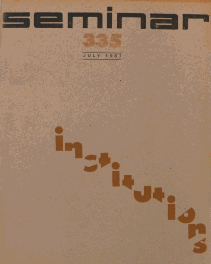
5. Ashoke Chatterjee, ‘NID Experience’, Seminar 335, July 1987.
6. Romesh Thapar, ‘Identity in Modernisation’. Keynote address: UNIDO-ICSID-India, 1979. National Institute of Design, Ahmedabad.
7. Design Education in India: Retrospection, Introspection and Perception. NID, Ahmedabad, 2014.
8. Romesh Thapar, ‘Identity in Modernisation’, op. cit., 1979.
9. Romesh Thapar, ‘A Design for Living, A Design for Development’, op. cit., 1966.