The fork in the road
A.G. KRISHNA MENON
WHILE planning this essay about the period I knew Raj and Romesh Thapar, I was reminded of David Lowenthal’s book, The Past is a Foreign Country.
1 The ’70s and ’80s were different times. I can now only imagine it, in Lowenthal’s metaphor, as a foreign country. It is not just because of the massive changes that have been wrought by technology and materiality of everyday life, that of course, but also in the changes that have taken place in the polity, in what we as a society aspire to be. But to understand the metaphor of foreignness of the past would perhaps require inputs from several disciplinary perspectives, which I cannot claim, so I will try and look at it from mine, architecture and urban planning, because it was from that perspective that I engaged with the Thapars.I will use the collective, Thapars, though my discussions were largely with Romesh, but Raj was always there, attentive, doing her own thing, adding occasionally to our conversation with perceptive comments. So, it was the Thapars with whom I conversed, and refer to in this essay. Many of these discussions took place in the ‘work’ environment, the Seminar office in Connaught Place. But many were conducted at their home at Kautilya Marg. And later, we spent many pleasurable winter days soaking in the sun and carrying on our dialogue, at their farm, Panch Pilu (5 Pilu trees), at the foothills of the Aravallis, near Sohna, that I designed for them.
On our return to India from our studies in the USA, Ritu and I decided to settle in Delhi in 1972. Ritu, of course, had roots in the city, but I was an outsider. I had to find my way, both socially and professionally. An earlier acquaintance with Mala and Tejbir, fellow returnees from our respective coming-of-age experiences in the US academic institutions, bonded into a closer friendship. Through them we were introduced to Raj and Romesh and their eclectic salon of intellectuals.
For me, an outsider, it was an instant entre into the Delhi intellectual circle, but in retrospect, I think my own critical vision of Indian architecture and urbanism was shaped as much by my fortuitous engagement with the Thapars and the Seminar magazine as by the trajectory of my personal intellectual journey to find my professional home in Delhi. I will explain what I mean by narrating two benchmarks in that journey.
|
|
|
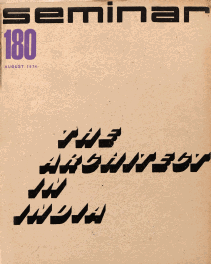
Cover: Trilokesh Mukherjee |
The first was issue no. 180 of the magazine, published in 1974 on ‘The Indian Architect’. In the course of my several wide-ranging discussions with the Thapars, we had connected on the subject of the terrible state of the built environment in India. Romesh’s trenchant observations were met by my equivocations as arguably, a complicit professional. I tried to explain to him that my perceived professional complicity in the creation of the poor state of our habitat had complex explanations. This led him to invite me and my colleague Ashish Ganju to edit the issue on the role of the architect in the creation of the habitat in India.
While some of us, young architects with not much work at hand, had been occasionally meeting and thinking about the subject, it had never got to the point of systematic analysis and articulation that was needed to put together the Seminar issue. Therefore, whatever impact the issue may have had on the readers of the magazine, the task Romesh gave us had a profound effect on our thinking about the discipline and professional practice.
W
e examined the problems of the profession under three broad, but overlapping categories, viz., (i) the problems of the architect’s self-perception and their role as professionals; (ii) the problems of developing a rational base for the profession to contribute to the spatial needs of society; and (iii) the problems of identifying the level of technology to be arrived at to meet the needs of development. The issues we addressed in that exercise reflected our concerns of the time, and we tried to correlate the state of the habitat with the state of the profession. We believed that it was possible for the profession to become the agent of change for the habitat needs of society at large.We recognized that there were many ‘professions’ in India, as there were societies: the most compelling expression of the different societies is embedded in the iconic nomenclatures – India and Bharat. There was an attempt then, which is implicit in the reading of the different contributions to that volume that architects – formally trained or others – should address the needs of both. As professionals we felt then that we were on the same page.
P
erhaps it was a different time. We felt that it was still possible to bring about change by pursuing our professional objectives as we discussed in that issue of Seminar and mediating the processes of delivery of services as well intentioned activists in the field. It led to the formation of a loose group of like-minded professionals we called Greha that to this day, through the involvement of a new generation of professionals, continues as an independent architectural and urban planning think tank.As a collective, Greha has produced several thought-provoking research papers and in 1990, it established a new school of architecture, the TVB School of Habitat Studies in New Delhi, to respond to the questions we had initially raised in Seminar on the role of the architect in India. The school functioned for seventeen years and was widely acknowledged as a pioneering effort to reform the profession, but finally, the overwhelming forces of conformity succeeded in closing the school down and it was absorbed as a department of architecture in the local state university.
The second benchmark I would like to narrate is my engagement with vernacular architectural practices in the country that we had yoked to the formal sector in the issue on The Indian Architect. Later in the 1970s, the Thapars engaged me to design a farmhouse for them on the Sohna Road, outside Delhi – the Panch Pilu. By now I was well on the way to try and put my theoretical proposition to work on projects.
T
here was lively debate at that time on the advantages of low cost appropriate building technologies to meet the habitat needs of the country. Greha was also engaged in advocating the need for ‘barefoot’ architects. Accordingly, I persuaded the Thapars to employ local mistris to build their farmhouse using local materials and vernacular building technologies. As putative barefoot architects, Raj and I scoured the local villages to identify the mistris to whom we could entrust the work.The house that was built was unusual because it was the product of negotiation between different stakeholders, not designed by an architect: I only facilitated the process. It was spatially open to the countryside, and could, we envisaged, work like the village chaupal, enabling villagers to freely meet and interact with the new urban inhabitants of their rural domain. The configuration of the rooms was such that there was no ‘outside’ or ‘inside’ to the house: the so-called entrance door (because a house must have an entrance door) separated one kind of open space from another and both were accessible from the surrounding farm. Subsequently, I helped others to build their farmhouses in a similar manner, including my own: it was a compelling idea.
Panch Pilu was in marked contrast to its neighbour, a beautiful architect designed house of Patwant Singh, the editor of Design magazine, the high priest of promoting modern architecture in India. It conformed to international ideals of modern architecture. The Thapars were happy in their mistribuilt home. It was the kind of house that the mistris may perhaps have built for themselves (allowing for my design inputs). It was an example of Indian modern in contrast to Patwant Singh’s International modern.
I
f one wants a graphic depiction of the transformation that has taken place in the fields of architecture and urbanism, one only has to travel down the Sohna Road today. Panch Pilu, of course, does not exist anymore (and nor does Patwant Singh’s farmhouse) having being replaced by multi-storeyed gated communities and globally oriented, self-financing education institution that decisively mock our youthful ideals of barefoot architecture and reliance on appropriate technologies to meet our spatial needs. The mistris and local building materials, that Raj instinctively dignified by reposing her faith in their traditional building knowledge and skills, have now been replaced by machines and factory made products; the crafts people have been reduced to becoming one of many anonymous labourers doing their assigned tasks in a building they can never hope to occupy.The difference between then and now, I want to highlight, is not only in the product, the physical building, but also in the process of building. The architect and urban planner, we argued in The Indian Architect, must learn from the local context and not seek to apply solutions from elsewhere. This was the reasons for my equivocation when I was talking to Romesh while planning the Seminar issue he commissioned. Romesh’s benchmarks were Bombay and his provocative conversations with his friend, Charles Correa, who had just co-authored the intellectually seductive proposals for New Bombay. My sights were set to different horizons which I found difficult to articulate in as compelling a manner. But in fairness to Romesh, he not only gave me the time of day but also space in Seminar to express another point of view. It was, as I said earlier, another time.
M
any years later, I came across this statement in a book by Lloyd and Susanne Rudolph on their research method, which expressed the point I was trying to make to Romesh more cogently: ‘We found ourselves learning from the other and grounding our concepts and categories in local knowledge and practice. We characterized our approach as situated knowledge, knowledge that arise out of particular times, places, and circumstances, and that result in contextual rather than universal truth.’2 As they go on to explain, universalistic theories project a single history common to making, a common development path along which all humans will tread. Situated knowledge, by contrast, projects futures by reference to where culture/society/polity is coming from. Its specificities shape the next step.3 Working with Raj on the construction of Panch Pilu, I knew that she understood and believed in the value of pursuing that perspective.In a quixotic effort, some us, the original protagonists involved in putting together the issue of The Indian Architect, initiated a conference on vernacular architecture with the School of Planning and Architecture, Bhopal, in December 2015, where we teamed with the Manav Sanghralaya (The Museum of Man) in Bhopal, and the Indian Trust for Rural Heritage and Development, New Delhi. The conference threw light on the continued saliency and significance of the ‘informal profession’ and reaffirmed our belief that the direction the formal profession of architecture was taking was inimical to the welfare of society at large.
In our own way, we were still trying to answer the questions posed by Romesh in 1974. The conference affirmed the need to promote vernacular architecture practices by drafting a Charter for the Propagation of Vernacular Conventions for Architecture in South Asia. The message one drew from the conference was that, then as now, informal vernacular practices continue to contribute to the built environment and inflect the ideology and practice of architects in the formal sector. But it was a cry in the wilderness.
The mainstream of the profession has ceded agency to global finance capital and high technology firms marketing their products to an eager government intent on leapfrogging to join the high table of developed countries through the Smart City and similar hubristic urban development programmes. Ideologically speaking, we have taken a different fork in the road, and the past has indeed become a foreign country.
T
oday, over four decades after we edited that issue of Seminar, it is clear that the ideas we discussed are still relevant. Both societies still exist, but the discourse in the profession is dominated by the needs of the formal sector of the economy, leaving the servicing of the needs of the rest to mistris and craftspeople. So, in reality, we are not on the same page as we thought we were then; perhaps, going back to Lowenthal’s metaphor, we are not even in the same country.
Footnotes:
1. David Lowenthal, The Past is a Foreign Country. Cambridge University Press, 1985.
2. Lloyd L. Rudolph and Susanne Hoeber Rudolph, Destination India: From London Overland to India, and What we Learnt There. Oxford University Press, New Delhi, 2014, p. xi.
3. Ibid., p. 192.