Evictions from and invitations to the fast city
SWETHA RAO DHANANKA
EARLY in 2016 two contrasting events occurred just a few days apart in Bengaluru. First, a public hearing on evictions in Karnataka was organized by the state-wide slum dwellers organization, Karnataka Slum Janara Sanghatanegala Okkoota. The second was the Global Investor’s Meet organized by the Karnataka state government, which rolled out a red carpet for the corporates of the world. While these events convey competing claims and visions of the city, I suggest that both events are different sides of the same coin. I link this string of events through an analysis of the different speeds of state bureaucracy. Analysing the multiplicity of state agencies involved and the deployment of information catering to different social spheres, this essay aims to depict the imperatives of ‘fast cities’
1 in an entrepreneurial region that is complicit with structural violence.2On 28 January 2016, I entered the Gandhi Bhavan in Bengaluru. Life-size statues of Gandhi on the premises conveyed a sense of responsiveness to his legacy. The room was packed with slum dwellers, activists and researchers who over two hours absorbed eviction narratives. It reflected crude state violence against the vulnerable who lived on land that their ancestors had developed from scratch and today unleashed monetary value. The land was now either worthy of speculative emptiness or the dreams of the rich, but not of those who served and maintained the city.
One victim’s remark, ‘The state should mix poison into food rations so that all the poor would be gone’, was followed by rousing applause by fellow slum dwellers. When the bulldozer strikes, identities, histories and hopes get crushed. According to one speaker, it was caste that justified evicting agents barging into settlements early in the morning, pouring mud into whatever food was available in these hutments, bulldozing their belongings, not even giving people time to pick up school books and proofs of identity, and even evicting a young mother while she was delivering her baby. Repeatedly, the evicted said that the police were there only to protect the bulldozer, and that there was no ambulance available to attend to the injured during this state-inflicted violence.
|
|
|
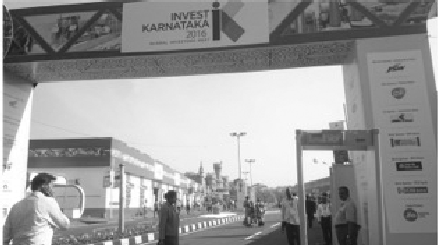
Figure 1: Venue of the Global Investors Meet 2016 – Karnataka Invest. Pic: Swetha Rao Dhananka |
By contrast, numerous ambulances stood ready at Bangalore’s Palace grounds, where the state government, less than a week after the public hearing on evictions, welcomed representatives of corporations from across the world to the Global Investor’s Meet, ‘Karnataka Invest’. A top-notch pop-up exhibition centre with air-conditioned meeting rooms and carpeted toilets, glossy documentation and lavish food awaited the delegates (see Figure 1). In the run-up to the event, Brand Karnataka was taken on a road show across the globe to invite the world to invest in the state. The press announced afterwards that MoUs (Memorandum of Understandings) worth 1.33 lakh crore
3 were nailed, based on the promise of making rural land readily available for industrial development and projecting Karnataka as a prime investment destination. The main motto of the effort was the ‘ease of doing business’ in Karnataka, which offers a single window clearance online system at http://ebizkarnataka. gov.in/ for which legal amendments had been hurriedly pushed through the state legislature.
I
n this essay I discuss these two events in greater detail to argue that both events are part of the same capital cycle of accumulation by dispossession,4 but that the state bureaucracy represents and paces itself very differently in respect to these diverse societal spheres. The events are contrasted first, by the speed the state actors respond and act; second, in the amount and diversity of the state agencies involved and the degree of coordination among themselves; and third, in the way information is differently deployed. This essay is based on participant observation and document analysis of both events and a long-standing engagement with the city of Bangalore.
I
n view of the public hearing on evictions, a group of involved community groups, activists and researchers documented cases of systemic deprivation of slums and its effects on people. From this documentation, twelve cases were made available as part of the public hearing to draw attention to evictions occurring not only in urban areas but also across the state. In this essay I draw on six case studies of slum communities located in Bangalore. All of the six communities have been in the city for 20-45 years; they reflect an evolving geography of poverty and squatting – near drainage canals, railway tracks, grazing lands and construction sites. They were evicted without notification and in the most inhuman ways. In none of the cases was transit housing arranged as an immediate measure. Only after staging protests did some of these communities get temporary shelter, but they were again evicted and forced to live on the streets, making women and children most vulnerable (see Figure 2).
A
cross these six cases, 14 government agencies were directly involved in evicting the poor and 11 other agencies were indirectly involved or were sought after by the grieving community for support. The former include the municipal corporation, parastatals, and elected representatives with their thugs, as well as private companies. The latter category includes the Karnataka Human Rights Commission, the High Court, the District Commissioner, revenue officers, housing funding agencies, the police and spying retired officers. In their plea for shelter, the communities approached designated agencies such as the Human Rights Commission or the Karnataka Slum Development Board, but their requests were ignored or they were promised relief that never came. Moreover, there was no coordination amongst the agencies.
|
|
|
Figure 2: A child’s representation of the eviction suffered, displayed at the public hearing. Pic: Swetha Rao Dhananka |
To illustrate this point, I present a few examples. A community was evicted from the city centre by the municipal corporation, as the land was transferred to a parastatal. They had been promised compensation (to 40 families), which was never paid. The rag-picking community, evicted from near a drainage site, had paid their MLA some money so that they would get houses, but never got them. One community that suffered from collapsing social housing in the city’s centre was promised rebuilt housing by the municipal corporation, but it never happened; instead, the same land was tendered out to a private company to build a mall. In all these cases, none of the promises were fulfilled, leading to further precarization of people already pushed to the limits of survival.
T
he role of information is noteworthy: In none of the cases were people given notice prior to eviction. Moreover, information had been manipulated in all these cases to work against the vulnerable communities. In the case of the community displaced by the NICE (Nandi Infrastructure Corridor Enterprise) corridor, the revenue inspector had submitted a false report indicating ‘no habitation’ in that area. When the community tried to rebuild in the same locality, against fierce threats of goondas, the police filed false allegations against the people. In 2015, the company even wrote to the municipal corporation not to receive taxes from those residents, because they were not authorized to live there. This request was complied with, thus blocking what little leverage the community could have had in filing their claim.
T
he low speed of action, the diversity and multiplication of bureaucratic and governmental agencies involvement, and the strategic deployment of information feed into and perpetuate what Akhil Gupta calls a structure of violence embedded in a state that is polycentric.5 He argues that violence becomes structural, as it is impossible to identify a ‘single actor’ who commits violence. Violence becomes impersonal, built into the structure of power. Indeed, these cases reveal the plethora of government agencies and actors involved, and highlight the chain of events following the evictions that often masks who is behind the eviction and why it has happened.Gupta argues that we should rethink our understanding of structural inequity to what he calls structural violence, in order to recast common occurrences such as evictions that have the potential to kill and inflict suffering through deliberate actions of those perpetuating a social order, in which extreme suffering is not only tolerated but also taken as normal. Such violence is constant rather than episodic and is perpetuated by the very procedures of the bureaucracy, and paradoxically through the everyday practices of the welfare state.
6 The negligent response of the government agencies (like the state human rights commission) from whom the grieving communities sought support, shows how the state tolerates suffering of low caste communities, and categorizes their status as ‘unauthorized’. In sum, by looking more closely at everyday bureaucratic practices and representations of vulnerable communities, we can discern the constitutive connections between political economy and social structures.
F
ive days after attending the public hearing on evictions, I made my way through Bangalore’s Palace grounds to get a glimpse of how inviting the state was towards domestic and foreign investors. The government had tendered out the entire event management and the compilation of promotional material. I could not help but notice the coordinated efforts of various government agencies, the impressive effort of information compilation and dissemination, and the persistent promotion of the ‘ease of doing business’ through higher procedural speed spurred by a single window clearance mechanism anchored in the nodal office called Udyog Mitra – a government of Karnataka undertaking. Its mission is to promote and facilitate investments and assist investors ‘to execute initiatives to enable a smooth transition, from receiving an investment proposal to the eventual implementation of the project.’ The main value proposition for single window governance is efficiency and cutting through red tapism, an outgrowth of India’s trade liberalization policy.7
T
he current ‘ease of doing business’ is promoted through a nodal office, in which members of all concerned line departments sit and coordinate for investment facilitation. Its rationale is embodied through the government’s website (see: http://ebizkarnataka. gov.in/). It welcomes a potential investor onto the site with a short presentation and displays three tabs to click on: ‘Start a Business/Apply for In-principle’, ‘Department Approvals’ and ‘Apply for Amendments’. Clicking these tabs take you to lists of clearance prerequisites and government departments. There is a concerted effort to streamline the approval process through a single nodal office without physical contact, only through online transactions.Single window implementation is an extremely complex and costly undertaking requiring tremendous efforts of coordination, information compilation and political will.
8 At the Global Investors Meet itself, government delegates were in a celebratory and self-congratulatory mood after having taken Brand Karnataka on road shows across the globe, to conferences and exhibitions to attract investors. The state of Karnataka had indeed topped the list in attracting investments, but did not fare well on the ease of doing business, as the key departments – urban development, revenue and law – pulled down the state’s overall ranking due to procedural delays.9
W
hile the promotional materials were glossy and dotted with appealing pictures, bullet point text, rankings and key statistics, the details of the amendments to the Karnataka Land Reforms Act 1961 were highlighted in the overview brochure. Speeding up the approval of land allocation for investors seemed the main feature of ‘ease of doing business’ through single window clearance. In the run-up to the Global Investors Meet 2016, the Karnataka government had identified 115,000 acres of land that could be acquired for industrial or real estate projects; 50,887 acres had been notified for acquisition and 21,486 acres had already been acquired.10Land is the material face of virtual global capital that is directed towards investments into property and real estate as an important route to access emerging markets.
11 As several scholars have noted, real estate has become the frontier of wealth accumulation in India.12 Such investments require that transnational finance capital interface with state actors at a city-regional level. This interface intrinsically relates to the removal of regulatory impediments.Within the purview of the Karnataka Industrial Policy 2014-19, to simplify procurement of land and for speedy conversion of agriculture land for industrial purposes within a stipulated time, the state government in July 2014 passed amendments to Section 109 of the Karnataka Land Reforms Act 1961. The amendments also extended the time allowed for the purchasing company to utilize the land from two to seven years and a maximum of ten years upon request. This change essentially gives investors time to speculate on land by blocking in their capital and exiting (before the policy prescribed time) after making a profit without having to actually build anything on it. In consequence, they are taking precious land out of the hands of farmers and adversely affecting food production.
I
t has been argued that land speculation, enabled by active dispossession inside and surrounding the city of Bangalore, has become the main business of government.13 An examination of the promotional material distributed at the investment meeting revealed only two instances where it is mentioned that those who lose their land in the process would get ‘fair compensation’ and one job per family. However, numerous studies have shown that such compensation is usually not fair and fails to better the situation of farmers, as they often use the money to pay off debts, marry their daughter or spend for the construction of a house – types of expenditure that do not generate recurrent income.One job per family frequently remains an empty promise, as land losers often do not have the required skills to take up the available jobs. Local industries avoid hiring local workers fearing unionization. Land dispossession more often than not leads to a downward spiral into poverty. Current compensation mechanisms do not take into account the financial realities and the skill base of land losing families, and are justified based on unrealizable myths of new employment opportunities through industrialization and bottom-up entrepreneurialism.
E
viction of urban poor settlements and global investor meets are contrasting embodiments of the functioning of a polycentric state. In the case of evictions, the state was represented by a multiplicity of government agencies, slow speed of action or even non-action in view of the suffering and scarce information availability to the aggrieved. Whereas in the case of the Global Investor’s Meet, the state channelized efforts to attract investors by compiling and readily supplying relevant information to potential parties and by increasing speed through a single point of contact in the form of a nodal office. The latter is an instance of what Datta and Shaban14 call ‘fast cities’. They focus on speed as a strategy of innovating, competing and leapfrogging into urban futures, through the active construction of temporal binaries between fast policy and slow government, free markets and state bureaucracy, master planning and local consultation, state vision and local democracy.The legitimacy for acceleration derives from the rhetoric of urgency, which calls for speeding processes of bureaucracy, planning and democracy, which are perceived to be slowing down urbanization.
15 Fast cities reorder urban temporality by actively engaging in innovation strategies designed to bypass ruptured infrastructure and unworkable regulatory regimes.16Datta and Shaban present three propositions to characterize fast cities: first, new utopias by design; second, fast cities materializing at the scale of regional urbanization, concomitantly scaling up economic and industrial corridors; third, the preoccupation of the entrepreneurial state with ‘lawfare’ – the increased use of ‘brute power in a wash of legitimacy, ethics and propriety’
17 to build new cities, by using disorder to internalize the logics of capital and extend power over new territories and populations.
E
victions are symptoms of ‘fast cities’ strategies by state agencies grabbing new territories through force and bypassing slow procedural democratic impediments of local governance and consultation. The state is slow to hear cases of evictions, but rapid in its violent action to evict, and fast to facilitate land sales and conversions; yet, these actions are viewed as distinct. These mechanisms apparently cater to vastly different societal spheres, but both spheres hold high stakes in the future of the city. It is for us to recognize that evictions from the city and invitation to it are two sides of the same coin.
* This essay was written during a post-doctoral fellowship sponsored by the Swiss National Science Foundation.
Footnotes:
1. A. Datta, Mega-Urbanization in the Global South: Fast Cities and New Urban Utopias of the Postcolonial State edited by A. Datta and A. Shaban. Routledge, London, 2017.
2. A. Gupta, Red Tape: Bureaucracy, Structural Violence, and Poverty in India. Duke University Press, Durham, 2012.
3. http://www.business-standard.com/article/pti-stories/gim-attracts-investment-proposals-worth-over-rs-1-33-lakh-cr-1160204 01706_1.html, accessed on 10 March 2017.
4. D. Harvey, ‘The "New" Imperialism: Accumulation by Dispossession’, Socialist Register 40, 2004, pp. 63-87.
5. A. Gupta, op. cit.
6. A. Gupta, op. cit.
7. J. Koh Tat Tsen, ‘Ten Years of Single Window Implementation: Lessons Learned for the Future’, Global Trade Facilitation Conference, United Nations, 2011.
8. Ibid.
9. http://www.thehindu.com/news/cities/bangalore/Karnataka-tops-in-investments-but-plummets-in-ease-of-doing-business/article16091397.ece, accessed on 10 March 2017
10. Karnataka government promotional material: ‘The preferred destination for investors’. Department of Information and Public Relations, Government of Karnataka.
11. L. Halbert and R. Hortens, ‘Filtering Risk Away: Global Finance Capital, Transcalar Territorial Networks and the (un)Making of City-Regions: An Analysis of Business Pro-perty Development in Bangalore, India’, Regional Studies 48(3), SI, 2014, pp. 471-84.
12. S. Doshi and M. Ranganathan, ‘Contesting the Unethical City: Land Dispossession and Corruption Narratives in Urban India’, Annals of American Association of Geographers, October 2016.
13. M. Goldman, ‘Speculative Urbanism and the Making of the Next World City’, International Journal of Urban and Regional Research 35(3), 2011, pp. 555-81.
14. A. Datta and A. Shaban (eds.), Mega-Urbanization in the Global South: Fast Cities and New Urban Utopias of the Postcolonial State. Routledge, London, 2017.
15. Ibid.
16. M. Murray, ‘Frictionless Utopias for the Contemporary Urban Age. Large-scale, Master-planned Redevelopment Projects in Urbanizing Africa’, in A. Datta and A. Shaban (eds.), ibid.
17. John L. Comaroff and Jean Comaroff, ‘Law and Disorder in the Postcolony: An Introduction’, in J.L. Comaroff and J. Comaroff (eds.), Law and Disorder in the Postcolony. University of Chicago Press, 2006, cited in A. Datta and A. Shaban (eds.), op. cit.