Surface tensions: art in public spaces
ANGARIKA GUHA and PRASHANT PARVATANENI
Kabir stands in the market, a flaming torch in his hand
says burn your house down and walk with me.
TODAY Kabir and his verse stand on Brigade Road, as if trapped in the mural’s intricate design, stuck to the wall, rendered immobile. Kabir neither walks, nor does he burn down any walls. The walls remain intact and the market entertains its consumers. They are not listeners, not seekers, not ‘the public’. The people on this street, dutifully performing their role as consumers, might look at the mural in the same way as they do at the billboards. They might even be tempted to shop more and immediately when they read Kabir who says – ‘kal kare so aaj kar, aaj kare so ab’ (‘If you think you’ll do it tomorrow, do it today. If you think you’ll do it today, do it now’).
Not so long ago, art practices in public spaces of Bangalore carried with them an air of novelty and radical optimism. Euphemisms like ‘revitalization’ and ‘occupation’ of city spaces for the public, and art’s crucial role in it, populated the discourse of the city. This was around 2008-09, when the city also saw the emergence of new collectives that primarily focused on art in public spaces. Our own collective, Maraa, started with an earnest belief that through creative practices in public spaces we can ensure that these spaces remain open for engagement with diverse publics. This was also the time when the city’s public spaces and infrastructure were undergoing massive transformations with capital flowing into the city for redevelopment.
Eight years down the line the story of art in public spaces seems full of cracks, or rather gaping holes. It follows closely the story of the idea of public space itself. At the core of both, we argue, is disillusionment – a shattering of assumptions. At the surface, the story of Bangalore’s transformation in the last decade is one of progress, development and other clichés. It’s the story of road widening, flyovers creating new bypasses, and the metro taking over the heights and depths of the city. Scratch the surface and story reveals itself as one of evictions, dispossession, and arbitrary discrimination. If we choose to listen to this story, the assumption that there exists an all encompassing entity called ‘public’, which has a ‘space’ of and for its own, is revealed as merely that – an assumption.
Arbitrary patterns of ownership, crisscrossing government bodies, municipalities, private companies and exclusive citizen groups make themselves apparent when we question, ‘Who does this public space belong to?’ A Residents’ Welfare Association takes over a park and decides to keep it locked at night. A homeless person wanting to sleep on the park bench stands outside, alienated from this ostensibly ‘public’ park. A ‘concerned citizen’ files a PIL (public interest litigation) and gets the vendors who have been vending for years on her street evicted with the support of others in her housing society. Are these instances of the ‘public’ reclaiming their right to neighbourhood spaces, or is it about the entitlement of one class over a space that dispossesses persons from another class? Who is the public here?
What happens when artistic practices intersect with this embattled concept of public space? What role does art play in this narrative of change and transformation of the city? Our experience of working with the arts in public spaces tells us that it has been rather easy for the arts to be appropriated into the uncritical optimism of the burgeoning metropolis.
Parallel to the city’s transformation, the nature of art in public space has also undergone several mutations. From being scorned to being celebrated, from being at the cultural fringe to taking the centre stage with generous funding and legitimized support, art stands incriminated in the process of urban redevelopment. The artist occupying a street for a performance or a wall for her mural is no longer a vandal but a partner of the state. Sometimes the intent is candidly expressed as beautification, and at other times it is garbed in terms like public engagement and participation.
S
paces presumed ‘dead’ are taken over by the artists, or rather formally given to the artists so they may invest these spaces with new ‘life’. Place-making becomes a veneer that hides the uncomfortable and embarrassing foibles of the city behind a facade of new projections of the space. In a rush to ascribe the metaphor of life and vitality to a public space we hop, skip and jump over the uncomfortable questions as to why the spaces died in the first place. Or, is the perceived death even real? Are the flyover columns really dead and meaningless, waiting for the arts to come and revivify them? What gives art the privilege over the flyers and billboards that small businesses stick on flyover columns or the walls across the street?It is possible that the arts are going by the similar assumption of an all-inclusive public which needs art for the city spaces, just as this imagined public needs constant urban redevelopment. It is also possible that somewhere down the line, art in public spaces has given us a pleasurable and comfortable story to tell about the city – a story that plays out either against the backdrop of the new improved infrastructure (metro stations, flyovers, redesigned public parks) or against the spaces perceived to be dead and abandoned (old buildings, crumbling walls, garbage dumps, slums).
What seems to be missing from this story is an acknowledgement of conflicts and loss that accompany the birth of this newness, or of forces, tensions, resistance and contestations that have remained alive despite the facade of death and decay of the space. The work maybe shrouded in some abstract idea of ‘collective’ ownership (as opposed to an artist’s authorship), but can we ignore that it is still something that an artist or a group of artists or citizens or a community have imposed upon the space. It is rather impossible that this imposition happens with the consent of every public that engages with the space or might engage with it in the future. So what happens when a specific intervention becomes a part of the general identity of the space? What are the ramifications of this place making or artistic presence over the experience of the space?
A
rt has always possessed a certain affective potential. Pleasure and entertainment have long been a part of that affect. But we are also aware of the ways in which this affective potential has been played with to provoke thought and critical engagement. Artists have played the fool in order to raise uncomfortable questions. They have been miscreants who disrupt the stasis of ideas, attitudes and assumptions. So, is the presence of art in public spaces raising those critical questions about the city and its spaces? Is the artistic representation of the city and its people in public spaces critical of the dominant structures that own, govern and define the spaces or is it merely illustrative – a projection of the image of the city, real or metaphorical?
T
he challenge before art in public spaces today is to not get subsumed under the consumer aesthetic and experience. In the last decade we can see the blurring of forms between advertising and art or cultural forms of engagement or resistance in public spaces. Advertisements are not merely 30 second jingles or one minute television commercials or 4x6 inch images any more. There are also campaigns, flash mobs, slick installations, and even graffiti. Above all, advertisements ‘engage’ the public in a space using creative practices.In a landscape dominated by such penetrative projections and facades and constant activity, how does a creative practice stand apart? Art practices in public spaces might choose to not send across a consumerist message. They might not sell a specific product or a service. But if the forms of artistic experience start to resemble the forms of advertising so closely – be it place making, or impromptu performances, or murals as big as billboards – then the mode of engagement with the public space remains static and worse, gets normalized. It’s as if between the publics and the space there exists a wall of attraction that keeps them occupied or, more troubling, distracted. We are no longer shocked by what we see; nor any longer appalled by art. We don’t shift our weight uncomfortably from one leg to another. We simply take a selfie against the image.
Public spaces are being mediated excessively. Depending on who owns the public space (which department of the state, who is the designated private partner) and who governs it, there is a tendency to fix rules of access and things that can occur in that space. For instance, in some parks people can only walk on the cobblestone paths, and children can play only in the play area; there is a specific corner reserved for exercise which has a new attraction – gym equipment out in the open.
Art in public spaces is also implicated in this process of mediation. It creates a sense of activity and engagement in a space. It creates exciting things to do in an otherwise dull space like a metro station. But precisely by creating this inescapable sense of mediation, it falls into the trap of being a distraction which stunts political engagement with the space and dilutes the questions one might ask if left to the dull and dreary experience of the space: questions related to who owns this space, who is not allowed, what kind of transgressions happen in a public space, and so on.
T
urning to our own practice, we have ourselves felt these dangers and fallen into such traps while intervening creatively in a public space. We were faced with the challenge of how not to let our representations become mere facades or grand projections about the city. It was important to question the category of public space and idea of ‘public’ itself. Our recent work centred in Cubbon Park grappled with these concerns.In the course of our work in public spaces across the city, we have always returned to Cubbon Park. Bangalore’s largest public green space, Cubbon Park has preoccupied legislation for over a decade, with a constant redefinition of its boundaries and competing claims to ‘save’ the park. Whilst the colonial imprint is obvious in the park’s architecture and aesthetic, a kind of exclusivist attitude also carries forward through self-appointed guardians of the park, such as walkers’ associations, who zealously guard the park against ‘contamination’.
T
his urge to beautify and sanitize the park has been aggravated by the arrival nearby of the metro line and a metro station exclusively for Cubbon Park. When this metro line was proposed, a number of citizen groups raised a cry against appropriation of land and the cutting of trees. The concern was that the city’s ‘lung space’ would be compromised. Several compromises and one crucial amendment to the Karnataka Parks and Preservation Act1 later, the metro found its way in anyway.The citizen groups still resurface once in a while to show their concern for the park, but no longer question the metro. Their concern still lies with the greenery and fresh air of the park. The encroachment of trees and land by the metro is a forgotten newspaper article today. The metro has increased footfall and also sharpened the spotlight on the park. With the spotlight comes the spectre of restriction. More gates and fences, increased surveillance, calls for safety, maintenance, and cleanliness begin to mould the surface of the park, resulting in manicured enclosures and cobblestoned pathways. The imagined users for the park are respectable joggers and walkers, families with disposable incomes, cultured audiences with a taste for Carnatic music on Sunday mornings. Plans for increased CCTV surveillance and an entry fee are in the pipeline. Through the ‘activism’ of a select few elite users (in the form of associations like the Walkers’ Association), the park restricts the movement of vehicles through the park, but also results in freshly painted signboards that prohibit hawkers from entering the premises.
As a collective interested in developing artistic works and engagements in public spaces, Cubbon Park has been an important site for us. Our perspective and understanding of the park has shifted over the years. From using the park as a rehearsal space, to hosting performances, to framing our interventions as ‘reclamations’, we found ourselves at a point where no existing frameworks and vocabularies fit our observation of public spaces, and in particular Cubbon Park. We were left with a set of questions: What kind of threat does transformation pose? How acutely is it felt? Is it absolute? How does change register for those who know the park intimately? How do forms of daily resistance coexist with increasing regulation? What are the imaginations of a public park? Is it a space for diverse publics?
I
n one of our interventions, we invited people to create scarecrows as a way of representing their experiences or memories of the park – thereby embarking on a strange journey. The figure of the scarecrow is replete with meanings as it travels across contexts and tradition, from its close association with agricultural practices and harvest cycles, to its reincarnation as an ambiguous figure in literature and folktales. Is it human, monstrous, animate or an object? The ambiguity enhances the scarecrow’s frightening appeal.We played with this understanding at three levels: First, the twisted patchwork of the scarecrow stands at odds with the aesthetic of the park, of maintenance and order. From a distance, the figure resembles that of a human. On closer inspection, the combination of perishable materials, of a deliberate mismatch, belies an image of ‘normalcy’ or ‘order’. Little wonder, then, that we were constantly questioned by park authorities during the process of making these scarecrows, and accused of initiating processes of ‘black magic’ in the park. The smallest act that falls outside of the normative field of enforced order is construed as a threat.
S
econd, the very process of creation. By using and moulding hay, old clothes, sticks, bits of thread to recreate characters from the past, the present, and the future, the creation of the scarecrow offered a brief avenue for catharsis. Characters square off. Painful pasts are recreated. Chance encounters are prolonged. Meetings that never took place are enacted. A kind of hypnosis is induced, as the scarecrow comes to life. The scarecrow embodied each maker’s ‘hidden-self’. The process of making the scarecrows created an intimate space for sharing and confession within the vast public expanse of the park.Finally, the idea of gatekeeping. The scarecrow traditionally guards against a threat, but is also always an outsider. Throughout our time in the park, we heard stories that challenged a singular narrative of ownership. Stories and experiences of daily life in the park, cutting across class/occupation, gender, sexuality and class, of prohibitions, transgressions and risk illuminate everyday practices of resistance.
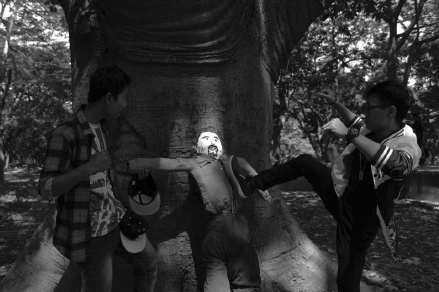
A group of migrant workers from Manipur, who work at a local restaurant, brought their boss to life. A native of Hubli, ‘Mr Vasant’ (Figure 1) embodied corporate greed, and his entry into Cubbon Park marked the start of a gentrification process, with restaurant chains, coffee shops and an increase in prices. He was also inherently suspicious of the ‘outsider’ and wanted to make the park a safe space for locals. Through conversations with the workers, stories of tensions between migrants and locals emerged, as they shared anecdotes of being discriminated against because of their accents, the way they look and the kind of food they eat.
|
|
|
Figure 1: Khadoos Manager. (Photo: Shikha Sreenivas) |
A
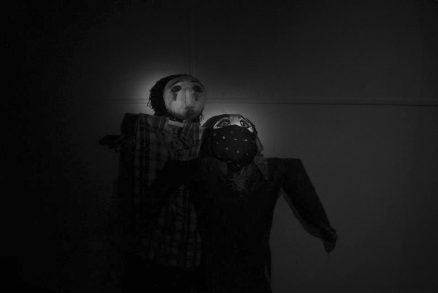
rshiya stood with her head bowed to one side, her burkha revealing a pair of terrified eyes. She was created by her best friend from school, who recollected the day she heard about her murder. Arshiya had developed a relationship with a boy from a neighbouring school and they used Cubbon Park as their hiding place, meeting away from the prying eyes of their families. She was spotted by a family member and when her parents were informed, her fate was sealed. The case never made it to the police and the parents were never arrested. (Figure 2)|
|
|
Figure 2: Lovers courting risk. (Photo: Shikha Sreenivas) |
T
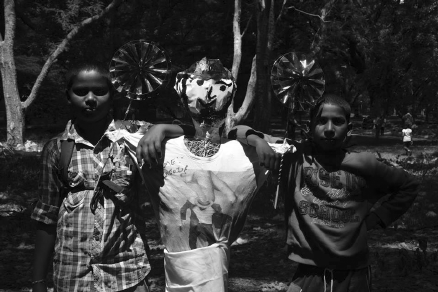
he park is more than just a space for leisure and recreation, the space it provides allows for the formation of unlikely friendships and communities. In one corner, a group of sex workers and hijras exercise ownership over the park. A day spent making scarecrows with them revealed an experience of the park marked by violence and exploitation at the hands of police and clients; but also of love, solidarity and desire that sustains their friendship. The park is home, providing them a sense of solace and laughter, as much as it is a site for daily humiliations, indignities and violence. A plan to rejuvenate the parks lakes might threaten the space they occupy, as a push toward ‘cleansing’ seeks to erase the heterogeneity of experience and ownership that currently exists within the park.Multiple claims of ownership, which fluidly adapt to changing climates of prohibition, are continuously exercised over the park. This is not to discount the increasing difficulty in occupying space in the park for particular groups of people, but an acknowledgement that power is never total, hegemony remains porous, and pockets of resistance continue to prevail. The scarecrow became a symbol of defiance and resilience, in staking stubborn claim to the park, by embodying experiences – a challenge to the diktat of ‘prohibited’ through an active and symbolic presence in the space. (Figure 3)
|
|
|
Figure 3: ‘Prohibited’ vendors continue to claim Cubbon Park as a space to earn a livelihood, their experience inscribed on the scarecrow they call Maraiah. (Photo: Prashant Parvataneni) |
Throughout the process, we were faced with our own sets of challenges in using a public space: Should the scarecrows be placed back in the park they emerged from, or should the stories travel? Is the intended audience only those who inhabit or visit the park, or do the experiences these figures embody speak to a universality that travels beyond the site of creation?
W
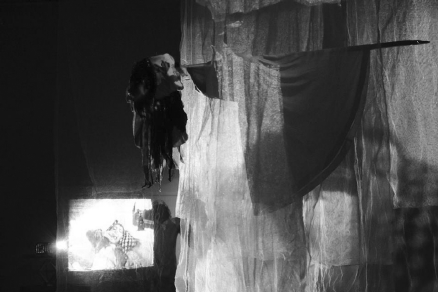
e have experimented with various options. At first, we placed the scarecrows in the park, demarcating a portion and creating our own exhibition space. The scarecrows were displayed with their stories attached to them. Skirting around the inquiries and threats from park authorities, we chose not to take permission for the exhibition. This was our act of resistance – to not feed into the culture of permissions/licenses/contracts that are beginning to shape the usage of the park and urban public space in general.In the second edition of the exercise we displayed the scarecrows in a gallery adjacent to the park, a government owned space that is currently at the risk of privatization. This gave us the opportunity to create a concentrated, immersive experience, within four walls. We played with the idea of viewing, rejecting the usual movement induced within a gallery. The scarecrows stood, lay, and were suspended, creating multiple navigational possibilities. Their stories lay scattered in various parts of the room, leaving a viewer the freedom to create their own narratives about the park. The idea was to simulate a microcosm of the park within four walls. (Figure 4)
|
|
|
Figure 4: Scarecrows and projection at Venkatappa Art Gallery. (Photo: Prashant Parvataneni) |
O
ur process was not without its own limitations. Do the scarecrows come across as fixed representations which are themselves part of the incriminated medium, that of image and representation? Are we fixing and limiting the image of the ‘other’ from our own possibly privileged vantage points? Once the thrill of the grotesque subsides, and the connection to the real becomes more visible, the image becomes one of the many categorical images ascribed to an individual.Creating work within and for a public space leaves it vulnerable to all kinds of interpretation, some of which may speak in ways counter to the intent of the artist. Case in point: we created a scarecrow that embodied the experience of being a woman in a public space, with its connotations of morality, risk, danger and surveillance. Whilst our intent was to question these assumptions, in a few cases the scarecrow itself was perceived as a warning, part of the usual messaging around women’s safety.
The question of representation looms large. How do we translate the experiences that we had, and that were shared with us, into a written form? How much liberty can we take with our own fictions as we rewrite somebody else’s story? What language do we use – our own preferred form of expression or a form that might relate more closely to the diverse publics in the park? Do we adopt a particular style of writing when we try to transcend class and speak in the voice of the ‘other’?
T
o conclude, our intention was to create images that are not easily digestible, not meant for a contemplative consumption, but which disturb and unsettle. In most cases, the scarecrows embodied experiences that would not feature in mainstream narratives around the park. The exercise illuminated the spectrum across which claims of ownership and attachment over a given space are made. Whilst the park continues to steadily transform, the resistance and subversion continues through acts of everyday resistance carried out by those who use the park, not just for escape or recreation, but for livelihood, solace, privacy and shelter.The stories that these instances of everyday resistance tell us are not grand narratives but small snippets. Art can act as an important way to understand these snippets of experiences, ideas, theories, and aspirations that are inscribed in a space. Unlike academic or statistical research, art opens up an affective window to look at space and multiply the ways of sensing the space itself. The act of making and creating reveals a different texture of the space. However, as artists and practitioners we need to be careful to not let our entitlement and conception of the space overpower its own materiality and lived experience. Art can reveal the constant contestations, acknowledge the resistances and confront the omissions in the narrative of a public space. Or it can remain as a facade and simulation built of empty signifiers that give a comfortable and digestible picture of the space. It can provoke us to listen to the space and find our own location in it, or it can turn it into a cocoon of pleasurable consumption.