Music is the weapon

back to issue

Chimurenga is a pan-African institution of art, culture and politics based out of Cape Town. It serves as a thriving platform for free ideas and political reflection by Africans about Africa. CNN described it as ‘Africa’s answer to The New Yorker’; the Financial Times said it will ‘change your view of Africa.’ Chimurenga publishes The Chronic, a quarterly gazette borne out of an urgent need to write the world differently, and runs PASS, the pan-African Space Station, a pop-up radio station and performance space – among various other print, Internet and event-based projects around the world.

Ntone Edjabe is the founder and editor of Chimurenga. He is a writer and theorist, and an actively working DJ, originally from Cameroon, now based in South Africa. He discusses the origins and future of Chimurenga through the multiple worlds of words, magazines and music.

Achal Prabhala is a writer based in Bangalore, and a fellow of the Shuttleworth Foundation. He writes frequently for Chimurenga, and has served as a contributing editor at the publication.


AP: Let’s start at the beginning, Ntone. When you picked the name Chimurenga, were you setting out to start a magazine, or the gloriously undisciplined organism it has become today?

NE: Well, initially, just a magazine of writing. That was the first manifestation of Chimurenga. This was way back in 2002, when we published our very first issue.


Was there something that sparked the effort? The excitement of doing something new? Or was it just the frustration of not seeing what you wanted to read in print?

It was a combination of all those things. I knew of people who were brilliant writers here in South Africa, but there was just no space for them to get their writing out. At the time, in 2002, the Jazz Festival in Cape Town was on, and I thought, let’s get together some new writing, let’s put together a collection. At the time, you had all these guys who were writing about music like it was entertainment, and I was pissed off about that. I had been having discussions my whole life about the political aspects of music. So I started collecting work from people like the poet Sandile Dikeni and others.

The idea was that I would go to the jazz festival and sell copies over the two days of the festival. I printed 1500 copies and sold pretty much every single copy by myself.

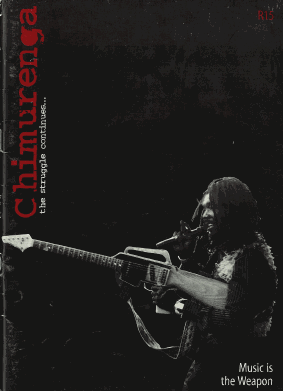
Our cover had Peter Tosh aiming his guitar at apartheid South Africa like an AK-47 [from a photograph taken at a concert he played in neighbouring Swaziland in 1983] and we titled the issue ‘Music is the Weapon’ as a response to this stuff. It was a collection of writing on music and politics, and how they come together quite naturally, and that’s why the name – that’s what Chimurenga means, that’s where it is: music and politics.

It wasn’t imagined as a magazine at all, but a collection of writing. At the time, I was already DJ-ing in clubs and on radio. I had a weekly show on Bush Radio which ran for 10 years. At the same time, I was writing, and my own journalistic work also explored exactly this theme: the connection between music and politics.


Music and politics are inextricably entwined in South Africa. Was it something about the country, specifically, that pushed you in this direction?

Of course. But there were people and publications who had pushed these limits before. My contributors had a history of exploring this connection. Publications like Staffrider during apartheid, people like Sandile Dikeni, Neville Alexander, Njabulo Ndebele – all of these people came from a lifetime of black political engagement, so you had writers who came from politics and they were dealing with the frustration of spaces like Staffrider disappearing when the new nation was being constructed. It was a uniquely South African situation. I can’t imagine Chimurenga coming together in another country at any other time.


In a sense, music is really the literary archive of South Africa, no?

Absolutely. And for me, being in South Africa at the time made me think very seriously about Fela Kuti. About my time studying and living in Nigeria. I had been trying to find a way to articulate my experience, and South Africa gave me a way to do it. You know, to write about Fela Kuti as something beyond an entertainer. The thing is, in Cameroon, music is about seduction even when it deals with social issues. It never confronts, that’s a post-Fela attitude. And then I found that in South Africa this was the norm, but more broadly southern Africa – there’s the same tradition in Zimbabwe for instance, which is where we got the name Chimurenga, referring to a popular music that got its name through a people’s struggle.


Is there a way to articulate the literary value of music in a country with a strong history of literature like Nigeria?

That’s very interesting, because aside from the Achebes and Soyinkas, aside from the canon of Nigerian literature in English, I’ve started to think of Fela as the alternate Lagos intellectual. If you start putting the language of Fela together, then you have this great Nigerian novelist, the only difference being that his form is not seen as literary. Ironically it is the music of Fela that drew me to Nigerian popular writing, to people like Cyprian Ekwensi (whose characters turned up in the lyrics of many highlife songs through the sixties) or Sozaboy, Ken Saro-Wiwa’s novel in ‘rotten English’. Maybe this will change with Bob Dylan winning the Nobel Prize. Whereas in South Africa, as far back as the mid-seventies the two most important poets from the black consciousness movement, Wally Serote and Mafika Gwala, published their epic works in response to popular songs by Winston Mankunku (Yakhal’inkomo) and Miriam Makeba (Jol’inkomo) respectively. And these are not exceptions. Here, music is very much seen as the body of knowledge.
 

The closest parallel I can think of in India, in terms of something that’s smart, subversive and popular all at once, is street theatre. In the present moment, a group like the FOKN Bois, the great Ghanaian musical duo, would seem like the perfect inheritors of that Fela tradition, no?

Exactly. At a time when economists are speaking of ‘Africa Rising’ and a suit-and-tie renaissance, they’re going back to that troubadour approach, with shock tactics. While you struggle to find writers who can spell Boko Haram in print, they shoot videos in northern Nigeria, in Boko Haram territory, about ‘Sexing Islamic Girls’. That’s some Fela-sized balls right there. With very different gestures, of course: they can’t quite call their music revolutionary, they have to name their form something else that’s more attractive to this new age of Twitter and Facebook, but they’re right there with Fela, and their strategies are similar.

Coming back to South Africa, the musicians, especially jazz musicians, they really thought of themselves as intellectuals and political activists. When you think of the Drum generation in South Africa, you had all these black people who were artistically ambitious, and everything was mediated by jazz. When Todd Matshikiza wrote his great opera in the 1950s, the first jazz opera ever, it was an act of serious ambition; serious intellectual ambition.

The first issue we published was an attempt to reassemble this kind of space. When Njabulo Ndebele wrote that essay on Brenda Fassie, in relation to the culture of ungovernability – which in the 1980s was rife in this country – no one had ever written about Brenda in that manner before. And Neville Alexander sent in an essay about the Marxist aspects of Rastafarianism, and I thought – what the shit! That’s the kind of stuff I got really excited about.


In so many countries there is a sharp distinction between high and low culture. There’s all that self-conscious writing about pop culture in the academy, of course, but it still seems amazing that one of South Africa’s foremost intellectuals, the then Vice-Chancellor of the University of Cape Town, would write about Brenda – wild, wayward Brenda – as a fan, as a participant.

Now you see, there was a tradition of such writing in this country that even I wasn’t aware of. But by 2002 those spaces had disappeared. What happened is this. I heard on the grapevine that Njabulo Ndebele has been talking about Brenda, and had all these interesting things to say. So I wrote to him telling him that we were putting together a collection of writing on music and politics, and he sent his essay to us, and I was fucking blown away.

The irony is that even an intellectual as influential as Njabulo Ndebele did not have a space to write about Brenda in the way he wanted in 2002.


Taking stock for a moment, you’ve produced dozens of magazines, you’re producing a newspaper – an actual newspaper – every quarter, you’ve won dozens of awards including the Principal Prince Claus Award in 2011, you run a major cultural event somewhere in the world practically every month. Where do you go from here?

For me, everything comes together through sound and music. During the process of working on Chimurenga and becoming more aware of small magazines that existed on the continent, magazines like Transition, Black Orpheus and so forth, I used to think that this was our lineage. And yes, we connect ourselves to these older magazines. But I started moving further and further away from the ‘small magazine’ as a project – and I moved towards the immediacy of sound, as a way to connect writing with the urgency and fluidity of everyday life on the continent.

This shift came out of discussions with people like the writer and performance poet Lesego Rampolokeng. I remember a conversation we had, where I was constantly referring to Staffrider, saying we were on a similar journey. And Lesego, who was an integral part of that history, who had actually worked with Staffrider, said no, you are doing something totally different. It got me wondering, and I began to realize we had moved away from the magazine as a club, like the Mbari Club in mid-sixties Ibadan or Makerere University for the Transition writers. We had been trying to open the space up.

We’d produce an issue and then have a thing we called the Chimurenga Sessions, where we brought people together to translate the ideas behind the issue into a performance – which sent our work into a much bigger world, into many other conversations. I think this is what Lesego was referring to. Small magazines look at editing as a tool of control. We don’t edit so much, we say go back and write it again. Come again, as they say in Jamaican dancehall culture. In terms of writing and writing culture, we wanted to loosen control, and the events played a key role – they became a kind of editing process of their own.


Nothing in Chimurenga is easy. Not the graphic art, not the prose, nothing. You need to engage with it very closely to get it. Is there a paradox here? You reject the exclusive writers’ club, and yet you seem to have a perverse love of complexity.

The popular is sophisticated. It’s as simple as that for me. What we consider popular, I consider complex and really difficult to capture in writing. I think that to seriously engage with popular culture – outside this academic bullshit of cultural studies – you just can’t do it without complexity. The model for black popular writing in South Africa remains the Drum generation or to some degree the plays of Gibson Kente – and these cats embraced opacity.


What you’re not doing is to dumb it down. In fact, you’re doing the opposite. Is that a hurdle? I mean in terms of attracting people outside a small, strange group of folks who might think of it as sexy. Also, your complexity also seems like its own peculiar thing. It’s anti-theory. Or am I just projecting my own prejudice against turgid academic writing?

I think our lives are far more complicated than the most complex text. You need to be smart to stay alive here, you need to be super-fucking smart.

Now on theory, for instance, one of the first things we published was a talk that Mahmood Mamdani gave at the University of Cape Town in 1999. He had a notoriously difficult tenure there. I’ve read Citizen and Subject, his most famous book, but you know, that talk, that was what we wanted to publish – where he was angry, and free.

Instead of becoming a dumping ground for academics with ideas, we wanted to become a space where we could really push language, and I think this is what magazines should do, to push language to become something that speaks to our concerns and dreams and bring them to a public space.


How does Chimurenga function? I’m interested in how you finance yourselves. Is it through sales of books and tickets for events, or grants from institutions? What’s the mix? And what would you like it to be?

Well, whoever is giving us money is buying something. They’re not necessarily supporting the arts, or black writers, or blah blah blah. I think we need to move away from the grant system. We’re now in a position where we can say, look, we have a radio station popping up in Amsterdam for a week, and if you want to be there, then you can buy in. The difference between institutions and individual readers who buy into what we do is that we get the former to pay more.


Getting back to South Africa for a moment, do you think Chimurenga has got its due in the country? I remember seeing all that international attention for you some years ago, and there wasn’t much coverage within the country. I know that a small group of black journalists celebrate your work regularly, but outside of that, does white South African media care about what you do?

Come on, man, you know what the answer is! Since we’re not prepared to play the interpreters of black culture, white South Africa doesn’t know what to do with us. On the other hand, our pan-African approach is suspect to many black South Africans. Many still view other African countries and their cultures as backwards. That’s always been part of the tension – we have never been South African enough. I’m as interested, for instance, in what is going on in the Democratic Republic of Congo. Not in a foreign correspondent kind of way, but in listening to people from the DRC describe what’s going on there right now.

But you know, being in South Africa in the 1990s was an experience. Everything was up for question. Sex, the size of your bed, the colour of your hair, everything was up for question. In my mind, there is no doubt that a kind of relentless questioning in me was a product of that experience. I’m refusing to give it up. I’m not buying into this new parochial self-confident uncritical hyper-South Africanism.


Where do you find your contributors now? Do people write in with ideas that go on to become pieces or are you still commissioning the majority of what you publish?

A bit of both. After the ‘Music is the Weapon’ issue, we were flooded with responses, and that’s how the second issue came about; almost entirely out of responses. Binyavanga Wainaina read that first issue, and wrote an unbelievable essay on his experiences of living in South Africa, and returning to Kenya – and I immediately thought, we have to publish it, we have to build something around it, and that was how we made our second issue. That’s still the approach.


What’s the one project you’ve been most disappointed by?

We just keep at it, man. If something doesn’t work, we’ll ground it, then bring it up again, repackage it, and give it another go. Can’t afford to be disappointed.


And the one project that most surprised you in a good way?

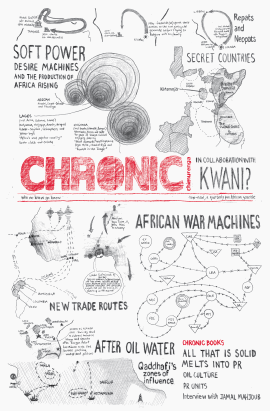
We had a Chronic issue on cartography out recently. Of course it wasn’t really about making maps, and in fact was completely anti-cartography. But we had all these professional cartographers writing to us – seriously – who loved it and wanted to collaborate with us. It was definitely very surprising.


I remember having a conversation with you about how much longer you would do this. You said you saw yourself moving into a space which is more about facilitating conversations. A new kind of sound, for a new kind of literary archive.

I think that’s exactly where we are going. We’re working in that mode where, for some of our larger writing projects, we start with conversations. We bring writers together, and that becomes a conversation, which happens on PASS, and then we finally get to the writing. In the future, my hope is that the Chronic becomes a vehicle by which everything that has gone on before it, all the conversations, all the events, have a reflection in print. We are definitely trying to move away from that old top-down, commissioned, edited thing.


I think the most awesome thing about Chimurenga is that it puts writing in its proper place. It seems like writing will always be a part of the Chimurenga project, but it’s not going to be the goal of your literary adventure. What a brilliant way to chart the future of a twenty-first century magazine.

top