Recycling end of life vehicles
N.S. MOHAN RAM
OUR perspective of the world, understanding of problems and approaches to solving them, are inevitably coloured by our background. Having worked as an engineer for nearly six decades, I naturally tend to perceive issues from an engineer’s perspective.
For nearly five decades, my economic model was linear: using resources, materials and energy, applying engineering science to manufacture products and services for consumers, who would discard them at the end of their life as ‘waste’. The impact of the manufacturing system on environment and nature was of little concern. This hands-offs attitude is characteristic of most in the engineering profession.
I have now started looking at the larger picture of the impact of technology on society, depleting resources and degradation of nature. Many engineers are beginning to devote attention to the challenge of producing goods and services in a sustainable manner, with concern for the environment.
The problems confronting India’s fast growing automobile industry in disposing of vehicles which have reached the end of their life, and the role of recycling in achieving it in an economically viable and environmentally sustainable manner, is the theme of this article. The automobile industry is a sub-set (albeit a major one) of manufacturing in India. Its success or failure in ensuring sustainability will majorly impact and influence other industries.
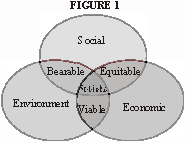
The United Nations defined sustainability, a part of the concept of sustainable development: ‘sustainable development is development that meets the needs of the present without compromising the ability of future generations to meet their own needs.’ Sustainability rests on three inter-linked pillars – society, environment and economics. The intercept of the three creates a socially acceptable, economically feasible and environmentally tolerable paradigm of sustainable development.
The description ‘environmentally tolerable’, concedes that ‘tolerable’ environmental degradation is the price to be paid for sustained economic development and improvement in the standard of living of people, especially in developing nations.
|
|
Is a truly circular economy feasible? The honest answer is a clear no. There is nothing one can do to fully return natural systems to their original state. The folly of mankind was in an acceleration of the adaptive change of natural systems by a mindless application of technology. The best we can now do is to mitigate the situation and reduce the damage.
The second law of thermodynamics, a basic law of physics, states that the total entropy of an isolated system always increases over time. This increase is a measure of the irreversibility of natural processes, and the asymmetry between future and past. Without an external input of energy, there is no way one can return to the original state of a system. (The ultimate external energy machine for our earth is the sun!) A truly circular economy in which nature returns to its original state is a utopian dream; it is physically impossible.
D
eveloping nations and the third world are striving to improve the quality of life and standard of life of their citizens. This quest is fraught with severe and adverse consequences for the global environment if they do not adopt sustainable practices. Their share of the world economy is showing an increasing trend. Global actions to mitigate environmental impact of economic growth will necessarily have to factor in their legitimate aspirations.Advanced nations cannot expect the developing world to slam the brakes on their quest for a better quality of life for their citizens on grounds of sustainability. The world has to find a way of reconciling the needs of nations for improving their economies while working towards sustainability.
Developed nations passed through stages of urbanization, deforestation, growth of extractive industries like mining and mechanization before reaching their current stage of development. If they did not mine in their own countries, they accessed metals and energy from their colonies or through commerce. For instance, a blanket ban on mining of coal, iron ore or strategic minerals is not a feasible option in India. Our per capita consumption of steel, aluminium and energy is very low and has to increase if we are to improve the living standards of our people. To achieve this India has to make trade-offs and hard choices. The bottom line is that production of any engineered product or service consumes energy and natural resources. It is not physically possible to make anything which uses up zero resources and is energy neutral. The best one can hope for is to minimize resource use and reduce waste.
Recycling of engineered products yields significant gains. Recycling conserves materials, reduces mining, reduces consumption of energy and results in large reduction in pollution, especially release of greenhouse gases. It can only reduce and not eliminate consumption of energy and resources.
T
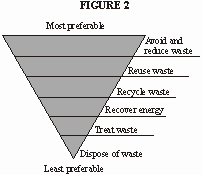
he hierarchy of waste (Fig. 2) has three components – Avoidance: action taken to reduce amount of waste generated by households, industry and government; Resource recovery: reuse, recycling, reprocessing and energy recovery efficiently; and Disposal: in an environmentally responsible manner.The hierarchy of recycling consists of the so-called three ‘R’s stages (i) Reuse, (ii) Recycle, and (iii) Recover energy.
Metals are recovered from end-of-life products by the physical process of melting as opposed to benefaction of metals from ores which is the chemical process of smelting. Melting requires less consumption of energy, uses less natural resources and causes less environmental damage. The most resource and energy efficient approach is to reuse a part or component. If it is not feasible, the part can be recycled to separate basic materials like metals, plastics, rubber etc. which can be further processed and used as feedstock for manufacture. Whatever is left over, to the extent possible, can be converted to provide energy. The residue left over is mostly dumped in refills.
|
Savings by Recovering Metal by Recycling Versus Mining Virgin Metal from Ores |
||
|
Metals |
CO2 Reduction |
Energy Savings |
|
Aluminum |
> 92% |
> 93% |
|
Copper |
> 65 % |
> 65 % |
|
Iron/Steel |
> 58 % |
> 74 % |
|
Zinc |
> 76 % |
> 60 % |
|
Lead |
> 99 % |
> 95 % |
A proper regime of recycling of engineered day-to-day products like cars, bridges, aircraft, ships, refrigerators, washing machines, microwave ovens etc. in an environmentally friendly manner can greatly reduce energy consumption and release of greenhouse gases.
D
esigners are increasingly using engineered plastics to save weight and reduce costs. However, most of these long chain carbon molecule polymer plastics are virtually indestructible. There is an urgent need for research to develop biodegradable plastics. Rubber (used extensively in tires of cars and aircraft) also poses similar problems, especially development of non-toxic processes for recovery of useful components.
|
Hierarchy of Waste |
|
|
R
ecycling of means of transport, such as ships, aircraft and automobiles is easier than dismantling and recycling of static structures like power plants, bridges, and fixed offshore platforms. In nuclear power plants there is the added problem of disposal of radioactive waste. Ships which have reached their end of useful life are beached or dry docked to recover useful materials, mainly metals and steel and equipment like generators. Aircraft are increasingly being recycled in special facilities like the one at Tulsa, Oklahoma in USA. (http://magazin. lufthansa. com/de/en/aviation-en/aircraft-recycling-new-life-in-the-desert/)By far the most ubiquitous transport vehicles are automobiles; two wheelers, three wheelers, cars and commercial vehicles. They consume huge resources at production stage and large quantities of fossil fuels and other depleting resources during their operating lives. They have great potential for recycling and saving energy and raw materials.
Automobile populations are growing. The world vehicle population topped one million in 2012 (http://wardsauto.com/news-analysis/world-vehicle-population-tops-1-billion-units). The fastest growth is occurring in middle income countries like China and India. The growth is driven by higher prosperity levels, growing populations and more intense economic activity. Penetration levels of vehicles is low in developing nations as opposed to developed nations where vehicle populations are saturated.
The automobile industry was moribund in India till the early eighties. The advent of Maruti Udyog and Japanese bike makers in partnership with Indian partners, gave a fillip to the industry in the eighties. The industry took off after being delicensed in 1991. Today India has a vibrant automotive industry, growing at a frenetic pace. It accounts for close to 7% of the national GDP and nearly 40% of the manufacturing GDP. It is by any standards a success story.
I
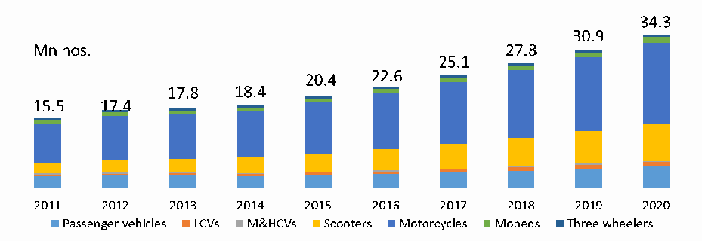
ndia has added over 174 million vehicles over the last twenty years (128 million, i.e. 73%, having been added in the last 10 years), with an estimated vehicle population in excess of 200 million. Over 75% of the population comprises of two wheelers. A growing middle class, demographic changes, increasing disposable incomes, higher aspirations of consumers and easy financing are creating a huge demand for four wheelers. The manufacturers are aggressively aiding this process through introduction of new models, low cost cars (to replace two wheelers), innovative financing models and buy back options, etc.|
FIGURE 3 Total Automobile Sales Forecasts |
|
|
India is a two wheeler nation. More than 75% of the vehicles on the road are two wheelers. Cars are still beyond the reach of the vast majority. Poor public transport infrastructure, low/affordably priced two wheelers, higher mileage levels without sacrificing power and easy manoeuvrability have helped drive sales of two wheelers.
Three wheelers comprise both passenger and transport vehicles. Passenger carriers constitute 80% of the three wheeler market and have witnessed a rising demand thanks to their being a cheap and convenient public conveyance. New permits and a rise in CNG filling infrastructure have further buoyed demand for three wheelers. Given this background, vehicle sales are expected to touch 35 million by 2020 (Feedback consultancy’s estimates of 2014-2015 sales at 23 million were higher than projected!)
F
rom market studies one can obtain information on the average life of different classes of vehicles before scrapping and estimate future scrapping volumes from past production. The figures will be approximate but are good enough for planning purposes.
|
Vehicle category |
ELV age (years) |
|
Passenger vehicles |
18 |
|
Commercial vehicles |
|
|
LCVs |
12 |
|
M & HCVs |
10 |
|
Two wheelers |
|
|
Scooters |
12 |
|
Bikes |
12 |
|
Mopeds |
12 |
|
Three wheelers |
15 |
It is estimated that 8.7 million vehicles will reach their end of life by 2020 and 26.6 million by 2030 based on the current estimate of lifespan of vehicles.
Automobiles are among the most recyclable of products, consisting of metals over 75% and also recyclable plastics and rubber. Europe and Japan using modern methods have achieved useful recovery of materials and energy in excess of 95% by weight of a car, minimizing the residues going into refills to less than 5%.
|
TABLE 1 |
||||||||||
|
Year |
Passenger vehicles |
Total commercial vehicles |
LCV |
M & HCV |
Total two wheelers |
Scooters |
Bikes |
Mopeds |
Three wheelers |
Total vehicles |
|
2020 |
0.68 |
0.46 |
0.22 |
0.24 |
7.23 |
1.05 |
5.77 |
0.41 |
0.31 |
8.68 |
|
2021 |
0.71 |
0.52 |
0.20 |
0.32 |
7.41 |
1.15 |
5.83 |
0.43 |
0.53 |
9.17 |
|
2022 |
0.90 |
0.64 |
0.29 |
0.35 |
9.37 |
1.46 |
7.34 |
0.56 |
0.51 |
11.42 |
|
2023 |
1.06 |
0.63 |
0.36 |
0.27 |
11.77 |
2.06 |
9.01 |
0.70 |
0.54 |
14.00 |
|
2024 |
1.14 |
0.66 |
0.46 |
0.20 |
13.41 |
2.56 |
10.07 |
0.78 |
0.48 |
15.69 |
|
2025 |
1.38 |
0.73 |
0.52 |
0.21 |
13.80 |
2.92 |
10.09 |
0.79 |
0.44 |
16.35 |
|
2026 |
1.55 |
0.64 |
0.43 |
0.21 |
14.81 |
3.60 |
10.48 |
0.72 |
0.53 |
17.53 |
|
2027 |
1.55 |
0.72 |
0.50 |
0.21 |
16.42 |
4.15 |
11.49 |
0.79 |
0.56 |
19.25 |
|
2028 |
1.95 |
0.80 |
0.58 |
0.22 |
18.23 |
4.77 |
12.60 |
0.86 |
0.59 |
21.57 |
|
2029 |
2.50 |
0.90 |
0.67 |
0.22 |
20.24 |
5.49 |
13.82 |
0.93 |
0.62 |
24.26 |
|
2030 |
2.63 |
1.01 |
0.78 |
0.23 |
22.48 |
6.31 |
15.15 |
1.02 |
0.51 |
26.63 |
Broad brush estimates of material and energy savings and environmental impact can be made on the basis of the weight of the category of vehicle. A thumb rule for car equivalents is:
8 motorcycles = 1 car.
3 three wheelers = 1 car.
2 cars = 1 LCV.
5 cars = I HCV.
Using these ratios, potential gains from effective recycling of ELVs by 2020 is estimated to be: Material recovery 2.1 million tons of steel, 200,000 tons aluminum; Forex saving close to $1 billion; Energy savings 2.95 million mwh from steel and 4.5 million mwh from aluminum. (One ton of recycled steel conserves 1.5 tons of iron ore, 0.6 tons of coke, 0.25 tons limestone; reduces slag by 0.3 tons and 2.5-3.5 tons of furnace gas containing 50 kgs of dust.) Effective recycling of one typical car saves 1.6 tons of greenhouse gases in material recoveries. The potential for savings by 2020 is in excess of five million tons. Due to an increase in ELV population @ about 10% year, the gains will also increase by 10^% every year, more than trebling by 2030.
D
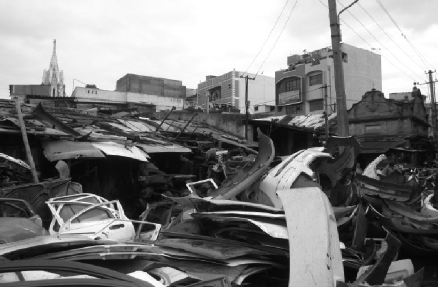
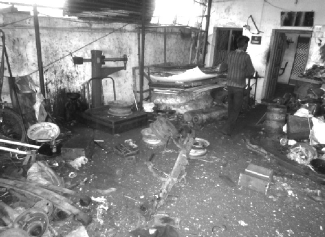
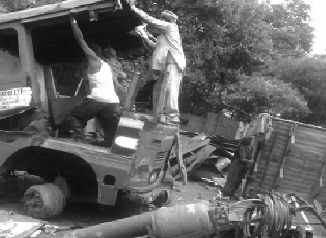
espite an increase in ELVs, automobiles are recycled in India by the informal sector, which employs over 100,000 people all over the country. These units are located in crowded residential areas of cities and use crude methods resulting in poor hygiene, unsafe practices, and pollution of air and ground water and low yields. They need to be relocated away from residential areas. The labour has to be trained in modern techniques of recycling.
|
|
|
Recycling area at Shivaji Nagar, Bangalore. |
NATRiP under the Ministry of Heavy Industry, in cooperation with the automobile industry, has set up a demonstration centre near Chennai to develop improved methods to suit Indian conditions, recycling of two wheelers and training and upgrading labour in the informal sector. There is an urgent need to create and nurture an economically viable and environmentally friendly recycling industry using modern methods and techniques. The informal sector has to be relocated away from crowded areas in specially designated recycling parks with better hygiene.
Deteriorating air conditions in the cities are alarming with Delhi claiming the dubious distinction of being the most polluted metropolis in the world, overtaking Beijing. About a third of the atmospheric pollution is attributable to automobile exhaust. Many older vehicles built before emission norms were tightened are running on our roads. The courts have become active in regulating vehicles. The National Green Tribunal has banned older vehicles from Delhi and restricted diesel vehicles. The Ministry of Transport is also working out a proposal for fleet modernization and retiring older polluting stock.
This rare confluence of judicial activism and executive will promises action soon in banning older vehicles on the road. But the retired vehicles have to be recycled efficiently to get maximum benefit to society. There is an urgent need to create a modern recycling infrastructure and upgrading the informal sector.
A
major constraint in creating a recycling infrastructure is the availability and high cost of land. Recycling units require hard paved impervious floor, water purification facilities, IT support and specialized equipment for neutralizing air bags and seat restraint systems which contain explosives. A practical approach is for state governments to acquire land away from the cities and provide common expensive facilities and relocate existing units from crowded areas. The area released can be converted into green parkland, providing much needed lung space for our cities. The park may also be provided with a large baling press which can be shared between the units.
|
|
|
|
A recycling shop in Madurai. |
Crude methods of breaking up a truck. |
Relocation of units will inevitably be opposed by current operators supported by interested political elements and NGOs. They cannot be allowed to operate in residential areas and have to move. Similar problems were experienced when relocating other utilities like the vegetable market in Chennai which was moved to a more spacious market twenty kilometres away from the city centre.
The numbers of refrigerators, washing machines, microwave ovens and other domestic appliances coming for scrapping has also increased. Many of the technologies and techniques used for scrapping cars are applicable to these goods also. In some units abroad, white goods are scrapped along with automobiles.
A
fter dismantling, the steel hulks of cars are shredded abroad. India is yet to get shredders. It is only a matter of time shredders become necessary and economic. Ferrous and non-ferrous elements are separated by magnetic and eddy current separators. Earlier the 15 to 20% residue after shredding and separation went into landfills. In Europe and Japan residue has been mandated to be less than 5^% and post-shredding techniques have been implemented. The US with abundant land still uses landfills as the more economic option. Land usage in India is intense. Landfills for municipal waste are running short. It is therefore essential that India adopts post-shredding technologies from the beginning. A recent study revealed that a similar situation prevailed in many developing countries, such as Indonesia, Malaysia, Vietnam, Laos, and Philippines etc. India’s efforts at solving the problem can serve as a blueprint to other developing nations.
I
n conclusion, I would recommend the following: (i) The creation of a viable regime for recycling of ELVs should be taken up as a priority task by the central government along with the automobile industry in mission mode. (ii) Existing informal sector units operating in residential areas need to be relocated to recycling parks and upgraded and trained in modern methods. (iii) Tax breaks and duty concessions should be given for new units entering the business. (iv) Land should be made available for recycling parks at concessional rates. (v) Inspection and maintenance regime has to be strengthened; vehicles which are unfit should be scrapped. (vi) Recycling of end of life vehicles should form part of the curricula of automobile engineering courses. (vii) Centres of excellence should be set up to research efficient recycling of rubber, plastics and post shredder treatment. (viii) Recycling parks should be set up away from cities by governments with shared facilities for new and upgraded units.