Technology, city planning and job creation
R.K. MISRA
TEN years of poor governance and corruption by the UPA, combined with a deft electoral strategy and carefully curated brand Modi, propelled the BJP to an ‘absolute majority’ in Parliament, a rare achievement after a long gap of three decades. The pre-election euphoria and electoral promises created huge expectations among the poor, middle class and business community alike. So when a larger than life Narendra Modi promised acchhe din, a significant majority actually believed it.
Recent surveys indicate that the lack of job creation is perceived to be one of the biggest failures of this government. Unless addressed urgently, unemployed youth in a young nation like ours will become an electoral liability in 2019. Truly, employment generation is the biggest challenge facing India, with more than 50% of her people below 25 years of age. With 12 million educated youth joining the job market every year and given the huge backlog of educated unemployed youth, India needs to generate at least 20 millions jobs every year for the next 10 years. But where and how will these jobs be created?
Megacities, which by present definition exceed 10 million inhabitants, have played a significant role in the economic growth story of nations. More than 12% of global city dwellers, i.e. more than 470 mn people, lived in the 29 megacities that existed in 2015, of which Tokyo (38 mn), Delhi (25.7 mn) and Shanghai (23.7 mn) were the largest. Delhi is projected to add another 10 mn inhabitants in the next 15 years. This is in contrast with the megacities in Japan, US and Europe that are growing at a snail’s pace. Indian megacities, Delhi and Mumbai have a proportion of children – 25% and 22% respectively – that exceeds the share in the Chinese megacity population, and over the next couple of decades will have to overcome huge challenges in respect of creating employment for this ‘demographic dividend.’
Notably, megacities as a category can be misleading, as there are three different phases each of them go through. While some cities, such as Tokyo, New York, London and Paris, are in the high maturity phase, most Indian megacities are currently only transitioning from low to medium maturity. Beset by problems such as extreme poverty, inadequate housing, transport congestion, chronic air and water pollution and consequential poor health outcomes, low education and skills, and high disaster risk, they have a long way to go before reaching the high maturity phase.
At the same time, megacities that have already attained high maturity present an aspirational goal for other megacities to live up to. Their economies are probably bigger than most other countries. New York generates $1.4 trillion in total economic output and London $836 bn.
1 The 20 megacities identified by the McKinsey Global Initiative as part of their emerging 440 city cluster are estimated to generate $5.8 trillion of GDP growth by 2025, a compound annual growth of 7.6% – almost double the growth rate expected for the global economy as a whole.2Our urban population, currently at 31%, contributes over 60% to India’s GDP, and is projected to contribute about 75% in the next 15 years.
3 In 2012, India had 54 metropolitan cities which together with their hinterlands (65 districts) accounted for 40% of GDP, and 45% of consuming class households. The projection is that this will grow to 69 metropolitan cities in 2025, accounting for 54% of India’s incremental GDP from 2012 to 2025, and 50% of India’s total income in the terminal year, thus matching the contribution of India’s eight ‘high performing’ states.4 Hence, investing in Indian cities has sound economic rationale as it will lead to enhanced economic activity resulting in large-scale employment generation, a much desired socio-economic outcome in a young nation where a majority of the youth is either unemployed or underemployed.
T
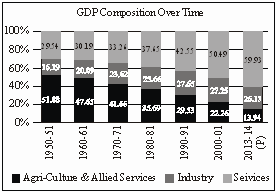
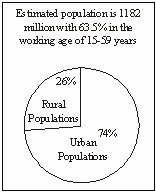
he share of agriculture and allied services, the primary source of livelihood in rural India, in our GDP has shrunk to around 15% even as it continues to engage around 74% of our working age population. This has led to subsistence living and distress in rural India, given that average landholding in our country is less than one acre. Rural India cannot provide a sustainable livelihood to India’s youth. An average urban job has approximately 1.9 times the productivity of an average rural job in the manufacturing or industrial sector, and the corresponding multiple is about 1.7 times in the services sector.4 Such a wide productivity differential is structural in nature and is expected to continue.
M
igration to cities is, therefore, inevitable and we must focus on making our cities economic growth engines that provide employment to the youth. Unfortunately, a massive increase in the urban population in India has not witnessed a parallel scale of urbanization commensurate to this growth. Between 1951 and 2011, while the urban population increased sixfold, the level of urbanization rose only from 17% to 31%. Further, the changing pattern of urbanization during 2001-2011, when the urban growth rate picked up and the level of urbanization increased from 27.7% to 31.1%, was driven more by rural-urban reclassification of settlements than by rural to urban migration.6|
|
|
There is thus an urgent need for our cities to better handle large-scale urbanization and socio-economic complexity, improve efficiency of service delivery, be resilient to economic and natural calamities and improve the quality of life of their denizens. We have to ensure that the investment in our mega cities and resultant economic and industrial activity leads to large-scale employment generation with a better quality of life for city dwellers, all of this being achieved through sustainable means.
E
ight metro cities with a population of more than 50 lakh – Delhi (NCR), Mumbai, Bangalore, Chennai, Kolkata, Hyderabad, Pune and Ahmedabad – are responsible for a disproportionate share of tax revenue and net job addition to India’s organized labour market. Even if these eight metro cities get selected in the Smart City Mission, given the meagre amount available to each city under this scheme of just Rs 2,000 crore over five years (500 crore from the Centre, 500 crore from the state and 1,000 crore from the private sector), at best only a tiny area of these metro cities may get a superficial facelift without any substantial improvement in their creaking infrastructure or the quality of life of its residents. Instead, city development ought to be reimagined, with special emphasis on the eight megacities mentioned here.Notwithstanding the huge investment required to make these mega-cities ‘smart’, they should be able to attract private sector investment due to enhanced economic activity and the ability of city dwellers to pay user charges for better services. Every rupee invested in these cities will lead to disproportionate economic returns due to increased productivity and economic efficiency gains. Hence, investment in these cities makes good economic sense.
F
or better planning one needs to further categorize these eight metro cities into those with a population exceeding one crore and below one crore. Mumbai, Delhi, Bangalore and Hyderabad will be in first category whereas the remaining four metro cities will fall in the second. The category-1 cities will require infrastructure investment in the range of Rs 120,000 crore ($20 billion) each over the next eight years (2017-2025), whereas the remaining four category-2 cities will need around Rs 60,000 crore ($10 billion) each. These are fairly conservative estimates based on the long-term infrastructure development plans made by these cities themselves. The central government should formulate Mega City Mission-2025 guidelines and offer to provide 50% of the proposed investment, whereas 25% should be provided by the respective state governments and the remaining 25% raised by the municipal government by way of levies, borrowing, municipal bonds or through the PPP model.Given the centrality of these cities in the economy of their respective states, state governments ought to invest in these cities to ensure their continued revenue growth and economic viability. Bangalore, for example, accounts for 60% of Karnataka’s GDP and 70% of its tax revenue. Similar is the case for Delhi, Mumbai and Hyderabad within their respective states. The economic vibrancy and growth potential of these cities will make it easy for the state and cities to mobilize the required financial resources. The central government must use this opportunity to nudge the state and city governments to implement requisite governance reforms and citizen centric delivery systems. Given the high economic growth potential and ability of their citizens to pay for better services, these cities are best suited to borrow a portion of their infrastructure investment needs from the market.
T
here is tremendous confusion about what is meant by a smart city or, more specifically an Indian smart city. There is a misconception that smart cities are all about IT, big data analytics, high-tech gadgets, free WiFi, and CCTV cameras with routers and cables hanging from the trees and electric poles. While all of this technological deployment is needed, we should first get the basic infrastructure in place for these systems and technologies to make efficient use of the available infrastructure. No amount of big data analytics will help streamline traffic flows on a potholed road with dysfunctional traffic signals. In this regard, four key infrastructure targets have to be at the heart of the proposed Mega City Mission-2025, and technology will play an important role in accomplishing these targets.1. Mobility Management – traffic and transport. (Target – 45 minutes maximum commute time within the city.) The biggest challenge of Indian cities is the chaotic traffic due to inadequate mobility infrastructure. In Bangalore, the IT industry alone loses $6 billion annually in productivity due to traffic related delays.
The same is true of each of the metro cities. Our focus should be on creating efficient public transport with an emphasis on Mass Rapid Transit Systems (metros, light rail transit, bus priority corridors, bus rapid transit etc.) because industrialized cities need reliable, efficient and affordable public transport for commute. Elevated road corridors should be built for intra-city vehicular movement so that surface roads can be decongested by letting traffic pass through on elevated roads. The mobility planning must be outcome driven and not project centric, with a defined service level – for all metro cities, 45 minutes should be the maximum time taken to reach any point in the city using public transport or a private vehicle, as is defined in the current smart city guidelines. Global investors will be happy to invest in these mobility infrastructure projects as there is revenue earning potential through user charges by way of ticketing and tolls.
2. Solid waste management – garbage and debris. (Target – 90% of solid waste must be reduced, reused and recycled.) Our cities are among the dirtiest in the world. We still process less than 20% of our solid waste (garbage/debris). Most of our garbage ends up in landfills and we are running out of space. This is the most unscientific method of disposing solid waste. We must adopt waste to energy protocols for solid waste management and make it mandatory for all our metro cities as part of the mega smart city plans. Japan, Germany and all other developed nations recycle their garbage and debris with zero emission and no pollution. This is achieved by burning it at very high temperature with very low oxygen.
H
ere again we should plan based on the specific outcomes with definite service levels, setting a target of 90% of reduce, reuse and recycle of solid waste. 10% of the waste like hospital waste, radioactive and electronic waste will require specialized handling.3. Drinking water and sanitation management. (Target – 100% sewage treatment and 75% reuse for Industries/parks.) Among our cities, metro cities are the biggest polluters with the large proportion of this pollution coming from untreated sewage. Our metro cities treat only 30-50% of total sewage generated by the city. Bharat cannot become swachh unless we treat 100% of our sewage, especially in our eight metro cities which accounts for 42% of total sewage entering our rivers and lakes. 80% of our drinking water gets converted to sewage, but we let this waste flow untreated in the rivers. Singapore, Shanghai, London and Tokyo and other major global cities treat almost 100% of their sewage water and reuse 60-80% of treated water for industrial use and watering the parks.
M
any of our metro cities like Bangalore, Pune and Hyderabad are endowed with natural and man-made lakes and reservoirs which supplied drinking water to the city until recently. Today these lakes have become sewage ponds. We need to rejuvenate our lakes by creating bunds around them and ensuring that only rain water and/or treated water is let into the lakes. This will help the ecology as also replenish the ground water table, which in some cities has receded to below 500-800 meters.4. Health, education and housing for the poor – making our cities inclusive. (Target – zero slums and 100% school attendance/health insurance.) The rural poor and unemployed youth migrate to cities in search of better lives. Skilled and unskilled labour helps sustain city life – be it construction workers, household help, plumbers, electricians or taxi drivers. City life cannot be imagined without the help and support of these unsung heroes. Unfortunately they live in slums with poor hygiene and no access to quality healthcare and education. We cannot build world class cities with 20-30% of our city dwellers living in slums. As migration to cities grows, this problem will become bigger. It is incumbent upon our city planners that we invest in low-cost housing by providing subsidized land and incentivizing developers. We must also ensure universal health coverage and incentivize school enrolment. Only inclusive cities are sustainable cities and we must ensure that every mega city dweller has access to health, education and housing to ensure social equanimity.
W
hen the government attempts to deploy technology to infuse life and vitality to city spaces, it would be critical to carefully and wisely allocate resources. Instead of piecemeal allocation of relatively measly sums to a wider spread of cities in the name of equity, it is better to take the most significant metro cities and first revamp their operation and functioning as a whole. Putting in place efficient city systems is a big challenge and so it would be best to begin with those that are truly positioned to attract the biggest swathe of human population in the coming years. Moreover, fixing these systems will provide great teaching towards handling mass scale city space revitalization projects and may be transplanted more intelligently to other city spaces without huge learning costs.It is not so much the mass adoption of technology or subservience to its ‘coolness’ factor, as much as its intelligent deployment to address basic infrastructural problems, that will determine the infusion of efficiency, transparency, and accountability through technology in existing city systems. In this regard, some of the tech initiatives in Bengaluru are worth looking at. Technology has been deployed innovatively to explore solutions to the longstanding issue of uncoordinated digging of roads by multiple utility providers and infrastructure corporations such as Bengaluru Electricity Supply Company (BESCOM), Bengaluru Water Supply and Sewerage Board (BWSSB), the Bengaluru Metro Rail Corp. Ltd., and other agencies. Through a novel effort branded the Multi-Agency Road-Cutting Coordination System (MARS), the Bruhat Bengaluru Mahanagara Palike (BBMP) makes it mandatory that agencies apply online and seek the permission of other agencies before going ahead with road cutting and digging operations in the city.
A
Bangalore political action committee sponsored crowd-sourcing initiative called Spotter helps Bangalore residents use a smartphone app to efficiently capture pictures and other details of consumer grievances for redressal by BBMP, BESCOM, BWSSB, and the Bengaluru Police (crime and traffic). Similarly, BBMP has made it mandatory for all property tax payments to happen online and provided helpline desks to facilitate mobile internet use by the technologically disadvantaged, thereby redressing the problem of about 600 fake accounts created by fraudulent employees and agents. The Bangalore Development Authority is creating a data visualization project that makes use of comprehensive city dashboards to track property ownership, tax payments and other citizen commitments.The journey is long, and no one governmental mission can truly address the complex problems and issues plaguing city life in India today. However, with vision and intelligent application of technology’s facilitative potential, many milestones can be achieved in much shorter time than currently envisaged.
Footnotes:
1. See Allianz Risk Pulse, ‘The Megacity State: The World’s Biggest Cities Shaping Our Future’ (November 2015), available at https://www.allianz.com/v_1448643898000/media/press/document/Allianz_Risk_Pulse_ Megacities_20151130-EN.pdf
2. McKinsey Global Institute, ‘Urban World: Cities and the Rise of the Consuming Class’ (June 2012), available at http://www. mckinsey.com/global-themes/urbanization/urban-world-cities-and-the-rise-of-the-consuming-class
3. PwC India, ‘India: Surging to a Smarter Future’ (2015), available at https://www. pwc.in/assets/pdfs/publications/2015/india-surging-to-a-smarter-future.pdf
4. McKinsey Insights India, ‘India’s Economic Geography in 2025: States, Clusters and Cities’ (October 2014), available at http://mckinseyinsightsindia.com/Documents/India%E2%80%99s%20economic% 20geography%20in%202025%20-%20 states,%20clusters%20and%20cities.pdf
5. Ibid.
6. Ram B. Bhagat, ‘Changing Pattern of Internal Migration in India’, in Christophe Z. Guilmoto and Gavin W. Jones (eds.), Contemporary Demographic Transitions in China, India and Indonesia. Springer, 2016, pp. 239-54.