Interview
![]()
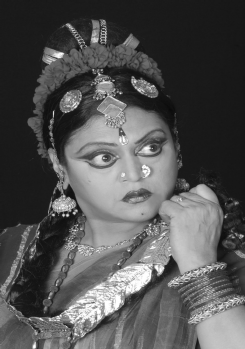
Swapna Sundari
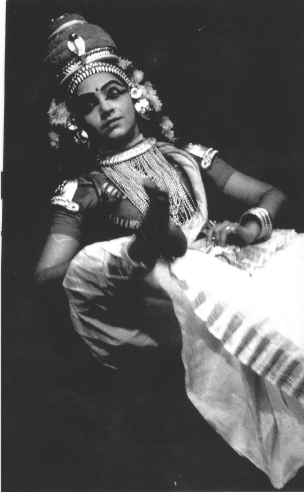
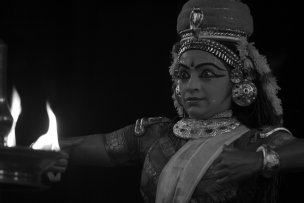
is an artist of great accomplishment and renown, having been recognized for her achievements in dance with the Padma Bhushan, the Sangeet Natak Akademi award, as well as numerous others. Her performances all over the world are marked by her deeply nuanced sensibility and musicality. She has championed an Andhra Pradesh performing tradition of temple dancers under the name vilasini natyam, including teaching and recreating their dances on the stage. Her two books on dance attest to her ongoing scholarship and attention to theoretical and historical aspects of the art forms she practices. Balancing the conventional and the contemporary elements in her art, Swapna Sundari combines the diverse roles of dancer, singer, choreographer, scholar, teacher and author.
In Delhi in February 2013, you performed Satyabhama, and in a tour de force of abhinaya you layered metaphor on metaphor to build to an intense moment where it all came together in conceptual unity. I can describe the play of images, because it moved me so deeply that I went home and wrote it all down. The abhinaya, much compressed, and with the words only suggesting a modicum of what your gestures and facial expressions were able to achieve, went something like this: ‘See the moon? It is only half, because the other half is here – my forehead. Kama has one bow, but I have two – my eyebrows. Kama shoots flower arrows that pierce the heart. So? my eyes like lotus petals, pierce the heart with my many glances.’ Then you ‘shot’ five distinctly different kinds of looks from your eyes. This went beyond expressive skill, and moved into the realm of magic.
To be honest, I do not recall the date and place of this particular performance. But I do appreciate the trouble you are taking to share your reaction to my portrayal of Satyabhama on that occasion. It is important to have feedback from someone who understands dance deeply, since such a spectator can clearly verbalize the things I do as a performer. The whole interaction becomes somewhat like seeing my reflection in the mirror. Thank you.
To answer your question, a change has come about over the decades, in the way I use my dancing skill to express myself. I feel that as I have grown in experience, I am using my ‘dance-tools’ better. I also do away with the unnecessary frills that typically mark a choreographed portrayal of a particular character. I like to get to the centrality of the character and to connect with its core as quickly and effectively as possible. Once I begin to do so, the lines that separate my individual self and the character I have taken up, start to blur. Gradually the separation disappears altogether. In this way, I unconsciously live a particular character through the piece.
|
|
|
Swapna Sundari |
This is the best way I can describe my own connectivity with Satyabhama. I cannot say very clearly whether I am giving shape to my own mind’s eye version of Satyabhama based on whatever I have learnt about her. All I know is, had I been Satyabhama, this is how She would be …I enjoy becoming her!
There was a wit and intelligence that came through, letting us into the quality of character that makes Satyabhama who she is. How does what is essentially set through the process of a ‘tradition’ interact with your own creative process?
Tradition is a highly misunderstood term. We Indians have great respect for the term ‘tradition’ but this term is also a hedge behind which mediocrity hides easily and few dare to venture out. Very often, the term ‘tradition’ is employed to uphold an artistic product which, while being well preserved, lacks vibrancy and creativity. Many dancers and musicians use the term ‘tradition’ to camouflage their own artistic limitations.
There is a difference between fossilization and tradition. A perfectly formed and carefully preserved fossil may be an important symbol of history but does not represent life and vitality. On the other hand, tradition is an established system which renews itself by breathing and living.
The purpose of tradition is not to create fossils but in fact, to ensure that fossilization does not take place. Our performing arts are traditions which replenish themselves continuously. Otherwise they would not have survived for so many centuries and nor would they have retained their intrinsic vibrancy over such a length of time.
A mature classical dancer must understand, therefore, that tradition is not a barrier to creativity. His or her art should reflect life-sustaining and life-extending qualities in order to serve the larger intent behind tradition. On my part I try to do this in different ways. One of the ways I follow is to reduce the gap between the reality of my immediate world and the ethos of the imagined world pertaining to the character I am portraying, the myth I am narrating and the emotion I am evoking.
I cannot deny or disinherit my reality but I can try and effectively employ all the artistic tools at my command to cross over to the imaginary world which I am seeking to create. At times I succeed. This is perhaps why as a member of the audience you might have felt that there was no dichotomy between tradition and creativity when you saw my Satyabhama.
A refined sensibility, aware of the qualities required on a modern stage, pervaded the whole piece. Can you elaborate on the relationship you have to the audience, given that we are no longer the type of audience the piece was created for?
It is not for an audience to try and become the ideal target audience. It is for the dancer to recognize and reckon with the fact that the audience is a human resource that can either be energized or left cold. That, of course, depends on a lot of factors but foremost amongst these is the communicative ability of the dancer. It is not enough if the dance is visually impressive, the topic is intellectually stimulating or the presentation is super-slick. The emotional connection supercedes all these.
Just as the electric lights are turned on by pressing a switch, so too, as soon as the performer and spectator connects, is the latent emotional energy activated. This is the process referred to as Rasanubhava in the Shastras. To understand why this happens almost consistently in the case of some artists but not at all in the case of others, one must delve into the deeper issue of the artist’s own internal ‘connect’ with her/his art, the electrical circuitry of the motherboard itself.
Speaking for myself, I follow a simple formula. Before I bring out a piece on stage, I put the initial concept itself through rigorous tests under factory conditions. I never consciously choreograph my pieces, especially those which are to do with abhinaya. I let the song, the literature, the character, the story brew and ferment at a subconscious level, like the fermentation of grapes before wine. I can feel it inside when my artistic fermentation is complete. That is the time I even begin to consider the possibility of shaping the idea into a performing format. In case a piece excites me initially but fails the fermentation test, it never goes on stage. When I eventually decide to share a well fermented piece with the audience, it is possible that the headiness which I feel while performing it, is felt by them too.
I know this is a silly question, but I have to ask it – how do you do those things you did with your eyebrows? I know how a dancer trains, and I know that Kathakali and Koodiattam have all kinds of exercises for eyes, eyelids, eyebrows, cheeks – but I had never seen the kinds of movements you used so effectively.
During my training under the devadasi dancers, I spent a lot of time observing the way their art incorporates so many elements described in fine detail by Bharata and others in our dance treatises. It is important to note that devadasi artists are not obsessed about the Shastra Sampradaya-Parampara – connectivity in the way everyone else seems to be.
These artists are not self-consciously applying well established Shastric principles while performing a piece. They are not looking to justify their work to anyone. To them, nritta is the natural and effortless application of movements to tune and rhythm. To them, abhinaya is an enjoyable exercise of using each part of their face to express every nuance contained in the poetry which they are interpreting. This unself-consciousness is the singular beauty of the devadasi art which distinguishes it from the self-conscious, calibrated dance interpretations one often sees in performances of reorganized Bharatanatyam in its present manifestations.
Though I trained under devadasi gurus at a fairly advanced stage of my career, this quality of their art percolated deep into my system so naturally that I am as comfortable as a fish in water (which makes me suspect that I might have been a dancing devadasi in one of my previous births). That’s why movements like the ones you describe flow easily in my dance now.
In the Satyabhama piece, you’re working with source material that exists as a given. Do you ever feel limited? Are there expressive possibilities you want to explore that are outside of the repertoire of the form?
The source material that a dancer uses contains a certain sensibility of its own. The dancer has the responsibility of comprehending that, translating it into the idiom of dance and conveying it through her/his work. This responsibility is defined by the Shastras as sahitya dharma and sangeeta dharma. I have never felt that observing this dharma is a limitation. On the contrary, I feel that fully comprehending any source material enriches me. I feel the same about working with the source material of Satyabhama.
I also emphasize that the popular perception of classical dance limiting the creative expression and individuality of the artist is a complete myth. It is possible for a classical dancer to creatively use established source material and yet explore any number of new possibilities. The Shastras provide ample scope and space for doing this, defining it as mano dharma’ (as the mind dictates). Therefore, for classical dance to be ‘complete’ in the true sense of the term, the elements of sahitya dharma, sangeeta dharma and mano dharma must be feature in the performer’s work. I understand this and try to maintain this balance to the best extent possible.
***
Padmini Chettur, dancer and choreographer speaks to M. Natesh, visual artist who has worked in the performance arts. They both live and work in Chennai and for the last two decades have followed each other’s work and exchanged thoughts and ideas on contemporary practise.
Do you remember the moment that pushed you to make ‘your own work’ either at variance from your current practice then, or something totally fresh? What were the factors? [Mine was banal… the final years at college to do ‘creative’-hahaha-work when six years is way too long of an epic college life.]
In 1990, I started my work with Chandralekha. My experience as a dancer in a group, under the gaze of an astounding visual eye, was of a body becoming the image. There was so much attention to line, to the space around the body, to the source of spine.
At a certain moment I started to feel a similar disconnect (which ironically was resolved in my later work with Chandra) to the one that led me away from Bharatanatyam. I had a sense that I wanted to feel my humanity again within the form. I wanted to explore areas that were not about ‘power’ and strength, perfection and wholeness. This is what eventually took me to ‘Fragility’ in 2000, a quartet in which all the dancers came straight out of a Bharatanatyam practice. A work that very much looked at discomfort, a tension of asymmetry, an almost stopping of time, a fragmentation of phrase. I think this was a turning point, and it was also the last work where I actually ‘gave’ movement to dancers. After this from Paperdoll in 2005, I started to look at more collective processes of vocabulary building.
Do you have specific list of productions?
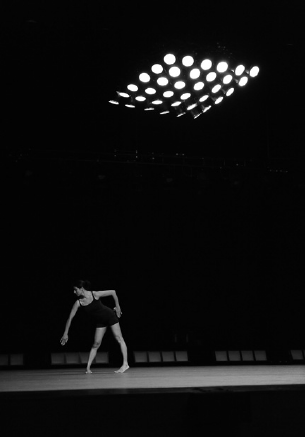
In 2008 I created Beautiful Thing 1, and then Beautiful Thing 2 in 2011. These were years in which I felt that the obvious political/social commentary in dance would actually have no impact. It was a moment for me to see the body more essentially for what it was and to focus on the visual and compositional elements of my practice. In my text I said that all I wanted to do was to create a Beautiful Thing. Later of course the study of the nature of ‘beauty’ in the work was something that led to its own political ideas, and those persisted through Wall Dancing (2013), which is a durational work that equally looks at time and performativity in ‘radical’ ways.
Can you discuss in detail the creative mobility of the end product? I presume that intellect which is actually archiving the results of human-intelligence’s efforts focuses on the product’s process in all its mushy organic nature… I mean series by series or production by production. We need to do it as some kind of a fun trip instead of going into the right or wrong of it. You know I disown ‘the self’ called Natesh immediately after my shows open – hence failing to promote them.
I’m not sure the words ‘creative’ and ‘mobility’ work together to describe what in actual fact is for me the most tedious aspect of my work – the touring. In the first 10 years or so of my career, I think that my definition of ‘success’ was to do with emulating a model that I knew well. Being invited to festivals and theatres, being able to afford a space, paying the dancers’ salaries etc. A few well-meaning but fickle European curators falsely held up the entire economic premise of my work. The problem was that there was no real support or foundation for the practice to survive like this. It was like simultaneously running a free training studio, working to train very raw bodies for years, throwing them onto the big stages of Europe and then starting all over from scratch.
At the same time, nothing much was changing within the country. The IFA remained as problematic as a funding body, institutions like Kalakshetra remained as closed and suspicious of the contemporary, and our rich patrons of the art prefer to invest in foreign spectacles.
So, since 2010, I have stopped trying to be a one-person institution. That I have no overheads means there is no pressure on my pace of work or its content. The small handful of people who have always followed my work continue to do so and I’ve stopped thinking about ‘selling’ and marketing my work or myself.
Till you started traveling abroad, I was doing the lights and some backdrops for you. So, what’s your take on such interference aka collaboration? Special directives (sets etc.) and light as a major punctuation/interference/intrusion/moment/definition and moment-memory-registration-in-audience. How do you rate it? How much do you wish to collaborate?
Again, I think as choreographers, we inherit so much baggage and we spend a lot of our professional lives doing things a certain way because of the ‘marketability’ of that way. Between 2003 and 2013, I created 9 or 10 works for the stage. I never worked much with sets; a few works had backdrops created by Sumant Jayakrishnan with whom I closely collaborated in 3 Solos (2003) and Paperdoll (2005). The need to ‘dress-up’ the work was also an expectation of the mainstream spaces. And so, through Pushed (2006, lit by Zuleikha Allana), and Beautiful Thing 1 and Beautiful Thing 2 (both lit by Jan Maertens), the work with light became more and more complex and present.
Of course, one chooses these visual/aural collaborators for a reason, and then one is open to their interpretations of one’s work. With Beautiful Thing 2 in 2011, it became evident that I also needed to create simultaneously a stripped down ‘studio’ version. I didn’t like to be living in this context, dependent on certain unsustainable technological requirements. I like to work in parallel like this. In very bare spaces and sometimes, in very over-lit ones!
|
|
|
Paperdoll, 2005. Photo by Jirka Jansch. |
Since Fragility, my most stable collaborator has been the composer Maarten Visser – his work on sound has been a very important part of my own aesthetic. I think it was very important for me to do this work on sound with someone who was equally interested in developing new techniques in his own work and someone who would really spend time following the processes in my studio. I’ve always created my work in silence with normally a very strong rhythmic grid. And Maarten has over the years found a very beautiful way to translate the visual into the aural in a way that they both read as two voices together. All his work is acoustic, and he works with instruments in ways that retain a real rawness and grittiness in what we hear. The result together with the movement creates huge tension in a space, and also an incredible silence in moments.
And finally, though I speak more about this later – the dancers who interpret my work. I’ve never been very attracted to creating solos. A large part of my choreographic thinking on structure has had to do with looking at tension – tension between bodies, between the larger collection of bodies and the surrounding space. I love the very particular harmony of bodies being together, and the potential dissonance when they aren’t. Dance is for me essentially about these narratives between the multiple presences of bodies in a space and therefore to tell the narratives well, the interpreters have a huge task. And I think that this is much greater when the score is abstract. I’ve been very lucky to have worked with some special minds: – Krishna Devanandan, Preethi Athreya, Sujata Goel, Anoushka Kurien, P. Akila, Aarabhi – to name a few.
Do you remember emotion turmoil with particular actors or dancers? Does that or did that make you restructure the dynamics of your work? Do you see it as a compromise? Are you unhappy with a few productions when you recollect. All my installations are failures. I regret doing them and having to do them. Though the product makes me happy… a few of them because of the memories from the process, from building them.
With every dancer there has been some kind of struggle. I don’t see this as a struggle between the dancer, and myself but I am more a catalyst for them to undergo a process of struggle within themselves. At first the physical language of my work often asks them to forget their past, to re-imagine the body. To rethink their alignment. The simplicity of the form I work with looks for a certain de-cluttering not only of body, but mind as well. To be still, to concentrate, to remain precise, to be open to fellow dancers.
From one production to the next, I think I’ve also been evolving and adapting my way of working and communicating. We are living in a time when the old gurushishya hierarchies and feudalism will not work. We can’t just demand and expect results; we must convince and individualize the processes. It’s also always been my choice and preference to work with more mature ‘thinking’ dancers, and therefore questioning and conflict is part of the studio dynamic.
Compromise? Yes, there have been moments when it could have been better, but on the other hand I’ve never been that interested in perfection. And especially in this context where there are no ‘ready-made’ dancers, where the technique and form are being created together during the choreographic process. At a certain point one realizes that that particular investigation is complete. The concerns that are left over are carried to the next work, or even maybe to the next series of performances. So perhaps, unlike for many visual artists, performative work is more ongoing, not so much about the finished product. And one is always prepared for the numerous erratic factors that make some performances special and others not!
Any memory of public life/events/angst that shaped a particular work?
My own personal life has been the space within which most of the movement towards dance has happened. When I was six, I lost my father and my family moved to India. I’d say that my early engagement with dance was escapist, a looking for a world as different from the more academic home I grew up in. At 17, I decided to study chemistry. For the next four years, I was immersed and excited by the logic and sense of patterning I discovered in organic chemistry. At 20, meeting Chandralekha was a huge turning point. I’d say that being with her was the only way I understood what it meant to be an artist. To live the life of the arts. In her workspace I understood how the internal and external live together in dance.
In 1992 (I was 22) I was the victim of a very violent physical assault, which perhaps led to my first solo Wings and Masks. It was Chandra at the time that helped me to understand that this experience could be processed rather than me becoming closed through it. Another important time for me was in 1998. I decided to have my first child as a single unwed mother, in the same year that my mother was diagnosed with terminal cancer.
I began work then on Fragility (2000), a very quiet work looking very deeply at this line between balance and imbalance, control and the loss of it. For the next few years, I was very busy with looking at ways of developing the language. I think this was always more important to me than the specific content of a particular work. Some people call me a structuralist! I have to agree with them. I strongly believe in the power of structures to express and communicate something that’s far more profound than a literal point of view or a ‘theme’. And in dance, there are so many layers of structure to deal with. The internal structure of the body, the structure of relationships between bodies, structures in time, even the performative qualities of a work have to do with structures of tension and emotion.
In 2008, after the birth of my second daughter, I unapologetically made Beautiful Thing 1! This is a moment when I felt I could very openly and without embarrassment state my artistic intention. To work on the skeleton of dance in its most pure, unadorned form. To look at this space between beauty and radicalism. To externalize the interior.
Which major ‘ism’ or social imbalance finds a place in your work – triggering or remaining as a residue? Or just entertainment?
In the early 1990s, the workplace of Chandra was a space where German expressionists would visit frequently, and as a young dancer, hungry to learn, I would constantly look at the systems of movement they worked with. So I’d say that initially people like Suzanne Linke, Reinhild Hoffman were very big influences. I’ve always said that those 10 years of working with Chandra was my school. Wherever we travelled she made sure we saw the right things, visited museums and archival spaces. At the same time at her rehearsal space in Chennai, artists like Dashrath Patel, Viswanathan were a part of the ongoing development of work. The women’s movement was also a very large part of the discourse for Chandra. After these 10 years of assimilating, when I began to articulate my own practice, I was very drawn to abstract expressionism in the visual arts, and to the minimalist composers. I was very excited by movements that relied less on information, more on a kind of non-virtuosic form through which something beyond what we can express through language was being communicated. So, I drew a lot of my understanding of composition from music and writing. For me this notion of translating from the other arts made sense, also because beyond a point, there were very few choreographers whose works I found inspiring.
I’ve never been drawn to the idea of an obvious political agenda that attaches itself to works of art almost as an afterthought. Or as a way to describe the intention of an artist. As artists, we live in a world constantly trying to make sense of our positions within it, and our final response is often through our art, in my case the performing body. And I hope that the politics of my performing body becomes apparent through its own presence. Starting from the departure from classical narratives, to the persistence of an alternate temporality. From its anti-seductive muscular physicality to its un-aggressiveness.
I think that in India one is also constantly dealing with the politics of colonialism and exoticism. So in a sense, what makes the work so much about the navigation of tension. Why the work confronts so many stereotypical expectations.
Entertainment? The predominant elements that reoccur in my work have been what people refer to as a ‘reductionism’. An intense engagement with slowness of time. At the same time for me, I’m constantly trying to sustain tension. The viewer can never just sit back and be ‘entertained’. The viewer must remain active in a certain way, if not they cannot ‘enter’ the work. So for a majority of people my work is dismissed as too hard, or too boring. I’ve since a long time reconciled myself to not being a mass entertainer...! And I don’t apologize for this. The Akram Khans of this world fulfil this need and they do it really well.
Do you remember what physical object/person/event/encounter shaped a particular work? I say, ‘mating’ is the only physical thing; the rest is metaphysical? What about fighting?
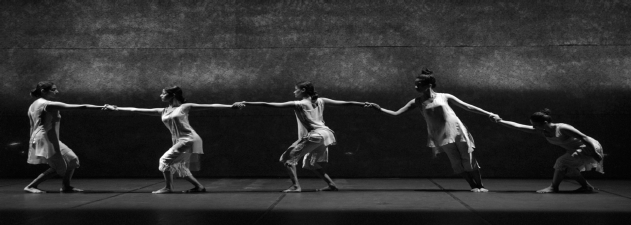
In 1993, my first solo Wings and Masks used a canvas of C. Douglas by the same name as a starting point. K. Pravin who was from theatre directed the piece. We played with these images to create a long improvisation that was probably very bad! My next few works, Brown and Unsung all had some similar starting image, or text. When I look back at this phase between ’93 and ’99, it was the moment when I was really just looking for a way to work. Re-orienting my body to the kind of work I later did. So somehow, the starting points weren’t so important, where they took me in terms of my physical research was. In ‘99, Fragility was the beginning of the next phase where the concept and form of the work were intrinsically linked. Paperdoll (2005) used the metaphor of a thin strip of paper dolls to deal with the tenuous link between bodies within the frame of a fixed space, so physically dealing a lot with ‘dependence’ and the idea of connected bodies. Pushed (2006) explored a certain way of categorizing emotion. My starting point here was a lot of personal text on emotion that came from the dancers themselves.
|
|
|
Beautiful Thing 2 (2011). Photo: SAF. |
Beautiful Thing 1
(2008) was a collaboration with poet Vivek Narayanan. Here the spoken word became the ‘object’ of the work. Some works have grown out of circumstance. In 2013, I found myself in a very small rehearsal space, with many interesting corners and wall surfaces. The only piece I could make there was Wall Dancing, which is a work in which the performers stay in contact with the periphery of the room. Often I start work with a question. For my solo Beautiful Thing 2 (2011), I asked myself how the body could carry its internal spaces from one point to another? This question is often enough for me to created the material for the work.
Have other aspects like smell and touch made you build a particular part of any work?
No. I think I’m quite primarily a cerebral maker of dance works. In actual fact, most of the time, I’m not so interested in what the movement is. Therefore, in my processes, I offer a question to my dancers. A very simple question, that doesn’t allow for too many things to go wrong. It’s what I make of the material, and then later, the quality with which that material is performed that makes the choreography work – or not. Of course, at this interpretive stage, performers might make their own associations between the movement and their personal memories/sensory experiences. This is not important or necessary for me to know. It’s perhaps what helps them to own the dance; it is their point of view.
Looking back, are there aspects of prime of youth that decided the ‘quality’ of your work?
Between the years ‘95 till ‘99, in between the productions with Chandra, I spent a few months at a time every year in Europe. Sometimes just attending classes and workshops, a couple of times working with choreographers. I didn’t necessarily enjoy these times and the work was mostly mediocre. Yet, this time was an important one because it put me in an environment of discomfort. The physical knowledge I had already felt a little shaky. The much more analytical, anatomical pedagogic methods of the west were intimidating. Yet this period gave me huge clarity. I knew then that to merely adopt and assimilate the western practices into my own would be of no use. I also knew that for my own personal reasons of usefulness, that several things I knew had to be unlearnt in order to open up possibilities for myself in terms of form and vocabulary. This was the starting point of a four-year research period with Krishna Devanandan that led to Fragility in 2000.
|
|
|
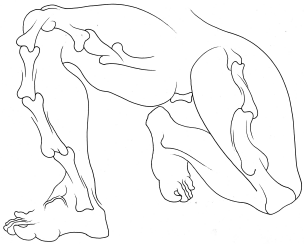
Drawing by M. Natesh. |
What aspect of ‘physicality’ is primary for the animalism of your rigour?
I’ve always wondered about the ‘need’ to move. In this context I’ve always found it necessary to clarify constantly this need within my own dance space. In order to find this clarity, I define and specify as many parameters as possible. So in other words, the body moving is defined as precisely as a scientific experiment. The starting and ending point, the line drawn, the qualities and most importantly the visual space that movement displaces attempt to be precise. This search is also limitless, for the body has perhaps a thousand possibilities of performing any action. So, in this context the rigour has partly to do with choosing and knowing the mechanics rather than relying on a mechanical virtuosity or habitual patterns.
I’ve also always felt that the body can only express its own ‘bodiness’. This is the animalism of body quality as well as the animalistic logic that is often commented on in my work. A sense of moving without trying to express. The anatomical research together with a more unscientific thinking of what the body actually is. These potentialities of the body in movement, unmoving even, are what propel me to work. This is perhaps far more urgent than the making of dance performances.
***
Kapila Venu is a practitioner of Koodiaattam – traditional Sanskrit theatre, and a disciple of Guru Ammannur Madhava Chakyar. She is also the Director of Natanakairali – Research, Training and Performing Centre for traditional arts founded by G. Venu in 1975. Kapila Venu is interviewed by T. Sasitharan, co-founder and Director, Intercultural Training Institute, Singapore, a unique training ground for contemporary artists. He is a noted actor, director, teacher and writer and commentator, with more than thirty years experience in theatre and the related arts.
We know that all tradition, no matter how ancient or venerated, is constructed. Tradition is always made, built up over time by the accretions of history, personal practice and the prevailing conventions of culture, aesthetics and society. Any particular conception of the construct of tradition, the way we think about it or value it, its shape, specific contours, colours, textures and characteristics, can vary widely from time to time and from one practitioner to another. What do you see as the construct of the Koodiaattam tradition? How would you describe it as it is enjoined in the practice of Natanakairali and how has it influenced, affected and formed your practice as an artist?
When I try to understand the construct of Koodiaattam as we know it today, three things come to my mind. One, the significantly long unbroken lineage of practitioners who for over two thousand years have brought about a certain distillation, sophistication and complexity in the theatre language, craft and technique; two, that this is an amalgam of the best of two worlds, the margi – the mainstream Sanskrit theatre tradition and the desi – the regional culture and aesthetics; and three, that unlike most of its contemporaries in other parts of the world, we see in Koodiaattam the presence of the female performer together with her male counterpart.
|
|
|
Kapila Venu. |
The ancient Tamil epic poem ‘Silappathikaram’, talks about the performance of a Koothachakkaiyan, a performer known as Chakkaiyan (Chakyar) from Parayur (a village in Kerala) enacting the Kottichetam, a choreography in which he delineates with one half of his body the masculine energy of Shiva and with the other half the feminine energy of Uma, his consort. It is considered to be one of the earliest references in literature to a theatre form akin to what we know under the general term Koodiaattam
1 today. Interestingly, to this day, the episode of Parvativiraham, the love quarrel between Shiva and Parvati where an actor shifts between the two characters in succession is considered an important sequence in our repertoire that only a highly skilled actor can convincingly perform. This shifting of the actor’s body between the male and female energies with ease and grace is considered the hallmark of greatness in a performer.It is challenging to put down a very precise story about the evolution of Koodiaattam. We do know for sure that the southern region of India in which lies Kerala and parts of Tamil Nadu, is known to have a very strong tradition of highly skilled actors/performers, both female and male, and that their skill was held in high regard and theatre practice was taken very seriously. We also know that the communities of male and female performers were already established in their art before the advent of the Sanskrit dramas to Kerala. When the presentation of Sanskrit dramas came into vogue in several parts of the Indian subcontinent, it happened here too. We know that later Kulashekhara Perumal, a king, playwright and theatre enthusiast was responsible for reviving and modifying the Sanskrit theatre into the format that we know today as Koodiaattam.
As young students of the art form we grew up hearing legends that describe actors and actresses with extraordinary acting capabilities such as Ammannur Parameswara Chakyar who once pretended to throw a stone at an Englishman’s dog. The action was so convincing that the dog felt he was hit and started whining. To prove his innocence to the angry Englishman, the Chakyar enacted the sequence of the lifting of a mountain. Towards the end of the performance the Chakyar suddenly allowed the mountain to slip from his hand and the Englishman who was totally engrossed in the performance fell from his chair because he felt the mountain was falling on him.
As a woman it is of utmost importance to me to know that my predecessors, female performers, were highly skilled in the art of abhinaya. There is a word in Tamil from the Sangam era, virali, for danseuse. The word literally translates as ‘one who can transform her entire body into eyes’. Eyes are considered to be the most expressive part of the actors’ body. This term signifies that the actress was so skilled that she could transform her entire body to resonate with the same expressive quality as her eyes. We also hear of female performers who could balance on one foot on top of a walking elephant while performing the sequence of Karthiyayinipurappad in Subhadradhananjayam Koodiaattam.
Ammannur Madhava Chakyar, our master was a legendary presence among the performers of Koodiaattam. Apart from his training in traditional method he was one of the last performers who benefited from the Kodungallore Kalari, an actor-training centre at the Kodungallore royal family where three generations of scholars researched and trained in various techniques of acting with special emphasis on breath.
At Natanakairali, G. Venu’s main effort was directed towards making known to the world the unmatchable talent of the legendary Kutiyattam performer Ammannur Madhava Chakyar and to ensure that his art was passed on to a new generation. Together with Ammannur Madhava Chakyar, he co-founded Ammannur Chachu Chakyar Smaraka Gurukulam, a training centre for Koodiaattam. Once a new generation’s training had considerably progressed, G. Venu then established Abhinayakkalari actors’ laboratory at Natanakairali with an aim to supplement the training at the gurukulam with advanced training in abhinaya and for making a space for creative experimentation and new productions. Several new productions in Koodiaattam took shape here, some of which were very bold deviations from the restrictive rigidness in the tradition. One of the main contributions of Abhinayak-kalari was to make equal space for the female performer by reinterpreting female characters from texts like Kalidasa’s ‘Abhijnana Shakuntalam’ and ‘Vikramorvasheeyam’ with a very feminist approach.
As a performer of Koodiaattam, the work at Natanakairali has been of immense importance to me. As a woman being a part of productions like Sakunthalam, Vikramorvasheeyam and ‘Urubhangam’ gave me the chance to share equal space onstage with my male co-actors which would otherwise be unthinkable. The research studies and training on various aspects of Koodiaattam like hasta and netraabhinaya, swaravayu and navarasa saadhana form the strong foundation of my performance work.
In your understanding and by your own practice, would you say that Koodiaattam and Nangiar Koothu have crossed some discernible threshold/s to be considered ‘modern’ performing arts practices? If so, what would these thresholds be, what would this modernity consist of and how are the practice, teaching and transmission of these performing art forms different now from their ‘premodern’ state?
You may choose to reflect on this question as a course of change and continuities, a river as it were, that flows from the art, practice and teachings of Guru Ammannur Madhava Chakyar, through your father Gopal Venu’s art, practice, teaching and scholarship to find a sea in your own body as artist and teacher. How and where do you see it flowing on from you?
Yes, I do think Koodiaattam and Nangiar Koothu have crossed certain discernible thresholds to be considered modern performing arts practices.
In the 1960s for the first time Koodiaattam was performed outside the temple precincts. This was the first threshold that Koodiaattam crossed from being a part of the temple ritual to being presented purely for the sake of performance. A few years later, due to the dwindling number of students within the community, the masters opened their doors to students from other communities. This was the next threshold to cross.
The last three or four decades have seen drastic changes in the evolution of Koodiaattam. A new generation of trained artistes, from backgrounds both traditional and non-traditional, equipped with modern education and exposure to other cultures, has brought about several changes in the culture, practice, aesthetics, repertoire and presentation of performances. Whether the effect of each of these changes was favourable towards the art or not is a debatable topic but the changes are real.
I do not belong to the Nangiar community but I had the opportunity to train for several years in a gurukula system under the greatest exponent of Koodiaattam, Guru Ammanur Madhava Chakyar, who belongs to a very orthodox community. My master never showed any difference in affection or dedication to students based on whether they were from within the community or not. Previously it would have been strictly prohibited to share their knowledge outside the community.
My father, after having studied the traditional knowledge thoroughly paved the way for new thinking and innovation. He encouraged us to broaden our perspectives, to learn about other cultures so that we have a more dynamic understanding about our own tradition, to read and to have our own ideals. There are several aspects in the tradition that need to evolve with the times. One important example is the attitude towards of female characters and female performers.
|
|
|
Kapila Venu. |
Thinking of my own life as a practitioner of a traditional art, I constantly attempt to make sure that my art practice remains meaningful in the lives of people in the modern world. I do not want to be looked upon as someone from the past that people cannot relate to. Everyday I think about my connecton to the people around me, sensitizing them to the intricacies of this art form.
Reflecting on your own practice as an international (or transnational) artist and performer, what would it mean to ‘comtemporize’ (to make or read as ‘contemporary’) Koodiaattam and Nangiar Koothu? I refer here to a specific meaning of ‘contemporary’ in Arthur Danto’s sense: ‘Contemporary art, manifests an awareness of a history of art but no longer carries it forward. [It] speaks as well of the relatively recent loss of faith in a great and compelling narrative, in the way things must be seen. It is in part the sense of no longer belonging to a great narrative, registering itself on our consciousness somewhere between uneasiness and exhilaration that marks the historical sensibility of the present, and helps define the acute difference between modern and contemporary art. It is characteristic of contemporaneity – but not of modernity – that it should have begun insidiously, without slogan or logo, without anyone being greatly aware that it had happened.’
Do you think Koodiaattam and Nangiar Koothu practices and performances, ‘manifest[s] an awareness of a history of art [forms] but no longer [carry] it forward’? Has there been a ‘recent loss of faith’ or are these performing art forms still practiced, performed and seen as belonging to ‘a great narrative’? If so, what is this narrative?
We always use the word contemporary in the sense of ‘belonging to the present’, which I think Koodiaattam, Nangiar Koothu and all other ‘living’ traditions do. In connection to this particular description of contemporaneity, Koodiaattam and Nangiar Koothu most certainly manifest an awareness of a history of art, but also carry this awareness forward in its practice. There has been a considerable and recent ‘loss of faith’ in the religious significance of the art, maybe more for practitioners who were initiated from outside the community, but yes it is still practiced, performed and seen as belonging to a great narrative. This narrative is the long unbroken flow of the tradition which includes rigorous training and strict adherence to the technique and conventions of the form and the spirit of the art form from the master to disciple.
Turning to your own practice as a performer, could you describe the process/es of work (or rehearsals) leading up to the recent creations of new and original adaptations of Kalidasa’s and Bhasa’s plays for the Koodiaattam repertoire by Natanakairali? By ‘process’ I mean the inclusive totality of deeds, tasks and strategies employed, e.g. the training exercises, textual analyses, directorial treatments and dramaturgical considerations that are part of the work, commitments and discipline regimes of the performers (like you and your compatriots in Natanakairali) seeking to bring to fruition a new works/adaptations like Abhijnana Sakuntalam, Vikramorvaseeyam and Urubhangam?
For a new work like Sakuntalam, one starts with the seed – the text. The first step usually is to gather all available textual and other material like films, documentations etc related to the chosen text. This includes different versions, interpretations, reviews and studies. All members of the group including the director G. Venu, actors, musicians, make-up artistes and stage managers sit together and read the texts. This usually continues over several weeks or months. Slowly the different possibilities for performance begin to take shape in each one’s mind. We then choose, after a lot of discussion, from the main text, portions that we really like and make an edited version of the text for performance, which is sent to a scholar for checking. Then we start by improvising each line together. Every actor does his/her homework before coming to the workspace.
By now most actors have also been assigned the roles they are going to play. This process again takes several months. We make notes for each scene and then an attaprakaram (acting manual) is put together for the whole performance. This manual is flexible and subject to change after each repetition or performance. After several such repetitions we usually invite scholars, masters, special guests to watch our rehearsals and invite comments. Some of their opinions are very valuable. For the first performance again we usually have an invited public who stay on for long discussions afterwards.
During the work of Sakuntalam, which took three years, a lot research, documentation and training was done in various aspects of netra (eye) and hasta (hand gesture) abhinaya. All the actors also had annual ayurvedic massage treatments and training in Kalari and Yoga apart from our personal daily training in Koodiaattam. What makes this process different from the traditional routine is that traditionally a master would first study a text and write an acting manual and then teach it to his disciples. During the making of Sakuntalam we for the first time in Koodiaattam reversed this process, making it an inclusive one. We listened to each other and worked together and the acting manual was the last thing to be finalized.
All performers, particularly dancers and actors, strive to achieve a certain quality of ‘being’ on stage, which is extraordinary. This existential mode may extend across various dramatic, theatrical or choreographic moments and has variously been described as a heightened consciousness or activation. Alternatively it has been called a state of stimulation, awareness or availability to specific contexts or circumstances. It is a state wherein the inner world (thought, emotion, psychology associative mental image) of the performer is in direct, immediate and instantaneous connection with the outer, physical expressivity of her body. The performer is perceived as ‘activated body-mind’. Some call this state of being ‘presence’. It is that which captivates and holds the attention of the spectator; what Zeami dubbed the ‘flower’.
How would you describe your body-mind consciousness when you are fully present on stage during a performance? You may choose to reflect on the content and constitution of your mental state (consciousness), the muscular-skeletal alignment and tension/ease of your body (for instance the state of your spine, the alignment of your hips, position of your legs and feet, the posture of your arms and hands) when you are fully present on stage.
Also, you may consider the state (or flow) of the ‘energy’ or breadth while you are in this extraordinary state of ‘presence’. What elements of your practice (daily exercises, studio routines and processes) enable you to produce and sustain ‘presence’ at will during a performance?
This reminds me of another old legend I’ve often heard from my master about a nangiar (an actress) from the village Moozhikulamin Kerala, who suffered from a severe hunchback. However, the moment she stepped on stage to perform, her back would straighten and stay so until the performance was over. This is really the magic of an altered existence.
As a performer I do experience an activated body-mind state while on stage and I have been strongly discouraged by my master every time I have tried to analyze the content, constitution or process of my mental state during a performance. I will follow his advice for as long as I can because I believe that too much analyses and information could steal the natural flow of my body’s process. To achieve this state we go through several years of intense and concentrated training. Every actor then formulates his/her own daily sadhana – daily practice combined with daily prayers or yoga or meditation or farming or all or some of the above or something else completely.
In Koodiaattam we also follow a strict convention of minimal talking in the green room. As soon as the actor gets ready for make-up, he/she ties a red ribbon on his/her forehead, which grants him/her detachment from all external attachments and happenings until the end of the performance.
Over time, the act of performing becomes a ritual and a habit. We would have done it enough times that this transformation becomes natural the moment we make a turn in front of the Mizhavu drums and take three steps towards the oil lamp on the stage.
Notes
: Koodiaattam has now become a general name ascribed to a theatre tradition that was practiced by the Chakyar and Nangiyar communities in the Kuthambalams (temple theatres) of Kerala. However, the word Koodiaattam is actually a technical term in traditional ritual-theatre language of Kerala to denote more than one actor performing together on stage and is used in several other ritual art forms like Mudiyettu and Theyyam. The theatre form has two components Kuthu, solo performance, and Koodiaattam, acting together and the art of the Chakyars until recently was locally known as ‘Kuthum Kutiyattavum’ (Koothu and Koodiaattam) in Malayalam.![]()