In memoriam
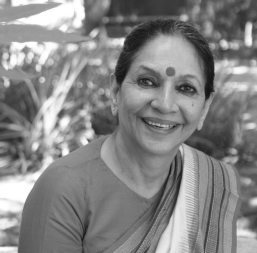
Veenapani Chawla 1947-2014
![]()
A year has gone by since Veenapani Chawla died, but for me she remains a living absence. While I do miss her physical presence, more than that I miss her insights on the performing arts. All who were lucky enough to know her have been influenced by her philosophy of life and art. Her invaluable contributions to the fields of theatre, classical and contemporary dance cannot be ignored. Her theories and practices of art connected with the life she lived, the environment she sought and the rigour she demanded. She had a genuine respect for classical art forms and no hesitation in borrowing formal as well as theoretical aspects while trying to develop her own art form. It is not through rejection of the traditional but by meaningful inclusion that she sought to develop a modern mode of Indian theatre.
For her, ‘modern’ in referring to art meant to evolve a new and all-embracing perspective. During that process she took great care to retain the essence of the traditional, while finding new meanings and contexts. In other words, her art was not exclusive but inclusive. In fact, she expanded the boundaries of theatre through the inclusion of practices from other art forms: she used dance, music, multilingual scripts, emotional expressions from folk as well as classical theater and to some extent cinema. She revelled in the hybrid quality of her art.
|
|
This borrowing from other forms was not random or artificial, but well researched and theoretically sound. Innovation or novelty assumed a rational and rigorous quality in her hands. Her scripts were not interpretations of existing texts, but detailed outlines for a staged, very physical performance. She added and rewrote, incorporating suggestions from her actors as well as audiences, so that the script did not stagnate but grew and developed, gathering new energies and wisdom. She never relaxed or simplified her artistic practices, but was very democratic when it came to accepting ideas from a discerning audience, giving us a sense of true participation. Thus dramatic pieces never lost their freshness.
Veenapani chose Koodiyattam guru, the late Ammannur Madhava Chakyar, as a mentor for the kind if hybridization she practiced. Breath control, one of the cardinal principles of Koodiyattam, became a techinique for her own development. She also borrowed freely from Chhau and the ancient martial art form of Kalaripayattu from Kerala and included the practice of yoga. Veenapani’s theatre practices cannot be understood or experienced in the fullest manner if we do not understand the basic principles of these movement forms. Even the mental and emotional expression she required came when Kalaripayattu became part of the actor’s training. Her elaborate and systematic training programme emphasised the fitness of the body as well as of the mind.
She surprised the audiences in each new play. In watching Impressions of Bhima and Brihannala, we experienced a new understanding of the Mahabharata heroes Bhima and Arjuna. In Ganapathy, she made the music the most important narrator. In The Hare and the Tortoise, she unveiled many hidden layers to the old children’s story. Profound thought became an essential part of entertainment.
Veenapani Chawla not only had a vision but she was that rare creature who transformed her vision into reality in Adisakti Laboratory for Theatre Arts and Research, a unique space for artists to meet, live, work, exchange ideas and develop a sense of community.
I was her friend, allowed to enter the inner circle of her constantly evolving theatre. I observed her generosity of mind, her kindness to troubled souls, her love for friends and her ability to expand our thinking. The void left by her death on 30 November 2014 is very difficult to overcome and the sorrow becomes more intense when I think that I did not grow up to her expectations and practice the detachment she would have expected of me. She herself never stopped growing and insisted that her actors also do the same. In that sense she is not dead; she continues to inspire.
Vasanthi Sankaranarayanan
![]()