A perfect stillness: the art of Shanta Rao
ASHOKE CHATTERJEE
Shanta Rao, a pioneer in the renaissance of classical dance, was an outsider to tradition. ‘Why dance?’ in those days was a question reflecting both ignorance and propriety. Nice girls might get as far as Uday Shankar’s rich fantasies, but not yet to the roots of his inspiration. Born to a privileged family of Saraswat Brahmins in Bombay, Shanta’s early enthusiasm for dance was dismissed as a child’s fancy. Opposition hardened as enthusiasm turned to passion, not just for dance but for classical traditions remote from city experience in the 1930s. ‘Why dance?’ rebuked a precocious child, symbolizing barriers of respectability and logic of those times. When Shanta rejected conventional schooling, it became clear that this child was not for turning. Finally, a hint of paternal sympathy allowed Shanta to travel to poet Vallathol Narayana Menon’s Kerala Kalamandalam with a chaperone: G. Venkatachalam, a family friend reputed for his scholarship and familiar with Vallathol’s efforts to revive Kerala’s traditional arts. The journey to Shoranur reflected the towering reality that would mark an entire life in art: Shanta would dance ‘because it is there’.
Kalamandalam’s great asan, P. Ramunni Menon, was horrified at the prospect of a girl attending Kathakali classes. Shanta refused to budge. At Vallathol’s urging, Ramunni Menon finally relented, and the Kalamandalam received Shanta as its first girl student. Other ‘firsts’ would follow. Kathakali became the first classical tradition Shanta would master, and bring her the first of many controversies concerning integrity in dance classicism. It was also at the Kalamandalam that Shanta would encounter the last great guru of Mohini Attam, Krishnan Panikkar, becoming the only dancer to whom he entrusted his heritage of movement and music. This monopoly would draw Shanta into conflict, as other ‘Mohini Attams’ emerged from the Kalamandalam and elsewhere after Krishnan Panikkar’s passing, each offering alternative credentials of authenticity.
|
|
|
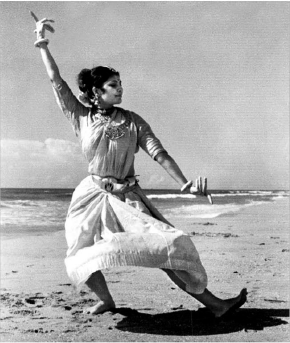
Photographs of Shanta Rao by Sunil Janah. |
During seasonal breaks in classes, Shanta journeyed with Venkatachalam to Pandanallur village in Tanjore district, to the feet of the greatest Bharata Natyam guru in living memory, Meenakshi Sundaram Pillai. From that moment the art of Shanta Rao would be associated indelibly with the ‘silk and steel’
1 of the Pandanallur style, electrifying audiences around the world with the power and intensity of her master’s tradition.To those expecting lyrical grace, Shanta Rao’s Bharata Natyam was a revelation. To some, it reflected the influence of Kathakali. Meenaskhi Sundaram rose in defence: ‘I have taught generations of devadasis who in their time won name and fame. It was only very recently that educated girls have taken to Bharata Natyam and one of the first to learn from me was Srimati Rukmini Devi of Adyar. After her I have had the good fortune to welcome Shanta Amma as my pupil who has come to our village very regularly, stays in our humble cottage as one of the inmates and learns the art with such devotion, intelligence and understanding as no other pupil has done before. It delights my old soul to know that there is at least one gifted pupil of mine to reveal the true tradition and the technique of an old art which it has been my privilege to foster and nourish.’
2It was Meenakshi Sundaram Pillai who would memorably describe his dance as the perfect stillness: ‘For what is great art but a yoga? A yoga of one-pointedness – a yoga where one becomes completely immersed in art. To attain that perfect stillness one has to labour and sweat for the sheer joy and love of art…’
3In the 1960s Shanta began an exploration of traditions particular to Andhra Pradesh, where Kuchipudi was claiming classical status. Her research would lead to collaboration with a young and talented teacher, Vempati Chinna Satyam. A Kuchipudi Dance Academy was set up in Madras. Its brief history would end in further controversy. Aspirations of classicism were found by Shanta to have less to do with scholarship and more with Andhra ambitions to match the status of ‘Tamil’ Bharata Natyam. Shanta dismissed parochial ambitions, pointing out that so much of Bharata Natyam sahitya was in Telegu and that Kuchipudi claims should correctly acknowledge the parent Bhagavata Mela Nataka dance-drama tradition. The academy was wound up. Before returning to Bangalore, Shanta declared in an interview: ‘Let’s not be superficial in our discussion of art forms. Black is black, white is white. There is no Kuchipudi.’
4 Vempati Chinna Satyam went on to become a renowned guru, while Shanta responded to a mysterious summons from an Andhra priest, Venkata Chalapathy Shastry.
|
|
|
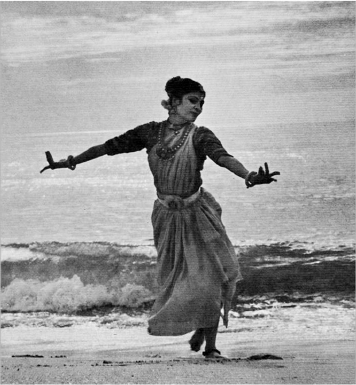
Sunil Janah |
Shastry was the last in a hereditary line of a cult known as Bhama Sutram. Not a dance form, these rituals were performed in secret within the temple to which the guru was attached and which Shanta had to enter alone, without escort. There she discovered a treasure house of gesture, music and shlokas as well as a unique code for recording movement. These offered a wealth of clues to the differences and similarities among Carnatic dance traditions, and Shanta’s creative instincts were stirred. Yet, Shastry sternly forbade any public revelation of his rituals, and never revealed why he had summoned Shanta, claiming to be completely unaware of her artistic reputation. His discipline was bone-breaking and his demands of secrecy so severe that Shanta developed a strong superstition ‘that if by some chance or accident I was to act against its beliefs, some great ill-luck would come my way.’
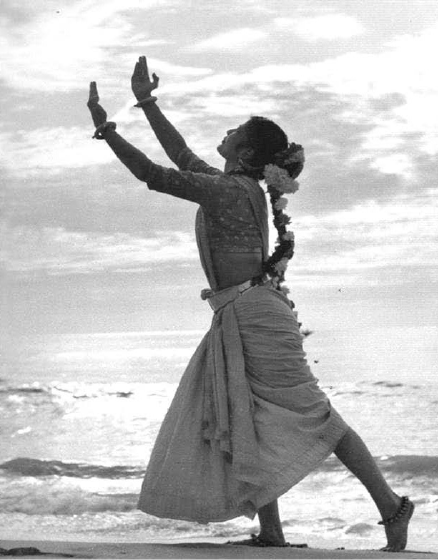
5Having long isolated herself into a stern regimen of practice and study, she now withdrew completely from public life for over three years. From this period of contemplation emerged Bhama Nrityam, a classical dance form inspired by the rituals and applied, with the guru’s blessings, in a manner that did not infringe on the sanctity which Shastry had entrusted to Shanta.
|
|
|
Sunil Janah |
Shock and disbelief greeted an announcement in early 1965 that Shanta Rao was to present a fresh form within the classical tradition. As venue, she chose the pioneering Indian National Theatre in Bombay. Next morning a leading city newspaper hailed Shanta as a pioneering force comparable to Picasso.
6 For her, the inner journey to stillness had found its perfect expression: ‘Bhama Nrityam is the gods’ gift to me. I feel a whole new world opening. It is as if my musicians and I stand at an open doorway, dancing, singing and playing our instruments for the very first time.’7‘Why dance?’ had found an answer that was simultaneously inscrutable, inevitable and perfect. In June 2006, for what was to be her last performance, Shanta Rao chose Ashta Mahishi, a two-hour Bhama Nrityam composition performed without a break, recounting legends of the eight wives of Lord Krishna. A year later she was gone, leaving only a radiant memory: ‘Years pass. Somewhere in the folds of memory, the one figure of a dancer prevails over other images and impressions: a figure, clear-cut in sweeping lines, emerging again and again in the beauty of form and grace of movement… What is it that makes her stand out in distinct dignity, such singular appeal?... The dance remains for Shanta Rao an experience in creativity: a creativity that radiates the aura and atmosphere of the religion of art, that shines in grandeur from the depth of being, and what is more, awakens the mind to the eternity of art… That is why, years pass. But Shanta Rao will remain, for her art is for all time.’
8
Footnotes:
1. Arnold Haskell, Balletomania, Then and Now. Weidenfeld and Nicholson, London, 1977, pp. 249-250.
2. Sunil Janah/Ashoke Chatterjee, Dances of the Golden Hall. ICCR, 1979, p. 56.
3. Ibid., p. 42.
4. Illustrated Weekly of India, Bombay, 4 June 1965, p. 36.
5. Sunil Janah/Ashoke Chatterjee, op. cit., p. 96.
6. Indian Express (Bombay), 15 April 1965.
7. Op. cit., fn. 2, p. 99.
8. S.V. Vasudev, Art and Life. Institute of Cultural Dynamics, Mumbai, March 1991.