An overlay of the political: the recognition of Sattriya
ARSHIYA SETHI
Sattriya, born from the ritual dances of the Vaishnav monasteries of medieval Assam established in the wake of the Assamese efflorescence of the Bhakti Movement, was initiated by Shrimant Shankaradeva in the 15th and 16th centuries. The new faith had a unique monastic institution called the sattra that went on to become the epicentre of the socio-religious life of the people, and the crucible of cultural creativity and artistic performance. Performance was used to carry forward the faith’s message and as part of its ritual practice in these institutions.
The sattras encouraged integration of the mosaic of migratory communities which landed at this large crossroads of migration with the several extant indigenous communities and were, to a large extent, responsible for the birth of an Assamese identity. In an organic, continuous and seamless process, forms and practices imbricated resulting in what scholar Kapila Vatsyayan has called a ‘new self-conscious awareness’.
1 The sattras became laboratories for the Assamese language and a unique music, drama and dance tradition steeped in bhakti. Though almost five hundred years old, the dance of the sattras was formally granted national recognition only in the year 2000. This article explores the links between the play of politics and the recognition of Sattriya.There are two types of devotees of a sattra. Most are householders, while a far smaller number is that of celibate monks. Despite fewer in number, they figure prominently as they were the holders of a rich artistry. Almost all Sattriya dances belong to two registers: dances that were part of the bhaona or drama tradition and those that were ritualistic and performed independently as part of daily or occasional worship. Thus the dance form of Sattriya, like many of the classical dance forms of India, has in most part been extracted from a larger body of sacred theatrical practices.
T
he sattra provided the ideological, creative and material environment for embedding culture into religious practice. In the Sattriya, culture and performance, iteration and multiple arts like writing, stagecraft, costuming, mask making, and other plastic arts, come together to leave a lasting message and provide a transformative impact on the viewer. However, one prominent difference between Sattriya and the other classical dances is that Sattriya acknowledges dance to be a product of human agency for the specific purpose of propagating the faith, much like shabad kirtan in Sikhism. As an acknowledged product of human agency, reinforced daily through orality, it bypassed the need for recording and documentation in word, line or relief. With this it escaped any rigidity that usually accompanies a consciously texted tradition.|
|
|
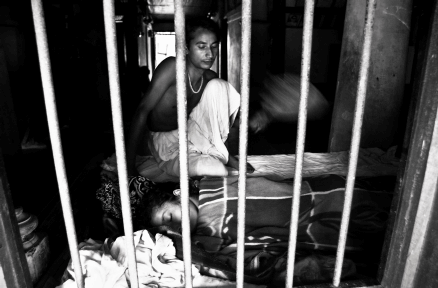
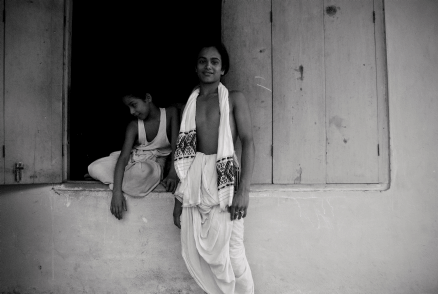
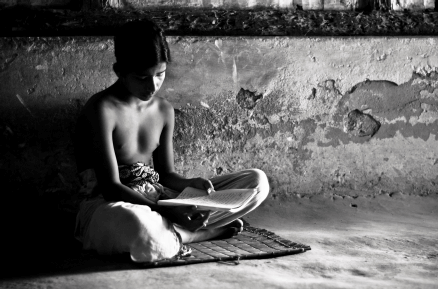
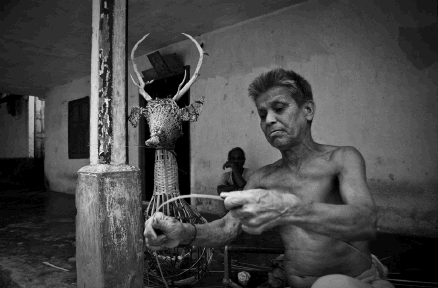
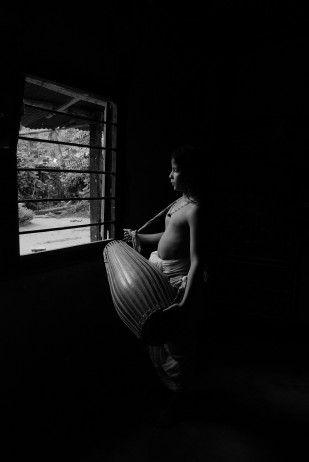
Life in a sattra. Photographs by Sunny Lamba. |
The art was transferred from generation to generation within the monasteries through a process of oral transmission. The text of the form being encrypted in memory and written on the body of the practitioner, and encoded in centuries of established practices has, therefore, a more fluid linkage with an archetype of ‘tradition’. This tradition is common to all dances in the sattras and constitutes the inviolate spirit of the dance, its non-negotiable core. As the sattra continues to be a living tradition, it is still capable of speaking for itself.
|
|
|
Sunny Lamba |
The patterns of practice of a living and lived tradition, far from being static, have changed to organic rhythms. While some of these traditions were lost over time, others have survived and often continue in ‘almost’ unchanged patterns of practice. The practice incorporates the challenge of the mastery of multiple arts and trans-gender artistry, made possible through a training involving great discipline – personal, spiritual and artistic – which was more a way of life and worship rather than a consciously structured pedagogical system.
A
t the point of its creation, this new sacred performance contrasted with the loud, drum-driven religion of Mother Goddess worship prevalent then. It would not be wrong to say that in the early days these were performances of quiet resistance. The ideology reflected defiance, going against the then current trends as it denounced animal and human sacrifice, caste concerns (not just anti-brahmanism), and advocated the vernacular, the local and a pacifist worldview that adopted an anti-‘establishment’ stance. Over time the practitioners of the religion moved from a position of social non-conformism to conformism, from royal hounding to royal founding and from penury to enjoying the benevolence of feudal patronage. These were some developments that introduced new changes in the artistry, location and context of these dances.
T
he dances of the sattras that came into being at the cusp of the 16th century were collated under the rubric of the newly minted term – Sattriya – in the second half of the 20th century, eventually receiving national recognition to join the pantheon of classical dances of India at the commencement of the 21st century. This recognition evokes a variety of questions and stirs a slew of contestations – ranging from the ownership of cultural wealth, to charges of usurpation and appropriation and the disenfranchisement and marginalization of traditional performers. A long and living tradition of orality was threatened, bringing to the fore the vulnerability of the non-textual traditional knowledge, with state patronage creating a new cultural elite that does not live by it. The decision has resulted in relocation, re-population, re-crafting and re-positioning its agenda.
|
|
|
Sunny Lamba |
The statist intervention is explained in terms of positive action directed towards fulfilling the long cherished demand of the ‘people of Assam’, which was first articulated in 1958. This argument, however, wears thin in face of the fact that this ‘altruistic’ action was conceded rather grudgingly and that too after a long period. During this period of wait, a prolonged and brutal insurgency engulfed Assam which stemmed from all-round neglect and mistreatment of this ‘frontier province’ from the cosmopolitan centre.
T
he largesse extended to these Vaishnav monasteries by the Koch and Ahom monarchies was in recognition of the role that they played in strengthening the process of state formation and in the legitimacy they accorded to kingship. It appeared at a point in Assam’s history that the Bhagawat and the sword were serving the same end – the integration of the diverse populations. Active collaboration with the royals, even though often selective, not only secured financial solvency for the sattras but also allowed them the leisure and resources to pursue spiritual and artistic activities which helped uplift their social and cultural status.During the colonial period, initially, the sattras were the only medieval institution to retain their position in the new dispensation which saw the complete marginalization of the old royal elite. However, with the coming of colonial power, many things changed. Assam’s fate was governed by economic drain and a frontier mentality. Formulating a distinct identity became a desired salve, and in the 19th century, Assam struggled to be recognized for itself, as a proud bearer of the label of Assamese. A struggle against the imposition of Bengali played itself out in many fora, in which some sattras too participated. In such sattras, plays in Assamese constituting the genre of matri bhasha natak, were written and performed. The sattras responded to the breeze of nationalism, albeit slowly. The role of sattra abbots – Krishnakant Dev Goswami, Pitambar Dev Goswami and Gahan Chandra Goswami – is well known.
T
he politicization of issues around dance, particularly the anti-nautch and anti-devadasi movements, is nothing new and became evident from the early 20th century. In the classic work on the devadasis, Amrit Srinivasan has established how by the 1920s the anti-nautch agitation had become inextricably linked up with the communal politics of the Dravidian movement.2 But the stigma that was associated with the devadasi and even the mahari of Odisha, as established by Frederique Marglin, was not experienced by the sattra monk. Scholar Dambarudhar Nath reiterates that the monk was not only socially well respected but a part of all sakam – auspicious functions – a practice that continues even today.
|
|
|
Sunny Lamba |
At the time of independence, the northeast region consisted of an expansive Assam and the princely states of Manipur and Tripura. Assam had both the largest land area and the highest density of population. At the time, Assam desired political, cultural and economic integration with the new nation, even enthusiastically accepting Hindi as the national language.
3 However, starting from 1963, Assam experienced a process of balkanization; other states were carved out from its territory as the government attempted to appease various recalcitrant tribes and communities. This resulted in a severe truncation of its land area, with its present borders being confirmed only as recently as 1987. Yet, while Assam no longer occupies the largest land area, it still has the highest density of population – ostensibly a fallout of the continuing migration from neighbouring Bangladesh that has been the cause of turmoil in much of Assam’s recent political history. All this is part of the complex political dynamics of post-colonial federalism that was also attempting to integrate a vernacular cultural expression into the rhetoric of ‘national’ culture.Soon after independence, the first National Seminar of Dance was organized by the Sangeet Natak Akademi to take stock of the dance heritage of the country.
4 The Sattriya team led by scholar Maheswar Neog, made an impressive presentation, arguing the case for its recognition as a classical form. At the time, Shanti Dev Ghosh of Shantiniketan too supported the idea of Sattriya dance being recognized as classical. In fact, he even advanced the proposition that the origin of Manipuri lay in Sattriya dance.5 In the evening, during the performance segment, though the team from Assam performed to a standing ovation, it unfortunately failed to make the cut as classical.6
|
|
|
Professor Maheswar Neog. Photo courtesy Pranavswarup Neog. |
However, in response to a demand raised at the 1958 seminar, Humayun Kabir, the Minister of Education, announced the formation of an expert committee that included Maheswar Neog, the most significant voice rooting for Sattriya’s recognition, V. Raghavan and Rukmini Devi Arundale. They recommended the inclusion of Sattriya for the Akademi awards, but not its ‘recognition’ as classical. Maniram Dutta Muktiar Borbayan became the first recipient of the Sangeet Natak Akademi award for Sattriya in 1963. It must be clarified that at that time dance awards were given by name only in the four classical dance categories of Bharatanatyam, Manipuri, Kathakali and Kathak. The award to Maniram Dutta Muktiar was offered, not in a new independent category of Sattriya, but of ‘other traditional forms’. Other dance forms, like Odissi, that successfully made its case for classical status on the same platform of 1958, raced ahead in national signification, and Assam continued to wage a losing battle for forty-two years thereafter.
Possibly in 1958, Assam’s perceived ‘irrelevance’ to nationalism – since it refused to speak the nationalist script – may have been the reason behind its failure to get the dance of the sattras recognized as classical.
7 An example of ‘not subscribing to the nationalist script’ is captured in the exchange of letters between Gopinath Bordoloi and Jawaharlal Nehru on the issue of accommodating the influx of migrant refugees from East Bengal, later East Pakistan.
I
n the years that followed, Assam became a blind spot of Indian decision makers, not just culturally but overall. The continued neglect of the infrastructure and economic development of Assam came in the way of its reaching the levels attained by the rest of the country.8 The Centre refused to play a more proactive and positive role to facilitate infrastructure development and the improvement of economic parameters. Further, the allegation that the ‘masters’ in Delhi had seriously considered the possibility of abandoning the state to Chinese aggression in 1962, fed into a growing Assamese realization of what their region meant to the nation. Even General S.K. Sinha, subsequently the Governor of Assam, admitted that ‘the Chinese aggression created new injuries.’ This, in a sense, was a repeat of what had happened in 1947 when Nehru by accepting the Grouping Plan, had said that Assam must make some ‘sacrifice’ for India’s independence.9 Subsequently, though several efforts were made to whitewash that moment,10 it continues to have a deep hold on the psyche of the people.11
|
|
|
Sunny Lamba |
The subsequent ‘balkanization’ of Assam, the economic neglect and the imposition of coercive measures in the name of the bugbear of the ‘security scenario’ – all contributed to converting Assam in the last quarter of the 20th century into an embittered area, in the throes of a secessionist youth-led movement that started in the 1970s. The immediate trigger was the migrant question, but behind its brutality and trauma was the anger of deliberate neglect and an asymmetrical relationship that had reached a flashpoint. Soon the popular unrest came to be controlled and directed by the most prominent insurgent group in Assam, the United Liberation Front for Asom (ULFA), which demanded secession from the Indian state. It was in response to this turbulence that Rajiv Gandhi signed the Assam Accord in 1985, after which in the same year, the Asom Gana Parishad became the first non-Congress party to come to power in Assam, and it did so on the issue of foreign nationals.
The issue continued to fester and in 1998, the then Governor of Assam, Lt. Gen. (Retd.) S.K. Sinha, wrote a letter to the President of India in which he said, ‘The dangerous consequences of large scale illegal migration from Bangladesh, both for the people of Assam and more for the nation as a whole, need to be emphatically stressed. …the spectre of the indigenous people of Assam being reduced to a minority in their home state looms large. Their cultural survival will be in jeopardy.’
12
A
perusal of entitlement politics played out in the northeast region proves that appeasement has become a convenient political tool in dealing with the uncertainties of politics. The attempt to respond to the demand of Assamese federalism and diffuse the dissatisfaction of its people, resulted in the Assam Accord of 1985,13 which included a strong cultural component. Articles 6 and 7 of the Accord specifically hightlight that ‘Constitutional, legislative and administrative safeguards ...shall be provided to protect, preserve and promote the cultural linguistic identity and heritage of Assamese people’ and that ‘the government shall take this opportunity to renew their commitment for the speedy all round economic development of Assam, so as to improve the standard of living of the people.’ These two articles recognized that the Union government had, in a sense, accepted the charge of neglect of Assam, and that henceforth the Assamese people would be given special signification in a pan-Indian context with respect to their cultural status.In the field of culture, the process began with acknowledging the centrality ascribed to Shankardeva who had been hailed by the Governor, Gen. S.K. Sinha, at his swearing-in ceremony itself, as an icon of Assam and a ‘national hero of India’.
14 This was reinforced by the President of India in his speech on the occasion of the inauguration of the Srimanta Sankaradeva Kalakshetra in Guwahati in November 1998. Barely two years later, when Assamese icon Bhupen Hazarika was Chairperson of the Sangeet Natak Akademi, on 15 November 2000, incidentally just two weeks after Irom Sharmila began her still continuing fast against the AFSPA, Sattriya, the dance form created by Srimant Sankaradeva five centuries earlier for the promulgation of his new faith, was finally and formally accorded national recognition. Could it then be concluded that politics, rather than artistic merit, was behind the recognition of its dance form?
T
he process of revising history, replacing the dramatis personae, appropriating cultural property and overriding memories is not new. Nation-states invest through many interventions in the production, mobilization and disciplining of memories to introduce a desired order and coherence. This helps mobilize the past within the statist rhetoric, constituting a very conscious weaving in of the past into the imagination and concerns of the present. Hence, when Sadir was reworked, starting from its naming as Bharatanatyam, the agenda was clear – as a product of the politics of nationalism, it was to be a reflection of the Indian state, Bharat.It is evident that dance has served the requirements of the nation by becoming one of the cultural instruments for crafting the modern Indian nation. The western labelling practices, favouring positivist categories for both folk and classical forms, were employed in the early years of the modern nation to project India globally as a young nation with an old culture. The classical was seen as fixed, constituting the ‘unity’ end, while folk was to represent the dynamic ‘diversity’ end of the dictum of ‘unity in diversity’ on which a plural India sought to carve out its nationalist position. The definition of ‘classical’ in the case of dance has been analyzed by Indian dance scholar Kapila Vatsyayan with reference to its links with textual and visual arts traditions in preference over living cultural practices. This hermeneutic move created the ‘classical’ as the privileged category in performance, even though, because of fractured histories, this category is not so much classical as neo-classical.
T
here is much to learn from Foucault’s theory of governmentality – a neologism created by him to describe those techniques of governmentality that appear to be pro-people at large, but invariably generate suitable conditions for privileging a certain group, which enjoys, as a result, access, equity, empowerment and the divination of opportunities to appropriate and exercise cultural leadership. Through refined technologies of subjectification, it is made to appear that the course of action is being directed by the subject population themselves for their own good. This is achieved through the subtly persuasive capacities of the neo-liberal state that resists attritional binaries, but manages to find a balance in an accommodative space. Thus, far from being a refuge from the political, culture is also the space within which politics plays out. So, the question remains: Did Sattriya lose out on getting recognition in 1958 because it was lacking in value or valorization? My position is clear.
Footnotes:
1. Kapila Vatsyayan, A Study of Some Traditions of Performing Arts in Eastern India: Margi and Desi Polarities. Banikanta Kakati Memorial Lectures, Department of Publication, University of Gauhati, Gauhati, 1981.
2. Amrit Srinivasan, ‘Reform or Conformity? Temple "Prostitution" and the Community in the Madras Presidency’, in Davesh Soneji, (ed.), Bharatanatyam: A Reader. Oxford University Press, Delhi, 2010, pp. 153-54.
3. This was in a startlingly different position from Tamil Nadu, where the anti-Hindi agitation commenced as early as 1937 and continued well after independence, forcing India to adopt a virtual indefinite policy of bilingualism.
4. The National Seminar on Dance was the fourth of the National Seminars of the Arts which were organized from 1955 onwards by the National Akademi of the performing arts: the National Seminar on Film, 1955; the National Seminar on Drama, 1956; the National Seminar on Music, 1956; and the National Seminar on Dance, 1958. It was held from 30 March to 7 April 1958 in Delhi and was attended by Prime Minister Jawaharlal Nehru.
5. Staff Reporter, ‘Xottriya Nas Hompoorna Hookia Shranir Bhartiyo Hastriya Nritya: Hongit Natok Acadimir Rashtiya Nritya Seminarar Dara Sekriti’, Natun Asomiya, 21 April 1958, Guwahati.
6. Ashish Khokhar, ‘1958: the First National Dance Seminar’, Narthaki, 6 December 2008. http://www.narthaki.com/info/tdhc/tdhc3.html. Accessed on 1 June 2011.
7. Dancer Indira P.P. Bora claims that ‘we could have got recognition earlier, but we lacked patrons at every level’, Times Crest, 30 April 2011. http://www.timescrest.com/coverstory/sattriya-monastic-to-modern-5280
8. Assam Human Development Report, 2003, pp. ii-iii. http://planningcommission.nic.in/plans/stateplan/sdr_pdf/shdr_assam03.pdf
9. S.K. Sinha, ‘Violence and Hope in India’s North East’. http://www.satp.org/satporgtp/publication/faultlines/volume10/Article1.htm. This paper is based on the inaugural address delivered by HE Lt. Gen. (Retd.) S.K. Sinha, Governor of Assam, at the seminar on ‘Addressing Conflicts in India’s North East’ organized by the Institute for Conflict Management, 25-27 June 2001, New Delhi.
10. It was soon after the Chinese aggression in December 1962 that Bhupen Hazarika was sent on a mission to assuage the bruised sentiments of the local people who bore the brunt of the armed misadventure of the neighbouring country and to restore the confidence of the armed forces through the healing touch of music. It was there that he wrote his moving ode to the fallen soldier, Koto jowanar mrityu hol (Grieving about the soldiers killed by the enemies) that does not cease to bring a tear to the eye even after half a century. Hazarika’s left leaning idealism changed after the Chinese attack.
11. The issue was recently raked up again during the Bangladesh visit of the prime minister where he inked the land pact. The Assam Tribune wrote that the Congress, it appeared, was ‘trying to hand over Assam to foreign countries. During the partition of the country, efforts were made to hand over Assam to East Pakistan, which was thwarted by Gopinath Bordoloi and then during the Chinese aggression, the then Prime Minister Jawaharlal Nehru wanted to give Assam to China. But after the failure to do so, the Congress has now handed over a portion of land to Bangladesh’, The Assam Tribune, 8 September 2011.
12. Letter of Governor of Assam, Lt. Gen. S.K. Sinha, to the President of India, 8 November 1998. http://www.satp.org/satporgtp/countries/india/states/assam/documents/papers/illegal_migration_in_assam.htm (accessed on 9 October 2011).
13. Appendix VI – text of the Assam Accord.
14. Lt. Gen. S.K. Sinha, Guarding India’s Integrity: A Proactive Governor Speaks. New Manas Publications, Delhi, 2009, p. 84.