Who is ‘the people’?
MANAS RAY
PERHAPS the greatest riddle of democracy lies in the expression, ‘the people’: democracy’s raison d’être, the source of its dynamism and moral standing, is however also ever illusive. A scene from Calcutta shortly after the Partition: Apparently one Aswini babu of the accounts section of a central Calcutta college would come out to the long steps in front of the college building during recess hour and yell in his East Bengal dialect, a voice laden with despair: ‘Janagan, chokkhe ki dekhona ki choilshe!’(Janagan, can’t you see what’s happening in front of your eyes!) His voice floated vacantly and was lost in the teeming footfalls of the Calcutta afternoon’s thoroughfare. Janagan never answered back.
We all, each one of us, are ‘the people’, yet no one is. If the singular, the real-life flesh and blood human indicates to the finitude of the concept, then ‘we’ as collectivity points to its infinitude. In other words, only by bringing finitude and infinitude at one place can one understand ‘the people’. Because of this magical mix, ‘the people’ is the ever receding point of democracy; the more we try to locate it, pin it down, the more it recedes from us. This placement of democracy at the interface of finitude and infinitude is what gives the modern democratic secular state its sacredness: the modern sacred, we can say – at once immanent and transcendent. Because of this infinity again, democratic profiling of the people cannot be restricted just to the citizens.
C
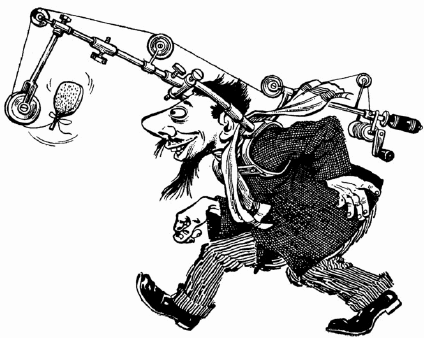
onceptually, the idea of the citizen must carry within itself a bridge to humanity at large, the ontological human where particularities are destined to meet – a move that does not reduce the importance of particularities; rather, gives it a needed, haloed ethical presence by placing them on the trajectory of universal humanity.Carl Schmitt, German legal philosopher of the early 20th century of some notoriety and belated recognition, and a few others in more recent times have discussed the constitutive influence of theology in the formation of modern secular democratic nation states. In democracy, ‘the people’ as the source of legitimation and driving force is clearly deific. One can never approximate ‘the people’; neither will it ever quit the scene. Like in khuror kal of the Bengali nonsense rhymer and artist Sukumar Ray, it will always dangle at a distance in front of you, lure you, and dangling, it will move with you as you cross miles enchanted by it.
‘The people’ in democracy and God in theocratic states have very similar architectonics and location. (Interestingly, in capital’s self-definition too, it is an ever-widening grid that no one can own.) Novelist Sunil Ganguly once commented that God is the sweetest and cruelest rumour of human societies. In line with our analogy of khuror kal, we can say that he must also be the most productive rumour, for to keep him happy the kind of labour that humans will perform and the extent to which they will go is truly amazing. To carry on with the tropes of God and ‘the people’, like practiced magicians, politicians play all kinds of bunny and hat games with the latter. The history of democracy is in a way the history of humankind being made a fool at the altar of the people.
T
he theological homology of secular democracies has been amply discussed. I would, however, suggest that what is more interesting is the opposite argument: that is, how in spite of a massive deific load, democracies can resist deific over-determination, how they manage to retain a measure of difference from the theological state. According to Peter Fitzpatrick, the well known legal philosopher, ‘(t)he deific substitutes are critical of modernity but modernity is in ways critical of, and incompatible with, them.’1 As he sees it, sovereignty’s self-generating supremacy crucially depends on a responsive incorporation and assimilation of the multitude of disparate forces that continually come to (re)constitute it. This he calls sovereignty’s ‘incipient vacuity’.2 The idea holds interesting parallels with, classically, Rousseau’s idea of the plenitude of collective presence needing an empty centre, impossible to occupy. (Incidentally, Fitzpatrick holds Rousseau as a notorious presence in the pantheon of seculartheologic apostles.)The significance of this line of analysis is that it indicates that the politics of protest and rebellions only enriches democratic rule, even if in a skewed way; in incorporating and assimilating them, sovereignty gains in comprehensiveness and dynamism. In other words, the insurrectional mode – the ever-renewed act of revolt, critique, and subversion – is part of the democratic apparatus. It ideally gathers its energy from those acts. Democracy’s etymology, demo+cracy (‘cracy’ indicating force and violent incorporation) gestures toward a necessary insurrection. The suffix ‘cracy’ has another meaning in Greek – i.e., healing. That actually completes the understanding of modern democracy: at once violent incorporation and the promise of healing.
U
nderstandably, modern democratic states have two sides to them. The first is the world of strategies, marked by ceaseless attempts to retain hegemony over myriad social relations, strife and tensions. Here Michel Foucault’s notion of governmentality comes to effect, i.e. the coming together of practices of the state in the form of local and targeted interventions with new regimes of knowledge.3 And, second, guiding such down to earth interventions is a kind of transcendence where the state is supremely the bearer of human rights of which the primary right is the right to life (translated mostly in our part of the world as right to livelihood).4 This is the moral life of the state; in upholding this right, the state is the will of the people. Because of these two streams, the citizens are both sovereign and subject to the state’s pedagogy.|
|
|
‘Khuror Kal’ in Sukumar Ray’s Abol Tabol. Illustration by Bimal Das. (Source: kolkata-online.com) |
As Ranciere points out, worried theorists (Plato onwards) saw in ‘the people’ a sign of sheer arbitrariness, the unrestricted freedom of individuals to act as they like without concern for common discipline. For Plato, democracy is the overturning of natural relations – the fathers obey the sons, the elders imitate the young, women and slaves are as free as men and masters.
5 Such phobia notwithstanding, if the larger part of the world goes for democracy, it is because in democracy people can be made to live, work and cohere more productively. The biggest challenge to democratic rule is in ground level democratic surge. Democracy thus has to constantly devise strategies to incorporate this excess that it itself throws up and without which democratic rule loses its inventiveness and, importantly, its legitimacy.
T
herefore, democracy can ill-afford to be a field of ontologies which, as a matter of fact, are better seen as rhetorical openings to different positionalities and interventions. If we believe in what French political historian Pierre Rosanvallon has to say then the answer to democracy’s durability lies in its unceasing zest to pose as an experiment. Democracy, observes Rosanvallon in his book Democracy Past and Future, rarely solves anything but makes solutions problematic and derives its energy in this very gesture of making issues problematic.6 This is its power of indeterminacy and flexibility through which it manages its citizens. If democracy seems an unsurpassable horizon of political formations even after more than two hundred years of the French Revolution, the reason, says Rosanvallon, lies here.
D
ebating issues, making solutions problematic, casting ever wider the discursive net is the key to democracy’s hegemony, its seductive power that gives everyone the feeling of being a participant. It is this promise of flexibility that lends democracy its rationale and energy, its power of indeterminacy through which it manages its citizens. And for this to happen, the citizens ought to be ‘free’. Unlike the theocratic order which is marked by the certainty of destination (in the theocratic order, origin, more often than not, is also the destination – origin is the paradise we have left behind and to which we must return), democracy draws its charge and mode of expansiveness by framing itself as a nagging quest for an ever receding destination. To Rosanvallon, democracy draws its ambulatory trait from European enlightenment, in the long history of disenchantment with religious prejudice and obscurantism. The French have a romantic mode of writing that casts a spell on the reader. Here allow me to quote from the author: ‘From democracy’s unmoored wandering has followed both a quest and a nagging absence of destination. One must begin with this fact in order to understand what democracy is: the history of disenchantment and the history of indeterminacy are bound up with one another.’7
T
he way it is framed in European theorizing, bringing together disenchantment and indeterminacy, democracy by definition carries a strain of secularism; only liberal secularism can make democracy possible. Looking closely, however, the romantic poser of uncertainty, it seems, comes with a huge certainty – the certainty of its supremacy as a system of organizing society, the certainty that every other mode is inferior, the certainty that makes going to war overseas and establishing democracy in traditional societies not only not considered wrong but, from a progressivist standpoint, unavoidable.To cut a long story short, western democracy, religious disenchantment, modernity, universal reason, progress, capitalism, and ‘the people’ – they all have coeval births, they are part of the same discursive matrix. If you don’t follow all, you cannot truly belong to any. If democracy is both the highest value and the best possible means to solve problems, then it can hardly escape a holy altruistic character, an ever repetitive reality, born a thousand times only to die in each case of its own weight. Such is its enchanting captivity that once inside the spiral of democracy one can only make complaints about democracy to the court of democracy. This is democracy’s no-exit wizardry that defines the political lives of the West, its hopes and in a way the miseries it foists on the rest of the world.
I
f democracy is rule by consent, who effectively rules then? The very ground of the power of ruling, says Ranciere, is that no ground exists; legitimacy for political governance is not along the lines of seniority, fatherhood, science, strength, et al – or what he calls, borrowing the Greek word, the arkhe of ruling. The power of demos is the power of those for whom no arkhee entitles to exercise it.8 Hence, democratic rule is all the more insidious because there is not one predefined definite ground. It is the rule of the people who have no greater qualification for ruling than for being ruled. Therefore, we would argue, democratic rule necessarily takes the form of a modern day pastoralism – a technology of care to absorb the needs and heightened expectation of the people and along with it, if required, incarceration or even termination in the name of security.Derrida highlights what he calls democracy’s auto-immunity – that is, a continuing two way process of unlimited self-criticism inherent in democracy on one side, and democratic government’s suspending democratic rights on the other, in order to protect democracy from dissolving into chaos.
9 This binary principle of endless auto-critique and fear of chaos lends itself straight to Enlightenment worries about modernity. Koselleck, perhaps the best known philosopher of the history of Enlightenment Europe in the second half of last century, reads in Rousseau the constitutive crisis of modernity along the lines of an infinitely expanding subjectivity and the need to rein it back to the centre. Prior to Rousseau, at the very dawn of modernity, Hobbes conceptualized the City as tanquam dissoluta, ‘as if it were dissolved’, gesturing to this ever renewed threat of the state of nature, which for him was not a chronological marker but an eruptive possibility of violence and anarchy needing to be tamed and constantly monitored for civilization to have any prospect. Modernity, in other words, began its journey as war on terror.10
F
or democracy to pave a way out of its solipsism, its extreme preoccupation with itself, it must open up to its otherness, an impossible inclusion that marks the horizon of ‘democracy to come’. Derrida’s is not a feasibility agenda; otherwise one could have explained his position as what democracy cannot incorporate but must always try to, thus ever stretching the limits of the possible. Democracy is haunted by the other; this symptom is constitutive. If liberal democracy is, as imagined by Margaret Canovan, a garden in the midst of a jungle, then it effectively lives on the threshold, always anticipating encroachment and attack.11 To Ranciere, the political in democracy lies in the displacement of settled limits by the eruptive excess which enacts the equality of anybody with everybody else. We would like to maintain that the political is the interface of recalcitrance of the population and the governmental interventions to assimilate it by extending the bounds of the legal, for it is here, in this fuzzy zone, that the social is extended by the contested creation of new meanings.
S
ingularly, an individual can be corrupt but ‘the people’ as a collectivity can never be said to be so. While it is individual lives that in the last analysis count, it is collectivity that gives democracy its species character. The ballot box as the principal instrument of parliamentary democracy is a symbol of democracy’s legitimacy. Magically, to go by the logic of democracy which places its main significance in safeguarding the rights of minorities, electoral representation ought to uphold an ethical promise far beyond the number game. The victorious candidate is not only the representative of her party and those who have voted for her, but of the entire electorate. Even if the win is at a 51-49 margin, the one who wins is equally a representative of all. This is not so much a technical or tactical question about which sections of the electorate to woo so that a win is ensured in the next husting as well, but fundamentally an ethical position without which democratic representation becomes meaningless. This is the Achilles heel of modern electoral democracy. No matter how one might have won, one represents, and should be fair to, the entirety of ones electorate.To remain true to this symbolic value of representation, people – I mean, real-life people – must be on the alert. Therefore, right from the beginning of parliamentary democracy, a number of checks and balances and ways of applying the brakes have been devised. Voting attributes to democracy juridical legitimacy. But this cannot be an entire assurance for the life of democracy. Along with juridical legitimation, there is a mobilization of trust to counter the erosion of confidence in the democratic process. This is a complex assortment of practical measures, along with the informal as well as institutional social counter-powers to challenge and combat the trust deficit in a functioning democracy. Rosanvallon calls this process ‘organizing distrust’. It comes from the understanding that regimes based on general will could go astray. It makes sure that elected officials keep their promises and find ways to maintain pressure on the government to serve the common good. Its common measures are powers of oversight (vigilance), forms of prevention, and testing of judgments. Calling this counter-democracy, he explains it in the following way:
‘By "counter-democracy" I mean not the opposite of democracy but rather a form of democracy that reinforces the usual electoral democracy as a kind of buttress, a democracy of indirect powers disseminated throughout society – in other words, a durable democracy of distrust, which complements the episodic democracy of the usual electoral-representative system. Thus counter-democracy is part of a larger system that also includes legal democratic institutions.’
12
I
n Indian politics, the Aam Aadmi Party is the first major political party based on the promise of what Rosanvallon characterized as counter-democracy – the democracy of vigilance. It is also remarkable how people across class and social divides voted it to power.But by and large people vote not so much for issues or the candidate; one votes for one’s own party, which stands for a set of interests and gives the voter an identity. Michigan Paradigm, a study conducted nearly thirty years back, clearly showed that voters choose on the basis not of their political knowledge, which is minimal, but rather of partisan identities that they acquire early in life. Quite often the allegiance to any one particular party becomes a matter of block voting. After the last Lok Sabha election, a victorious candidate from Maharashtra was seen to be walking around his constituency wearing a shirt made of gold and having three gun-toting men as his escorts. Once the picture became public, there was some controversy. But the MP was undeterred, as were his supporters. In all likelihood, if there were a fresh election around that time, he would have once again been victorious. For his voters, he is the sign of historical injustice committed against them and also the means for achieving positive discrimination in present times and setting the score right. Surely it is not he but what he represents for them that would count. His personal practices would be seen as nodes in a symbolic contest of history.
D
rawing clues from the above discussion, it can be said that at the moment we are witnessing two opposing trends in Indian democracy. One is of block voting and the other of surveillance. I want to enlist two related trends – that of supra-democracy and counter-democracy. As categories, they are flexible and one can take the place of the other. Nonetheless, there is a conceptual difference between the two.Here, let me make clear, I am using the terms differently from Rosanvallon. Supra-democracy, in the way I am using it, is born of the people’s disillusionment and lack of trust in the prevalent mode of governance. What Rosanvallon has called counter-democracy in his book is, in our consideration, supra-democracy, because surveillance is its main plank. What I am calling counter-democracy, on the other hand, is the product of powerlessness and marginalization of a large section of the populace. It is effected by attacking the institutions and protocols of democracy. Usually the supporters of these movements come from the underdogs of the city. As examples, we can cite those who participated in the movement to oust Tasleema Nasreen from Calcutta or those who vandalized the paintings of M.F. Husain in Mumbai. Here the issue is one of staking claim not only to the city, but over the city by those who have been traditionally kept outside the effective folds of politics.
I
n a democracy, people make a plurality of demands. When the demands are sifted into their specificities and dealt with separately, they remain within the proper fold of democracy. But when demands are persistently neglected, multiple frustrations trigger social logics of an entirely different kind. These demands then, argues Laclau, form a composite through equivalential links. The subject of such composite, equivalential demands is populist. There is a sense in Laclau that in modern day democracy, only populism is pro-people, addressing as it does the needs of the underdogs. When demands are in separate fragments, it is easier for the state to take a clientalistic approach. Populism alone offers a sense of the people through aggregation, where horizontal, synchronic demands become vertically integrated into a popular will.For Laclau the grand example of populism through a logic of equivalence is the Solidarnosc movement, a political whirlpool of sorts that rapidly converted the demands of a particular working class group in Gdansk into the signifiers of multiple frustrations and grievances of ordinary Polish people. In contemporary Indian history, the Singur-Nandigram movement can serve as a parallel example. There the popular protests of peasants against forceful eviction from land soon transformed into a mega-text for the cumulative grievances of the rural population against the long rule of the Left Front. Populism also needs the foisting of an enemy, responsible for all the miseries of the people. For Bengal at that point of time, it was the CPI(M), its leaders and the cadres.
T
o Laclau, more than the contents of the demands articulated, it is the prevalence of equivalential over differential logic that demarcates a movement as populist as against democratic. However, he admits that quite often the actual social demands are repressed by the violent imposition of the dominant equivalential discourse. This, in a way, is an admission that there is clearly an anti-people element in populism; its ad hoc approach to problems and mode of dispensing immediate gratification does the people harm in real terms. Regardless, Laclau maintains that only populism attributes the underdog the agency of history, something not possible through procedural-democratic means.Here a disclaimer is in place. By underdog as history’s agent, Laclau does not proclaim the unmediated universality of the proletariat, the secret of whose existence is the dissolution of the hitherto world order. The proletariat in Marxist literature is a negative sign, a charged emptiness vowed to recast history. What Laclau means by history’s agency is the ability to make the ruling class meet the demands of the underdogs in concrete terms. Questioning the institutional order of liberal democracy, he is ‘an agent which is an other in relation to the way things stand.’ Since the logic of equivalence is also at the heart of the principle of representation, Laclau will claim a generic similarity between populism and ‘the people’ as a construct: ‘(t)he representative matrix out of which the "people" emerges: a certain particularity which assumes a function of universal representation; the distortion of the identity of this particularity through the constitution of equivalent chains; the popular camp resulting from these substitutions presenting itself as representing society as a whole.’
13
B
ut is Laclau correct to claim equivalential logic as the fundamental trait of populism? Not at least if one goes by the contemporary history of political mobilization in India, where more than a variety of groups coming together with a smorgasbord of demands and complaints and forming a complex of ‘people’s demands’, what is prevalent is the indulgence of the ruling parties in populist measures. To cite certain instance from today’s West Bengal, under the TMC government: distributing cycles among rural school-going girls, introducing salary of local Imams, doling out money to ground level party cadres in the name of giving grants to local clubs (many of which come into being only at the time of receiving the money). Here, more than responding to unattended ‘people’s demands’, one needs to understand that these demands are formed only in the process of announcement of the awards.Mamata Banerjee, who came to power in 2011, riding on the crest of an exceptionally successful anti-eviction campaign by her party, made it her official policy to disallow government role in land acquirement for commercial or other purposes, thus making procurement of land de facto impossible in a state where land is highly fragmented. Consequently, investment and job creation have taken a sharp jolt. Banerjee does not have the good fortune of having an identifiable ‘enemy’, one who can be held responsible for the state’s miseries. Decrying the left does not yield much purchase four years after its resounding defeat.
Threatened by the prospect of exposé of Saradha scam and geared by the hope of a friendly government at the Centre during the conduct of the next assembly election, she cannot afford to antagonize the BJP beyond a point. For her, the only way out is to appease the people by continuing with a slew of ad hoc populist measures to different sections of population. In the absence of a powerful opposition (which is an onerous task given the credibility deficit and ongoing coercion), ordinary people become used to restricting their hopes to occasional gratis in a scenario of internecine strife and poverty.
A
distinction between popular and populist demands is perhaps in order here. Kejriwal’s AAP swept the assembly polls not by promising money to the voters, or money to the local clubs for entertainment, but by promising better municipal schools, cleaner and registered slums and better health care for the poor. If local people agitate for a cluster of demands – better street lighting, more drinking water, repair of roads, and police action against criminal elements – merely the equivalential character of demands does not make the agitation populist. Regardless of the logic of equivalence, it should qualify as a popular movement because they address the genuine needs of the people. The poor in India – be it in the urban slums or in the dusty villages – are the main votaries of modernity. This is the prime effect of India’s democracy. They fight for their rights, primarily the right to livelihood, which the politicians try to give a populist angle for their partisan benefits.
P
assive revolution under conditions of electoral democracy makes sure there is a transfer of resource from corporate accumulation to the livelihood needs of India’s burgeoning poor, many of whom have been left landless and jobless due to the operations of primitive accumulation. These people (only formally citizens) live outside the effective reach of civil society. This is the section of population that political theorist Partha Chatterjee calls political society. The concept owes its life to democracy which assures everyone a vote, and thus translates its legal-social marginality into a potent political factor.14The section that is hurt most by rampant corruption is of course the poor. But its own livelihood, ironically, quite often lies in fuzzy legal zones. This is not, however, corruption for greed, like the cops who extort hafta from these people, but corruption for sheer existence. Political society, says Chatterjee, operates as a community, but it is a contingently constructed community. Its main purpose is to negotiate with governmental agencies its moral right to livelihood from its location of fuzzy legality. From the side of the government, the thrust here is to provide biopolitical security to the economic underdogs. The deep penetration of governmental technology ensures that these people rely less on local fixers or are no more caught in a patron-client relationship with the powerful.
Following this line of analysis, it can be said that there are clearly two registers of India’s democracy today: if electoral mobilization gives political society its life, then the bureaucratic-managerial class, print and visual media, and the judiciary provides civil society its clout. It is through the combined labours of these professionals and media channels that corporate capital exerts its sway on the Indian state.
15
W
hether this two-prong pattern will work for long and with what degree of neatness is a matter of speculation. Here a caveat needs to be added about the continued use of the expression ‘primitive accumulation’. Classically, resettlement was not an agenda for primitive accumulation. In India, throughout British rule and even in the first three decades of independence, this too was the case. But in recent years, land prices in India have skyrocketed and are now the highest in the world. As Sanjoy Chakravorty’s work demonstrates, if land were to be taken in Singur after the Right to Fair Compensation and Transparency in Land Acquisition, Rehabilitation and Resettlement Act, 2013 (LARR), what was 10 lakh per acre in 2007 would now effectively cost Rs 85 lakh. This exceedingly high price has invited a nexus of politicians and local real estate mafia, or what is called in newspaper and social media, ‘syndicate raj’. Such a turn of events is likely to recast the corporate capital/political society equation in the coming years.A notion is increasingly gaining strength with its contemporary lineage going to the Club of Rome’s influential report, Limits to Growth which argues that given the levels of technology and also the propensity to produce more value added commodities (which fetch more profit), at least one third of the world’s population is becoming redundant, both as labour and market. This implies a fortified accumulation economy along with a huge hinterland of need economy. Binding the two spheres is the new industrial-commercial public sphere that unlike the classical public sphere, exploits the lived experience of everyday life as its raw material and provides a tapestry of dream fulfilment that these days quite often runs in the line of a flesh hunt. This would also mean a democratic rule of arbitrary care and a termination and ceaseless production of detritus. This is fast becoming the face of post-colonial neo-liberalism.
The day Lalmohan Tudu, the Maoist leader from Midnapore, was shot in his eyes and killed, the same police force which killed him also made sure that his daughter was escorted to the local Ram Krishna Mission school for her Madhyamik examination. Mike Davis in his book, Planet of Slums, calls this production of detritus ‘surplus humanity’ which he initiates as a critique of neo-liberal economy and also as a statement of facts.
16
I
n Politics of the Governed, Partha Chatterjee shows how the inhabitants of a rail line bustee, people whose very habitation or livelihood stood on the other side of legality, managed to make para-legal arrangements with the state. This example is well known. But the one that is seldom cited is his other case study of the coalminers of Raniganj, who showed little or no interest in a rehabilitation project, even though they lived dangerously with fires breaking out any time and any where in their living surroundings. Used to living on the brink of death, it appears that the zest for life has left them. They are the living dead of India’s democracy.
Footnotes:
1. Peter Fitzpatrick, Law as Resistance. Ashgate, London, 2008, p. 294.
2. Ibid., pp. xxi-xxii.
3. Michel Foucault, Security, Territory, Population. Picador, London, 2009.
4. Michel Foucault, Birth of Biopolitics. Picador, London, 2010.
5. Jacques Ranciere, ‘Does Democracy Mean Something?’ in Costas Douzinas (ed.), Adieu Derrida. Macmillan Palgrave, London, 2007.
6. Pierre Rosanvallon, Democracy Past and Present. Columbia University Press, New York, 2007.
7. Ibid., p. 37.
8. Op. cit., fn. 5.
9. Giovanna Borradori, Philosophy in the Time of Terror: Dialogues with Jurgen Habermas and Jacques Derrida. University of Chicago Press, Chicago, 2004.
10. Reinhart Koselleck, Critique and Crisis: Enlightenment and the Pathogenesis of Modern Society. MIT Press, Cambridge, Massachusetts, 1998, p. 8.
11. Margret Canovan, Nationhood and Political Theory. Edward Elgar Publishing, Northampton, USA,1998.
12. Pierre Rosanvallon, Counter-Democracy: Politics in the Age of Distrust. Cambridge University Press, New York, 2008, p. 8.
13. Ernesto Laclau, ‘Democracy and the Question of Power’, Constellations 8(1), 2001; Ernesto Laclau, ‘Populism: What’s in a Name?’ in F. Panizza (ed.), Populism and the Mirror of Democracy. Verso, London, 2005.
14. Partha Chatterjee, Politics of the Governed: Reflections on Popular Politics in Most of the World. Columbia University Press, New York, 2006.
15. Partha Chatterjee, ‘Democracy and Economic Transformation in India’, Economic and Political Weekly 43(16), 19 April 2008.
16. Mike Davis, Planet of Slums. Verso, London, 2007.