Misplaced reforms
JANDHYALA B.G. TILAK
HIGHER education is in crisis, not just in India but in the region as a whole. The crisis is not what Phillip Coombs
1 identified in the 1960s, or the ‘continuing crisis’ of the kind J.P. Naik described.2 Nor is the issue that of numbers, or finances, or even quality and relevance. While these are important associated features, the crisis is deeper, better described as an absence of policy and/or misguided policy. Our governments have adopted a laissez faire approach – a policy of non-intervention in higher education – preferring to run the system via executive orders and quick-fix solutions which suffer from a lack of coherence and consistency in approach with no long-term perspective.Despite differences, the South Asian countries share several common features; the nature of problems they face is similar as are the policy approaches being adopted. This comes as no surprise since the countries are not only geographically knit together, but also share a common history, colonial legacy, and common heritage and culture. Demographically, the region has both some of the smallest countries of the world as well as the largest. Politically, though constituent country each claims to be a democracy, the quality and functioning greatly varies. Finally, each country is marked by uneven development.
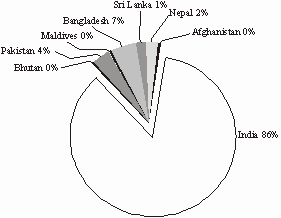
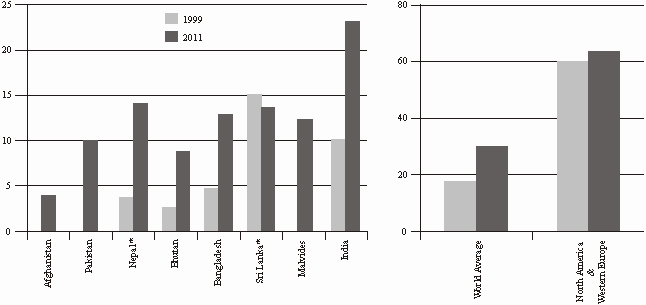
In terms of size, India has one of the largest systems of higher education in the world, with about 21 million students accounting for 86% of the total enrolments of the region in nearly 700 universities and 40 thousand colleges. Bangladesh and Pakistan are a distant second and third, with 2 and 1.8 million students respectively in higher education. Student numbers in Sri Lanka (0.23 million) and Nepal (0.39 million) are very small while Bhutan with only one university and Maldives with none rank at the bottom (Figure 1). The gross enrolment ratio ranges from about 10% in Pakistan and Afghanistan to above 20% in India, far below the ratio in many advanced counties; the world average being 31% with even the average of the developing countries being 25% (Figure 2).
|
FIGURE 1 Enrolments in Higher Education, 2010 |
|
|
|
Source : UIS (2013, 2014). |
Thus in relation to both the population and socioeconomic needs, and in comparison with other countries/regions of the world, the South Asian countries have rather small systems of higher education. Normally, a 30-40% enrolment ratio is considered as a threshold level for a country to prosper economically, socially and politically.
3 Moreover, the spread of higher education remains extremely uneven, both within each country and between the countries of the region. Finally, the gap between South Asian countries and other regions/countries is widening.
|
FIGURE 2 Gross Enrolment Ratio in Higher Education |
|
|
|
Source : UIS (2014) |
A predominant share of the higher education systems in South Asian countries is accounted for by undergraduate enrolments. Enrolments in the Masters and research programmes are small. Only about 10% of the enrolments in Sri Lanka and 18% in India are in the Masters’ programmes, while in Nepal, Pakistan and Bangladesh the corresponding proportion is 20%. These figures may be contrasted to 35% for Hong Kong. Enrolments in doctoral programmes are infinitesimally small in South Asian countries.
4 In this sense, higher education remains confined mainly to teaching at Bachelor’s level programmes.The countries of the South Asian region fare unfavourably not only in terms of quantity, but also in quality and equity dimensions of higher education. The low and declining quality and standards in higher education is visible in many ways. Our universities rank poorly in international rankings. Barring a few, no higher education institution of the region features in any of the global rankings of the universities, e.g., the Academic Ranking of World Universities, the Quacquarelli Symonds Rankings or the Times Higher Education World University Rankings. And those like the Indian Institutes of Technology in India that do, fall in the lower half of the top 400. Further, inequalities in participation in higher education by gender, social groups and between the poor and the rich and between rural and urban populations are marked, though of late some progress has been made, particularly in gender terms. As described in the Economist, there is a ‘quiet female revolution’ in higher education in some South Asian countries, but with respect to other dimensions, progress is limited.
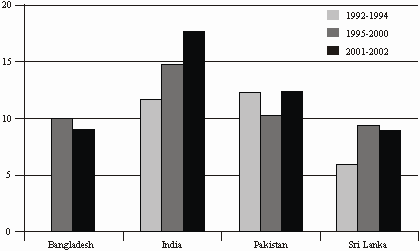
5All the countries in the region have under-invested in higher education, as evident in the estimates of rates of return. Not only are rates of return on higher education higher than for secondary and primary education, they generally show an increasing trend over the years. The available estimates of rates of return, with all their limitations, make clear that investment in higher education benefits society as a whole not just individuals; incidentally investment in women’s education is even more beneficial (see Figure 3). It is also clear that supply has not sufficiently responded to the growing demand, and that there is need for further investment and expansion in higher education.
6
|
FIGURE 3 Rates of Return to Tertiary Education in South Asia |
|
|
|
Source : World Bank (2007). |
P
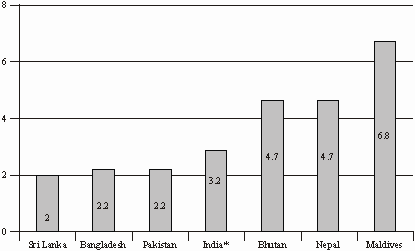
aradoxically, rates of graduate unemployment are high in many South Asian countries – 12% in India, 9% in Sri Lanka, and 8% in Pakistan; they are relatively low only in Bangladesh.7 On the whole, the rates of unemployment are higher among the more educated, increasing at higher levels of education (except in Sri Lanka); barring Bangladesh they reflect an increasing trend. It must however be noted that rates of unemployment are high only in the initial years, significantly falling subsequently, suggesting that high initial rates of unemployment should not detract the state from making heavy investments in the sector, as it is not higher education that creates unemployment.Despite the broadly accepted norm of spending at least 6% of national income on education, no country in South Asia except Maldives comes anywhere near that level. India spends about 3.5% of its GDP; Nepal and Bhutan spend a higher proportion, while Sri Lanka, Bangladesh and Pakistan allocate a low 2% to 2.2% of their respective GDP (Figure 4). Thus, financial priority for education remains lower than expected.
|
FIGURE 4 Public Expenditure on Education as % of GDP on Education, 2011 |
|
|
|
Source : UIS (2013, 2014) |
It is insufficiently appreciated that public expenditure on education matters significantly. Expenditure on tertiary education as a percentage of GDP is positively related to the gross enrolment ratio in higher education in several OECD countries. In fact, the simple coefficient of correlation is higher in case of public expenditure and enrolment ratio than between private expenditure and enrolment ratio.
It is important to distinguish between private and public expenditure on higher education as they have dissimilar effects. Many expect an increase in private expenditure to benefit the higher education sector, assuming a complimentary relationship between government and private expenditure. Such an assumption does not hold, at least in South Asia. If at all, in South Asia, they substitute each other during a phase of increased government expenditure, and they may be positively related at times when the government cuts its allocations to higher education.
When government expenditure on higher education increases, the private sector generally withdraws resources. For instance, if government grants are plentiful, the private institutions cut back on spending. If, however, the government reduces its expenditure on higher education, the private sector does not feel compelled to proportionately raise its own resources, or even improve the efficiency of its expenditures given the decline in government grants. In either case, with the entry of the private sector, the total resources available to higher education may not necessarily be higher than earlier. To state it sharply, the gap created by reduction in public expenditures is rarely filled by the private sector.
A trend decline in the levels of public funding of higher education is often accompanied by several ‘direct’ measures of cost recovery – raising student fees and user charges, promoting educational loans, introducing self-financing courses, and so on. Almost all the countries in the region have raised tuition fee levels, with few exceptions, viz., Sri Lanka continues to offer postgraduate programmes without charging tuition fees. India has considerably raised tuition and other fees during the last quarter century, as have Pakistan and Bangladesh. In addition to tuition, many other user charges have been introduced in higher education institutions.
I
ndia restructured its educational loan programme in the early 1990s. Countries where loans are not so popular (Pakistan and Bangladesh) have also introduced educational loan programmes. A student loans scheme was launched by the Government of Pakistan in 2001-02 in collaboration with major commercial banks to offer loans to the meritorious and needy students for scientific, technical and professional education within Pakistan. Sri Lanka has also recently introduced educational loan programmes. In all cases, commercial banks – public and private sector – who operate these loans are more concerned with commercial viability and efficiency than with any educational issues. In practice, most loans are made available to students primarily for programmes that ensure quick and remunerative employment. Pakistan does offer interest free loans to all, while India offers an interest subsidy only to the weaker sections. But for such marginal correctives, the adverse effects of these cost-recovery measures are increasingly overlooked.
T
he relative decline in public expenditure on higher education has affected several other dimensions of higher education. One dimension which has suffered the most is teacher recruitment. There has been no recruitment of regular faculty for several years, resulting in severe stagnation in the stock of teachers. In India, there has been no recruitment in several state universities and some central universities for over 15 years. With no increase in faculty strength and multiplying student numbers, the universities are forced to temporarily recruit persons best described as ‘para-teachers’, a term that was earlier used only for school education. Recruitment of para-teachers – under-qualified, underpaid and subjected to unfair service conditions – in higher education has been a marked phenomenon from the 1990s onwards. In fact, many universities in the region today have more para-teachers and contractual staff than regular teachers.All the countries of the region face a severe shortage of teaching faculty, with vacancies ranging between 30 to 70% in several universities. With a large number of vacant teaching positions filled by para-teachers, both the quality and quantity of higher education expectedly suffers. As a consequence, the academic profession, despite a steep rise in pay and remuneration in countries like India, has increasingly become unattractive. Moreover, teacher recruitment is not merely a question of finance; it has political ramifications in many countries of South Asia, as teachers also serve as vote banks. All the higher education systems in the region are highly politicized and almost every facet of higher education is intractably related to political factors.
With a rapid growth in the demand for higher education – not matched by public expenditures – countries in the region have begun placing heavy emphasis on open learning systems as a viable method of massification of higher education. Open learning systems are seen as resource-saving for the governments and revenue generating for the institutions; they also require fewer teachers. India’s Indira Gandhi National Open University has emerged as one of the largest open universities in the world. Other countries in the region also boast of large open universities. Apart from the Allama Iqbal Open University in Pakistan, Open University of Sri Lanka, and Bangladesh Open University, Nepal has also taken steps to set up an open university. Moreover, many conventional universities offer degree and diploma programmes in distance mode.
A
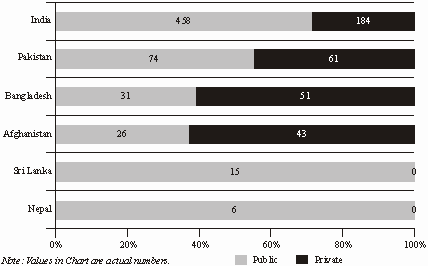
major phenomenon of the last quarter century is the alarming growth of private – fee-charging – institutions of higher education. With philanthropy on the decline in many countries, the profit-seeking private sector has emerged as a major player in higher education. Today, when one speaks about private education, it is not the initiatives that we were familiar with for a long period –philanthropy-based private education institutions, not motivated by profits. Today, by private sector one means only the business-oriented, profit-motivated private sector. This trend captures the shifting relative balance in favour of the private sector and a significant diminution of the public sector.In Pakistan, private universities emerged in the mid-1980s and in India, in the mid-1990s. Currently, Pakistan has 61 private universities and 74 public ones (Figure 5). In Bangladesh there are 51 private universities, compared to 31 in the state sector.
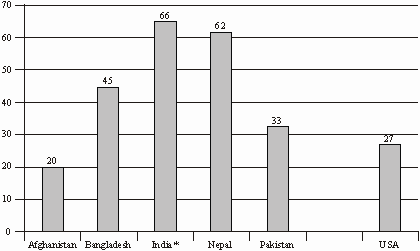
8 According to recent estimates, there are 191 private universities in India, accounting for a third of the total number of universities;9 but at the college level, nearly two-thirds of the nearly 40,000 colleges are in the private sector. In all, there are nearly 30,000 private institutions of higher education, compared to 16.7 thousand public institutions in India.10 As high as 60-70% of the enrolments in India and Nepal and above 40% in Bangladesh are in private institutions, compared to about 25% in a country like the USA (Figure 6). On the whole, some South Asian countries like India today have a more privatized higher education system than many other parts of the world, including the USA.11 Sri Lanka and Nepal are an exception; so far they do not have private universities though Sri Lanka has a few unrecognized private institutions. Both Sri Lanka and Nepal also lack a legal framework to establish private universities.
|
FIGURE 5 Distribution of Public-Private Universities in South Asia |
|
|
|
Source : Economist (2013) and India: MHRD 2014. |
A
decline in public expenditures on the one hand, and introduction and/or restructuring of cost recovery measures such as student fee and educational loans on the other, has pushed the universities into focusing on some disciplines of study to the neglect of others. There is an undue emphasis on information technology, engineering, management and commerce courses; humanities, social sciences, natural and physical sciences face increasing neglect. The liberal arts programmes have already disappeared in many places reflecting low, demand or public support, despite being inexpensive. As a result, many universities in the region have virtually closed down some of these departments/schools. Private institutions also focus on revenue generating departments and market relevant areas of studies, and not disciplines that are important for the holistic development of higher education. On the whole, countries seem to forget that to build a humane society we need not only technicians, scientists, doctors and engineers, but also good social scientists, philosophers, language and culture specialists, artists and critical thinkers.|
FIGURE 6 Private Enrolments % in Total Enrolments in Higher Education, 2010/11 |
|
|
|
Source : UIS (2013, 2014). |
How do we explain the apathy for higher education in South Asian regimes. Under the neoliberal policies that were introduced in the late 1980s and early 1990s, governments decided to slash grants, disinvest in higher education, and encourage the growth of private higher education, even when aware of the consequences of such policies. In part this reflects a decline in fiscal capacity of the governments, dampening willingness to spend on sectors like higher education, claiming serious shortage of resources. While neoliberal policies have no doubt played a part, it is the government’s unwillingness to invest in higher education that is responsible for the overall neglect. Governments feel that there is no need to spend on higher education; that either parents and others will spend, or that it can be ignored with no serious cost to the society.
A
more serious development than these two relates to the faulty assumptions about the role of higher education. It is widely believed that: (i) More than higher education, it is primary education and literacy which matter for development – be it economic growth, reduction in poverty or improvement in income distribution. The estimates on rates of return to education have also contributed to this misconception. (ii) Not only has higher education expanded in our countries at the cost of basic/elementary education, goals with respect to basic education cannot be accomplished unless resources are diverted away from higher education. (iii) Higher education has over expanded, producing graduate unemployment. (iv) Higher education is heavily subsidized by the state, resulting in serious distortions in allocation of resources. (v) Higher education is a sector from which the state can and should withdraw, leaving it to the private sector. (vi) Higher education is not a public good; it is actually a non-merit good.
W
orth noting in this context is the growing use of hitherto unfamiliar or unacceptable terminology in the higher education discourse and a drastic change in attitude and approach of the governments, the people and society at large. Terms like consumers, consumer satisfaction, profits, stakeholders, export/import, and so on, in higher education are new. A generation ago most people, governments and even educational business entrepreneurs were hesitant to admit that they were involved in the educational business; today it is fashionable to claim that they are in the educational business, a quick profit-yielding business, like any other. Many argue that there is nothing wrong with profits. The 12th five year plan in India states that there is nothing wrong with profits and that we should allow profit making in higher education institutions.This signals a significant change in the attitude and approach of the government and impacts the very nature of higher education. For a long time higher education was considered a social responsibility and a public good benefiting society. Today, we tend to consider it as a private good that only the individual concerned should be bothered about – not the family, the state or the society at large. The student himself has to bother because this good only benefits him.
Of late though government thinking has changed a little. Today everybody is concerned about higher education, and governments repeatedly announce introduction of reforms, of course, without ever clarifying what ‘reforms’ mean. They are also interested in building knowledge economies, again without clarifying what this means. Perhaps it is understood that without strong and widespread higher education there can be no knowledge economy. At the base of this are strong democratic and demographic pressures for the expansion of higher education.
C
ontrary to the traditional understanding that reforms in higher education refer essentially to matters academic – curricular and pedagogic reforms, or reforms that promote access, equity and quality in higher education – today the reference is largely to neoliberal reforms. Globalization has a significant impact on educational reform strategies. Today what matters most are reform measures aimed at improving financial efficiency – cost reduction, reduction in teacher pay, recruitment of contractual teachers, introduction of performance and criteria based funding, and so on. Equity-driven reforms now imply targeting public subsidies, and even allocating public resources to private institutions; curricular reforms are understood as introduction of market relevant disciplines, induction of industry personnel to teach in universities, and so on; and managerial reforms involve an increase in the role of the private sector, competition, introduction of corporate culture into universities, among others. Many of these reforms can be described as ‘competitiveness-driven reforms’.12 Thus, the term ‘reform’ itself has acquired a different meaning, and almost all reforms being introduced in universities and other academic institutions aim at what the corporate sector aims at, viz., economic efficiency and financial sustainability. These reforms clearly suggest that several basic characteristic features of higher education, such as being a public good, merit good, social investment, and higher education as a human right are being ignored, and that the long cherished and well established role of the state in higher education is under increasing attack.
W
e also witness some piecemeal reforms being attempted in a few countries of the region. Pakistan restructured its University Grants Commission into Pakistan Education Commission. Bangladesh proposes to upgrade its University Grants Commission to a Higher Education Council; it also proposes to set up a National Search Committee to select vice-chancellors of universities. Nepal is preparing a composite Higher Education Act. India plans to replace its University Grants Commission and many other regulating agencies by a common body called National Commission for Higher Education and Research. India has also introduced several bills in Parliament that aim to set up educational tribunals, prevent unfair practices in private institutions of higher education, and allow foreign universities to enter the education market in India, among others.13 Sri Lanka and Bangladesh are also considering similar legislation to enable foreign universities to establish independent campuses. India also proposes to establish a few world-class universities in the name of research and innovation. It also wants to develop education hubs. Many countries have initiated measures to build transnational education partnerships, though not successfully.The kind of reforms proposed highlight the point that in most countries the problems are similar as are the initiatives proposed. India, Pakistan, Bangladesh face problems of acute shortage of faculty. Bangladesh and India recognize some of the problems that private institutions create. Regulation and quality assurance mechanisms are needed in all the countries. But many of the reforms being currently attempted are only piecemeal, quick-fix solutions that do not recognize the magnitude of the problem in a larger context of inadequate development of quality higher education and the irreparable damage that can be caused by the erosion of the role of the state. All countries are attempting similar measures, but not successfully, even if success is interpreted in a narrow framework.
T
o conclude, the emerging paradigm in South Asia is one that recognizes higher education as a private good, as a commodity that can be subjected to commercialization and marketization – commercialization within the national borders and trade across borders. Fundamentally, policymakers in the South Asian region have an extremely short term perspective with respect to higher education. There is no perspective plan even of the kind that we had in the 1950s, 1960s and until the 1970s, for instance in India. A long-term vision for the holistic development of higher education is missing in many countries, a vision that understands its critical role in national development. A strong passion and commitment for higher education of the kind one finds in some of the East Asian countries is woefully absent in the South Asian countries.
Footnotes:
1. Philip H. Coombs, The World Educational Crisis. Oxford University Press, New York, 1968.
2. J.P. Naik, The Education Commission and After. Allied, New Delhi, 1982.
3. Jandhyala B.G. Tilak, ‘Education and Development: Lessons from Asian Experience’, Indian Social Science Review 3(2), July-December 2001, pp. 219-66.
4. UIS, Higher Education in Asia. UNESCO Institute for Statistics, Montreal, 2014.
5. Economist, Higher Education in South Asia. (June). Intelligence Unit, The Economist, London, 2013.
6. World Bank, The Knowledge Economy and Education and Training in South Asia. World Bank, Washington DC, 2007.
7. Ibid.
8. Economist, 2013, op. cit.
9. FICCI, Handbook of Private Universities in India 2012. New Delhi: Federation of Indian Chamber of Commerce and Industry. http://www.ficci.com/spdocument/20245/ficci-universities-edu.pdf
10. Planning Commission, Twelfth Five Year Plan 2007-2012. Government of India, New Delhi, 2012.
11. Jandhyala B.G. Tilak, ‘Current Trends in Private Sector in Higher Education in Asia’, Higher Education Review 41(2), Spring 2009, pp. 48-77.
12. M.Carnoy, Globalization and Educational Reform. UNESCO, IIEO, Paris, 1999.
13. Jandhyala B.G. Tilak, ‘Policy Crisis in Higher Education: Reform or Deform?’ Social Scientist 38(9-12), September-December 2010, pp. 61-90.