Ensuring a civil life
YOGESH JAIN, ANJU KATARIA, RAMAN KATARIA, RACHNA JAIN and RAVINDRA KURBUDE
‘When I give food to the poor, they call me a saint. When I ask why the poor have no food, they call me a communist
.’Dom Hélder Câmara,
Catholic Archbishop of Olinda and Recife, Brazil, circa 1990.
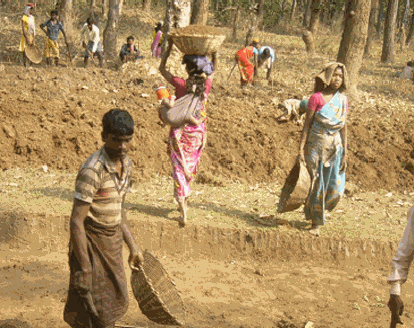
THE general belief is that adivasis face a greater burden of illness for which care is often compromised due to the inaccessibility of health facilities and inadequate personal resources. It is also felt that adivasis are affected mainly by infectious diseases; other conditions like cancer, diabetes, mental illnesses and heart disease are uncommon among them.
Unfortunately, there is only scattered information on the actual burden and patterns of illness that afflict adivasis. For example, even for a serious and important illness like tuberculosis, reliable information about its prevalence amongst adivasis is scarce. Data comparing the patterns of these illnesses between tribals and non-tribals sharing the same geographical space is just not available. The situation becomes worse when one talks of the unequal distribution of determinants of these illnesses such as food, public health systems, roads and safe drinking water. What is the reason for this apparently high burden of disease that manifests itself in such a severe form? Could it be attributed to deprivation? Or genetic factors? Or cultural factors that could influence people in choosing to seek health care, select food choices or adopt a certain lifestyle?
Not just this – discussions on tribal health often concentrate on the exotic nature of many rare and genetic illnesses they suffer from. Let us take the example of sickle cell disease. This is an inherited blood disorder that developed due to a strong survival instinct when people in central India were exposed to the deadly falciparum malaria parasite. Those who inherit a single gene from one of the two parents are partially protected from this serious form of malaria, while those who inherit the gene from both parents suffer this painful and potentially fatal illness. Both adivasis and non-adivasis in central India face the brunt of falciparum malaria equally; yet this disease affects adivasi’s more severely because of their inability to access adequate health care.
Similar beliefs are held about their nutrition as well. While many people know about the frightening figures on the high levels of hunger among adivasi adults and children, there seems to be little concern about how that affects overall health, how prone they are to falling sick and even when treated, whether they can recover quickly. The stunting of both the physical and intellectual potential that may result, particularly when a young tribal infant or toddler suffers such food deprivation, does not seem to give sleepless nights to the policy planners.
A
t Jan Swasthya Sahyog (People’s Health Support Group) in rural Bilaspur, where we run a community health programme accessed by people from over 2500 villages of north-central Chhattisgarh and eastern Madhya Pradesh for their major health needs, we observed illnesses that people suffer from through the lens of hunger. While we have provided for some unmet needs of health care and nutrition support through focused interventions, especially to under three-year-old children, we see our larger role, and that of other civil society organizations working in adivasi domains, as advocates of these perspectives and in providing solutions.|
|
|
In this essay we share some specific observations about these links with the objective of debunking commonly held myths, as well as suggest some solutions to nutrition and health problems in adivasi and other poor rural communities.
O
verall, we believe that the adivasi predicament in both health and nutrition is a result of continued deprivation – a consequence of a historical injustice, especially the carting away of natural resources. The deprivation adivasis face is not just of food, but also the quality of the environment (such as water and air) and public services such as health systems, roads, transport, education and markets. Not determined by either cultural factors or anything genetic, the status of adivasi health and nutrition could be equated with that of the poorest in this country. Unnecessary deaths, a huge burden of diseases that have become more complex, and problems relating to nutrition are the bane of the people.
I
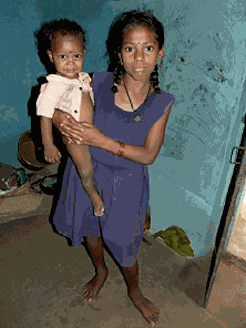
n their local habitat, the weight of adivasi children is generally normal in over 75% of children at birth. This is maintained for the first six months of life, thanks to breastfeeding. As breast milk alone cannot meet the energy and protein needs of the child after six months, an appropriate amount of supplementary feeding becomes essential for the child’s growth. If that does not happen, these fairly healthy children progressively become weak, and by the age of two, a majority are significantly undernourished.
|
|
Almost 65% of Indian children below five are undernourished. Most of the mental development occurs in early childhood, and mostly before three years of age. Undernourished children grow into undernourished adults who have a low threshold for illness and poor work capacities. This in turn affects their earning capabilities. Undernourished girls grow into weak mothers and give birth to underweight babies, and the vicious cycle of poverty and ill health continues. Unaddressed undernutrition in the first three years of life thus has both immediate and long-term consequences, causing more acute illnesses and deaths. Further, once a child is malnourished due to a chronic dietary inadequacy, the catch-up is likely to be difficult. What should put us Indians to shame is the fact that our infant and young child feeding practices are even worse than our poorer neighbours, Bangladesh and Nepal.
W
hy don’t our young children get enough nutrients? Poverty cannot be an adequate explanation because most families can afford some cereal, even if their diet lacks in oil, meat, lentils and milk. One possible reason may be inadequate knowledge, but the most important reason is probably that the child is not looked after for a better part of the day when both parents, who are often poor, are out working. As a result the child gets very little food, mostly given by an older brother or sister or an old grandparent.
T
he government run anganwadis under the Integrated Child Development Services (ICDS) aim to provide supplementary feeds to preschool children. However, their effectiveness is compromised by poor attendance of the six months to three year old children, that they run only for four hours and that the child caretaker ratio is 20:1 or more, making care for them almost impossible. The current practice of ‘take home’ rations for the under three-year-old child is also ineffective as the full ration does not reach the child. Developing homestead gardens or going in for intensive IEC and health education activities too have not been effective. Running nutritional rehabilitation centres (NRCs) or addressing severe acute malnutrition (SAM) will by itself not solve the problem unless we concentrate on preventive strategies. Since we are unable to feed our young children, we suffer from the persistent and shameful record of poor under-three year old child malnutrition, with the adivasi children coming way down the pecking order.
T
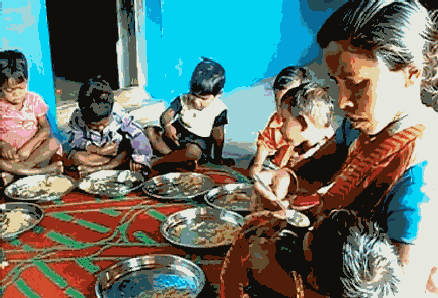
o address this problem we promoted crèches or phulwaris as we call them, at hamlet level for children below three. This involved the parents, particularly in the selection of a caretaker who is a woman from the same hamlet. These crèches operate for eight hours a day at a time suitable to working parents. With a child caretaker ratio not exceeding 10:1, the phulwari workers provide three hygienically prepared meals, ensuring at least 75% of the children’s daily food needs. These care givers are trained enough to recognize common childhood infections and ensure treatment from the local accredited social health activist (ASHA) worker as well as provide early childhood education to these kids. Over the last nine years, more than 1200 children in 126 phul-waris in 56 adivasi villages of rural Bilaspur have benefited.This programme has been a runaway success, with over 85% eligible children in the poor and remotest villages regularly attending the phul-waris. With a secure and comfortable environment for their young children close to their homes, not only are parents more confident to go out to work, the elder ‘child-parent’, who had to stay back to look after their younger siblings is now able to return to school. The enrolment of women in MGNREGA has increased substantially. Happily, with nutrition levels improving, the rates of childhood illness have dropped substantially. We felt proud and fulfilled when a middle aged woman from Surhi village in the Achanakmar Sanctuary, said, ‘hamaarey bachchon ke pet mein aaglagaadee hai!’ (Food has started reaching our children’s bellies!)
The success of this strategy in rural Bilaspur led to several civil society partners in Madhya Pradesh, Rajasthan, Orissa, Jharkhand, and Bihar immediately taking up similar programmes. The chief minister of Chhattisgarh announced that phul-waris would be set up in each hamlet of the poorer districts. However, progress has been tardy.
Even if we don’t count the spin-offs mentioned above, here is an intervention, tested out in a poor adivasi area, that offers a solution to the almost insoluble problem of preventing early child malnutrition, at a cost of Rs 26 per child per day (including the wage of the caregiver).
H
ow can this be up-scaled? One way is for the Women and the Child Department to establish crèches or modify anganwadis at the hamlet level to meet the needs of the under-3 year old child. A second possibility is to harness the existing provision of the crèche in the MGNREGA, even if it is for 150 days a year and run a special programme in poor rural areas? Unfortunately, our efforts to advocate this simple technical solution along with operational details has met with little success, possibly because solutions emanating from civil society do not get the attention of policy makers.At our clinics, we measure the weight and height of those who seek treatment. Our community and hospital based health work allows us to confirm massive levels of hunger or malnutrition among people in central Indian villages. This manifests as both stunting or short heights as well as wasting as measured by low BMIs (birth mass index). We observed a clear gradient of worsening undernutrition as one goes down the scale, with particularly vulnerable tribal groups at the rear, and other adivasis only a shade better. (Table 1)
|
TABLE 1 Body Mass Index of People in Community Programme of Jan Swasthya Sahyog, 2012. |
|||
|
Social group |
25th centile |
median |
75th centile |
|
Particularly Vulnerable Tribal Groups |
17.35 |
18.36 |
19.71 |
|
Other Tribals |
17.26 |
18.69 |
20.18 |
|
Backward Castes |
17.44 |
18.75 |
20.34 |
|
Dalits |
17.78 |
19.11 |
20.38 |
|
Others |
17.61 |
19.35 |
22.37 |
|
Body Mass Index is a measure of wasting or undernutrition, calculated as bodyweight in kg/(height in metres)2*100; a value of < 18.5 suggests undernutrition. |
|||
P
roviding primary, secondary and, where necessary, tertiary level health care in the community health programmes has allowed us to observe massive levels of morbidity. A quick glance at the number of new illness episodes seen in the year 2013 shows that conventional infectious diseases such as tuberculosis, falciparum malaria, leprosy, childhood infections, skin and serious soft tissue infections occur in large numbers. Not just these, but also cancer, especially of the cervix and breast in women, and of the oral cavity in both men and women, severe hypertension, thin diabetes, rheumatic heart disease (most prevalent in the poor), mental health problems, crippling joint illnesses and thyroid problems are seen in equally large numbers in adivasis as in other social groups. Besides this, snake bites and from rabid animals and scorpions, obstetric emergencies, agricultural injuries, lightning strikes are clearly higher among the adivasis.|
TABLE 2 Common Serious Illness Seen at Jan Swasthya Sahyog Health Centre, Ganiyari, Chhattisgarh, 2013. |
|
|
Tuberculosis |
502 |
|
Cancers |
468 |
|
Severe hypertension |
555 |
|
Diabetes, 80% non-obese |
346 |
|
Leprosy |
134 |
|
Falciparum malaria |
189 |
|
Rheumatic heart disease |
118 |
|
Illnesses requiring emergency surgery |
250 |
|
Sickle cell disease |
141 |
|
Chronic renal failure |
108 |
Viewing the nutrition levels of these people, even those with non-infectious illnesses like diabetes, we find they are no better than those who have infectious illnesses. Adivasis thus suffer not only a double burden of infectious and non-infectious illnesses, but also show poorer outcomes. We believe that these outcomes are a consequence of their poor nutritional status, more complex presentations, delayed access to health care and inadequate resources at their disposal.
W
e would not have been able to understand and share these observations about tribal and other poor rural communities, had we not been in actual health care service delivery. Only when effective and necessary health care is accessed can we really understand the true burden of the illnesses. Health service provision, that is accompanied by careful documentation and asking the right questions, allows us to understand what works and what does not, and this information can help policy makers.Several questions seem to have come up regarding tribal health, and we are struggling to find answers. Should we attempt an exclusive health care delivery structure for the tribals, or do we need to strengthen an all inclusive health system that offers some positive affirmation for them? Are there illnesses that can be ignored since they don’t occur as commonly among tribals? Perhaps not! Are there any illnesses that are more prevalent among tribals as compared to non-tribals? Due to extreme deprivation, we continue to see some conditions such as syphilis, cholera, falciparum malaria deaths, snake bite deaths, lepromatous leprosy and acute rheumatic fever being proportionately higher among adivasis.
Once we understood the magnitude and the bottlenecks in reaching a solution, we thought of simple remedies. For instance, a blood slides courier system to ensure swift reporting of malaria and a method for detection of cancer cervix through paramedics in the remotest tribal villages.
T
he dynamic relation between hunger and illnesses can best be understood when we look at tuberculosis. Among tuberculosis patients, almost half of who are adivasis, we see the median body weight of women is 34 kg while that of men is 42 kg. Almost 80% of them are moderate to severely undernourished and about half are stunted. Even after successful treatment about half remain undernourished. Despite providing the best drug treatment free to those suffering from tuberculosis, the death rates of the severely undernourished are at least twice that of the normally nourished. There is clearly a case for providing supplemental food rations for the family besides free and effective care for people suffering from tuberculosis.The larger issue to address is how the massive level of undernutrition makes a person more vulnerable to serious illnesses such as tuberculosis. A woman weighing 40 kg is at three times higher risk of getting tuberculosis compared to one who weighs 50 kg. These shocking statistics on nutrition are rarely revealed and hide the vulnerability of some people, and the inhumanity with which they are treated. People like us, who work in such areas, must prevent this by uncovering the truth. Once we realize its importance, we should look at the possible remedial actions such as ensuring adequate food for all so everyone can have a basic, normal nutrition level.
Here it may be of interest to look at the role of public distribution systems (PDS). Chhattisgarh has a robust and well-functioning PDS that provides 35 kg of cereals and 2 kg each of black gram and pulses per month to 90% households. This PDS is certainly better than that of most states in the country and has the potential to prevent acute starvation and hunger. But we still need to determine whether it has led to better food intakes among those who are chronically hungry. It is likely that the money saved from supply of subsidized food is now available for other pressing needs. In our study among few adivasi households in 2011, we found that the PDS food grains last a median of 13 days in a month; for the rest of the month the families have to depend upon their own produce or buy food from the market.
A
nother point to ponder on – when we know that body weight broadly affects a person’s ability to labour and thus earn – is whether there is a case for body weight related wage determination? Otherwise those who are undernourished due to food deprivation will always stand at a disadvantage in their ability to earn. Can MGNREGA or other employment programmes take cognizance of this?Civil society organizations should not limit themselves to merely implementing health care and nutrition programmes which have been contracted out by the state or by corporates as part of their ‘social responsibility’. Their understanding of ground realities and where the real problem lies has placed them in a more responsible position. They should be asking difficult questions about the poor state of affairs, documenting problems, suggesting solutions, and aggressively lobbying for them at the right fora.
* The authors are doctors based in rural central India, running a community health and nutrition programme for the last 14 years.