Nutrition, biodiversity and traditional knowledge
CAROLYN STEPHENS
INDIGENOUS peoples are the most potent symbol of our human diversity of culture, language and spirit. They have been the guardians of our global environment and its medicines for millennia – built on a holistic communal view of humanity and its links to the ecosystem. Yet now, in the new millennium, indigenous peoples are amongst those most marginalized within many nation states, have the worst health indicators, and their knowledge is fast disappearing as their land is appropriated and environment destroyed.
Before we begin to discuss the issue of nutrition for the indigenous peoples of Asia, it is important to place the debate about indigenous well-being in context. The first challenge at the international level and in almost every country is the very definition of ‘indigenous’. In most contexts, indigenous peoples are those groups or individuals who self-identify as ‘indigenous’ within national surveys and or in a national census. Box 1 shows the complex United Nations position on the definition of indigenous. This is important to highlight because in many contexts indigenous peoples may go unrecognized as ‘indigenous’ by governments, or may not want to self-identify due to stigma and marginalization within the dominant mainstream society. This makes it very difficult to understand both how many indigenous peoples exist in each country or region, and subsequently, what health and well-being problems each indigenous group experiences.
|
Box 1 – Defining ‘Indigenous’ ‘Indigenous communities, peoples and nations are those which, having a historical continuity with pre-invasion and pre-colonial societies that developed on their territories, consider themselves distinct from other sectors of the societies now prevailing on those territories, or parts of them. They form at present non-dominant sectors of society and are determined to preserve, develop and transmit to future generations their ancestral territories, and their ethnic identity, as the basis of their continued existence as peoples, in accordance with their own cultural patterns, social institutions and legal system. This historical continuity may consist of the continuation, for an extended period reaching into the present of one or more of the following factors:
Other relevant factors: ‘On an individual basis, an indigenous person is one who belongs to these indigenous populations through self-identification as indigenous (group consciousness) and is recognized and accepted by these populations as one of its members (acceptance by the group). ‘This preserves for these communities the sovereign right and power to decide who belongs to them, without external interference’ (United Nations 2004). |
A second problem we have in understanding indigenous well-being, including nutrition, relates to the way in which we measure health. In Occidental or western medical science, for example, ‘health’ is evaluated with measures such as mortality and morbidity. In nutritional terms, nutritional status is measured with anthropometric indicators such as weight for height, weight for age and height for age.
Most indigenous groups do not conceptualize their health and well-being in these terms at all. They often do not regard ‘health’ as an individual physical state but as a state of community and ecological well-being, and often indigenous concepts of health include a spiritual component. This is particularly important in terms of foods and medicines – some foods may be spiritually important and this importance is greater than their direct value for nutrition. The same is true of medicines.
This is extremely important to understand when we discuss indigenous nutrition as it becomes simplistic, and often misguided, to look at indigenous nutritional health simply in terms of western concepts such as mortality and morbidity, or measures used in anthropometry. Interestingly, and also important to understand, in many senses indigenous definitions of ‘health’ are closer to the World Health Organization definition of health as, a state of complete physical, mental and social well-being and not merely the absence of disease or infirmity, than current measures used by western medical science.
B
earing in mind first the complexity of defining indigeneity, it is estimated that globally there are more than 370 million self-identified indigenous peoples in approximately 70 countries. This comprises over 5000 cultural and linguistic groups, who form the basis of the world’s linguistic, genetic and cultural diversity. These peoples are often the original inhabitants of the lands where they live, but are now usually in a minority within the current nation states where they live. The largest concentration of indigenous peoples internationally is in Asia and the Pacific – an estimated 70 per cent of all indigenous peoples live in this region.
I
ndigenous wisdom internationally and within this region is under threat. In a globalized world, traditional knowledge can be eroded, and ecosystems put to service of international economic processes such as mining, resource extraction, and deforestation.A major Lancet series on global indigenous health in 2006 identified several key themes that define the well-being of indigenous peoples. Lack of data is very important: indigenous identity is highly contested, and where indigenous peoples are recognized, data are rarely routinely collected or disaggregated. Where data exists, evidence suggests that in all settings indigenous peoples suffer poverty, marginalization, extreme ill health, and many population groups are at risk of demographic extinction. Indigenous peoples’ concepts of poverty, development and health differ from western models. Rarely focusing on individual well-being or on traditional ‘poverty’ indicators, indigenous peoples see their social and physical well-being as intimately linked to that of the wider community and the resources of the ecosystems in which they live. Sociopolitical factors linked to marginalization and colonialism, and relationships with land and environment, are seen as fundamental determinants of indigenous poverty, well-being and health.
I
n many settings, there is a basic lack of evidence on indigenous poverty, health and well-being, particularly for those in isolated settings, and indigenous peoples have often been overlooked in national programmes on poverty, health or education. If we look specifically at the Asian region, here are approximately 260 million indigenous peoples. They live in the following 17 countries throughout the region. If we now turn then to the countries of South Asia, including India, Nepal, China and Burma, indigenous peoples in the region sustain a wealth of cultural and ecological diversity, largely based on their highly diverse indigenous cultures living in remote forest and mountain ecosystems.It is only now being understood that the bio-cultural treasure of South Asia is maintained by the region’s indigenous peoples. This treasure includes foods and medicines of direct importance to human well-being, but also includes a history of indigenous spiritual beliefs which have influenced Asian philosophy and religion for millennia. Directly, indigenous peoples hold knowledge about foods and medicines from their lands of origin that are important for them and the peoples of the region, but globally Asian bio-culture contains foods, medicines and knowledge that have been used for centuries throughout the world.
Many countries in Asia have incredible cultural diversity. In India, for example, 461 ethnic groups are recognized as Scheduled Tribes (STs) – which can be considered as a way of defining indigenous groups in India. In mainland India, STs are usually referred to as adivasis, a controversial and often pejorative term which has been widely criticized but is still in use. These groups have an estimated population of 84.3 million, and comprise approximately 8.2% of the total population. It should be noted, however, and this relates to our former point about data, there are many more ethnic groups in India who are not officially recognized. It may be that as many as 635 indigenous groups exist in India and the largest concentrations are found in the seven states of Northeast India, and ‘central tribal belt’ stretching from Rajasthan to West Bengal.
I
ndigenous peoples in this region experience discrimination, expulsion from their lands, and displacement to urban settlements where they lose access to their cultural heritage and their traditional foods, practices and languages. They are often unable to access health services and are stigmatized when they try to use their traditional medicines. In many countries, indigenous communities are considered ‘backward’ and are treated as second class citizens, just as the adivasi are in India.Despite these challenges, indigenous peoples in the region continue to maintain their cultures and languages, and hold a wealth of knowledge about their ecosystems, local indigenous medicines and foods. Nutrition of indigenous groups in their local forest and mountain environments is often good, but deteriorates on contact with outside population groups and with displacement and acculturation into mainstream societies.
A
study of indigenous nutrition in Arunachal Pradesh, India, found that the Adi indigenous community, living in remote regions of the mountainous state, maintained an intimate knowledge of foods and medicines that they could access from their ecosystem. Members of the same communities, but in closer contact with mainstream society, had lost a significant amount of traditional knowledge about their foods and medicines and were unable to access those that they did remember from childhood or family. Important local traditional foods included: cereals and millets, rice boiled and as wine, and mirung (finger millet) as wine; legumes principally boiled; vegetables including ongin (Cleroden-drum colebrookianum), pettu (Bras-sica), kopi (Solanum torvum), kopir (Solanum khasianum), and ange (Collocasia), fermented bamboo shoot. They also eat fruits including banana and pineapple, meat and local fish and use spices such as ginger and chilli.Forest ecosystems in Asia are incredibly important for the nutrition of indigenous peoples. Forests cover 26% of all land area in Asia and comprise 740 million hectares. This sounds an extensive area, but in fact Asia has the lowest proportion of forest cover per capita in the world, with only 0.2 hectares per person, and this is rapidly being encroached by deforestation and population growth.
Despite threats to the forest ecosystem in Asia, indigenous groups have lived and learnt from the forest for millennia and they utilize a wide range of forest products for both direct nutritional benefits and for indirect support of their agriculture and well-being. This includes products from trees and plants including fruits, berries, leaves, seeds, nuts, barks, mushrooms and from forest wildlife, insects and wild animals and grubs. Indirect benefits for nutrition include fodder for livestock, fuelwood and charcoal and stabilizing agricultural products. Forest foods are also a source of income for indigenous peoples with products such as jams, wines and dried fruit and insect products.
F
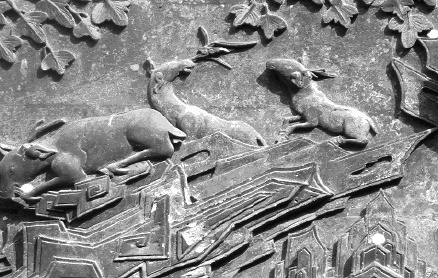
orests and mountains also have an incredible and valuable spiritual component for indigenous nutrition and well-being, not only in Asia but also internationally. For example, a study of indigenous use of forest plants in Nepal found that more than 80 different plant species and their products were required to perform religious and cultural festivals. The nature of species varied from annual herbs, climber, palm trees, shrub to big sized trees and their parts. The plants ranged from purely wild to domesticated plants and trees. The accompanying image shows animals, plants and birds pictured on an ancient mural in central China.Things change for indigenous peoples when they are displaced from their forests and mountains in Asia. This is often due to deforestation or major projects including mining and road expansion. As these changes occur, indigenous peoples are often displaced to towns and cities in Asia – where lifestyles are very different, and major inequalities exist between the urbanites who have managed to achieve western lifestyles and the vast majority of city dwellers in Asia who live in unhealthy low income settlements, where conditions are poor in terms of water, sanitation and housing. This has impact on nutrition and indicators for low income urban peoples are as poor or poorer than their rural counterparts. Indigenous peoples arriving in these towns and cities rarely move into wealthy, healthy areas and almost always end up in the low income settlements as displaced peoples.
I
n western biomedical terms, there is a vast difference in indicators of health and well-being between isolated indigenous groups who are able to maintain their culture and access to their ecosystem, and those forced off their lands and distanced from their culture and traditions. Indigenous community members who are displaced to urban settlements often experience the worst of both the worlds of modernity and antiquity. They find it difficult to adapt to urban life and even harder to maintain their cultural traditions and access to traditional foods. They also lose touch with their important spiritual contact with the mountains and forests.
|
|
|
Traditional mural in China. |
What does the future look like for indigenous peoples in Asia? There are major issues of population growth, urbanization, massive inequalities and increasing deforestation and destruction of ecosystems. All this will potentially impact negatively on the well-being of indigenous peoples unless governments protect them from the impacts of these massive development policies. Ironically, if Asian governments do not protect the 260 million indigenous peoples in thousands of cultural and linguistic groups, the region and the world will lose a vast amount of cultural diversity and wisdom. We stand at a crossroads to choose whether to protect or abandon those who have protected and cared for the forest and mountains ecosystems of Asia for millennia.
A
longside this bleak picture, the international stage has been changing. The crucial role played by ‘indigenous peoples and local communities’ has increasingly been highlighted in global environmental and development policy processes, including the United Nations Convention on Biological Diversity (CBD) and the UN Framework Convention on Climate Change (UNFCCC). In January 2011, the International Union for Conservation of Nature (IUCN) met with indigenous representatives and conservation organizations to discuss conservation priorities in the context of indigenous rights. The 2011 meeting concluded with a call to reinforce IUCN’s multi-level process (encompassing international, regional, national and local levels) to assess and advance the implementation of the ‘new conservation paradigm’.
S
pecifically, they call for assessments in protected areas with indigenous peoples that can specify recommendations to address gaps between the observed practices and the ‘new conservation paradigm’. A major challenge is how to bring indigenous communities to local and international policy tables, particularly given their relatively isolated existence in remote forest locations, where normal communication technologies do not reach. Isolated in many settings, but increasingly in contact with modern society to the detriment of health and well-being, the nutrition of indigenous peoples in Asia will ultimately depend on their ability to maintain their healthy ecological and sustainable lifestyles with their access to biodiverse environments and cultural traditions. The world has an enormous amount to learn from these communities and stigmatizing, marginalizing and displacing them is the last thing we should be doing.
References:
P. Durst, Inedible or Incredible: Asia Pacific Forests for Improved Nutrition and Food Security. FAO, 2009.
International Work Group for Indigenous Affairs http://www.iwgia.org/culture-and-identity/identification-of-indigenous-peoples
H.V. Kuhnlein, B. Erasmus and D. Spigelski (eds.), Indigenous Peoples’ Food Systems: The Many Dimensions of Culture, Diversity and Environment for Nutrition and Health. Food and Agriculture Organisation, Rome, 2009.
United Nations. ‘The Concept of Indigenous.’ Background paper prepared by the Secretariat of the Permanent Forum on Indigenous Issues. ‘Workshop on Data Collection and Disaggregation for Indigenous Peoples.’ D. o. E. a. S. Affairs. United Nations, Secretariat for Indigenous Peoples. New York, 2004.