Street wise
VIBHUTI SACHDEV
A street is the face of a community. It can be a pinboard of rumours and gossip, a place where one can have a hot political debate over a cup of tea and pakoras, or an informal pedestrian space where one can stroll aimlessly. The vehicular pace of a street is slow but a lot gets packed into that slow moving space. Buying, selling, bargaining, cajoling, debating, performing and hanging out are some of the activities that happen on a street. It is used throughout the day even when the frantic daylight activities peter out. At night it gives shelter to the homeless and provides hot cups of tea to those who work late. A street differs from a road in both its spatial and aesthetic qualities. It looks and feels different from a road. The scenes of street life, though increasingly rare in new cities like Gurgaon, are commonplace in older, denser cities such as Shahjahanabad and Jaipur.1
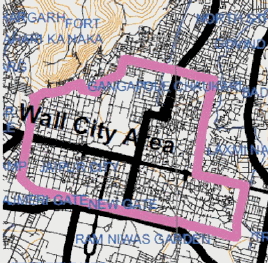
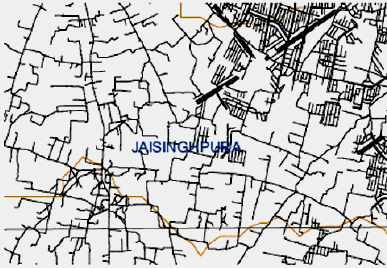
According to a study on open urban spaces,2 denser cities allocate a greater share of land to streets but have less street space per capita (Fig 1 and 2: Compare road and street maps of the old walled city of Jaipur and the new development outside it). The pre-modern dense cities of Shahjahanabad and Jaipur have less vehicular traffic and high levels of pedestrian movement and congestion. The high urban density also makes the task of modernizing modes of transport to include automobiles and metros extremely difficult. Introducing cars, for example, in older cities increases congestion and disturbs the pace of movement that the city was designed for. Cars and autos occupying space meant for slow moving non-motorized transport results in chaotic traffic movement in cities like Jaipur. The irony is that the use of a car within the walled city doesn’t get you to your destination any faster than going on foot. In fact, the pedestrian speed of cars on the roads of Jaipur renders the automobile an inefficient mode of transport, reducing it to an air-conditioned box moving at the speed of a bullock cart.
|
|
|
|
|
Fig 1: Roads and streets of the walled city of Jaipur. |
Fig 2: New development south of the walled city. Source: Mapbook 1, Base Map Jaipur Region, Master Development Plan 2025, JDA, p. 9. |
Automobile-led cities, on the other hand, allocate less land area for movement compared to older, denser cities. As new cities are vast and less dense, there is more urban space per capita for movement but this space is almost entirely dedicated to vehicular movement. Although exact data is not available on the percentage of land dedicated to vehicular movement and parking, it is clear that in the new urban development of Gurgaon the amount of street space dedicated to pedestrian movement is abysmally low. Even when pavements are provided, they quickly get swallowed up by informal parking of light vehicles and are often encroached upon by neighbouring landowners.
Reacting to the shrinking urban space for walking, a people’s initiative called Raahgiri was started on 17 November 2013, with a vision to ‘encourage people of Gurgaon to develop living streets – streets that encourage pedestrians, cyclists and other non-motorized transport (NMT) modes. Streets are public assets but on most days are monopolized by cars, two-wheelers, trucks, buses etc. On this day, predefined roads are blocked so that people can regain ownership of the streets.’3
|
|
|
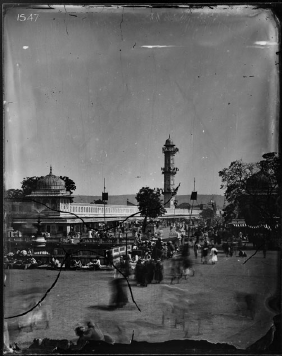
Fig 3: Chhoti Chaupar, with vendors selling wares under the cool breeze of the fountain. Photograph: Studio of Maharaja Ram Singh II, c. 1870. (2012.04.0059-0004) |
Every Sunday, cycling and sports enthusiasts gather on pre-designated vehicular roads that are closed to traffic from 7 am to 12 noon, and enjoy performing in spaces that support little pedestrian activity during the week. By altering the function of an urban space, the event provides a different experience of the city to the participants. Calling the roads ‘streets’, however, is misleading. The Raahgiri agenda suggests that it is streets that have been taken over by vehicular movement and require reclaiming, whereas in fact it is roads that are blocked every Sunday and used as mock-up streets. These roads were never designed as streets. ‘Regaining ownership’ by pretending that the roads are actually streets doesn’t help the cause. The event is enjoyable for the participants and generates a mood of defiance against the authority by politicizing a secular space. But it fails to address two important urban planning issues.
First, the absence of variety in spaces for movement – streets, alleys, bylanes, walkways and cycling tracks – in new cities has resulted in the dominance of an automobile-led development. Typically, one leaves the house in a car to go to a basement parking of an office block, while to shop one drives to a different basement, in a mall. There’s no space to walk or cycle or run. Strolling on a road is a life-threatening activity. Moving around in a vehicle has also changed the way in which we encounter buildings. Despite the alluring facades and grand entry designs, the visitor to a building enters through its guts: from the basement to the elevator, landing at the back of a lobby, facing a wall.
|
|
|
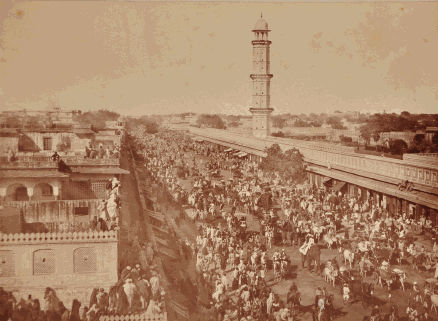
Fig 4: One of the principal streets of Jaipur during a procession. Photograph by Lala Deen Dayal, c.1880. (2011.02.0003-0001) |
The window through which one experiences the facades of buildings today is that of a car – a point that the architect rarely incorporates in design. By contrast, a wide variety of roads and streets can be seen in pre-modern cities such as Jaipur and are discussed at length in traditional texts on architecture and urban planning.4 So, why are they not available in new cities any more? The multifunctional non-polluting streets are sacrificed in order to make space for fast moving, taxpaying automobiles. Well, in theory; judging by the condition of most roads in Gurgaon, one can hardly move faster than a bullock cart.
|
|
|
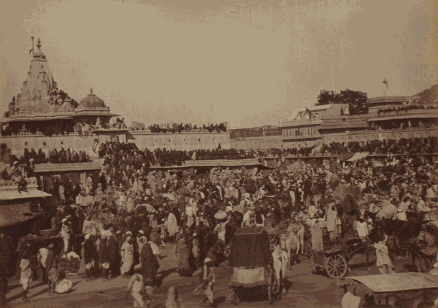
Fig 5: Bhanu Saptami procession. Photograph by Lala Deen Dayal, Jaipur, 1886. (2011.02.0039-0009) This photograph captures the crowds gathered to witness the procession of Surya who descended from the hills. The procession was presided over by the Maharaja in his multistorey chariot, the Indradhvaj, pulled by elephants. During such processions, the royal household provided the motor of the festivities for the people of the city who gathered for a darshan of their favourite deities and of the Maharaja, and to enjoy the melas that were set up along the processional path. |
Second, new cities do not allocate outdoor spaces for public events like festivals and congregations. The open spaces designated as ‘parks’ do not allow celebration of festivals, and community halls are hardly appropriate spaces for enjoying Durga Puja and Gangaur. This rigid single-function approach to spaces destroys the multiplicity of urban experiences and leaves no room for variety and innovation in the way public spaces may be used. Other open spaces such as roundabouts are decorative landscaped discs that are to be enjoyed only from a car window.
In the walled city of Jaipur, the chaupars placed at the crossings of wide roads earlier had stepwells and now have fountains (Fig 3). These spaces were, and still are, accessible to the people of Jaipur. These are not merely decorative, landscaped ‘square-abouts’. Vintage photographs show roads, streets and chaupars being used for a variety of routine activities while accommodating crowds that throng the streets (Fig 4) of Jaipur during festivals and processions (Fig 5).
The seasonal festivals celebrated in Jaipur bind the city and its people in significant ways. One of the major festivals for both the Jaipur court and the city is Gangaur, in March/April. Preparations for Gangaur begin soon after Holi. The ashes from the Holi fire are collected to plant wheat or barley seeds in clay pots, which are watered daily. The seeds germinate quickly and become a symbol of growth, life, fertility and hope. Women and young girls adorn themselves in fine clothes and jewellery and apply henna on their hands for good luck. The pots of germinated seeds and the clay images of Gauri and Issar are consigned to a well or left in a garden as an offering.
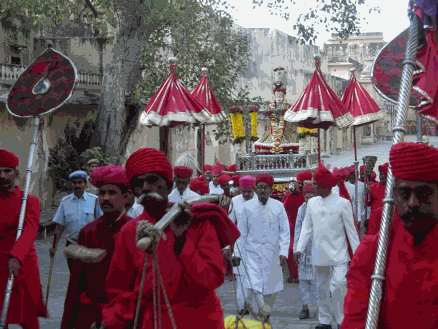
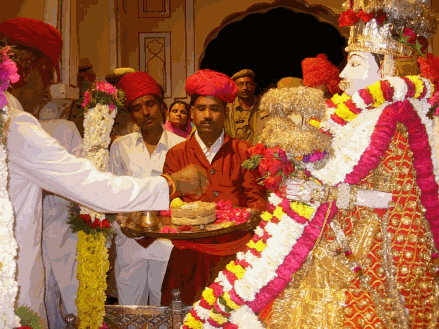
The glorious Gauri, who resides in the zenana of the City Palace, steps out in a procession for the two days of Gangaur in all her magnificence. She is dressed, adorned and worshipped in the main courtyard of the zenana. The puja is performed by a female priest and presided over by the women of the zenana. The goddess is then carried on a platform and placed on a silver palki, to join the lawazma of decorated elephants, bands, bullock carts, camels and horses (Fig 6). The route this procession takes is similar to the one during Teej, and dates back to the early years of the city. The goddess’s first public appearance is at the Tripolia Gate, where thousands of devotees congregate to offer coins and seek her blessings.
|
|
|
Fig 6: Devi in procession on Gangaur. |
The 18th century text Pratap Prakash describes the occasion: ‘Gangaur is the festival of Parvati. On this day three kinds of dresses are arranged: gul-ambari (green), kasu-mal (dark red) and kesariya (saffron). The procession of Gangaur starts from the Zenani Deorhi and proceeds with full lawazma (paraphernalia) to the Chaugan through the main bazaars. Thousands of people have darshan of the deity. The Maharaja goes to watch the procession from Moti Burj. All his attendants wear a uniform dress. When the procession is over, the Maharaja sails in Talkatora. Fireworks are arranged; rockets and guns are fired. Many other kinds of entertainments are organized. The whole programme is repeated the next day.’5
F
rom the Tripolia gate, the procession meanders in a red joyous stream through the city towards Amber Chaupar and Gangaur Gate. As the lawazma comes out of the Tripolia, it gains momentum in terms of the number of people trailing it and the number of spectators perched on ledges at every level of the street it passes through. People dressed in red clothes are out on the street soaking in the festive air of Gangaur. For two afternoons, the main streets of the walled city of Jaipur remain dedicated to the procession.‘Held back along the avenues by policemen, lining verandas and roofs of pink painted buildings along the way, occasionally darting forward to place a flower at the feet of Gauri, Jaipur’s populace is a mass of colour in the afternoon light. Shrill tones of shehnai and horse mounted naqqars vie with trumpets and horns of "western" bands.’6
|
|
|
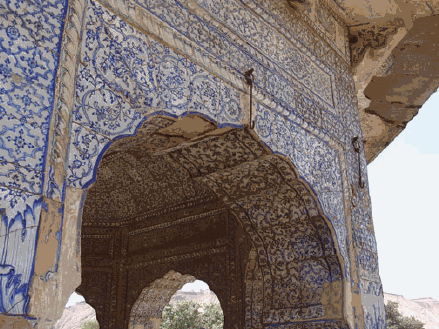
Fig 7: Chini Burj. Pavilion, rubble masonry, lime plaster and blue and white glaze tiles. City Palace Jaipur, 18th century. The name of this burj or pavilion is derived from the fine blue and white porcelain glaze that covers it. The joins in the glaze suggest that small portions were first individually painted and glazed, and then fixed to the surface of the pavilion. The accuracy of the pattern and uniqueness of the pavilion suggest that this was probably achieved by an in situ production of the glazed tile work. A representation of this blue and white pavilion in a painting that shows Sawai Jai Singh watching animal sports suggests that it was made in the eighteenth century. |
In earlier times, the procession moved through the vast grounds of the Chaugan, observed by members of the royal household from Moti Burj, and by their guests from the Chini Burj (Fig 7). Up until a few years ago, a big fair used to be held in the Chaugan during the Gangaur and Teej festivals. Vendors selling trinkets, bangles, clothes, snacks and toys; performers, magicians, and astrologers cajoling and bargaining with the visitors in an animated enthusiastic style, created an experience that tickled all the senses. Various sounds, fragrances, colours, tastes and textures and crowds of men, women, children and animals filled the mela ground. The dynamics of the mela changed as soon as the procession reached the ground, as everyone paused to turn towards the goddess for darshan. As the procession snaked through the Chaugan, the visitors resumed their haggling, bargaining and arguing with the vendors.
I
n 2006, the Jaipur Development Authority re-designated the Chaugan land as a sports stadium. With the change in land use, the Chaugan is no longer filled with the hustle and bustle of vendors and of buyers evaluating clothes, toys, snacks and trinkets. The sports stadium, when complete, will not allow any seasonal, informal, non-designated activity like a mela, or even street vendors. Of course, one hopes that the sports stadium will be made use of throughout the year, though in reality stadia in cities generally remain locked, protecting the empty chairs and air-conditioned spaces. But it make no economic sense to keep an expensive facility in a city locked for the better part of the year. Most events in stadiums are ticketed; why should people of the city who have paid for the stadium through taxes, pay again to enjoy an event? And why are they not allowed to use it? Agreed, this is a governance issue, and protecting any place from encroachment and squatters requires policing, but keeping it locked is a waste of prime urban space. There is no guarantee that a high capacity sports stadium built on the grounds of the former Chaugan will be any different.
|
|
|
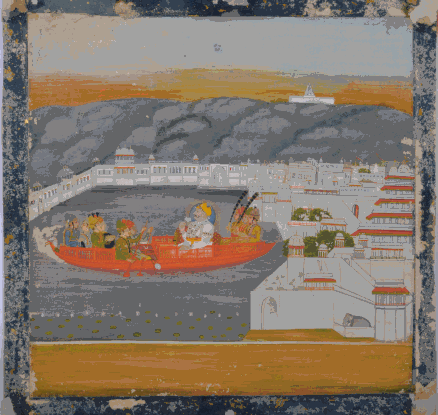
Fig 8: Sawai Madho Singh I in a boat in Talkatora. Painting, opaque colour on paper. 28.7 x 29.2 cm. Jaipur, 18th century. (AG 1371) The maharaja, enjoying the cool evening breeze on a horse-headed boat with his courtiers, is shown seated, and faces the Pal ka Bagh that is located on the banks of Talkatora lake. |
This kind of re-designation of urban open spaces in older dense cities is typical of a conflict between the flexible way in which traditional festivals use open sites, and the rigid modern urban planning laws that restrict use. A sports stadium cannot be used as a site for fairs because of security and maintenance issues. A modern urban bye-law has ended an important cultural event that each year re-energized the lives of thousands with entertainment, craft, music, cuisine and religious fervour. All major festivals included a mela or a fair in the programme. Recreation, socializing, shopping and gossiping are some of the aspects that people enjoy, and items bought at the Gangaur fair are considered auspicious. This heritage is now lost forever. The mock village fair scenes that some hotels (such as Chokhi Dhani) provide to its customers are no match for the genuine vibrant urban melas.
T
he procession moves through Anjir ka Darwaza, Chohtar ka Darwaza and Singh Pol, to finally rest in Pal ka Bagh. A small mela, a shadow of its former self, is allowed by the authorities here. The vendors are all local and their wares hold no special attraction as they are easily available elsewhere. ‘Pal’ means ‘bank’ and the garden so named is situated directly opposite Badal Mahal of the City Palace, on the northern bank of Talkatora. The Maharaja joins this resting place through a boat ride across the lake (Fig 8). (In recent years, the lake had dried up and become a dumping ground for rubbish, but it has now been refilled.) The goddess is seated in a pavilion facing Talkatora and worshipped by the Maharaja and the Raj Purohit (Fig 9). The goddess then returns to the zenana by a shorter back route. A majlis is held in the zenana and bhog is offered to the goddess.
|
|
|
Fig 9: Devi puja in Pal ka Bagh. Jaipur, 2012. Goddess Gauri being worshipped in a pavilion in Pal ka Bagh, facing the Talkatora and the palace beyond. |
Both Raahgiri in Gurgaon and Gangaur in Jaipur have succeeded in generating a highly charged and engaged audience. Participation in both events is non-ticketed and voluntary. Both lay claim to the street7 where normal routine activities recede into the background making space for people to walk. Raahgiri is like a flash mob, communicating with its audience through social media sites like Facebook, and stages random artistic expressions and statements of protest that throw the rigidity of the designated land use into disarray. It is unpredictable and surprising. The jubilant and celebratory mood is like an advance victory parade with little sustaining value.
T
he procession of Gangaur, on the other hand, transforms the street into a stage for ritual performance, making it sacred. The street is where the royal and the sacred merge with the mundane for two days to alter function, not as a form of protest, but as a living culture that binds and unifies the city. Gangaur has a strong cultural base that Raahgiri does not. Processions related to festivals like Gangaur, Teej, Taazia, Holi and Durga Puja are part of our heritage that need encouragement from the planning authorities to survive. The paraphernalia of festivals including dance, music, dress and food, are all part of our cultural heritage that require space in cities in order to flourish.
* The author’s new book, Festivals at the Court of Jaipur (Niyogi Books) is forthcoming.
Footnotes:
1. For an account of changing street culture, see Arjun Appadurai, ‘Street Culture’ in Vinay Lal (ed.),The Oxford Anthology of the Modern Indian City: The City in its Plenitude. OUP, Delhi, 2013, pp. 297-306.
2. Michael Manville and Donald Shoup, ‘Parking, People and Cities’, Journal of Urban Planning and Development 131(4), 1 December 2005, pp. 233-245. This article discusses the effect of off-street parking on urban form, and analyzes the relationship between population density and streets in cities. However, it does not make a categorical distinction between pedestrian streets and vehicular roads.
3. http://raahgiriday.com (accessed 29 April 2014).
4. For the variety of roads mentioned in traditional texts, see Vibhuti Sachdev, ‘Paradigms for Design: the Vastu Vidya Codes of India’ in Stephen Marshall (ed.), Urban Coding and Planning. Routledge, London, 2011, pp. 83-100.
5. Kavi Krishnadutt, in G.N. Bahura (ed.), Pratap Prakash. Maharaja Sawai Man Singh II Museum, City Palace, Jaipur, 1983, p. 13.
6. For a description of cultural performances and rituals on Gangaur in the 1980s, see Joan L. Erdman, Patrons and Performers in Rajasthan: The Subtle Tradition. Chanakya Publication, 1985, p. 172.
7. Lucinda Matthews-Jones, review of Paul O’Leary, Claiming the Streets: Processions and Urban Culture in South Wales c. 1830-1880, University of Chicago Press, 2012. http://www.history.ac.uk/reviews/ review/1410 (accessed on 3 April 2014).