Textile traditions
PRAMOD KUMAR K.G.
REVITALIZING urban spaces in the 21st century has meant that most cities have begun to brand themselves as unique destinations pegged around an idea. No region in India exemplifies this more than the state of Rajasthan in northwestern India. The initial thrust of tourism in the region was to brand itself as the ‘land of the Rajas’, an interpretation of the name ‘Rajasthan’. This was to soon give way to an idea of it being a place teeming with exotic locales and palaces converted into museums and hotels with the latter serving as a backdrop to elaborate weddings, conferences, festivals and other consumption of ephemera.
Today, careful airbrushing, soft focus picture postcard perfect images dot the landscape of destination weddings in India, none more so than in Jaipur, which has cast and recast itself as the premier wedding destination of India. Indians, NRIs and foreigners – no one seems to be immune to the charms of exotic locales, fort and palace hotels and the allure of royalty. While Jodhpur and Udaipur have emerged as destinations for celebrity weddings, Jaipur seems to have the edge for the large volume of weddings the city caters to. The city’s close pro-ximity to Delhi, frequent flights and the multitude of hotel options have all allowed for this idea to take off. However, one aspect of this historic city that is often ignored in most surveys and studies has been its historic status as a premium centre for the manufacture and collection of textiles, both for local consumption and for the ruling elite.
|
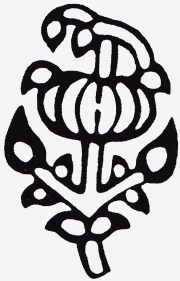
Buti |
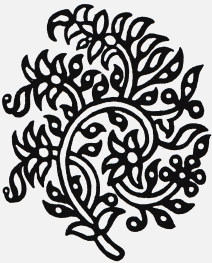
Buta |
Sitting in a room run by large national and international hotel chains using contemporary synthetic carpets, plush white linen, fire and stain safe upholstery fabrics, the average tourist might not be quite aware of the splendid history of textiles that this city has enjoyed, ever since its forefathers set it up in the early 18th century. However, for locals in the region, Jaipur was always the big city they came to for their annual purchases of printed, painted, embroidered, woven and otherwise embellished textiles. These textiles served the needs of everyday wear for both the person and home and the two choupads or squares within the walled city served as the main centres.
|
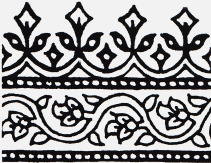
Bel |
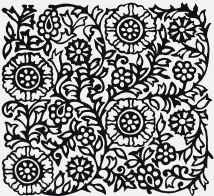
Jaal |
T
he Kishanpol Bazaar at the Choti Choupad was earlier a main centre for the purchase of elegantly block printed textiles from Jaipur and its neighbouring regions of Sanganer and Bagru. The first two were known for its design repertoire of dynamic buti (small floral motifs), buta (large floral motif), bel (vine) and jaal (grid) patterns in natural dyes and were much favoured in the courts of Rajasthan and among the elite. Bagru in contrast, while having a similar design repertoire, produced more crudely printed textiles popular among the common man. These mud resist prints were often smudgy after their multiple indigo and madder baths through the vibrancy of their colours and patterns has ensured that they are today more closely identified with the region. Printing in Jaipur and Sanganer with its small and delicate patterns almost came to a halt by the middle of the 20th century, while Bagru, Kaladera and other regions were to take on a much larger role in the production of printed textiles.
T
he City Palace Museum in Jaipur is a unique repository of the history of the printed textiles of the region, and the last samples to have entered its stores date to the early decades of the 20th century. While textiles continue to be purchased for use within the complex post this period, the changing status of royalty – from being absolute monarchs to equal participants in a new democratic India – meant that while the use of inherited trappings continued for ceremonies, the acquisition of textiles was increasingly in the personal domain for everyday use by the royal family, with the palace stores ceasing to show any new entries.The story I hope to briefly unfold here is of two textile archives or repo-sitories within Jaipur, one historic and the other from the 20th century, both of which have together placed the city on the international map as a centre for the study of textiles. While the general population is aware of their existence, their crucial role in nurturing textile traditions in the region has largely been ignored.
B
y the 1960s and ’70s a large num-ber of travellers and visitors to Rajasthan were eagerly looking at the multitude of crafts that were produced in the region. While many traditions were being lost a few valiantly conti-nued on a much smaller scale among a minority of craftsmen and women. One such tradition that was to attract the attention of Faith Singh, an Englishwoman who married into Jaipur aristocracy, was the art of the hand block printers of the region. By 1968/69, she and her intrepid husband John Singh had started the Anokhi label and were presenting western styled clothes made by local tailors from the region’s hand block printed textiles to discerning buyers at the height of the hippie movement in the UK and from an outlet in the newly opened Rambagh Palace Hotel in Jaipur.The Anokhi story has been meteoric since those early days and the company is today a large retail chain spread out across every major city in India and their products are available to consumers around the world. This author helped the founders start and set-up the Anokhi Museum of Hand Printing (AMHP) at Amber in the outskirts of Jaipur. The museum is dedicated to the history of hand block printed textiles from the region. The three and a half years of travel, research and study that went into creating this museum was to a great extent possible because Faith and Anokhi had chosen to record their story by maintaining an impressive archive of samples, patterns, fabric swatches and blocks from the early years of the company’s founding.
F
or nearly eight months, the author and Faith Singh were to examine this archive daily from 7-9 am at the factory premises at Jagatpura, then in the outskirts of Jaipur though it is today a bustling hub of much of the city’s rapid expansion drive.The clothes retained within the Anokhi archives were significant examples of innovations both in printing techniques and technologies while representing the change in clothing styles of men and women in urban India over the last four decades. Each textile in the archive was to highlight a print technique innovation, the ideo-logy or ‘client demand’ behind certain looks, improvisation over printing limitations and the happy coming together of accidents at the printing table that was to create fresh and unique takes. The emphasis was to remain on natural dyed textiles for a long time, though changing technology and consumer demands meant that sometimes trends of neon acid colour prints with Napthol dyes were used, but these were quickly weeded out and the company today continues to produce fashion made largely from natural and safe chemical dyes.
The increasing commercial demand for hand block printed fabric was to mean that a certain amount of mechanization and improvisation was needed within the industry to be able to cater to ever increasing orders. The first of many major breaks with tradition was to now occur with a shift from the low seated printing table as wide as an arm could reach, to large tables where the printer could go all around over much wider fabric. This change in scale was to affect every aspect of the print’s quality with small delicate patterns increasingly giving way to innovations of larger print repeat combinations and far more intricate though sometimes less successful patterns. A change in design repertoire was to be expected and it did happen, though to Anokhi’s credit older, more traditional patterns continue to be produced, albeit in smaller numbers. A line of textiles showcasing this rich history of local design is today sold at the AMHP museum shop and has become a big draw for discerning buyers and collectors.
T
he museum today showcases historic hand block printed textiles from the region and then follows the Anokhi story with garments on display showing newer innovation made every five years by the company. Examples include iconic fashions worn by cele-brities, successful and popular designs along with a series of technical panels which visually illustrate the laborious process of creating hand block printed textiles along with allied processes that bring these textiles to the consumer. Sections of the museum are also dedicated to the craft of hand block woodcarving and other tools of the trade. Visitors to the museum get a chance to physically print textiles in the museum and share the experience and painstaking process by which these textiles are made.
W
hile setting up the museum, my search for the fabled Sanganer printing continued and I eventually ended up at the Badi Choupad within the walled city where a few dealers continue to sell the traditional Safa (turbans) and Angochas (shoulder cloths) in the sparse white, black and red combination of the Sanganer tradition. These dealers cater to nearby villagers and older Jaipur inhabitants who still use these textiles. Our most successful revival while setting up the museum was in being able to identify the last remaining family still practising the craft in Sanganer. Newer samples were made for display at the museum, enabling entrepreneurs in the city to contact printers for their textiles. Thus work that had almost ended has picked up again and seems to be flourishing.For the largely anonymous hand block printing community of carvers, dyers and printers, the museum is a great source of pride and an acknowledgement of their rich tradition and continued contribution to the region. Anokhi’s success was to prompt seve-ral others to venture into the business and the trade has increased multifold. Pressures on land with rapid urbanization have meant that more and more printing centres have moved out of the city following government regulations. The laborious work needed to create these wonderful textiles has also meant that many younger gene-ration printers are loath to take on the profession and existing printers are slowly moving towards cheaper and more commercially viable screen-printing alternatives. The trade has come full circle and perhaps a new tradition will need to be created for hand block printing to enjoy a fresh revival.
I
n 2011, a slim book titled Rapture: The Art of Indian Textile by Rahul Jain, India’s pre-eminent textile researcher and historian, was published. Conceived as an illustrated overview of Indian textile imagery from across the centuries to the contemporary period, the book show-cases 85 distinct textiles. These pieces are either woven, painted, printed or embroidered and were manufactured across the length and breadth of this country providing a known but rare view of the astonishingly prodigious textile tradition extant even today across various communities and regions of present day India.For textile enthusiasts like this writer, one of the most fascinating takeaways from the book was that of the 85 textiles discussed, at least 14 were recorded or rumoured to be from the Rajput court of Amber/Jaipur and date from the time of Raja Man Singh of Amber (1550-1614) onwards. Amber was the precursor and adjoining region to Jaipur, with the latter being established as the new state in the early 18th century. These 14 textiles include rare draw loomed samite silk woven pieces depicting mythical creatures and floral motifs, wondrously hand patterned, resist printed and mordant dyed cotton kalamkaris, lampas silk woven furnishings, silk velvet hang-ings both patterned in weave and by stencils and richly embroidered silk and cotton furnishings.
These textiles served a range of functions – as fabric lengths, coverlets, canopies, floor spreads, animal trappings, and wall hangings or tents among other ritual and secular everyday functions. Evidently, they were useful to the lifestyle of Jaipur’s peripatetic rulers who were often away for long durations in the service of the Mughals.
Since at least the 16th century, the royal stores at Amber have been enriched by textiles from across India and other countries as far away as Iran and central Asia. From the late 19th and early 20th centuries, many textiles from the Jaipur palace stores were to move to other collections like other object d’art and this constant churn of material goods was to eventually enrich several present day internationally known collections.
S
ome of the present notable homes of these Jaipur textiles include the Calico Museum in Ahmedabad, Bharat Kala Bhavan in Benares, the Victoria and Albert Museum in London, the Los Angeles county museum in Los Angeles, Art Institute in Chicago, the Metropolitan Museum of Art in New York, Dar-al-Athar al-Islamiyya in Kuwait and the National Gallery of Australia in Canberra, among a host of other major institutions and private collections. The dispersal of Jaipur’s textiles is almost as interesting a story as its coming together under five centuries of recorded textile history of the Kacha-waha Rajputs, though they have been in the region from the 11th century onwards.However, beginning in 1959, the then Maharaja of Jaipur, Sawai Man Singh II was to open his collection to the public at large with the creation of the Sawai Man Singh II Museum. Material objects from the Kapad-dwara or the royal repository of textiles, costumes and jewellery have gone on to became a central focus of the museum, popularly known today as the City Palace Museum Jaipur. The textiles and costumes in the museum include a number of tailored dresses, fabric lengths, shawls, unused and uncut fabrics, furnishings, floor coverings, carpets, tented panels and ani- mal trappings. While the toshakhana probably dealt with the daily wear of the ruler and the royal family, the kapad-dwara was the store for the more expensive costumes and jewellery.
S
cholars believe that the system of inventorying objects received by the textile stores was akin to the Mughal system as mentioned in Abul Fazl’s Ain-i-Akbari. More research is however needed, and many scholars are now working on the indigenous and local, archiving and inventorying methods and techniques of various stores across Rajputana. Since the palace stores were not meant to be museum’s as we know them today, the metho-dology of recording data and ascribing provenance also needs to include histo-ric circumstantial evidence and aspects like design, weave, embellishing technique, among others.Nowhere else in India is there such an ‘embarrassment of riches’ of craft history, one that has seldom been mapped, studied or understood. Enq-uires have been few and far between and serious research non-existent though both the archives are well maintained and accessible to the scholarly community and those interested. The existence of a contemporary retail economy that manufactures and sells several of these textiles provides a wel-come environment for such a study.
The presence of these two distinct archives in Jaipur connected through craft traditions, but separated by time, allow for a rare look into craft continuities. Patrons, uses, needs, styles and qualities varied but several manufacturing traditions continued across the region. The story of Jaipur cannot be told without a history of its textiles, ancient and contemporary.