Cameras at court
MRINALINI VENKATESWARAN
THE late 19th and early 20th centuries saw a renaissance in princely India. Notable figures brought new energy to their role as leaders and protectors of their people – reform, modernization and improvement were the mantras, espoused and delivered with zeal and dedication. It was also a rapidly changing world with industrialization and the invention of new technologies, especially those related to communication; the close – albeit sometimes enforced – contact with Europe and the rest of the world through it, was an enormous stimulus.
Maharaja Sawai Ram Singh II of Jaipur (b. 1833, r. 1835-1880) was born at the beginning of these changing times in an atmosphere where felicitous outcomes were far from certain. He was declared the Maharaja of Jaipur when he was less than two years old, ushering in a minority government close on the heels of his father’s (Maharaja Sawai Jai Singh III b. 1819, r. 1819-1835). Inaugurated by a tussle for power between his late father’s scheming ministers, the Queen Mother, and competing factions of thakurs, the British played referee, at some cost to themselves.
1By the time Prince Alexei Dmitrievich Saltykov of Russia
2 visited Jaipur in 1845-46, things were on a more even keel. He met Sawai Ram Singh II: ‘The young Maharaja of Jaipur, a very plain-looking thirteen years old child, received us, sitting on his throne. Asking after my health, about where Russia is located and how long it would take to go there from Jaipur, the Maharaja ordered his English language teacher to ask him a few words in that language, which he is learning in order to please the Resident. Then he got up from the throne, walked to the archery hall, took up a bow, some arrows and showed us his skill in archery. In the right hand wall were small holes through which one could speak to his mother; beside these stood eunuchs. She told me that she would have liked me to come to the palace for a whole day, to have lunch and watch the elephants fight. The Maharaja’s toys are wooden elephants and horses, the same height as him; they stand in the throne hall.’3Although such a scene is potentially embarrassing to witness as an adult, the account is a charming one of a young boy showing off his accomplishments ever so slightly to his exotic guest. However, it is also a rare glimpse of the maharaja in his youth, illustrating the changing world he was growing up in, when Russian visitors and foreign language instruction were becoming the norm, expanding his world, his mind, and the information he had access to. The wondrous new technology of photography,
4 literally, ‘writing with light’, was another.|
|
|
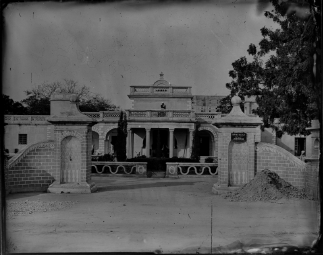
View of Mr Murray's residence, with his nameplate on the gatepost at right. Wet collodion glass plate negative, digitally reproduced, c. 1870. MSMSIIM2012.04.0013-0018 |
The story of Maharaja Sawai Ram Singh II’s first encounter with photography is both untold and unknown. In a museum publication dating to the 1980s, the then Keeper Yaduendra Sahai suggests that the photographer T. Murray’s visit to Jaipur in 1864 provided the impetus, with an earlier meeting in Simla setting the scene. Murray is believed to have returned to Jaipur several times, even being appointed court photographer.
5, 6 In a later publication, however, Sahai surmises that Sawai Ram Singh was familiar with photography as early as the 1850s, although he does not say how he arrives at this conclusion.7
I
nvented in the 1820s (the first photograph is acknowledged as one by the Frenchman Joseph Nicephore Niepce in 18268 ), photography was a new technology that was the playground of scientists, artists and inventors. It evolved from the older technology of the camera obscura (an optical device that projects an image of its surroundings on a screen), which made its appearance in Rajasthan as early as 1818 at the court of Udaipur/Mewar, where the British political agent James Tod describes it as ‘…the delight of the most refined, and by which even the dying moments of the prince of Oodipoor were soothed. He used to say I brought him Mun-ca-dowa, or medicine for the mind, as I sat for hours daily by his pallet, exhibiting these things.’9 By the time Louis Rousselet visited Mewar in 1865 and later Jaipur in 1866, photography was very much a part of courtly life, even if not of the populace. Rousselet recounts one of the nobles of Mewar, the Rao of Bedla having gone ‘into prolonged ecstasies over a stereoscope containing coloured views of the Tuileries and Versailles’ of which he subsequently ‘had to make him a present, for he could not tear himself from it.’10Recounting his later meeting with Maharaja Sawai Ram Singh II of Jaipur, he comments: ‘The conversation then turned on photography (he is not only an admirer of this art, but is himself a skilful photographer), and afterwards on France, of which we talked for a long time.’
11 A mere two years after Murray’s visit, he was considered skilful by an accomplished fellow practitioner (Rousselet was also an amateur photographer although he did not use photographic prints in the publication on his travels). Rousselet also comments on Sawai Ram Singh’s modern vision, seeing his support of reform and reorganization as the anti-thesis of the typical, superstitious native Hindu prince. Interestingly, this is in stark contrast to a later account by the English artist Valentine Prinsep, who in 1877 comments on his religiousness, and tendency to spend ‘regularly from ten to four at pooja or prayers.’ This was probably exaggerated hearsay, and more likely a convenient excuse to thwart pesky visitors.12
|
|
|
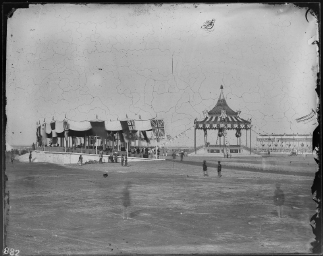
A view of the Imperial Assemblage ‘theatre’ (vehemently criticized by Prinsep), possibly taken when Sawai Ram Singh attended it. Wet collodion glass plate negative, digitally reproduced, 1877. MSMSIIM2012.04.0033-0011 |
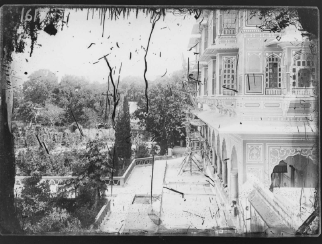
Prinsep, however, also goes on to provide some invaluable if tantalizingly inconclusive information on the maharaja’s photographic habits: ‘…Finally I was ushered through many dark passages into a courtyard, where there were a dozen fellows with hawks; from that again to another court, and then up some steps, when I found myself in a comfortable room, where the maharajah spends his leisure time photographing. Praying during the lightest hours of the day, he can have but little time for anything that demands light… The windows of this photographic-room look over a charming garden, beyond which rise the hills that encircle Jeypore, on whose precipitous sides I can yet trace in gigantic letters the "Welcome to Jeypore" placed there for the visit of the Prince of Wales.’
|
|
|
Although damaged due to age, this photograph taken from a window in an upper story shows the verandah of the Chandra Mahal, looking out over Jai Niwas garden to the left. It is exceedingly tempting to consider that this might have been the view from Sawai Ram Singh’s studio. Wet collodion glass plate negative, digitally reproduced, February 1867. MSMSIIM2012.04.0052-0004 |
In a later guide to Jaipur published by the indefatigable Thomas Holbein Hendley,
13 the location is noted more precisely: ‘The group of buildings immediately next and in line with the Chandra Mahal, is known as the Madho Niwas, having been constructed by Maharaja Madho Singh I… Above the drawing room are the photography rooms.’14 The space is within the private residential area of the City Palace complex, providing easy access and suggesting the regularity with which the maharaja used the space. This is supported by his diary entries, referred to later in this essay.
P
rinsep’s visit to Jaipur was a part of a long tour of India in connection with the Imperial Assemblage of 1877, one of a series of imperial durbars orchestrated during British rule to reiterate their supremacy and their feudal relationship with India’s princes. Prinsep commenced his tour proper in Delhi at the Assemblage, commissioned as he was by the Indian government to paint a picture of it as a present for Queen Victoria on her assuming the title ‘Empress of India’.15Prinsep is lively and opinionated about what he sees, especially art and architecture, which he considers himself qualified to comment on: ‘Today I have received visits from the artists of Delhi …their manual dexterity is most surprising. Of course, what they do is entirely traditional. They work from photographs, and never by any chance from nature. Ismael Khan showed me what his father had done before photographing came into vogue, and really a portrait of Sir C. Napier was wonderfully like, though without an atom of chic, or artistic rendering.’
16While his evaluation may be debated, it tells us that eleven years after Rousselet was obliged to part with his photographs because a Mewar noble found them fascinating (if already familiar), photographic references for painting had become de rigueur. Indeed, the image produced was considered traditional. The ‘vogue’ for photography had filtered down to the artist community, showing just how much more accessible the technology had become, and how ubiquitous a way of seeing.
This is borne out by the immense popularity of photographic societies – the first in India was established at Bombay in 1854; in January 1856, the Bengal Photographic Society at Calcutta was established with both Europeans and Indians as subscribers. Maharaja Sawai Ram Singh II is listed in the pages of its journal as a life member.
17 Aside from the conventional route of being introduced to it by a visiting practitioner, this is another way that he might have encountered photography. We know that he travelled for political reasons to the colonial centres of government at Calcutta and Simla, which were also centres of photography and had important studios.The role of such societies in shaping approaches to photographic practice can only be guessed. In the single volume referred to here (published in March 1869), essays discuss the role of the photographer, decry the sacrifice of art in photography at the altar of commerce, and hotly debate the role of the society. Originally formed to communicate new discoveries to its members and to popularize the technology, some members felt that photography was already so well established in India, and practitioners so wary of sharing what had come to be viewed as personal secrets, that the society should perhaps turn to other areas such as fine art. The suggestion was curtly dismissed, and while we cannot know what Sawai Ram Singh thought of such matters, it is enlightening to consider that this was the milieu and material that he engaged with and responded to.
Photographers wrote in from around India and even the world with tips and tricks, including a fascinating if highly technical essay by the archaeologist John Philip Vogel (who later worked with the Archaeological Survey of India) on the improvisations he made on site in Egypt to make acceptable photographic exposures. The journal also held and published the results of competitions and decided the rules that governed entries and the kinds of prizes that could be awarded. For instance, it made allowances for the day jobs of amateurs that might prevent them from dedicating as much time as a professional, as also the vagaries of the weather in various parts of India that might permit photography only in some months of the year. Copies of winning prints could be mail-ordered by members of the society for a specified sum. Although no prints traceable to this mode of acquisition have been found at Jaipur, such information sheds further light on the still-murky details of photographic collecting practices of 19th and 20th century India.
I
f we are unaware how Maharaja Sawai Ram Singh II began in photography, we have slightly more information on the nature of his practice. For eight months in 1870 (1 January-4 August), he maintained a diary18 in which in bullet-point style he noted his main activities of the day. The diary begins in Calcutta during the Duke of Edinburgh’s visit, and ends abruptly in Jaipur. The accompanying table reproduces entries that have references to photography. Also included are references to ‘Murray Sahib’; possibly referring to the T. Murray believed to have been appointed by Sawai Ram Singh as a court photographer. Note that since the name crops up both in Calcutta as well as Jaipur, it is possible that the reference is to two different people, although one cannot be sure as first names are not mentioned.Even excluding the three references to ‘Murray Sahib’, 36 days over a period of 7 months is an average of 5 days every month spent photographing, printing, checking chemicals, or sitting for photographs. He was also clearly hands-on about his equipment and chemicals, visiting shops to see the latest cameras and being able to spot spoilt chemicals (subsequently fixing them!). The terse style and inconsistent detail tempt one to think that he might have omitted to mention what he considered more mundane. But even as it is, and extrapolated over his lifetime, the diary entries are proof of a significant commitment of time and resources. Combined with his travels, his subscription to the Bengal Photographic Society and its journal (there may have been others, but no evidence has been found), and discussions with knowledgeable peers and practitioners such as Thomas Holbein Hendley, it is obvious that photography was a passion.
|
|
|
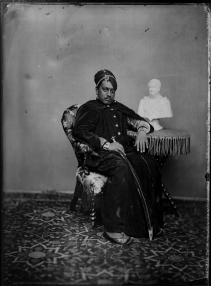
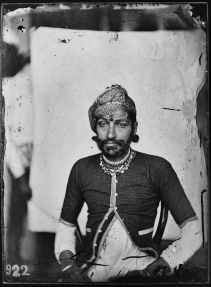
Maharana Sajjan Singh of Udaipur, photographed just after the 1877 assemblage. Records at Udaipur state that he stopped at Jaipur on the way where a picture was taken. A contemporary of Sawai Ram Singh in outlook as well as rule, he was also passionate about photograhy, albeit as a patron rather than a practitioner. Wet collodion glass plate negative, digitally reproduced, 1877. MSMSIIM2012.04.0063-0011 |
For instance, although the maharaja died before its completion, a major project for a new museum that showcased the arts and crafts of India was initiated under his direction and coordinated by Hendley. The immediate result of this was the Jeypore Exhibition of 1883, whose core collection was further augmented by Hendley towards the creation of the Albert Hall Museum (which opened on 21 February 1887). In both cases, photographs and photography had entire sections devoted to them, with the gold medal at the exhibition going to Lala Deen Dayal of Indore.
19 The Maharaja School of Arts established at Jaipur to promote the industrial arts was also the first outside British India to teach photography.20 It suggests that photography at Jaipur was both perceived as well as pursued seriously.
T
he collection of photographic material at the Maharaja Sawai Man Singh II Museum consists of 6050 individual prints (including duplicates) contained in 105 albums and 1,941 glass plate negatives containing 2008 images (some plates carry two). It also includes camera equipment. The albums range from the 1860s when Sawai Ram Singh II began photographing and collecting to the 1970s, and include the period when the then Maharaja of Jaipur, Sawai Man Singh II, was the Rajpramukh of Rajasthan in independent India. The photographic processes they encompass are albumen and silver gelatin prints, on both printed and developed out paper.Those belonging to Sawai Ram Singh’s period are all albumen prints, the dominant technology of the time. They range in size from cartes de visite or visiting card sized photographs that were mounted on thin card (eventually becoming thicker, gilded and more ornate), to roughly A4 size photographic prints by established photographers or studios such as Deen Dayal, Johnston & Hoffman and Bourne & Shepherd. Most of these albums contain landscapes or architectural images.
|
Day & Date, 1870 |
Location |
Translated extract (Translator’s interpolation) [Translator’s notes, author notes] |
|
Saturday 1 January |
Calcutta |
At 11 o’clock photographed the Duke of Edinburgh (and) then returned home (and) ate food. |
|
Sunday 2 January |
Calcutta |
Later photographed Nawab Faiz Ali Khanji. Later (photographed) Shambhu Singhji and Nawabji (and) Agent [possibly – unclear name] and Gor/Jorji [possibly – unclear name]. |
|
Monday 3 January |
Organized (put together) photographs. |
|
|
Friday 7 January |
Calcutta |
Shashi (Sache?) Westfield photographer took a photograph (of me). [Since Sache worked with Westfield this could be an interesting note, considering scholarship notes that Sache left Westfield by 1870. Since the name is written in Devnagari script the Indian name Shashi would sound like Sache. However, Sache has also been spelt as Sachi in official notices.] Then visited Lazarus [referred to in the Journal of the Bengal Photographic Society, so presumed to be a photographer rather than the well known furniture firm although they could also be the same person]. Later played croquet at Dr. Murray sahib’s (place). |
|
Saturday 8 January |
Calcutta |
Dr Murray sahib and Agent sahib arrived. |
|
Friday 14 January |
Calcutta |
(Once I was) done with the usual (normal) work. Attended the Council. Later visited the photography shop near Brosky. |
|
Tuesday 1 February |
Kashi |
Photographed Maan mandir. |
|
Friday 4 February |
Agra |
Photographed the Taj. |
|
Saturday 12 February |
Jaipur |
Visited the Tasveer Khaana (photograph department/room). |
|
Monday 14 February |
Jaipur |
Photographed Ibadullah Khan. |
|
Wednesday 16 February |
Went into the photograph room. Printed photographs. |
|
|
Sunday 27 February |
Jaipur |
I saw the new material that arrived in the photograph room/department. |
|
Tuesday 1 March |
Jaipur |
Took some photographs. |
|
Wednesday 9 March |
Jaipur |
Printed some photographs. |
|
Wednesday 16 March |
Jaipur |
I sat in the photography room (department). |
|
Sunday 27 March |
Jaipur |
On the way back photographed a horse. |
|
Tuesday 29 March |
Jaipur |
Took photographs from the corner of the palace. |
|
Wednesday 30 March |
Jaipur |
Took photographs from the corner of the palace. |
|
Tuesday 12 April |
Jaipur |
Did some work photography related work. The (photography) chemical compound / mixture spoiled (thus) had to be fixed. |
|
Sunday 17 April |
Jaipur |
Went into the photograph department/room. Printed photographs. |
|
Tuesday 19 April |
Jaipur |
Printed photographs. |
|
Thursday 21 April |
Jaipur |
Went into the photography room/department. Photographed the new doctor. |
|
Saturday 30 April |
Jaipur |
Went into the photography room. Printed some photographs. |
|
Sunday 1 May |
Jaipur |
Did some photography room (related) work. |
|
Monday 16 May |
Jaipur |
Printed some photographs. |
|
Monday 23 May |
Jaipur |
Printed photographs. |
|
Tuesday 24 May |
Jaipur |
Printed photographs. |
|
Friday 3 June |
Jaipur |
On the way back photographed the garden (but) these did not turn out. Later went into the photography room and photographed women (Since) these were seen in a hurry (the photographs were) spoiled. |
|
Saturday 4 June |
Jaipur |
Printed photographs. |
|
Sunday 5 June |
Jaipur |
Murray sahib arrived. |
|
Friday 10 June |
Jaipur |
The chemical compound/mixture for photography spoiled so had to fix it. |
|
Saturday 11 June |
Jaipur |
Went into the photography room, where the chemical compound was corrected (then) tried Benzene [possibly Benzene – word in Devnagari sounds like Be(n)zene]. |
|
Tuesday 28 June |
Jaipur |
Went into the photography room. Printed photographs. |
|
Friday 1 July |
Jaipur |
Later stayed in the photography room. |
|
Saturday 2 July |
Jaipur |
Later printed photographs. |
|
Monday 4 July |
Jaipur |
Took some photographs. |
|
Tuesday 5 July |
Jaipur |
Today photographed the sahibs. |
|
Sunday 10 July |
Jaipur |
Photography room. Photographed and printed. |
|
Tuesday 19 July |
Jaipur |
Rode the carriage (enjoying) the breeze towards Murray sahib’s (place). |
The glass plate negatives appear to have multiple authors as well. Although primarily the work of the maharaja or his ‘studio’ – i.e., taken by or with assistants at the foto ka karkhana or tasveer khana
21 – some plates have scratched onto them the names and negative reference numbers of Murray, Bourne and Sache. As is clear from Rousselet’s experience in Mewar, relinquishing a ‘collectible’ image as a souvenir was an accepted practice, and so it is entirely possible that the maharaja collected negatives just as he did prints and albums. The negatives also have numbers painted on, most likely as part of an inventory exercise in the more recent past.The negatives are primarily wet collodion plates,
22 which were in use from the 1850s to 1880s. While representing an important step in the evolution of photographic technology (the use of glass for negatives made images much sharper than the previously used wax paper, or metal plates for daguerro types), they were nevertheless cumbersome: they required the photographic material to be coated, sensitized, exposed and developed within a span of about fifteen minutes, necessitating a portable darkroom for use in the field. The early days of photography thus saw large, boxy cameras, fragile glass plates and wet chemicals that made anything other than the stability of studio photography a challenge.
I
n contrast to the photographic prints, the bulk of the images in the negative collection are portraits: of Indian men (fellow rulers such as Maharana Sajjan Singh of Udaipur, the Jam Sahib of Nawanagar and Maharaja Jaswant Singh II of Jodhpur, who was his brother-in-law, artists, nobles and ordinary people such as palace functionaries), Indian women (entertainers and those of the zenana), foreign men (including distinguished persons such as visiting British royalty, political representatives, and one presumes, interesting visitors to Jaipur or those encountered on his travels), women, children and families. They include art objects such as paintings and sword hilts, horses and other animals, and landscapes of Jaipur and Amber, as well as further afield such as Delhi, Agra, Simla, Lucknow, and Varanasi.
S
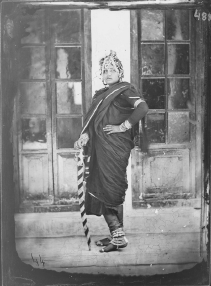
ome sitters are shot almost obsessively, such as one particular member of the zenana who was photographed in different attire and poses. Perhaps she had the status of a paswaan (normally a concubine who had borne a child) and it is tempting to identify her as a special favourite, Ram Sukee, whom Valentine Prinsep met: ‘I had another sitting from his Highness, who, notwithstanding his night-long praying, was quite brisk and talkative. We became great friends, and finished the afternoon playing billiards together. Among the curiosities of Rajpoot Courts are the nautch girls, who are a kind of privileged people, and wander through the palaces unveiled and unmolested. I had noticed a number of them here, and, presuming on my intimacy, got the Rajah to order one of the girls, whose photograph I saw, to sit. On Tuesday, then, I had a sitting from her. She is not young, but has a remarkably fine head… She wears a long flowing robe and winds her drapery around her with the air of a queen… Ram Sukee, this nautch girl, is a great friend of the Rajah, and soon he came to see how I was getting on, and pottered around me, arranging drapery and fancying he was of great assistance, whereas he generally spoilt everything.’23
|
|
|
|
This image, with the assistants stretching the white backdrop behind has a wonderful rough and ready feel to it. Wet collodion glass plate negative, digitally reproduced, c. 1870. MSMSIIM2012.04.0036-0007 |
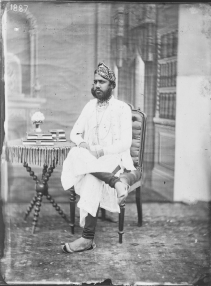
A young Madho Singh, possibly after his adoption as Sawai Ram Singh’s heir. Wet collodion glass plate negative, digitally reproduced, c. 1880. MSMSIIM2012.04.0074-0013 |
Later, on missing a final sitting with the maharaja due to the latter’s ill health, Prinsep huffs off: ‘I contented myself with his nautch girl, and, if only I can get drapery made like hers, shall paint a picture from my sketch on my return home.’
24 Sadly, no such image is known.
T
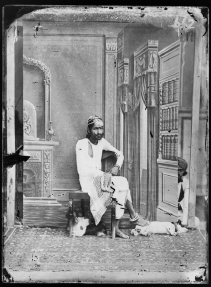
he other notable set of images amongst the glass plate negatives are Sawai Ram Singh II’s self-portraits, taken at various stages in his life, and portraying him in a number of ways. Some of these images – because they are uncropped negatives – also show the backdrop and the room beyond, offering tantalizing if frustrating clues on the interiors of his studio. Others show assistants, artlessly peeking from behind the curtain, and the most charming star, his pet dogs.
|
|
|
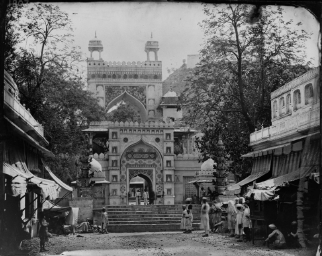
A striking view of the entry to the Dargah Sharif at Ajmer, possibly taken during Sawai Ram Singh’s travels. A cumbersome, time-consuming process, it was never easy to work with wet collodion glass plates, and many stories of ruined or broken negatives litter the history of early photography in India. Yet, the results could be spectacular. Wet collodion glass plate negative, digitally reproduced, c. 1870. MSMSIIM2012.04.0071-0003 |
A brochure
25 accompanying an exhibition held at the Maharaja Sawai Man Singh II Museum from 4 to 30 April 1985 is the first instance of this collection coming to light, their having been rediscovered at that time. Showcasing items donated to the museum by the royal family of Jaipur, it discusses an astonishing wealth of photographic material that included exclusive card mounts and photographic prints in the thousands, with the personal seal of Maharaja Sawai Ram Singh II, as well as books regarding photography and containing prints, and possibly including catalogues for supplies from which the authors confidently provide details of the maharaja’s cameras and other equipment.26The subsequent and more detailed publication
27 does much to build on the exhibition brochure.28 Both take important first steps on many of the specifics of Sawai Ram Singh’s photographic practice – for instance, by nailing down the exact date of an image of Jaipur city by corroborating it against details of when street lighting was installed, or whether the ‘Welcome to Jeypore’ sign painted on the hills above the city to welcome the Prince of Wales in 1876 was visible. The collection as a whole provides an invaluable record – as do photographic archives everywhere – of the physical changes to Jaipur and the City Palace complex on the one hand and important moments in the life of the royal family of Jaipur on the other, while also recording the people who lived in and visited it.
|
|
|
|
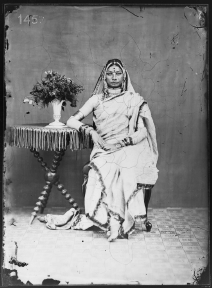
The obsessively photographed zenana woman, confident and ‘draped like a queen’, putatively Ram Sukee. She appears several times in various costumes and one additional image, sans make-up. Wet collodion glass plate negative, digitally reproduced, c. 1870. MSMSIIM2012.04.0054-0029 |
A charming image of the maharaja with his pet dogs against a library backdrop and furniture both known to have been his. An assistant holds the curtain steady at right. Backdrops and props in both paintings and photographs were meant to communicate something about the sitter, in this case erudition. Wet collodion glass plate negative, digitally reproduced, c. 1870. MSMSIIM2012.04.0025-0029 |
However, the material evidence of Sawai Ram Singh’s unique engagement with the camera begs the question – what drove his decisions? That he was keen and committed is obvious, but why for instance, did he shoot so many images of the women of the zenana – ladies whom he could see at a moment’s notice if he so desired? Although he never seems to have photographed any of his queens, his shooting women so extensively is unusual for a period when people believed that the camera could capture one’s soul. It has no comparison with any other contemporary Indian court.
29 Laura Weinstein30 suggests that in addition to this, in Sawai Ram Singh’s case, ‘exposing the zenana’ was about making a statement, to his foreign superiors in particular. Prevented access to zenanas, the British tended to view them both literally and figuratively as areas of darkness filled with women needing rescue. Indeed, moves to introduce education for women (though ultimately beneficial) were founded on such beliefs, and Weinstein suggests that Ram Singh signified his progressive outlook by photographing (at least some of) his women and showing these images to visitors such as Prinsep and allowing him to sketch them (Weinstein does not actually cite this example, but the extract quoted earlier supports her case). Further, their portrayal in standard, European, civilized fashion drove home their dignity and status; and, she argues, acted as a way to keep British interference in this otherwise extremely personal zone at bay.
W
e have no way of knowing what the women thought of either photography or being in the camera’s focus, or whether there was any patronage from the zenana31 (although the diary notes that they were not always cooperative – Ram Singh complains that some prints were spoilt as they were made in a hurry). Many remarkable images show them gazing fearlessly and directly at the camera, including a few rare images of a woman dressed in male garments or with traditionally male accessories such as a sword. But as loose photographic prints are not currently available, we do not know how many images were printed, what other images (of other places and people, including rulers) the collection originally contained, or indeed whether any of Ram Singh’s portraits (self or shot by others) were ever personal possessions of the women, or worn on their person as jewellery.
|
|
|
|
This striking portrait of an unidentified woman holding a man's sword with attitude is among the rarer in the collection. However, many of the subjects of Sawai Ram Singh’s studio hold the viewer’s eye equally directly. The photograph appears to have been taken against an actual building. Wet collodion glass plate negative, digitally reproduced, c. 1870. MSMSIIM2012.04.0019-0020 |
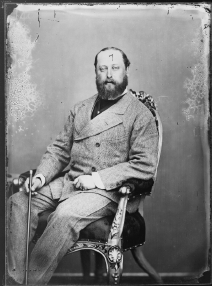
Albert Edward, Prince of Wales (later King Edward VII, r. 1901-1911), visited Jaipur in February 1876 as part of a royal tour of India. While in Jaipur he laid the foundation stone of the Albert Hall, which was named in his honour. Wet collodion glass plate negative, digitally reproduced, February 1867. MSMSIIM2012.04.0052-0004 |
His photographs of foreign men and women, aside from being souvenirs of a visit(or), are almost like his own album of ‘types’ à la The People of India series.
32 They are all composed in the conventional studio portrait format that was the photographic vocabulary of the time, but against his own painted backdrops33 (it has been surmised that these were later acquired by the Jaipur firm of Gobindram and Oodeyram after his death).34 The agency of colonial practitioners of photography is still a nascent area of study with essays such as Gayatri Sinha’s on performance in photography making a start on this; there remains much exciting new material for scholarship and interpretation.
T
he 2011 documentation of the photographic collection and the digitization of the images means that they are now available for study without the risk of harming the originals, which are fragile and of unique value to the history of photography in India. In keeping with the effort to offer new insights, the museum is scheduled to open a new gallery on painting and photography at the court of Jaipur that will showcase a much larger selection of images from Sawai Ram Singh’s archive than have previously been seen, facilitated by the documentation exercise. Revisiting and reconstructing Sawai Ram Singh’s life with the camera is now possible.
* My thanks to Princess Diya Kumari of Jaipur and the Trustees of the Maharaja Sawai Man Singh II Museum, Jaipur, for permission to use written and photographic archival material from the collection. I would also like to thank my colleagues at the museum (Giles Tillotson, Pankaj Sharma, Shefalika Awasthi, Ramkrishna Sharma and Sunil Chaudhry) and Eka (Pramod Kumar K.G., Deepthi Sasidharan). All images courtesy and © Trustees of the Maharaja Sawai Man Singh II Museum, Jaipur. Reproduced with permission.
Bibliography:
Aitken, M.E., ‘Pardah and Portrayal: Rajput Women as Subjects, Patrons, and Collectors’, Artibus Asiae 62(2), 2002, pp. 247-280.
Coe, B., The Birth of Photography. Ash & Grant, London, 1976.
Das, A.K. and Y. Sahai, The Photographer Prince Maharaja Sawai Ram Singh II (exhibition brochure). Maharaja Sawai Man Singh II Museum, Jaipur, 1985.
Diary of Maharaja Sawai Ram Singh II of Jaipur. Acc. no. 1808, Sawai Man Singh II Library, City Palace, Jaipur.
Falconer, J., India: Pioneering Photographers. The British Library Publishing Division, London, 2001.
Girikumar, S., ‘Technical Note on the Photographic Collection’ in K.G. Kumar, M. Venkateswaran, S. Girikumar and L. Power, Long Exposure: The Camera at Udaipur 1857-1957. Maharana of Mewar Charitable Foundation, Udaipur, 2014, pp. 194-211.
Hendley, T.H., The Jeypore Guide. Raj Press, Jeypore (available digitally on http://books. google.com), 1876.
Journal of the Bengal Photographic Society (New Series) 2, March 1869, acc. no. 3230, Sawai Man Singh II Library, City Palace, Jaipur.
Petrova, Evgenia (ed.), Prince Alexei Saltykov’s Journeys Across India. Palace Editions, New Delhi, 2012.
Prinsep, V., Imperial India: An Artist’s Journal. Asian Educational Services, New Delhi, 1879, reissued 2011.
Rousselet, L., India and its Native Princes. Niyogi, New Delhi, 1882, reissued 2011.
Sahai, Y., Maharaja Sawai Ram Singh II of Jaipur: The Photographer Prince. Dr. Durga Sahai Foundation, Jaipur, 1996.
Sasidharan, D., Mahallat: Photographs from the Chowmahalla Palace Collection, Hyderabad. Chowmahalla Palace, Hyderbad, 2006.
Sinha, G., ‘Performance in Photography: A Bridge between Ram Singh II of Jaipur and Contemporary Photographers’, in G. Sinha, (ed.), Art and Visual Culture in India, 1857-2007. MARG, Mumbai, 2009, pp. 282-299.
Tod, J., Travels in Western India. William Allen & Co, London, 1839 (available digitally on http://books.google.com).
Tillotson, G., Jaipur Nama. Penguin, New Delhi, 2006.
Watson, J.F. and J.W. Kaye, The People of India (Vols 1-6). W.H. Allen & Co./ The India Office, London, 1868-1875.
Weinstein, L., ‘Exposing the Zenana: Maharaja Sawai Ram Singh’s Photographs of Women in Purdah’, History of Photography 34(1), 2010, pp. 2-16.
Footnotes:
1. See Giles Tillotson, 2006.
2. An aristocratic Russian traveller and artist, he made two visits to the Indian subcontinent from 1841-43 and 1845-46, a period just after the British, through the East India Company, had established their supremacy in India, but had not yet been rocked by the challenge of the 1857 Uprising. He travelled widely, from the usual visits to princely states of various ranks to previously untrodden (by Europeans, that is) terrain such as the Himalayas. Although colonial society was yet to acquire the rigid distinctions that it saw after 1857, it was well on the way to doing so, and so Prince Saltykov’s openness to and engagement with all that he saw presents a refreshing change from other European voices of the time. These are reflected in his series of ‘Letters from India’, written to family and friends, where he also comments on those he encountered.
3. E. Petrova, 2012. p. 196.
4. From the Greek fos (light) and gráfo (to write). Historically, the practice of creating durable images by capturing light on a surface such as paper, made sensitive by coating it with an ‘emulsion’ containing light-sensitive particles, usually silver based compounds. Today, of course, this is accomplished electronically.
5. A.K. Das and Y. Sahai, 1985, p. 4, 6.
6. J. Falconer, 2001, p. 36. However, note that in the same publication with a biographical index of photographers, the entry for Colin Murray states that he was based at Jaipur. Of course, both Murrays could have been based in Jaipur, as Colin Murray worked with Samuel Bourne, and the museum collection contains original Bourne glass plate negatives.
7. Y. Sahai, 1996, p. 4.
8. B. Coe, 1976, pp. 14-15.
9. J. Tod, 1839, p. 263. The young prince recovered and survived for several years to rule as Maharana Jawan Singh.
10. L. Rousselet, 1882, reissued 2011, p. 161.
11. Ibid., p. 239.
12. It was probably also irrelevant. As Tillotson points out, maintaining personal faith was seldom at odds with progress and science to the rulers of Jaipur, even if commentators perceived it as such. G. Tillotson, 2006, pp. 128-129.
13. Thomas Holbein Hendley was the Residency Surgeon at Jaipur from 1873-1897. He organized the Jeypore Memorial Exhibition of 1883, was involved in the foundation of the Albert Hall Museum that incorporated the collections from the exhibition as well as added to it, and was extremely active in the arts and crafts of India, especially Rajasthan notwithstanding his official designation.
14. T.H. Hendley, 1876, pp. 26-27.
15. V. Prinsep, 1879, reissued 2011, p. 1.
16. Ibid., p. 47.
17. Journal of the Bengal Photographic Society (New Series) 2: March 1869, acc. no. 3230, Sawai Man Singh II Library, City Palace, Jaipur. The British Library contains volumes for 1857, and for 1962-65. The publication frequency seems to have been somewhat erratic. There is known to have been a break in publication from 1965 to 1968/69 due to changing membership and a lack of direction in the society.
18. The diary is unpublished as is the translation. The translation was undertaken by Mallica Kumbera Landrus during a research fellowship in June 2011, awarded by the Trustees of the Maharaja Sawai Man Singh II Museum. However, it is extensively referred to by Gayatri Sinha in an article discussing Ram Singh as a bridge between early and contemporary photography (G. Sinha, 2009, pp. 282-289).
19. A.K. Das and Y. Sahai, 1985, p. 4.
20. G. Sinha, 2009, p. 284.
21. In an endnote in India: Pioneering Photographers, John Falconer mentions the possibility that most of the images produced were not by Ram Singh, as he had appointed a foreign court photographer, T. Murray (J. Falconer, 2001, p. 36). However, the previously untranslated and unpublished diary of the maharaja (referred to earlier in this essay) makes clear his personal involvement.
22. For a technical note on early photographic processes in India as seen at the Pictorial Archives of the Maharanas of Mewar, Udaipur, but equally relevant here, see S. Girikumar, et al., 2014, pp. 194-211.
23. V. Prinsep, 1879, reissued 2011, pp. 94-95.
24. Ibid., p. 97.
25. A.K. Das and Y. Sahai, 1985.
26. The machine to emboss the maharaja’s seal still exists, as do the glass plate negatives and most of the albums. The camera equipment is also present, but being undocumented and with the accompanying catalogues unavailable, it is a challenge to piece their stories together. The process has just started in connection with a new exhibition on painting and photography at the court of Jaipur scheduled to open in late 2014. However, the rest of the material is currently presumed to be in sealed storage that is inaccessible for legal reasons.
27. Y. Sahai, 1996. However, it is important to note that many of the images from glass plate negatives reproduced in that publication are back-to-front, or the mirror image of what they should be.
28. However, the fact that the collection remained undocumented until 2011 means that we have no information on the remainder of the collection as it was in the 1980s (irrespective of and in addition to the objects themselves). For instance, Sahai specifies that there were over 2500 collodion glass plate negatives, which is more than the number that is currently available for documentation (Y. Sahai, 1996, p. 17). There are also lists of photographers whom Sawai Ram Singh II is authoritatively reported as ‘knowing’ in 1877 with no indication of how (A.K. Das and Y. Sahai, 1985, p. 7).
29. An investigation into photography at the Nizam’s court at Hyderabad suggests that such images when produced were entirely for private consumption, with negatives from the special ‘Zenana Studio’ of Deen Dayal required to be handed over to the palace. This was during the reign of Osman Ali Khan, Asaf Jah VII (r. 1911-1948) and dating to c. 1915, and thus many years after Sawai Ram Singh’s efforts (D. Sasidharan, 2006). The Hyderabad court is rather noted for these unusual, private images; in preceding them and through what is known of the way they were used, the Jaipur collection becomes especially unique.
30. L. Weinstein, 2010, pp. 2-16.
31. Molly Emma Aitken discusses the patronage and consumption of painted pictures, particularly in Mewar by the women of the court, and it is both tempting and feasible to assume that this extended to include photography – certainly at the time under discussion, with respect to Jaipur. See M.E. Aitken, 2002, pp. 247-280.
32. J.F. Watson and J.W. Kaye, 1868-1875.
33. Gayatri Sinha notes that there was an ‘entertainment department’ or Gunijankhana at Jaipur, and that it might have been involved in a symbiotic relationship with his photography studio. (G. Sinha, 2009, p. 284)
34. Personal communication from Giles Tillotson.