Agra’s street culture
RENU KHOSLA
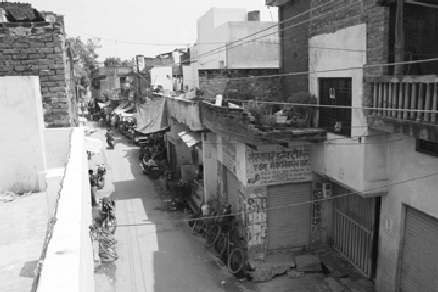
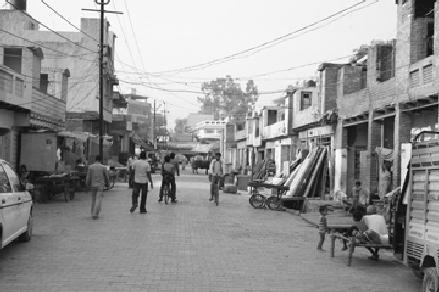
IT is difficult to imagine the idea of a city without its community. To understand the complexity of a city one must understand the ‘untidiness’ of its communities and life on the streets. ‘Life’, says Leo Hollis, ‘has a way of coming up from the streets and making itself felt.’1 Streets are where children of the poor play; the women cook, wash and hang their clothes to dry; people chat with their neighbours, walk or go about their business; vendors ply their wares and households collect and store water and fuel and so on. These interactions give meaning to the street – and streets are what give meaning to the city. If real life is lived on the streets, then cities must be planned for the way people live.
Agra is a historic city. It has the Taj Mahal and two other world heritage sites, but a lot more that is not as well known. Overshadowed by the Taj Mahal, Agra’s lesser-known monuments, the private built heritage, the darwazas, mandis, ganjs, tolas, padas, katras have been mostly forgotten. Also forgotten is Agra’s environmental heritage of wells and waterbodies that once made it a water resilient city.
A large number of Agra’s communities, especially of the poor, live among many of these not so significant heritage sites, providing a historic continuity to the city’s culture, cuisine, and craft. Barring the Taj and a few other protected monuments, the dominant narrative of and about the city is one of neglect and unconcern – a first class city with third class infrastructure! Agra’s 432 slum communities with an estimated 8.5 lakh people, half the city’s population, live in very poor conditions, and these include the 168 settlements that lie in the vicinity of the historic (protected and unprotected) sites. Nearly 40% are without access to municipal piped water supply at home. Others with access get minimal and/or dirty water. Most households extract groundwater for their needs, drying up the underground aquifers and destroying the city’s natural waterbodies. Underground sewage lines have been extended to outside 60% of the slums, yet 22% homes lack toilets and 10% of these flow directly into drains.
The streets of Agra’s slums provide the meta-narrative for the Centre for Urban and Regional Excellence (CURE) and Agra Municipal Corporation’s work in the city. These streets are where the lesser-known heritage of Agra and the settlements of the poor interface. Even though these monuments are situated in their backyard, few poor people benefit in any way from their presence – just one in four poor in the city in any case earn a living from tourism. On the other hand, they do pay a high cost for this proximity by way of the many legal restraints to bringing in municipal services.
T
he Centre for Urban and Regional Excellence is a development organization, which has been working in the city of Agra since 2005, to un-think and reimagine the city’s planning narrative, for making it inclusive, pro-poor and participatory. The overarching aim is to de-slum Agra. CURE has mapped the city’s slums and their street culture, documenting the wisdom of the slum streets, rebuilding the street’s social capital, and revitalizing what is lost.CURE’s process of community re-socialization is designed to: one, plan for upgrading the slum settlements, in particular bring in services that will improve environmental sanitation; two, promote sustainable livelihoods for the poor that are connected to the city’s core economy of tourism; and three, inculcate a sense of pride and an ownership and responsibility for the conservation of the community’s heritage.
People’s wisdom was gathered from the streets by talking to them, listening to their stories, mapping their settlements, courtyards and other social spaces, and learning about their skills, needs and concerns. Plans were prepared with the people for upgrading the settlements by providing basic services – of water, household toilets, improved drains, wastewater treatment systems, among others.
Even as communities have an intrinsic and deep-rooted knowledge of the place and its problems, the notion of community is almost always missing in the urban low-income settlements. Urban poor people are usually less involved with each other, and lack interaction. Working with these communities, CURE began the process of community rebuilding – mobilizing and organizing women and young people into small street groups and committees, nurturing local leadership and empowering them, crowdsourcing their talents and including them in the process of planned upgrading. Data, quantitative and qualitative, required to prepare the plans was gathered using participatory tools and processes, and building a community based information system on a geographic information system (GIS) platform.
T
he first project site was a bundle of five lesser known, but well preserved, monuments and neighbouring communities, spatially and historically connected to the Taj Mahal and the Mughal dynasty. Among these, Kuchpura became the epicentre of CURE’s upgrading and livelihood interventions. The Maharaja of Kuch, ostensibly the owner of the land on which the Taj was built, agreed to a land swap, moving his people across the Yamuna river. In the heart of Kuchpura stands the Humayun Masjid, pre-dating the Taj, Gyarah Sidi, the first of the five observatories in India and several old and functioning wells. Yet, Kuchpura in the city’s records, has been downgraded to a slum settlement.
A
Mughal Heritage Walk, a one kilometre walking loop, was carved out of the longer monument trail. It was designed to offer experience based tourism to the offbeat traveller while generating incomes from ticket payments for the residents. The walk catalyzed an incremental upgrading of Kuchpura, starting from one small home toilet. The home toilet, a priority articulated by women, was designed to fit the small housing space, limited budgets and availability (or unavailability) of trunk infrastructure. An improved septic tank was used for the toilet, prepared by a local entrepreneur who was enabled to provide localized end-to-end solutions for household toilet making. The septic tank effluent flowed down a repaired street drain, falling into the main nullah (drain). A toilet savings and credit system helped women build their home toilet. The balance amount could be borrowed from a Toilet Credit Fund and repaid in small, interest free instalments.|
|
The knock-on impact of the first toilets was unprecedented. First, every family on the ‘clean’ street and many more in the village began to build their own home toilets, taking advantage of the simplified credit system and custom-built technology. Second, CURE designed and constructed a Decentralized Waste Water Treatment System (DEWATS) on the main drain, an aerobic, bio-remedial system to treat and repurpose the wastewater and sustainably improve the environment and health of the people of Kuchpura. Third, a cleaner Kuchpura became increasingly attractive to tourists, enhancing resident incomes, throwing up new business opportunities in the community such as henna application, a tea terrace, souvenir making, etcetera.
A
Community Development Fund was set up, using the revenues generated through ticket sales from the Heritage Walk. The community has used it to fund small improvements such as installing a water pump for treated water to reuse in farming, house building and meeting other household needs, as well as to re-pave the neighbourhood school floor and provide school toilets.
|
|
Kuchpura’s upgradation has attracted public attention, bringing in the city’s resources to fill the infrastructure gap such as paved roads, home water connections and community toilets. In an unexpected and delightful development, the upgraded common courtyard has helped recast the social order – changing what was once a male-dominated space into a vibrant commons with enhanced participation of women and children.
T
here were two interesting features of the process of developing the Mughal Heritage Walk in Agra. First, the planning narrative became far more participatory, as city level leaders and officials realized the importance of the initiative in sustainable development. It became an entry point for introducing basic urban services into other poor settlements to sustainably improve the quality of lives of people. In consultation with the Agra Municipal Corporation and District Urban Development Agency, CURE prepared a plan to replicate this initiative in the historic core of Agra, the Tajganj.Tajganj is a densely populated area of 17 slum settlements and 4500 households, some of whom can trace their linkages to the Taj Mahal. The poverty of these communities is, however, threatening the living environment and the small built and intangible cultural heritage of Agra – private houses, temples and mosques, fairs and processions, flower markets, pigeon and kite fights, crafts of zardozi, marble inlay, shoe making and cuisines. Also under threat is the city’s environmental heritage – the numerous wells and waterbodies in the area that have run dry due to the unchecked withdrawal of water. Of the various wells in the area, over half are covered, encroached or silted, and all are dry.
C
ommunity interactions have helped formulate a plan for the revitalization of Tajganj – its society, livelihoods and heritage. The process of community mobilization is underway. The purpose is to bring people together and trigger a conversation around re-engineering societies and the ecosystem, by recharging the groundwater, harvesting the rainwater and reviving the wells.Social maps of wells, squares and streets helped to identify and connect with community stakeholders. The community is being mobilized through several initiatives: reviving the temple arti (prayer), the Bhagwad katha (Lord Krishna’s sermon) and documentation of village stories. Organizing youth sports, particularly cricket, led to the clearing of rubbish from the open ground, and the eviction of drug addicts and gamblers who had made the area unusable, unsafe and out of bounds for local residents.
The Taj Heritage Walk, meandering through the streets of Tajganj, has once again formed the spine around which CURE is rebuilding livelihoods and upgrading slums, albeit at a much larger scale and with greater financial support from the city. Area improvement plans prepared in consultation with people and resources from the state have raised Rs 63 crore to add a toilet in every house and connect it to the city sewerage system, introduce home water connections, upgrade the houses, pave roads and fix street lights. The money will also be used to fix the sanitation hotspots in the area such as community drains that are perpetually overflowing onto the streets or the ugly water stand posts and points where the water stagnates, creating a mess. With the help of architects, the physical designs are being altered according to public usage. At the same time people are being taught lessons in better hygiene practices.
A door to door waste collection service has been started from the small village market with its quintessential radio shop, sweetmeat seller and the vegetable vendor at the entrance. Together with the flower waste from the flower market, a vermin-composting site has come up in an entrepreneurship mode. The compost sales are yielding an income for the household to help establish a herbal plant nursery in the community for the use of residents.
T
he largest hotspot in the area is the Taj East Drain, a natural storm water drain that today flows past the Taj Mahal, carrying untreated waste from the city, dumping it into the river Yamuna. By intercepting the solid waste, as well as the sewage that discharges directly from unconnected toilets into the drain, and by treating the black water using DEWATS, reed beds, constructed wetlands and other appropriate technologies, CURE has helped the city design a plan to restore this storm water drain to its natural form and purpose.While community interactions have contributed to the design of an incremental process of settlement upgrading, the process of planning has resulted in crafting an extraordinary partnership between all the city’s local bodies. Besides contributing to the technical design, these agencies also pre-reviewed and helped synchronize relevant aspects of the Taj East Drain Improvement Plan, obviating the need for long-drawn rounds of approvals. The agencies have also earmarked funds for the plan’s implementation, converging and economising resources.
T
ajganj has over 90 wells. Most of them are dry, covered, silted, and/or encroached. These wells had once made Agra’s old city area water resilient, drawing their water from the natural underground water aquifers and rivers. Over the years, as the city modernized, switching to piped systems that made people dependent on municipal supplies, the wells slipped into disuse and dried up. Moreover, the natural hydrology of the area has been disturbed by deep groundwater extraction, because the city is unable to supply sufficient water for basic needs. Worse, a lack of collective wisdom and approach to the commons because of a socially fragmented society, has led to the invaluable loss of traditional wisdom about water conservation.CURE has embarked upon a long journey; a programme aimed at re-socializing the deeply divided communities, reviving their traditional knowledge for nudging the ecology back to its natural shape. The objective is to: (i) bring society together and revive its traditional knowledge and systems; (ii) conserve the wells and other built and cultural heritage of the area; and (iii) restore the wells and other water systems to their natural state.
Community mobilization and participation lies at the very core of CURE’s work. The effort is to identify and nurture community leadership and promote interactions and interventions to help revive water resilience. By being part of the everyday activity of the people and their special cultural events like kite flying, pigeon fights, fairs and festivals, CURE is seeking to build credibility at the community level. By combining two skill sets in the community – henna application and marble inlay – community talent has been crowd sourced to design new signage markers. The process is expected to instil a sense of commitment and ownership among residents and lay the foundation for this long-term programme of water conservation and ecological revival.
C
onservation of the built heritage in the Tajganj area is the second key feature of CURE’s intervention. As part of this effort, the water wells will be fixed, and other private built heritage that epitomizes the history and culture of this old society, protected. A house with nine pillars inside the area is one such small private heritage structure that is currently in ruin because of a lack of resources and building restraints imposed by the Archaeological Survey of India and National Monuments Development Authority. Sites like this and also the crumbling wells, will be repaired using appropriate building material and conservation techniques in consultation with architects and local communities.The wells themselves are interesting public spaces, each exemplifying diverse usage by the neighbouring community. While a temple well is the place to immerse the first lock of a baby’s shaved hair (irrespective of the well being dry), the market well is where people sit, drink tea and chat, and women wash and hang clothes to dry and sun themselves in the winter. Mapping these diversities in conversation with the people, the architects are redesigning these public spaces.
Repurposing the wells is the third critical aspect of the programme. Water sector experts are helping prepare the catchment area designs, slopes and recharge pits in consultation with the community after studying the history, geography, soil morphology and living patterns of the area. New rainwater harvesting systems are being installed in homes and community spaces. Besides collecting water during the rains, the objective is to collect surface runoff (including of wastewater), repair the recharge areas and build recharge pits to return to the groundwater collected during the monsoon.
‘Cities are good for you,’ says Leo Hollis. Poor people recognize this when they migrate to towns for work and a better quality of life. Where cities invest less in providing affordable and serviced housing for the poor, they move to un-served areas on encroached lands that over time become slums as no services are provided. The upgrading of Kuchpura and Tajganj has laid the ground for a meta-development narrative; the citywide slum development plan for an inclusive and slum free Agra. The Slum Free City Plan is aimed at networking and integrating the slums with the city’s urban infrastructure for ensuring equality and equity.
T
here have been three demonstrable impacts of upgradation at Agra. One, it has begun the process of melting down the barriers that created a distance between city officials and people, and among city agencies themselves. Local agencies and service providers are slowly recognizing the value of people’s participation in service planning. They are also coming together to deliver services jointly in a particular area, thereby comprehensively improving the settlements. Two, slum upgradation is being imagined at a larger scale, on a citywide basis, to make the city free of slums using local, decentralized or networking solutions and by way of an urban development imprint. Household toilets are now recognized as a default development option – an integral component of the city’s development plans – as opposed to common and shared services with high maintenance costs for the municipalities. Three, there has been critical leverage, an unlocking of financial resource to de-slum the city through in-situ development and making the last mile connect. For culture to become a tool that triggers pro-poor urban development, conventional planning systems will need to be de-engineered, informalized and simplified with the objective of making them more inclusive.
U
rban development revolves around a set of rules and regulations, which indeed are important as they keep the urban fabric neat and tidy. In their absence, cities would become chaotic, undisciplined and unmanageable, especially in the current context where land and space enjoy a high premium and where conservation can easily become a casualty of vested interests. However, as demand for urban services in historic areas grows, it is important to build the required infrastructure while safeguarding the city’s cultural heritage. This needs some bar bending. De-engineering is about doing away with old templates and fixed notions. In the complex mazes of historic areas with narrow lanes and by-lanes and densely stacked housing, service provision must be de-engineered – planned outside the box using decentralized, localized, pocket-sized solutions that respond to the way people live. De-engineering solutions are the only way to maintain the tidiness of the city – in fact make it cleaner and healthier for all – to de-slum it.Working with the poor using participatory processes also requires a new tool box to meet the requirements of today’s new contexts and conversations. For the informal communities, this tool kit must be repurposed. The tools at hand were designed for a formal world. Reusing these in the informal world of people, makes it that much harder for the poor to breach the barriers and get access to their entitlements. Informalizing the formal rules and regulations and administrative systems and ways of functioning is crucial for facilitating the needed change. Also important is to simplify these guidelines, ensure that the poor are able to understand and navigate them. The objective should be to assist and facilitate, not to monitor and inspect.
D
evelopment without people is not an option. While it is important for all planning processes to be participatory, in the case of the poor this assumes a criticality because of their precarious situation and vulnerability. Of all the vulnerabilities of the poor, lack of identity is the most critical. Without proof of residence, the poor are denied access to their entitlements. By bringing people to the table rather than keeping them on the menu, the city can ensure sustainability. It will imbue people with a sense of responsibility and ownership, help the city to safeguard that which is tangible, and the people to preserve and continue that which is intangible.The city of Agra is changing. It is rebranding itself as a listening and caring city by being open-ended, engaged, and by accepting the need and providing for home toilets by networking or decentralizing solutions. It is now recognized that, ‘If the city is not good for all, it is not good at all.’2
Footnotes:
1. Leo Hollis, Cities are Good for You. Bloomsbury Publishing, 2013.
2. Ibid.